

I’ve been a student of personal finance for nearly two decades and have taught personal finance since 2021. Since I started Think and Talk Money in 2024, I’ve offered my opinions on what I consider to be the most important concepts in personal finance.
After more than 150 blog posts, I’m still surprised at what opinions I share that generate the most pushback. For example, I recently gave you two simple questions to ask yourself to evaluate your current financial position:
- What happens if something goes wrong, like you lose your job or you have an unexpected medical expense?
- Can you take advantage if an incredible investment opportunity presented itself?
My recommendation was that if you didn’t like your options when considering these questions, it’s a good sign that you should think about building a financial fortress. Building a fortress means having cash on hand. If you don’t have cash on hand, you’re not in a strong financial position, regardless of how much you earn or how many assets you own.
People did not like hearing that they needed to keep cash on hand.
I was surprised at how much pushback I received on this notion of keeping cash on hand. Some readers thought keeping cash on hand was not a productive use of money. Another reader challenged the idea that cash was important for investment opportunities.
You can read my full post on keeping sufficient cash reserves here. In essence, cash is your first line of defense to protect your family. Cash covers you in times of medical or other emergencies, or if you lose your job.
Unfortunately, that’s happening to a lot people these days as big tech reallocates resources to developing AI. Meta (Facebook) recently announced it’s cutting 10% of its workforce. Oracle is similarly cutting thousands of jobs to focus on AI. Having cash on hand keeps you afloat when your income dries up.
To put it succinctly, cash is your safety net so you don’t lose all that you’ve built when times are tough.
Cash is not just about playing defense. Cash also lets you take advantage of unexpected investment opportunities. These opportunities could be anything from buying stocks to buying into a business or law firm. This is sometimes referred to as “keeping your powder dry.” When you have cash, you can act decisively and with confidence.
Think of cash on hand as a survival tool.
Author Nick Maggiulli wrote about a similar concept in his recent blog post, “Survival is the Only Success.” Here’s what Maggiulli had to say after discussing millionaires and billionaires who had shockingly lost their fortunes:
All of these falls from grace illustrate a deeper truth—survival is the only success. It doesn’t matter what you do in life if you can’t sustain it. You could make $100 million, but if you end up in a prison cell or broke, who cares? That’s not success. In fact, it’s the opposite.
***
But they didn’t stop. Why? Because greed is a hell of a drug. Greed drives people to behave in absolutely irrational ways. It drives some people to risk everything for just a little bit more. It’s the most negatively asymmetric payoff you could imagine—the upside is capped, but the downside is unlimited.
And yet people still make this trade all the time. There are people out there doing it right now. They may look successful today, but they won’t hold onto their success.
Like Maggiulli, when I talk about having cash on hand, it’s because I want you to survive. Who knew survival was such a controversial issue?
As attorneys, we should be even more motivated to survive than most. We’ve invested so much money and time into our educations and our careers. It would be a shame to see all that we’ve worked for disappear because we got greedy.
Keeping cash on hand is the antidote to greed. Yes, you’ll give up some potential investment returns. But, you will have gained peace of mind that you can survive and keep what you’ve already acquired.
The deeper you are into your career, the more you’ll start thinking about survival.
17 years into my career as an attorney, this is where I currently find myself. I’ve worked hard to get to where I’m at today, and I don’t want it to all be for nothing. That’s why I am currently dedicated to saving up three years of cash.
If you’re a new lawyer, you may not feel the same way. Trust me, you will.
If surviving sounds controversial to you, please drop a comment below and let me know your preferred alternative.
On the other hand, if surviving sounds important to you, consider building up your cash reserves.
You don’t need to sell all of your assets and move to an all cash position. Investing is still as important as ever. However, don’t lose sight of preserving what you’ve created. Plus, as your career progresses and your assets increase in value, you have more to lose.
If, like me, you are hoping to build up your cash reserves, it all starts with knowing where your next dollar earned is going.

Most of us don’t know where our next dollar is going.
The reason a lot of lawyers struggle to build up a cash reserve is because they don’t have a plan for where their next dollar is going.
Their income hits their checking account, they spend it on this or that, and pretty soon that money has disappeared. They haven’t used the money to advance any of their priorities, like building a fortress.
The money is just gone.
To me, this is one of the most important money mistakes that we need to fix right away. If not, as your earnings increase, you’ll continue making the same mistakes, just with more money to lose.
Having a plan for our money, before we earn it, is essential if we want to build our cash reserves. With a plan, we can eliminate those disappearing dollars with confidence that our money is being used to serve our purposes.
So, how do you create a plan for your money before you earn it?
You need to have a budget.
Don’t think you’re too sophisticated or make too much money for a budget.
Some people hear the word “budget” and immediately tune out. They think they’re too sophisticated or make too much money to worry about budgeting. Or, they don’t want to create a budget because they’re afraid of what it might reveal about their spending habits. Don’t be like these people.
If you truly want to take control of your finances, there’s no getting around this first step. I’ve read hundreds of personal finance books, listen to money podcasts and read blogs every week, and continue to learn from the leaders in this field. In all my years studying and teaching personal finance, I’ve yet to find any credible person who believes you can reach your financial goals without first creating a budget.
All of your most important money decisions stem from your budget. No, you don’t have to budget forever. No, you don’t have to be a servant to the spreadsheet. Once you have a plan in place that’s working, you likely won’t need to continue tracking your spending.
But, to take control of your finances, you need to know where your money is going. It’s as simple as that.
How to set up a budget that creates excess cash.
The first step in generating excess cash is to evaluate where your money is actually going each month. Once you know where your money is going, you can come up with a realistic plan and make thoughtful adjustments that puts your money to good use.
I call this process a Budget After Thinking.
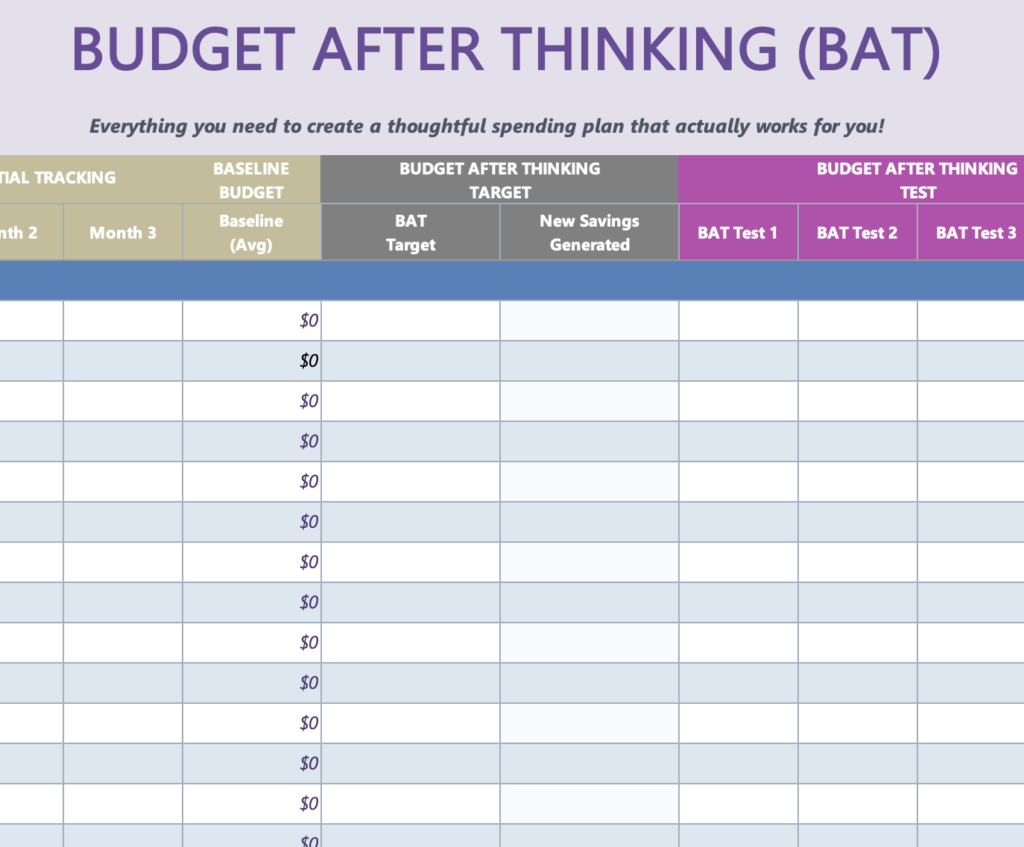
The best part of creating a budget? You would be amazed at the confidence you can build if you can stick to a simple plan for your money.
For a step-by-step guide on how to create a Budget After Thinking, read my post here and follow-up posts here and here.
My budgeting philosophy is premised upon your actual spending habits and realistic adjustments. In other words, forget about aiming for predetermined, generic goals like saving 20% of your income.
I’ve taught enough law students and lawyers to know that these rigid, predetermined targets don’t work. With massive student loan debt and soaring costs of living, generic savings targets just aren’t helpful.
If you aim for some predetermined amount, you’ll end up cutting out everything you like spending money on to the point where you will resent your budget. Then, you’ll give up on your budget and fall back to your old habits.
The beauty of creating a Budget After Thinking is that it is based upon a baseline budget of your actual, current spending habits.
In evaluating your current habits, you can then make thoughtful and realistic adjustments to that budget that will actually last. Through this process, you can accomplish the main goal of generating more fuel for your ultimate financial goals. That might mean building up your cash fortress or investing for long term goals.
Two simple questions to evaluate your financial position.
Let’s revisit our two simple questions:
- What happens if something goes wrong, like you lose your job or you have an unexpected medical expense?
- Can you take advantage if an incredible investment opportunity presented itself?
The more cash you have on hand, the better you’ll feel about your answers to these two questions. That doesn’t mean you should stop investing, but it does mean that you can reallocate some of your excess money to savings.
When you have cash, you can survive without losing all that you’ve built up. You can thrive by taking advantage of unexpected opportunities. In other words, create excess cash to survive and thrive.
This concept is particularly important if you’re at all concerned about the current state of world affairs.
If you’re not a fan of cash, drop a comment below and let me know more about your approach.

Leave a Reply