

Warren Buffett, Mark Cuban, Kevin O’Leary, Jamie Dimon, and so many other billionaires share the same fundamental money belief:
Having cash on hand is a necessity. If you don’t have cash on hand, you’re not in a strong financial position, regardless of how much you earn or how many assets you own.
Let’s start with Cuban, who has long advocated for the importance of having cash on hand.
Cuban says cash is king.
As early as 2008, he wrote on his blog:
The first step to getting rich is having cash available. You arent saving for retirement. You are saving for the moment you need cash. Buy and hold is a sucker’s game for you. This market is a perfect example. Right at the very moment when cash creates unbelievable opportunity, those who followed the buy and hold strategy have no cash. [T]hey can’t or wont sell into markets this low, that kills the entire point of buy and hold.
Those who have put their money in CDs sleep well at night and definitely have more money today than they did yesterday. And because they are smart, disciplined shoppers, their personal rate of inflation is within their means. Cash is king for those wanting to get rich.
In Cuban’s eyes, you can’t become and stay wealthy without having cash available to deploy when opportunity knocks.
Mr. Wonderful says you need cash to protect what you’ve built up.
Kevin O’Leary aka “Mr. Wonderful” of Shark Tank fame agrees. He believes that to be considered rich, you need $5 million in liquidity (cash or treasury bills). In a recent interview, he explained that $5 million is the magic number because that would earn $250,000 in pre-tax income at current interest rates, which is enough for any family to survive on.
While $5 million cash is out of reach for just about all of us, O’Leary’s reasoning is simple and applies universally. If you don’t have cash available, you’re one calamity away from losing everything you’ve built up. When all your money is tied up in real estate, a business, or other investments, you have no protection when things go wrong.
Buffett says cash is like oxygen.
Warren Buffett believes that cash is so important that it’s like oxygen. He explained to CNBC:
[Cash is] at certain levels necessary, but cash is not a good asset… You do need oxygen, and if you’re ever without it for four or five minutes, you will learn… And cash is that way. So you always need to have it available, because you do not know what will happen.
Like breathing, Buffett views having cash as a necessity, even if he would prefer to have his money compounding in investments.
None of us know what’s going to happen in the future. Having cash available is the best way to prepare for whatever happens.
Dimon says to build a financial fortress.
Jamie Dimon, CEO of JP Morgan Chase, credits the success of his bank to maintaining a “fortress balance sheet.” That means ensuring his bank was prepared to withstand any challenges by maintaining liquidity (cash on hand) and never getting over leveraged (too much debt).
Dimon stayed true to this philosophy even when the industry criticized him for being too conservative. The result of his fortress strategy is that JP Morgan Chase has grown to become the biggest US bank by a significant margin.
So, what can we learn from these billionaires when it comes to our personal finances?
It can all be boiled down to one core idea:
Keep cash on hand to build a financial fortress.
What does it mean to build a financial fortress?
Building a fortress with sufficient cash on hand serves two main purposes:
1. You can protect yourself from disaster. This type of cash is known in personal finance as Emergency Savings.
2. You can take advantage of opportunities. That may mean investment opportunities or life opportunities, like switching careers. I refer to this type of cash as Parachute Money.
When you have both Emergency Savings and Parachute Money, you’ve built a financial fortress.
At that point, you are in complete control of your finances and your life. If you want to have ultimate security and optionality in life, you need to build a fortress.
Today, we’ll look at what it means to build a financial fortress by keeping sufficient cash on hand.
First, let’s think about protecting everything we have worked so hard for.

Build a fortress for protection with an emergency savings account.
The first step to building a financial fortress is having an emergency savings account. This is your ultimate security blanket for whatever life throws at you. When the billionaires are talking about having cash on hand to protect yourself from disaster, this is the account they’re talking about.
For example, if you lose your job and the corresponding income, your emergency savings will keep you and your family afloat until you’re working again.
The idea is to use your savings so you don’t have to pull from your long-term investments or rely on credit cards.
Keep in mind that your emergency savings is not just for when you lose your job. Your emergency savings will also protect you in times of emergency (brilliant, huh?), like unexpected medical bills or expensive home repairs.
The idea remains the same: instead of pulling from your investments or falling into debt, you will have cash available in your savings account to cover your needs.
Listen to the billionaires: fully funding an emergency savings account is a crucial step in protecting what you have built up.
Aim for 3-6 months of Now Money saved for emergencies.
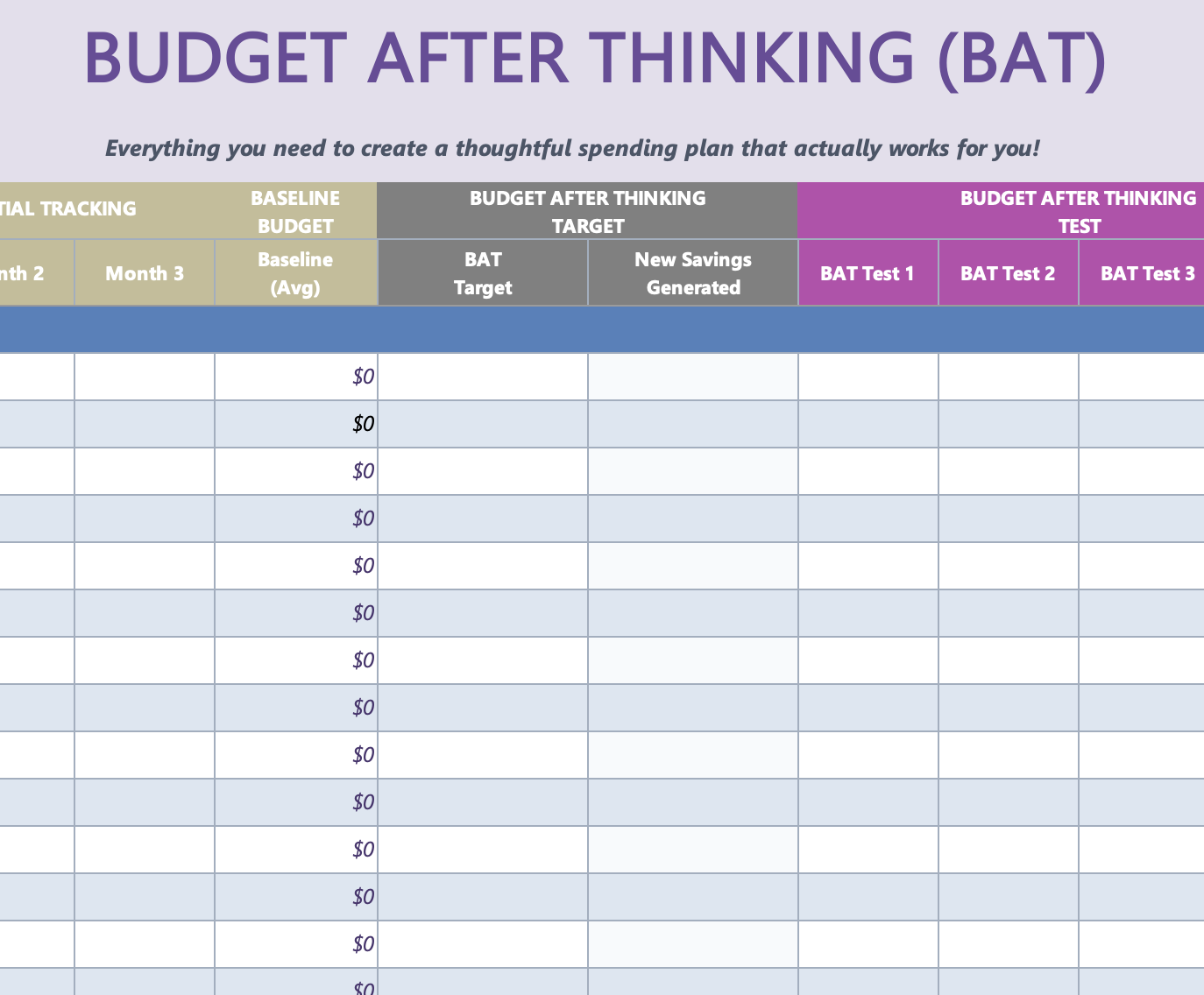
In your Budget After Thinking, Now Money represents the consistent, reoccurring expenses that you need to pay every month to take care of yourself and your family.
Aim for building up 3-6 months of your Now Money saved in a dedicated emergency savings account. That said, if you’re in a more volatile industry, you may be better served striving for 9-12 months of emergency savings.
Why only focus on Now Money instead of your full monthly spending?
Since you will only be using this money in times of emergency, you can, and should, forego some of life’s luxuries until you get back on track.
The same is true for fueling your Later Money goals. Take a pause until you sort out whatever it was that caused you to spend your emergency savings in the first place.
In short, having cash on hand in a separate emergency savings account represents your first line of defense when you lose your source of income or have a major unexpected expense.
But, having cash on hand is not only about playing defense. It’s also about being opportunistic when the moment is right. That’s where Parachute Money comes in.
Build a fortress to create opportunities with Parachute Money.
Parachute Money is one of my favorite concepts in all of personal finance.
The analogy goes like this:
Pretend your life is like flying on an airplane.
For whatever reason, you decide it’s time to get off this airplane. Maybe conditions outside of your control have forced you to jump. Or, maybe you’ve decided that it’s time to take control and make a change.
Either way, you’re ready to jump.
All you need is a parachute.
You have a choice between the only two parachutes on the plane.
The first parachute has only one string (or line) connecting the canopy to the harness . You think to yourself, “This doesn’t seem very safe. What if that one string breaks? That would end very badly for me.”
Then, you look at the second parachute.
The second parachute has 10 strings. You say to yourself, “OK, this one looks much safer. If one string breaks, the parachute still has nine other strings to keep me safe. Even if something goes wrong with one or two strings, I would glide safely to the ground.”
It’s obvious which one of these parachutes to choose, right?
So, what does a parachute have to do with money?
Each of your income sources, plus your cash on hand, is like a string on your parachute.
The central idea of Parachute Money is to create multiple sources of income and have sufficient cash on hand so you have optionality in life.
Picture each source of income and your cash on hand as separate strings on your parachute. The more strings on the parachute, the stronger it is.
With Parachute Money, if one of your sources of income dries up, like when you lose your job, you are more than covered with your other income sources and cash on hand.
Of course, the more sources of income and cash you have, the stronger your personal financial position is.
Parachute Money includes your primary job, any side hustles, any income generating assets, and your cash savings. It also includes the income of your significant other, if you share finances.
Billionaires know how important flexibility and optionality are. That’s why they prioritize having cash available, even if that means taking a more conservative approach to investing at times.
Just like the billionaires mentioned above, when you have cash to deploy, you can take advantage of investment opportunities. You also have the option to make big life changes, like switching jobs, without risking your family’s well-being.
The key to Parachute Money: give yourself options with various assets, income sources, and cash on hand.
Personally, I have my primary job as a mesothelioma and personal injury attorney, invest in the stock market, own rental properties, and serve as an adjunct law school professor. I’m also more determined than ever to build up my cash savings to solidify my financial fortress.

How much cash on hand do you need to build a fortress?
We talked about how 3-6 months of emergency savings is a good target for most people. That should be ample time to get back on track if you lose your source of income or face an economic emergency.
But, how much cash on hand do you need to solidify your fortress? Remember, emergency savings is just the first step in building ultimate financial security.
Like most money decisions, this is a personal choice you need to make after thinking and talking with your loved ones. I can’t tell you how much you need for your fortress, but I can tell you what I’m doing.
Personally, I am striving for three years of cash saved up to solidify my fortress.
Why three years worth of savings?
My thinking is that three years of savings is more than enough money to provide for my family if disaster strikes. At the same time, three years of savings provides me enough cash to deploy if an incredible investment opportunity presents itself.
One year of savings does not feel comfortable to me. I have three young kids and four investment properties. I need to be prepared for anything.
Two years of savings might be sufficient, but it still feels a little uncomfortable to me. Three years of savings feels just right.
The reason I’m not saving more than three years in cash is because I don’t want to miss out on the long-term benefits of compound interest by having more money tied up in cash instead of investments.
For the billionaires, three years of cash savings might not be enough. For the average lawyer, three years of cash savings may sound like too much. Evaluate your personal situation and do what feels right to you.
When you combine emergency savings and parachute money, you have built a fortress.
The ultimate level of financial success comes from having an emergency savings account for protection and parachute money for optionality.
No matter what happens with the economy, you are protected in a variety of ways. When other people are worried about losing their jobs, you will be thinking about options.
If you haven’t prioritized an emergency savings account or parachute money, let the current uncertainty in the world serve as a reminder of how important these concepts are.
As just one example, Meta (Facebook) just announced plans to lay off 10% of its workforce next month, with more layoffs to come. Whether you are in the tech industry or an attorney or a consultant, there’s no guarantee that your job will last forever.
The overall economic outlook is hazy at best right now. Ask five “experts” what the economy will look like in two years and you’re likely to get five different answers.
It’s up to each of us to build in multiple layers of protection in our financial lives to avoid disaster and to prepare for opportunity.
That’s why I’m building a financial fortress.
Do you have an emergency savings account? Parachute money?
How strong is your fortress?
Let us know in the comments below.

Leave a Reply