

At dinner this weekend, my good friend asked a question that many of us on the journey to financial independence have wondered:
“If I’m doing all the right things with my money, why does it feel like I’m stuck and not making any progress?”
Have you ever felt that way?
I know I have.
Picture a lawyer who is 35-years-old. Let’s call him Clarke. He’s no longer a new lawyer, but he’s not exactly the boss either. He has a good paying job and has no plans of leaving.
Clarke has paid off all of his student loan debt. He’s been maxing out his 401(k) for years. He regularly funds a brokerage account. He has 3 months of emergency savings.
Clarke does not have any credit card debt and pays his bills on time. His only debt is the mortgage on his home. His spending is in check, so he always has excess cash to save or invest at the end of the month.
Talk to any financial expert and they would tell you that Clarke is doing everything right.
So, why does Clarke feel like he’s stuck in the middle? Why does he feel so far away from having options and achieving financial independence?
Let’s discuss.
Striving for financial independence is like training for a marathon.
As many of you know, I’m training for the 2026 NYC Marathon. My training runs give me lots of time to think (…and talk to myself) about money.
I recently partnered up with Endure to Cure Pediatric Cancer Foundation to help children battling cancer.
Please consider donating to support children undergoing cancer treatment. Your donation will help provide children with uplifting gifts and special experiences that help brighten their spirits during incredibly difficult times.

When training for a marathon, progress is slow, repetitive, and often invisible in the middle stages. Some days you feel stronger. Other days you feel sore and question if you’re doing the right things.
I’m told that’s normal when training for a marathon.
I’m here to tell you that it’s also normal when striving for financial independence. Building wealth is about endurance. It’s not a sprint. It’s about staying consistent long enough for the compound interest to work.
If you’re hoping for a shortcut, you’re in the wrong place. Like training for a marathon, we all need to start at the beginning and slowly work our way to the finish line. Experienced runners will tell you that while the big event is the race, the real magic happens in the training.
Generating wealth works the same way.
Check out this next illustration to see what I mean.
$3,000,000 today or a penny that doubles each day for the next 30 days?
Let’s look at a fun example to demonstrate the power of compound interest.
At the start of each personal finance class I teach, I ask my students this question:
“Would you rather have $3,000,000 today or one penny that doubles each day for the next 30 days?”

Maybe the fact that I’m asking the question in the first place gives away the answer. Still, some students refuse to believe that the penny could grow to more than $3,000,000 in 30 days.
The real lesson in asking this question is not that the penny ends up being worth more. The lesson is that it’s not until the very end of the time period that the penny takes the lead.
Check out this graphic from TraderLion:

If you chose the penny, for the first 20 days, you’d be feeling pretty foolish. Even after 29 days, the penny still hasn’t outpaced the guaranteed $3,000,000.
Then, by day 30, you realize the full power of compound interest. The penny ends up being worth $5,368,709.12!
The beauty of this example is in how simply it illustrates that it takes time for the magic of compound interest to do its thing.
When it comes to investing, time is the most important factor that we can control. The more time you spend in the markets, the better chance you have of significantly increasing your wealth.
Next, let’s revisit our friend Clarke, the 35-year-old lawyer who is doing everything right but still feels like he’s not making any progress.
How to use an online calculator to measure your own progress.
Recall that Clarke already paid off his student loan debt and does not have any credit card debt. He has three months of emergency savings. As a result, he can max out his 401(k) and still stay on budget.
Let’s assume Clarke currently has $250,000 in his 401(k)after about a decade of working and plans to retire in 30 years at age 65.
In 2026, the 401(k) contribution limits are $24,500 for a 35-year-old like Clarke. To keep things simple, we’ll say Clarke contributes $2,000 per month to his 401(k) and does not receive an employer match.
He will continue to invest $2,000 per month for the next 30 years, even though the contributions limits will surely increase.
We’ll also assume he earns 10% annually, which is a reasonable assumption based on historical average market returns.
Using the TATM compound interest calculator, we can see that in 30 years, Clarke will have $8,310,207 in his 401(k):
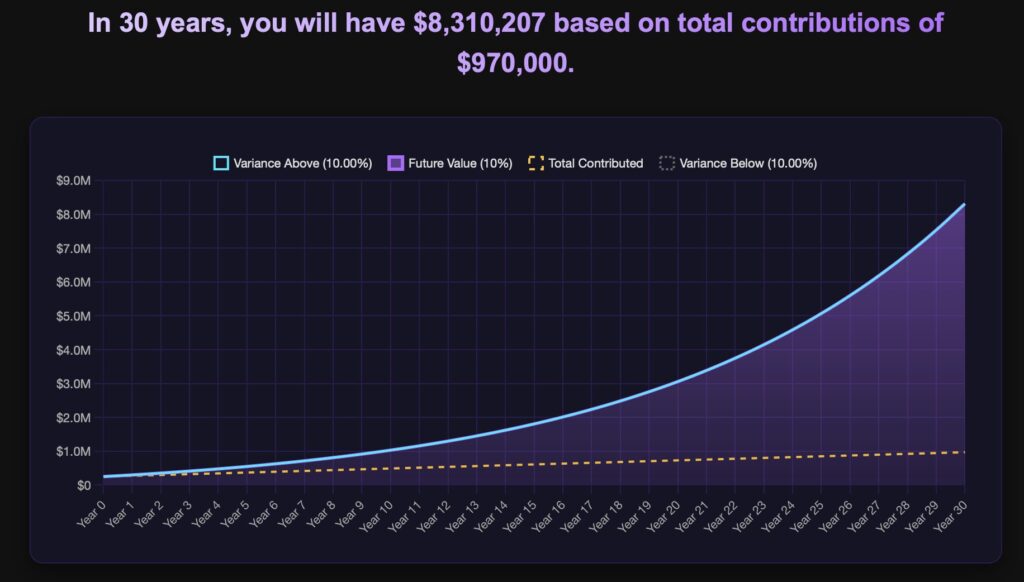
Notice how Clarke will have more than $8 million based on contributions of less than $1 million. That’s the power of compound interest.
Even though Clarke may feel like he’s stuck, he will have amassed a small fortune at this pace by the time he retires.
Now, let’s look at the corresponding table showing the last 10 years of Clarke’s investment horizon:
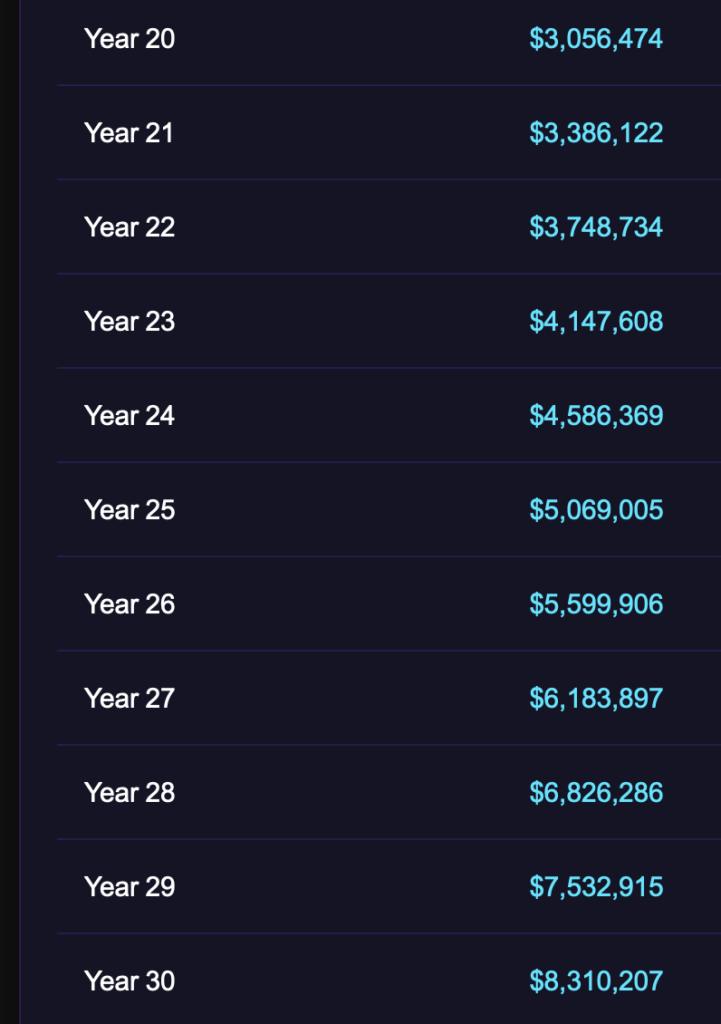
Just like the graph above, this table shows you how compound interest takes time to work in your favor. Each year that goes by, Clarke is earning significantly more from his investments even though his contributions did not change.
As with the penny example, Clarke’s small fortune will take time to amass. It may not feel like it right now. But, if Clarke continues to invest and stays patient, he will likely end up with more money than he can reasonably spend in retirement.
Maybe these calculations will help Clarke feel fetter about all that he has accomplished so far on his financial journey.
How to not feel so stuck on the slow journey to financial freedom.
For starters, know that you’re not alone. It is completely normal to feel like you’re not making progress. When most of your net worth is in a retirement account like a 401(k), it can feel like the money is not even yours. The same is true for the equity you are building in your home. Since neither of these assets help you with today’s spending, they don’t do much for making you feel financially secure in the present.
I find that using online calculators are very helpful in reminding me that I’m doing the right things, even if it doesn’t always feel like it. I encourage you to plug in your numbers so you can learn where you might reasonably expect to be in the future.
You may be very surprised at how much money you’ll have if you just give it enough time. You may even learn that you’ll have too much money in the future such that you can start spending more to enrich your life today. More on that below.
On the other hand, if you don’t like what the numbers show you, the next step is to get a plan in motion. Like we discussed in our example with Clarke above, make sure you’re hitting the key targets: pay off your student loan and credit card debt, fund your retirement accounts, build up your emergency savings, keep your spending in check, and save and invest every month.
What you’ll find is that the blueprint is not terribly difficult to understand. The execution is the hard part. Once your plan is in place, you need to execute it consistently and patiently wait for the payoff down the road.
The waiting can be challenging, but if any profession is well-suited for waiting, it’s the legal profession.

As attorneys, we are used to the wheels of justice turning slowly.
Think about any case that you’re working on right now. Most cases take years to complete. We’ve had litigation in my firm that’s lasted decades.
While a case is pending, there are some busy days and there are plenty of slow days. For one basic example, once you file a motion, there’s not much you can do until the other side responds, right? You can’t force the other side to respond faster than what’s set forth in the briefing schedule. You just have to wait before moving on to the hearing or ruling.
The same is true when it comes to our finances. Once your plan is in place, there’s not much you can do to speed up the process. You can increase your contributions as your earnings grow. You can rebalance your portfolio a couple of times a year. These are important steps to a healthy financial life, but they are not going to change your situation over night. You still have to wait for compounding to kick in.
The one exception would be if you earn an outsized fee on a single case or receive a major promotion that can dramatically speed up your time table. Even in that situation, you still need to have a plan in place so you don’t burn through that money.
The point is: use some of that patience you’ve learned as an attorney and apply it to your finances.
Along the way, you have to live your life.
This is where it’s important to remember that along the way, you have to live your life. You can’t be afraid to spend money today because you are only focused on some distant future. As part of your healthy financial plan, you should be spending money on things and experiences that make you happy today.
It may sound counterintuitive, but spending money today on things you love will actually help you save more for the future. That’s because you will be more likely to stay consistent and dedicated to your long-term goals. If you deprive yourself of a complete and fulfilling life today in hopes of a better life later on, you risk burning out.
You may hit your financial target on the spreadsheet, but if you were miserable on your journey to get there, would it really be worth it?
No way.
So, what’s the high level takeaway?
Create your financial plan.
Set it in motion.
Wait for compound interest to kick in.
In the meantime, live your life.
Leave a Reply