
Author: Matthew Adair

  • How Lawyers Can Think About Investing While in Debt

    How Lawyers Can Think About Investing While in Debt

    The Wall Street Journal recently wrote about the complicated financial lives of dentists. Reading the article, it was hard not to see the similarities in the financial challenges that we face as lawyers.

    Among America’s swelling ranks of moderate millionaires, few have more complex personal balance sheets than dentists.

    They earn high incomes, have built valuable businesses and have benefitted from the rising stock market of the past decade and a half. But they often graduate with significant student loan debt and spend years tying up money in building their practices.

    High incomes?

    Years of effort building our careers?

    Significant student loan debt?

    This article could just as easily been written about lawyers.

    The article continues:

    Entering their professional ives in a financial hole often leaves an indelible mark on the way dentists invest. Some take on risky self-directed investments, while others are forced to minimize their retirement savings until they pay off other obligations.

    This article serves as a reality check for anyone thinking that they’ll never have to worry about money if they simply obtain an advanced degree. To the contrary, choosing to take on student loans is a major decision that will impact your personal finances for years.

    The article also illustrates one of the most difficult money decisions that lawyers have to make: should we invest while in debt?

    Today, we’ll explore why I think it’s a good idea to start investing even if you’re paying off debt.

    It’s good to pay off debt and it’s good to invest.

    Same as the dentists featured in the WSJ article, It’s not uncommon for lawyers to have hundreds of thousands of dollars in debt.

    I regularly get questions about investing while in debt from law students who take my personal finance class. By the way, it’s not just lawyers with student loan debt who face this question. Maybe you have mortgage debt, medical debt, or consumer debt. Perhaps you’ve used a HELOC to buy investment property like I have.

    Regardless of the type of debt, I understand the urge to eliminate that debt as quickly as possible. Still, is it the best idea to avoid investing for the future until that debt is gone?

    I don’t think so.

    Obviously, we know two things to be true at once:

    Debt can be bad. 

    Investing can be good. 

    So, should we focus on eliminating the bad thing or doing more of the good thing?

    It’s not easy to serve two masters at once. How do we plan for the future while worrying about past debts?

    The way I see it? 

    You don’t have to choose only one door to walk through. 

    You can invest while in debt. But, striking the right balance can be tricky.

    The choice to pay down debt or invest for the future is tricky.

    Whatever the case may be, the choice to pay down debt faster or invest for the future is tricky. 

    For people feeling the heavy burden of debt, the idea of investing for some future goal can seem a little bit comical. I completely understand. 

    If you’re facing monthly debt payments for the next 10 years, you may not be ready to think about retirement 50 years from now.

    Trust me, I get it. 

    I know firsthand how heavy debt can feel. 

    In my 20s, I had both student loan debt and credit card debt. It was not fun to carry that debt burden. I’ll never forget the incredible feeling of accomplishment when I paid off those debts. I felt so much lighter. 

    I now have HELOC debt that I’m focused on paying off. That HELOC debt stems from buying five properties in seven years. My real estate portfolio is now exactly where I want it to be, so I’ve shifted from acquisition mode to debt-reduction mode.

    Just about every day, I think about how good it’s going to feel to have that HELOC debt paid off.

    The point is: you don’t have to convince me why you may want to focus on paying off debt. I understand completely.

    However, I think it’s worth considering the advantages of investing at the same time you’re paying off debt. You don’t have to go all-in on paying off debt or all-in on investing. You can strike a balance.

    Four main reasons to invest while in debt.

    There are four main reasons to consider when thinking about whether you should invest even though you’re in debt.

    If you’re not investing at all because you’re focused on debt, these four reasons should give you something to think about.

    blue and white toothbrush in clear glass jar representing that lawyers and dentists have similar financial challenges at the beginning of our careers.
    Photo by The Humble Co. on Unsplash

    1. Invest while in debt because of the psychological side of money decisions. 

    It feels good to see your investment accounts grow. This is especially true when you are accustomed to looking at huge debt balances on your laptop or phone screen. 

    Yes, it feels good to see those debt balances shrink. It also feels really good to see your investment accounts grow.

    As a lawyer, you work hard for your money. You spend a lot of hours away from home so you can work and make a living. You deserve to experience the fruits of your labor. 

    When your career is stressing you out, it can be very uplifting to observe a growing investment account balance month-to-month.

    2. Invest while in debt to develop the habit.

    It’s important to get in the habit of investing as early as possible in your careers. Once you start investing, even if it’s only $25 per month, you are creating a habit. This is the type of habit that will pay off immensely in the long run.

    Humans have a tendency to resist change. That’s why it’s difficult to break bad habits. This tendency also works in our favor when we have established good habits, like investing. We tend to just keep doing what we’ve always done.

    When you’ve established the good habit of investing, it’s easy to increase your contributions as you earn more money. The same is true when you’ve eliminated all your debt. You can easily use the money you had been putting towards debt for your already-established investments. 

    That’s because your accounts will already be set up. All you need to do is increase your monthly investment contributions.

    This makes it easier to solidify and benefit from the good habit you’ve cultivated.

    3. Invest while in debt because of compound interest.

    Compound interest is the most powerful force in all of personal finance. The earlier you start investing, the more benefit you’ll get from compound interest.

    You can check out more about the power of compound interest in my post on investing early and often.

    I also encourage you to use the Think and Talk Money Compound Interest Calculator to see for yourself how even small, consistent contributions will have a major impact on your finances in the long run.

    4. Invest while in debt because of the math.

    Even though money decisions are closely connected to our emotions, the math of investing can be hard to ignore. If you prefer to make money decisions primarily based on the math, here’s what you can do.

    We’ve talked before about how the S&P 500 has historically earned an average annual return of 10%. Of course, there’s no guarantee that you will earn 10% if you invest. You may earn less or you may earn more. Still, based on the historical data, it’s a reasonable estimate.

    You can then compare that 10% return to the amount you’re paying in debt interest.

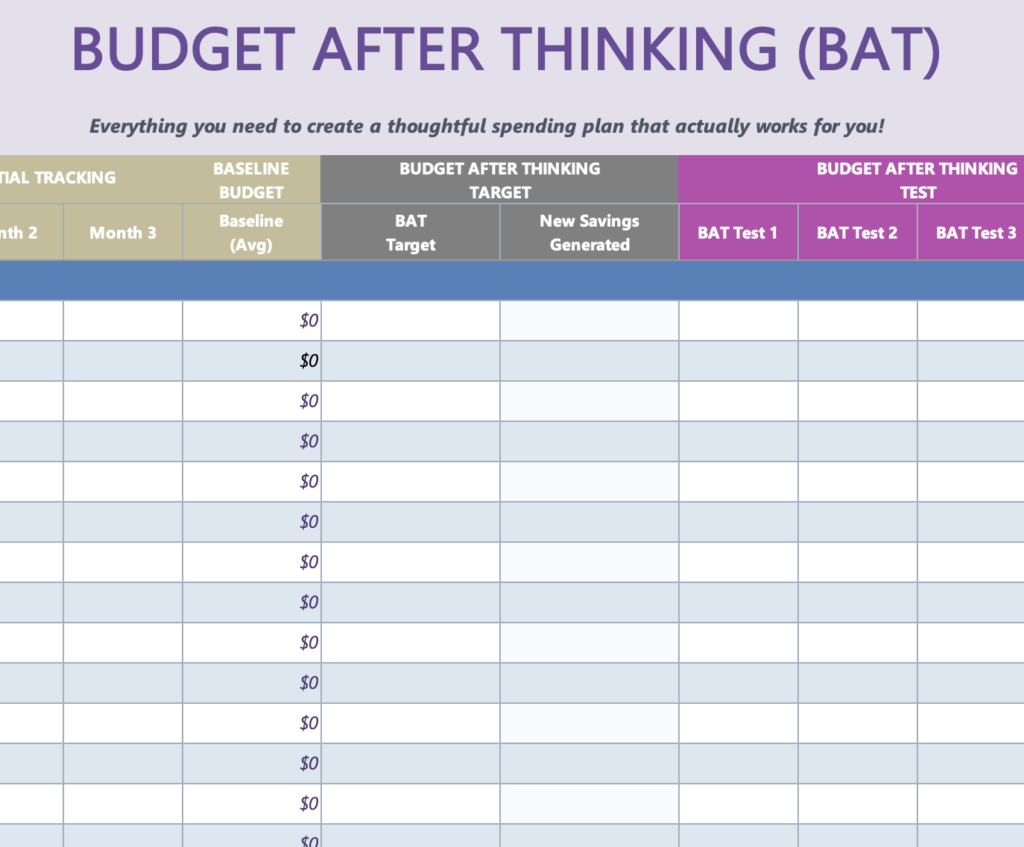
    For example, let’s say you created a Budget After Thinking that opened up an extra $200 in your monthly budget to allocate towards either student loan debt or retirement.

    You’ll next want to look up your current student loan interest rates. For illustration purposes, the current interest rate for undergraduate federal loans is 6.39%. The current interest rate for graduate and professional students is 7.94%.

    Then, visit the TATM Resource Library and use a calculator to help make your decision about whether to invest the $200 or put that money to debt. 

    If you put the money to debt, you’ll obviously pay off that debt faster. You can read more about how to easily do these calculations in my post on Debt Snowball vs. Avalanche.

    Likewise, you can use an investment calculator to see how much that $200 will grow in an investment account over the long run. You can see how to do these calculations in my post on risk as the cost to invest.

    Armed with the math, you can then make a decision that makes the most sense to you. 

    You may value getting out of debt faster. Or, you may be motivated by the larger balance in your retirement account. 

    It may come down to how high the interest rate is on your student loans. The higher your interest rate is, the more sense it makes to prioritize paying off that loan.

    The point is that there are mathematical reasons to start investing even while paying off debt.

    One final note about the math: your student loan interest rate is effectively locked in (unless you have a variable rate). On the other hand, your investment return rate is only a projection. That makes a difference. 

    It means that when you are in debt, you are guaranteed to be charged interest every month. In contrast, there are no guarantees you will make money when you invest. As you make your decisions, don’t ignore this key difference.

    Lost in the maze epresenting that lawyers and dentists have similar financial challenges at the beginning of our careers like whether to invest of pay down debt.
    Photo by Burst on Unsplash

    I prefer to allocate 75% to debt and 25% to investments.

    When you consider these four main reasons, you may be convinced that it makes sense to invest even while paying off debt. 

    So, the obvious next question becomes: how much money should you put towards debt and how much should you invest?

    The ratio that works for me is 75% towards debt and 25% towards investment goals. In other words, if I had $1,000 to allocate in my budget for debt and investments, I would use $750 for debt and $250 for investments.

    I used this ratio when I had student loan debt and continue to use it to eliminate my HELOC debt.

    This 75-25 ratio gives me the dual benefit of paying off my debt faster while also seeing my investment accounts grow over time. Once my debts are paid off, I will have already established the good habit of investing. In the meantime, I’m currently benefitting from compound interest and the math of investment returns.

    The reason I lean more towards debt is because I don’t like the feeling of being weighed down by debt. It’s hard to feel completely free when you are carrying the burden of debt. That’s why I am currently prioritizing paying off HELOC debt. 

    That said, I’m not willing to entirely delay investing for the future. The 75-25 ratio is a good balance for me and helps me accomplish multiple goals.

    75-25 has worked well for me. Having reached my 40s, I’m very happy that I did not neglect my investments entirely while dealing with debt.

    Don’t agonize about finding the perfect ratio between debt and investments.

    Whatever balance works for you, keep one important tip in mind:

    Don’t agonize about finding the perfect balance between debt reduction and investing for the future. 

    Take a step back and think about it for a moment:

    Paying off debt is great.

    Investing for the future is also great.

    If you’re doing both of these things in some fashion, you’re already making great money choices!

    If you’re able to pay off debt and invest at the same time, you most likely have already created a successful Budget After Thinking. You have proven that you can stay disciplined enough to allocate funds to your Later Money goals each month. 

    You have already done the hardest part.

    I consider this whole conversation of putting money towards debt or investments a win-win decision. There’s no reason to stress yourself out in search of the perfect balance. You’re already winning.

    Find a balance between debt and investments that works for you and stick to it. You really can’t go wrong. Either way, you are making progress on your money goals.  

    Some day in the future your debt will be paid off. 

    The bottom line is, one way or the other, you are going to pay off your debt. That’s assuming you are a reasonably responsible person on a typical career trajectory. 

    If you have student loans, it might feel like you will never get out of debt. I assure you that you will. 

    To put it in perspective, if you are on a standard repayment plan, you’ll be debt-free in 10 years. For most students, that equates to being debt-free sometime in your 30s.

    My guess is that by the time you retire, you won’t even remember how much debt you had or exactly when you paid it off. The only reason I remember when I paid off my debt is because I’ve been keeping a money journal since 2011.

    On the other hand, towards the end of your career, you will very much be aware of how much money you have saved for retirement. You will be counting on that money to allow you to step away from full-time employment. 

    As hard as it is to do when you’re in debt, try and picture that older version of yourself who is nearing retirement. That older version of yourself will be very grateful that you had the discipline to start investing even while paying off debt.

    That’s why I allocate 75% of my available funds to debt and 25% to investments. When my debt is gone, I’ll put the full 100% to investments.

    So, what do you think?

    Are you currently investing while paying off debt?

    What other factors went into your decision besides the four main reasons discussed above?

    Let us know in the comments below.

  • Get Comfortable Embracing Reasonable Investment Risk

    Get Comfortable Embracing Reasonable Investment Risk

    Two young coworkers, Mike and Elissa, start the same job at the same time making the same amount of money.

    While still many years away, Mike and Elissa both know that they should invest early and often for retirement.

    They each decide to fund a retirement account with an initial contribution of $2,500. They are also dedicated to making contributions of $250 every month until they retire.

    Both plan to retire in 40 years while they’re in their 60s.

    There’s one major difference between Mike and Elissa. 

    They view risk differently.

    Because they view risk differently, one of them will end up with six times more money in retirement.

    Let’s see how that happens.

    Mike doesn’t like risk.

    Mike doesn’t like risk. He wants to be able to sleep at night knowing that his hard-earned money is safe and sound in the bank. He can’t stand the idea of potentially losing money from one month to the next.

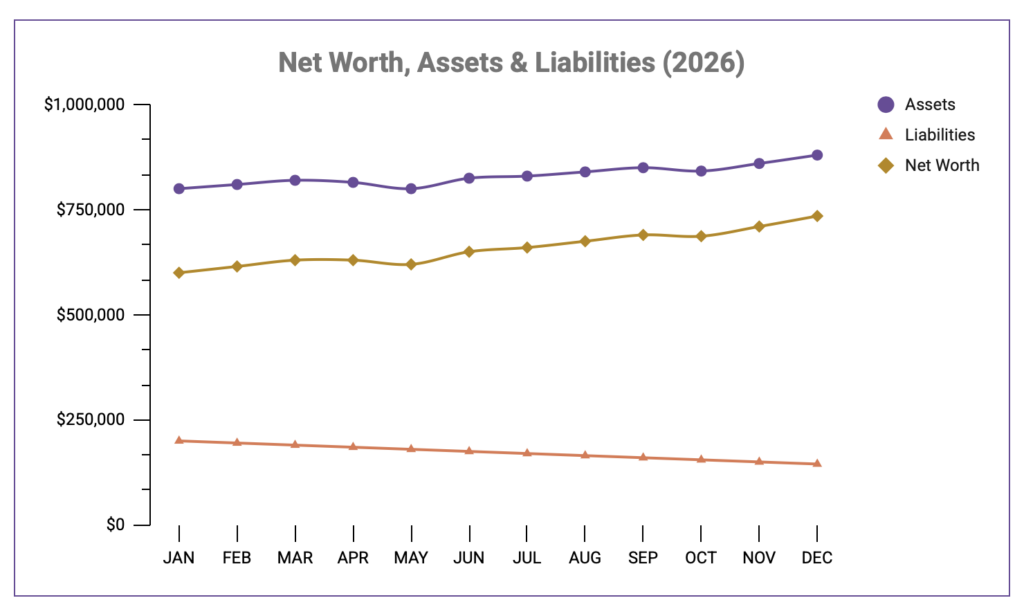
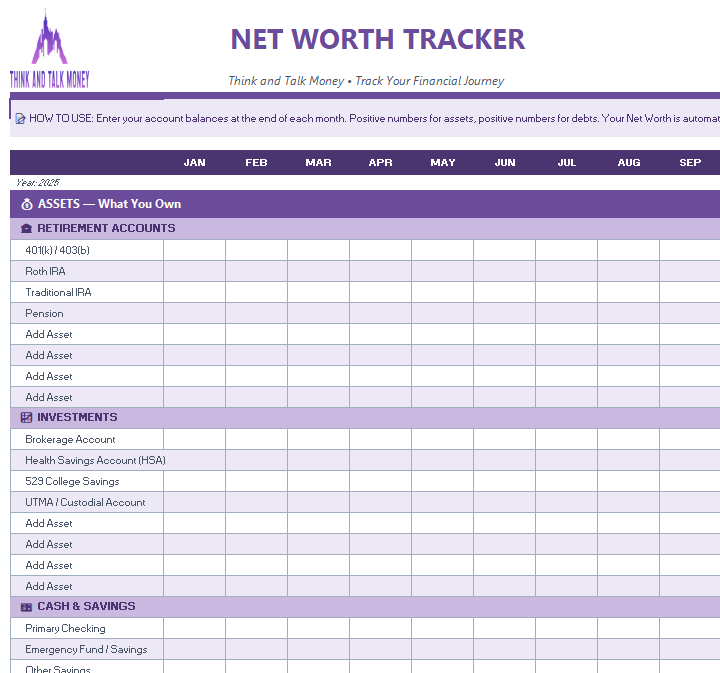
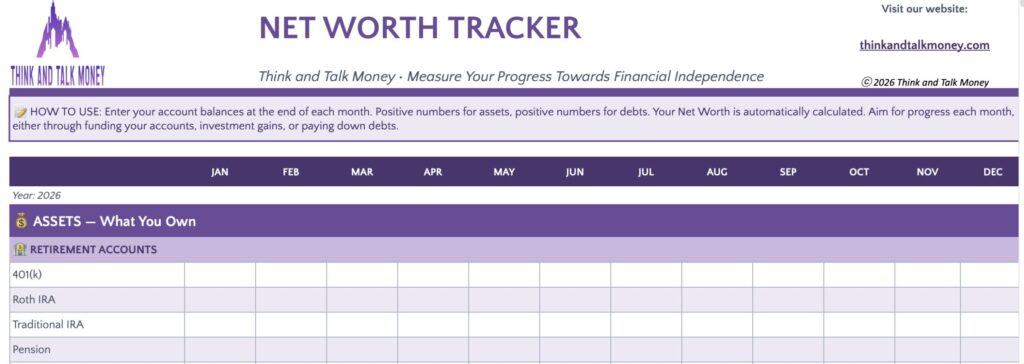
    Even though Mike doesn’t like risk, he knows that saving money is important. In fact, he’s a bit obsessive about tracking his accounts using the TATM Net Worth Tracker™️.

    When Mike wakes up in the morning, he likes to check his bank accounts while he drinks his coffee. He gets a jolt out of opening up his mobile banking app and seeing exactly how much money he has.

    Because Mike doesn’t want to take any chances, he decides to stash all of his retirement savings in a savings account that earns an average annual return of 3%. 

    Mike is lucky because this is a pretty generous return for a savings account based on historical savings account interest rates.

    Elissa is more comfortable with reasonable risk.

    Elissa is more comfortable with reasonable risk. Upon starting her career, Elissa was smart enough to know what she didn’t know about money. Because she had never learned basic personal finance skills, she was determined to put in a little bit of effort early on to set herself up for a prosperous future.

    Elissa was a frequent reader of Think and Talk Money. She listened to financial independence podcasts. Elissa even read JL Collins’ book on investing, The Simple Path to Wealth.

    Through the process of educating herself about personal finance, Elissa started thinking about what she really wanted out of life. Since she was young and had just started her career, it wasn’t easy to come up with a good answer. 

    Still, Elissa knew that whatever she wanted to do in life, investing was an important part of her financial journey. If she wanted to create more time for herself down the road, she would need passive income from investments to sustain her.

    So, after doing her homework, Elissa decided to invest her money in a low cost S&P 500 index fund. 

    While she appreciated that there are no guarantees when it comes to investing, Elissa had learned that the S&P 500 has historically earned an average annual return of 10%.

    Unlike Mike, Elissa only checked her accounts once per month when she updated her TATM Net Worth Tracker™️. Elissa slept fine at night because she knew time was on her side.

    Let’s see how Mike and Elissa turned out 40 years later.

    Using the Think and Talk Money Compound Interest Calculator, let’s see how much money Mike and Elissa will have in their retirement accounts after 40 years.

    The way I’ve framed our hypothetical, you can probably guess who ends up with more money. What may surprise you is just how much of a gap there is.

    Remember, both Mike and Elissa started with the same initial contribution of $2,500, made the same $250 monthly contributions, and invested for the same 40 year period.

    The only difference between their two journeys was that Elissa was more comfortable with risk.

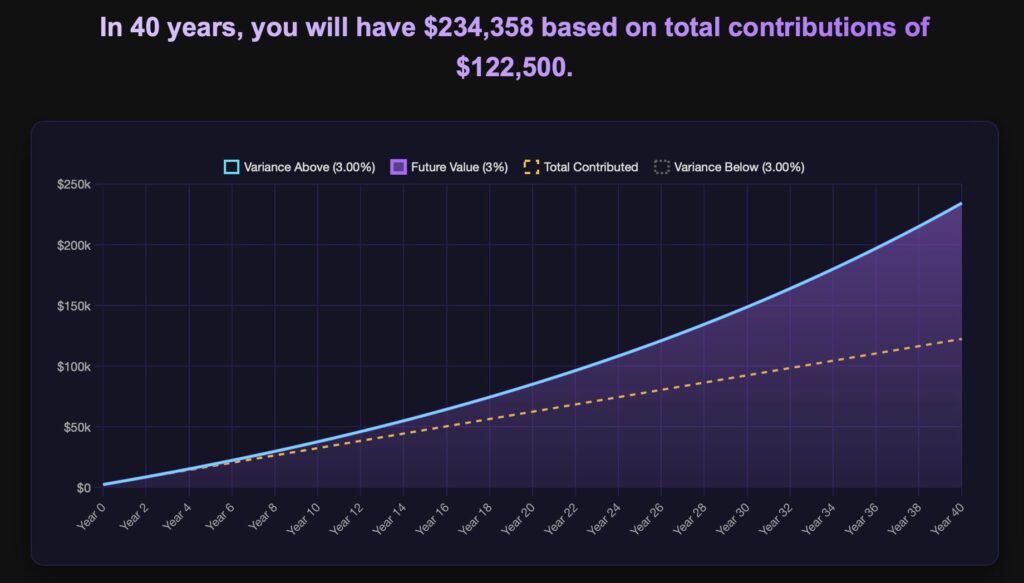
    After 40 years, Mike has $234,358.

    Use the Think and Talk Money Compound Interest Calculator to motivate you to invest and take on the risk even in uncertain times.

    After 40 years, Mike will have contributed a total of $122,500 to his retirement savings account. 

    At a 3% interest rate, Mike will have $234,358 after 40 years.

    In other words, Mike has just about doubled the value of his total contributions in his account.

    Not bad, Mike.

    Now, let’s check out Elissa’s account.

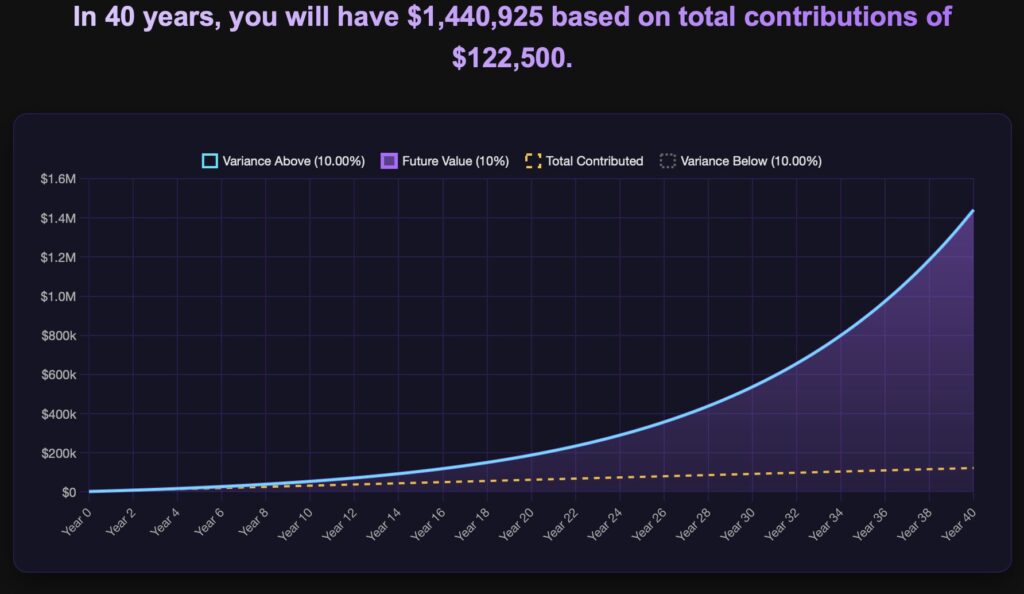
    After 40 years, Elissa has $1,440,925.

    Use the Think and Talk Money Compound Interest Calculator to motivate you to invest and take on the risk even in uncertain times.

    Elissa likewise contributed $122,500. After 40 years, at a 10% interest rate, Elissa’s retirement account will have a total of $1,440,925.

    Wow, Elissa!

    Elissa’s retirement account is worth 10 times more than what she personally contributed. Mike failed to even double his money.

    Recall in this hypothetical, Elissa did the exact same things as Mike, with one key difference. Elissa educated herself in basic personal finance concepts and was more comfortable taking on reasonable risk.

    Because Elissa was comfortable taking on some risk, her retirement savings were worth more than six times as much as Mike’s savings. Put another way, she has more than a million dollars more than what Mike has!

    person jumping from cliff to cliff illustrating the concept of reasonable investment risk for young people as shown by the Think and Talk Money Compound Interest Calculator.
    Photo by Micah & Sammie Chaffin on Unsplash

    Look at compound interest in action.

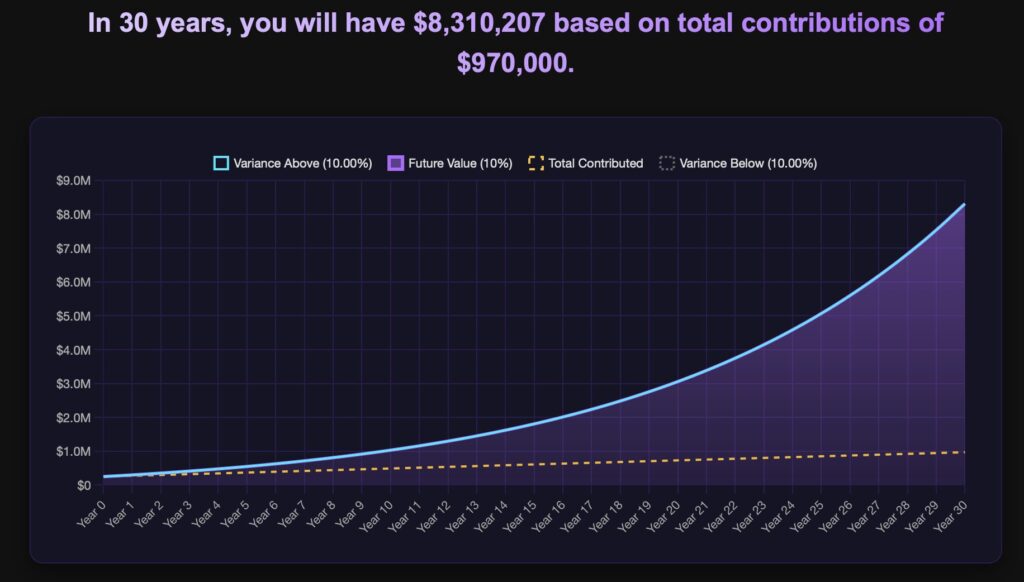
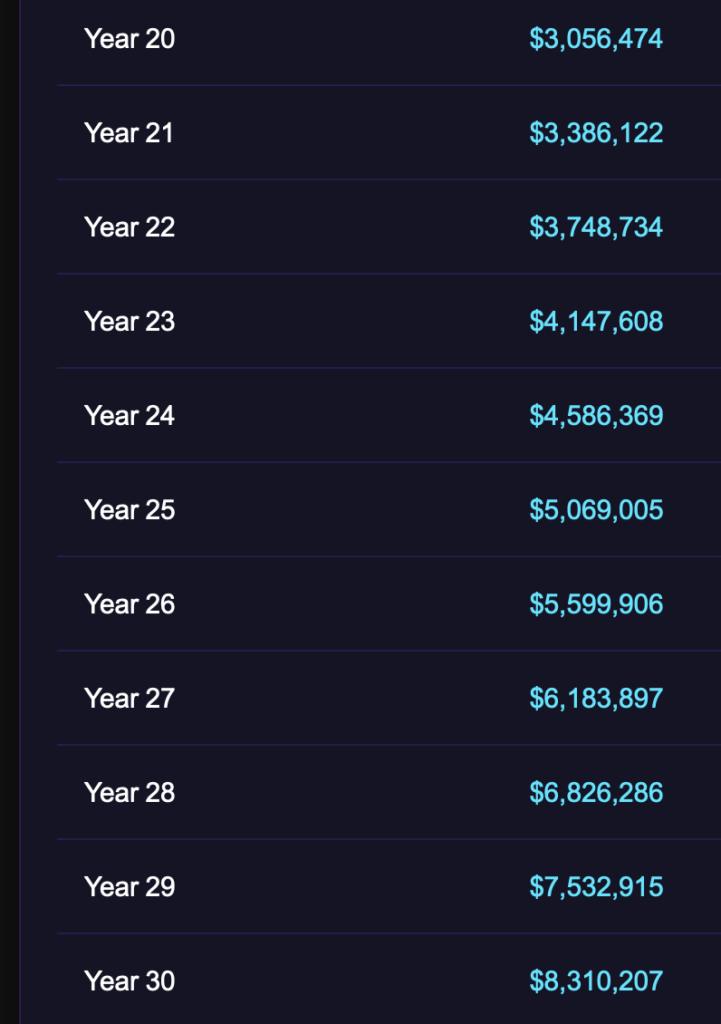
    One last thing: take a look at the pictures of Mike and Elissa’s investments over time. Notice the gaps between each of lines on the graphs. The blue lines represent the total account value, and the dotted lines represent only the contributions.

    While they each benefited from compound interest, Elissa benefited exponentially more. 

    Look at how Mike’s blue line stayed much closer to the dotted line. Because he wasn’t earning as much overall interest, he didn’t have as much money to multiply from compound interest.

    On the other hand, Elissa’s blue line mirrored her dotted line closely for the first 12-15 years. Then, the gap widened before the blue line skyrocketed over the final decade or so. 

    That’s the power of compound interest kicking in.

    So, what can we learn from Mike and Elissa?

    The point of this hypothetical is to reinforce the concept of risk when it comes to investing.

    We’ve all heard the saying, “You don’t get something for nothing.”

    That motto applies to investing as much as anything else. There is always risk involved in investing.

    The question is how do you react to that risk.

    Some people are so fearful of that risk that they don’t invest at all, like our friend, Mike. 

    Other people are so desperate to get rich quickly that they take wild risks.

    The people that tend to reach and sustain financial independence are the ones who educate themselves and become comfortable with taking on reasonable risk. This is what Elissa did.

    Think of risk as the cost to invest.

    If you want to reach true financial independence or any other financial goal, it’s going to cost you something. 

    Think of risk as the cost to invest.

    Sure, there are lawyers out there who may reach financial independence on a massive salary, even with poor financial habits. 

    For the vast majority of us, we’re going to have to get comfortable with investing and taking on reasonable risk.

    If you’re on the fence about taking on reasonable risk, now’s a good time to think about your ultimate life goals. Embrace the reasons for why you’re investing. Think about what would motivate you to open yourself up to reasonable risk. For me, it’s having ultimate optionality in life.

    It never hurts to remind yourself what you are hoping to achieve in the future. When you know what that thing is, it’s much easier to pay the cost of risk.

    When you understand reasonable risk, you know that market fluctuations are a good thing.

    Warren Buffett once said, “Look at market fluctuations as your friend rather than your enemy; profit from folly rather than participate in it.”

    This wisdom is important to remember today as multiple wars are being fought around the world and nobody truly knows where the economy is headed.

    Recently, I’ve talked to people still early in their careers who are selling stocks and moving into “safer” positions, like precious metals and cash. Setting aside whether these asset classes are in fact safer, I think it’s a mistake for young lawyers to get out of the stock market right now when they have decades of investment horizon ahead.

    Right now the market is fluctuating. That is completely normal. As Buffett says, this might be a great time to lean into the stock market. When the market goes down, if you consistently invest in broad-based index funds, you can purchase stocks on sale. That’s what Buffett means by profiting from other people’s folly instead of participating in it.

    This is why it’s important to think of reasonable risk in terms of decades, not weeks or months.

    When you look at Elissa and Mike’s future outlook, who would you rather be? 

    It’s not really a hard question, right?

    It’s not only that Elissa has a bigger bank account. What matters even more is that she has created options for herself. 

    Elissa should be in position to do whatever she wants at that point in her life, within reason.

    Mike won’t be.

    The takeaway is that when you have decades ahead of you, let risk work in your favor. Let other people panic and sell their assets when the market is dropping. Ignore the noise. You can’t time the market. Stay invested for the long-term by embracing the risk.

    Readers: are you naturally more inclined to act like Mike or Elissa when it comes to investing?

    If you’re more like Mike, have you thought about what outcome in life would make it worth taking on some reasonable risk?

    Does it feel more difficult to stay invested when the market is dropping?

    Have you tried flipping the script by telling yourself that stocks are on sale when the market drops?

    Let us know in the comments below.

  • My Advice: Sometimes You Gotta Spend the Money

    My Advice: Sometimes You Gotta Spend the Money

    The financial independence community sometimes gets a bad rap for encouraging excessive saving at the expense of present day spending.

    The reputation is not entirely undeserved.

    I listened to a podcast once where the guest admitted to the folly of trying to replicate Trader Joe’s trail mix by buying each of the ingredients individually and mixing them himself.

    I thought to myself, “This is what financial independence is about?”

    That never sat right with me.

    The podcast guest was happy enough to admit that the meager savings from making his own trail mix was not worth his time or energy. Still, if there was ever one aspect of the financial independence community that turned me off, it was advice like “make your own trail mix.”

    He was not alone in promoting what I considered excessive frugality. The word “miser,” referring to someone extremely stingy with money, comes up regularly in criticisms of people pursuing financial independence at all costs.

    To this day, I’ve never connected with the voices that promote extreme saving at the expense of present day convenience and fulfillment.

    I’ve also come to learn that this type of personal finance advice doesn’t work for lawyers.

    Advice like “make your own trail mix” doesn’t work for lawyers.

    As lawyers, we invest a lot of time (and money) into our education and careers. It’s no secret that we work long, stressful hours. One of the tradeoffs for all the hours we put in is that we have the opportunity to earn high incomes.

    Considering we work long hours and earn good money, advice like “make your own trail mix” isn’t very helpful. It’s not worth saving a few pennies in exchange for our limited free time when we could be doing the things that make us happy. When we’re not working, our time and energy should be better spent elsewhere, like being with our family, socializing with friends, or relaxing.

    What I’ve learned teaching personal finance to lawyers is that we are generally not interested in saving every penny possible until we can quit our jobs. This makes sense to me. Putting that much constraint and pressure on ourselves does not sound like a fulfilling existence.

    The lawyers that I work with know they need to save for retirement. At the same time, they want to use some of their hard-earned money for a better existence today.

    That’s why I recommend that lawyers spend money in ways that increase happiness, convenience and time. One of the best ways to practice this type of intentional spending is to create a Budget After Thinking.

    When you follow a Budget After Thinking, you give yourself permission to spend on things that make you happy today, while still achieving your long-term goals.

    Personally, shopping at Costco is an example of spending money today that brings me happiness, convenience, and time.

    A detailed close-up view of a mixed nuts and dried fruits snack, showing natural textures and colors. Ideal for healthy eating, nutrition, and food background concepts and illustrating why sometimes you gotta spend the money.
    Photo by Monaz Nazary on Unsplash

    What I learned about spending money by shopping at Costco.

    This past Sunday afternoon, my wife and I took the kids to Costco. I was thinking about all this while we walked through the store loading up our two carts.

    It was a nice family outing. We killed a couple of hours, the kids had fun, and we have food and supplies to last us for a month.

    On average, we shop at Costco once per month. We get our staple items (toilet paper, ground beef, coffee, etc.) and always end up with a few things not on our shopping list. On this weekend’s trip, the kids talked their way into Kit Kat chocolate bunnies (didn’t even know they made those) and enough AA and AAA batteries to power an airplane.

    The thing about shopping at Costco: no matter your best intentions walking into the store, the final bill is always big. Somehow, the cart always fills up. What a business!

    Anyone who shops at Costco will instantly know what I’m talking about.

    I’m no longer shocked or disappointed with the final bill. When my wife jokingly asks what the total is, my answer is always the same, “A lot.”

    What I’ve learned is that despite spending a lot of money at Costco, I view this as money well spent. We usually pick up some fun items that are relatively inexpensive and make us and the kids happy. Plus, because we load up on essential items to get us through the month, we don’t spend much time or money each week at the grocery store.

    Even though the final bill is always big, I view shopping at Costco as an example of intentionally spending money in a way that increases happiness, convenience, and time.

    Which leads me to one of the most important money lessons I’ve ever learned:

    Sometimes, you gotta spend the money.

    Sometimes, you gotta spend the money.

    Personal finance is not only about saving. Yes, saving is crucial to achieving our long-term goals. But, I don’t recommend that we save so dogmatically that we make ourselves miserable along the way.

    As lawyers, we work hard and we work a lot. If all we did was save every penny we earned in hopes of quitting our jobs one day, we would quickly burnout.

    Instead of making your own trail mix, remember this piece of advice:

    Sometimes, you gotta spend the money.

    Buy the direct flights.

    Costco is only one such example of when it makes sense to spend the money. I spend a lot of money at Costco each visit. But, we enjoy our family outings and get most of the essential items we need for the month in one trip. That’s money well-spent on happiness, convenience and time.

    If my goal was to save every penny possible, I wouldn’t feel the same way about Costco.

    Not a Costco shopper? Here’s another recent example when I decided to just spend the money.

    My brother-in-law’s wedding is in Scottsdale this fall. When I booked our flights, I could have saved real money by connecting in Denver or Los Angeles instead of flying direct to Phoenix. But, at what other cost?

    Anyone ever flown across the country with young kids?

    A four-hour flight with three young kids is hard enough. My wife has it especially tough with the baby on her lap the entire flight. By the time we land, it feels like we just worked out for 4 hours.

    The last thing in the world that we need is to extend the adventure with a connecting flight, even if it saves real money. My priority is to arrive in Arizona feeling energized and excited to celebrate this once-in-a-lifetime event with my family.

    Sometimes, you gotta spend the money.

    boy shopping for stuffies indicating sometimes you gotta spend the money.

    Personal finance is tied to our emotions.

    Humans are emotional creatures. Of course, we can rationally look at examples and charts and won’t dispute the long term magic of compound interest. At the same time, we have emotions and feelings that need to be tended to now.

    At Think and Talk Money, we regularly explore how personal finance is tied to our emotions. There’s nothing wrong with admitting that in certain situations, the right choice is to spend the money.

    Traveling is a good example of spending money to increase happiness. In fact, the happiness effect has been well-documented when it comes to traveling. People get a happiness boost in planning the trip, then taking the trip, and finally remembering all the fun things they did on the trip.

    That’s why so many people “love to travel.” It brings them happiness before, during, and after the trip.

    Personal finance is about how we spend money today, not just in the future.

    Personal finance is not just about long term goals, like saving for retirement. Just as important, personal finance is about how we spend our money in the present.

    It’s not realistic to expect people to put off all happiness until some unknown time in the future. It is realistic to make reasonable choices now to ensure a better future.

    What might be a reasonable spending choice for one person may be totally unreasonable for someone else. That’s perfectly fine. Still, we all need to make those choices for ourselves.

    What I’m suggesting is that if you’re spending most of your time each week at your job, like most of us lawyers do, shouldn’t we think about using some of the money we earn so we can elevate our present day lives? 

    The key is understanding what those things are, so we actually spend our money in pursuit of those things.

    That’s the essence of what it means when I say, “s , you gotta spend the money.”

    So, what’s a recent example of where you decided to spend the money?

    Let us know in the comments below.

  • Young Lawyers: What to Do When the Market Slides

    Young Lawyers: What to Do When the Market Slides

    The stock market has been sliding so far in 2026.

    As of this writing, the S&P 500 is down 3.3% in 2026 and the Dow is down 3.8%.

    The market can change suddenly, for better or worse. Nobody knows what’s going to happen. Don’t believe anyone who tells you otherwise.

    During times like this, it’s important for all of us, and especially young lawyers, to remember the fundamentals of investing.

    I was asked recently, “What am I doing with my portfolio while markets are falling in early 2026?”

    Despite how chaotic it may seem in the world today, this is not a difficult question for me to answer. 

    I’m not doing anything.

    I invest in the stock market to help achieve my long-term goals. My two main long-term goals are to save for college and to save for retirement. 

    Each objective is so far away that time is on my side.

    Our oldest child is six-years-old, so I have 12-13 years until she even begins college. Over the past two years, we super-funded a 529 college savings plan for my oldest daughter and my son. We plan to do the same for our baby girl.

    I fully anticipate that the market is going to go up and down over the next two decades while my kids are in school. That’s part of the process.

    As for retirement, I have even more time in front of me. Same as what we just talked about with saving for college, I fully expect the market is going to go up and down many times before I retire.

    Time is on my side. That’s why I’m doing nothing.

    Like you, I don’t enjoy seeing my portfolio drop so suddenly.

    It’s not fun to read the headlines right now. My brain seems to jump to the worst case scenario. Maybe you do the same thing. As lawyers, we’re trained to think of the worst case scenario, right?

    This is one of the reasons why I only look at my portfolio once per month when I track my net worth.

    To remind myself to hold steady during the down times, I think of a study that examined what would happen if an investor missed the 10 best days for the market in each decade since 1930. 

    As summed up by CNBC:

    Looking at data going back to 1930, the firm found that if an investor missed the S&P 500′s 10 best days each decade, the total return would stand at 28%. If, on the other hand, the investor held steady through the ups and downs, the return would have been 17,715%.

    These results illustrate how risky it would be for me to try to time the market. The last thing I want to do is miss the upswing. I have no idea when it’s coming. 

    But, time is on my side. 

    I’m going to be in the market when that upswing eventually comes. It may not be until years from now. That works for me and my investment horizon.

    Think of it this way: the market is on sale right now.

    One other mental hack that’s helping me right now:

    I’m telling myself that the market is on sale. How so? I can buy the exact same stocks today for less money than they would have cost even a few days ago. I do love a good sale.

    In the end, no matter how bad things seem right now, I plan to continue making regular contributions to each of my investment accounts. 

    Since I’m investing for the long run, I’ll let the market do its thing while I’m off doing my own things.

    Disclaimer: Your situation may be different. I am not an investment advisor. Do your homework and make the best decisions for your personal situation.

    What is my personal investing strategy?

    When it comes to investing in the markets, I’m about as boring as can be. 

    My wife and I invest primarily in index funds. We are not active traders. We don’t seek out the newest, hottest stocks.

    All we do is make regular contributions to our various investment accounts and let the markets take care of the rest.

    As an example, for my daughter’s 529 plan, we chose a passive investment option that’s a mix of stock index funds and bond index funds.

    Our portfolio automatically rebalances over time based on my daughter’s projected first year of college. Essentially, the closer we get to her first year in school, the more conservative our portfolio becomes.

    We chose a similar option for our other kids’ 529 plans. It’s boring but it works.

    Why index funds?

    I wrote a post detailing the 7 reasons why I love index funds. Here’s a preview:

    1. Anybody can do it
    2. No wasted mental energy
    3. Low fees
    4. Automatic diversification
    5. The closest thing to predictability
    6. I don’t have stock FOMO
    7. Good enough for Buffett, good enough for me

    Like so many others in the financial independence community, I fell in love with index funds after reading J.L. Collins’ book The Simple Path to Wealth. You can read my full review of The Simple Path to Wealth in my post here.

    Even if you work with a financial advisor, it’s crucial to educate yourself so you can make informed decisions, especially in times of economic uncertainty like we’re in right now. As Collins explains, benign neglect of your finances is never the solution.

    By the way, it’s not just Collins urging us to invest in broad based index funds. So does the single greatest investor of our lifetimes, if not ever: Warren Buffett.

    In 2013, Buffett famously instructed that after he dies, his wife’s cash should be split 10% in short-term government bonds and “90% in a very low-cost S&P 500 index fund.”

    Good enough for Buffett, good enough for me.

    For more on index fund investing, check out our full series on investing.

    man sitting on bench during sunset showing that when markets decline it's important to chill and not make sudden investing mistakes.
    Photo by Free Walking Tour Salzburg on Unsplash

    How much money should you put towards each of your financial goals?

    Between saving for emergenciessaving for college, and saving for retirement, there are a lot of options. In addition, you may have other short term goals, like paying for a wedding or a house. Or, you may want to invest in real estate.

    So, how do you determine how much to allocate to each goal?

    There’s no perfect answer here. 

    The first thing you should do is to spend some quality time formulating your version of Tiara Goals for Financial Freedom.

    Then, let those goals inspire conversations with your people to help you make the best decisions. This is exactly how my wife and I came up with our financial goals for this year.

    It also helps to attach specific targets to your financial goals, like we did when we estimated how much you should be saving to pay for college.

    Once you know what you’re striving for, it’s time to commit to a Budget After Thinking. The primary focus of a Budget After Thinking is to generate fuel for the most important goals in your life.

    Are you saving too much for retirement?

    Spend enough time on the internet, and you’ll get many different answers about how much to save for retirement. There are just too many variables in play to generally answer this question, like what kind of retirement you want and when you want to retire.

    My perspective on retirement savings evolved after reading Die with Zero by Bill Perkins.

    In Die with Zero, Perkins suggests that many of us are saving too much for retirement at the expense of using that money to live our best lives now. 

    Perkins’ book is one of the most compelling personal finance books I’ve read in a long time, and I highly recommend it.

    Perkins is not suggesting that saving for retirement isn’t important. He’s saying that the hard data shows that most of us are over-saving.

    Believe it or not, you may be closer than you think to achieving your retirement goals.

    That’s a very powerful realization.

    Think about the options you can create for yourself if you no longer need to save a hefty chunk of your paycheck for retirement.

    Personally, after reading Die with Zero, I used the Think and Talk Money Coast FIRE calculator to estimate my projected retirement savings. As Perkins would have expected, at our then-savings rate, my wife and I risked over-saving for retirement. In other words, we have reached Coast FIRE.

    With that realization, I made some adjustments and am now targeting my other financial goals at a faster rate. I’m also not skipping out on any experiences that appeal to me because of fears about retirement.

    What is Coast FIRE?

    Coast FIRE relates to Perkins’ thesis that many of us are over-saving for retirement.

    The central idea behind Coast FIRE is to aggressively fund your retirement accounts early in your career so you won’t have to save for retirement as you get older.

    For lawyers more established in their careers, Coast FIRE represents the idea that all those earlier years of saving means you no longer need to worry about retirement. You can sit back and let compound interest do its thing. Your retirement years are covered.

    This is the essence of Coast FIRE: knock out retirement planning early on to create more career and life flexibility later. Coast FIRE does not mean you can stop working altogether. It means that you no longer need to save for retirement.

    Why is achieving Coast FIRE so beneficial?

    Because once you hit your projected magic retirement number, you no longer need to fund your retirement accounts. With retirement covered, you can reallocate those funds to other financial or life goals. That means you have more optionality in life.

    For example, you won’t need to earn as much money if you’re not allocating a big chunk of your income to retirement. That opens up the possibility of switching jobs or working fewer hours. It also means that you can focus more dollars on your present-day self.

    Achieving Coast FIRE also means that you can focus on adding present day liquidity to your portfolio. Liquidity means having cash and investments immediately available in case you need it. Increasing liquidity is an important step for maximizing optionality in your life.

    On top of that, when markets are dropping, knowing that you have cash-on-hand can give you a lot of confidence to ride out the dip.

    How do you figure out if you have achieved Coast FIRE?

    The easiest way to determine if you’ve reached Coast FIRE is to use an online calculator, like the Think and Talk Money Coast FIRE Calculator.

    Here’s an example.

    Let’s say you are 35-years-old and plan to retire at age 65. After 9 years of working at a law firm, you have $400,000 saved up in your various retirement accounts. You also currently contribute $3,000 per month to your retirement accounts.

    Your goal is to have $200,000 annually to spend in retirement.

    We’ll assume an average annual return of 10% (on par with the historical results of the S&P 500). We’ll also factor in a 3% inflation rate (the historical average in the United States). Finally, we’ll assume a safe withdrawal rate of 4.7% in light of the updated “4% Rule.”

    Now, we’ll plug these numbers in the Think and Talk Money Coast FIRE Calculator.

    Based on the above variables, your Coast FIRE number is $559,009. 

    Think and Talk Money Coast FIRE Calculator showing you're closer to retirement than you probably think.

    What does this mean?

    At your current saving rate, you will have $559,009 saved up and will reach Coast FIRE in six years. That means that at the age of 41, you will no longer need to fund your retirement.

    The big win is that the $3,000 you had been saving for retirement can be repurposed for other life goals or experiences.

    Yes, you need to keep earning money to sustain your present lifestyle. However, you have the option to pursue a lower paying, lower stress job because your retirement years are already covered.

    Note: Your FI number (magic retirement number) is significantly higher: $4,255,319. That’s how much money you’ll need saved up by the time you turn 65 in our example to spend $200,000 annually in retirement and not run out of money. Because of compound interest, your balance should grow to that amount without any additional contributions after age 41.

    When markets are falling, stick to investing fundamentals.

    If you are a young lawyer with a long investment horizon, you shouldn’t be concerned when markets are falling like they recently have been.

    Time is on your side. Stick to the fundamentals.

    I prefer to invest in broad based index funds, like Collins and Buffett recommend. Regardless of markets rising or falling, I make regular contributions and let compound interest work its magic.

    Because I have already achieved Coast FIRE, I am now focused on building more liquidity, which translates into more optionality.

    It’s not as much fun to track my net worth these days, but the cyclical nature of the markets is part of the process we need to accept.

    Young lawyers: what do you tell yourself when markets are falling, knowing you have a long horizon?

    Does it help stay the course if you talk to your people?

    Let us know in the comments below.

  • Young Lawyers: Don’t Give Up on Your Financial Future

    Young Lawyers: Don’t Give Up on Your Financial Future

    In a recent paper called “Giving Up”, authors Seung Hyeong Lee and Younggeun Yoom examined a troubling trend in younger generations.

    The authors found that because home ownership has become so expensive, many younger generations have given up on the idea altogether.

    Whether you want to own a home is not the main takeaway. We can debate the merits of home ownership all day long.

    The main takeaway of the article is something far worse than that.

    The authors hypothesize that the high cost of home ownership has impacted young people’s overall outlook on work, spending and life.

    Because people don’t think they can afford to own a home, they shift their entire behavior when it comes to money. The authors project that:

    [Those] born in the 1990s will reach retirement with a homeownership rate roughly 9.6 percentage points lower than that of their parents’ generation. The model also shows that as households’ perceived probability of attaining homeownership falls, they systematically shift their behavior: they consume more relative to their wealth, reduce work effort, and take on riskier investments.”

    More consumption?

    Less work effort?

    Riskier investments?

    Do these projections raise any red flags for anyone else?

    The authors go on to explain their thesis. Goals like purchasing a home, paying for college, or saving for retirement require sustained effort over the long-term. However, these goals are getting harder to attain due to rising costs for homes and childcare, not to mention inflation.

    The problem with these goals being so hard to reach?

    As the authors explain:

    [W]hen such goals become exceedingly difficult and are perceived as beyond realistic reach, households may cross a threshold at which they begin to give up on them entirely. Unfortunately, this abandonment of major life goals is becoming increasingly common world-wide, particularly among younger generations. 

    According to the Harris Poll’s 2024 State of Real Estate Survey,1 42% of Americans and 46% of Gen Z respondents agreed with the statement, “No matter how hard I work, I will never be able to afford a home I really love.

    No matter how hard I work, I will never be able to afford a home I really love.

    If the authors are correct in their theory, this is a troubling article.

    Should we give up on personal finance education?

    When I first read this article, I immediately thought about a law student in my personal finance class a few years ago.

    After the course, she wrote to me that the material we covered will never apply to her. She explained that she already had too much debt and will never earn enough to think about saving and investing.

    She had already resigned herself to living paycheck to paycheck in a perpetual struggle to get by. In the end, she wrote, personal finance education would never matter for her.

    At first, I was shocked by her perspective. She was about to graduate law school and had endless potential in front of her. Why was she so pessimistic about the future? Sure, it would take some time and effort to pay off her loans, but there was a path forward.

    After a few more years of teaching, I realized that she was not alone in her concerns. The only thing different about her was that she was vocal and honest about her money fears. I’ve come to learn that a number of my students have the same worries:

    High education debt.

    Rising costs of housing and other consumer goods.

    Incomes that have not kept up.

    I can understand why some people give up when the odds seem so stacked against them.

    Of course, I know that some people are beyond convincing that personal finance education is crucial to their overall well-being. I get trolled on socials all the time by people with this type of mentality.

    So, while I understand the anxious money mindset, I’m not even close to giving up on young people having a solid financial future. This is especially true when it comes to young lawyers.

    Now, when I read articles like this, I am more motivated than ever to teach personal finance to lawyers.

    Being a lawyer is a hard job.

    It’s no secret that our profession is a challenging one.

    I know plenty of lawyers who make a lot of money. That doesn’t mean they’re good with money. Far from it. 

    This is a problem because our profession can be very taxing. We tend to work long hours under stressful conditions. 

    This means time away from our families. It means less time available to exercise, cook healthy meals, and sleep. You already know how important these things are to a healthy life.  

    Sadly, the nature of our profession means that lawyers have high rates of alcohol abuse and depression

    In a prominent study, the American Bar Association and the Hazelden Betty Ford Foundation found rates of alcohol abuse and depression among lawyers are among the highest of any career field in the U.S.

    Studying nearly 13,000 attorneys, the authors concluded:

    Substantial rates of behavioral health problems were found, with 20.6% screening positive for hazardous, harmful, and potentially alcohol-dependent drinking. Men had a higher proportion of positive screens, and also younger participants and those working in the field for a shorter duration… 

    Levels of depression, anxiety, and stress among attorneys were significant, with 28%, 19%, and 23% experiencing symptoms of depression, anxiety, and stress, respectively.

    The authors further concluded:

    Attorneys experience problematic drinking that is hazardous, harmful, or otherwise consistent with alcohol use disorders at a higher rate than other professional populations. Mental health distress is also significant.

    As a lawyer, and someone who comes from a big family of lawyers, these conclusions terrify me.

    Which is a major reason why personal finance education is so important for lawyers.

    Walk your path including not giving up on your financial journey as a young lawyer just as you're getting started..
    Photo by Ioana Trandafir on Unsplash

    Some of the personal finance challenges have changed, but the fundamentals remain the same.

    For lawyers, high student debt loads and other financial pressures are certainly among the reasons for our personal challenges.

    The thing that gets me the most is when people give up at the very beginning of the journey, sometimes before the journey has even started. 

    Whether we like it or not, money touches all aspects of our lives. Why give up on learning about money instead of learning how to use it for the tool that it is?

    If learning personal finance sounds appealing to you in light of the challenges we face, here are three steps to help you get started.

    Step 1: Foster a positive money mindset.

    The first step is to foster a positive money mindset. Without establishing why you want to be good with money, none of the specific skills and recommendations will matter.

    This first step is essential and will help any young lawyer who is thinking about giving up on the future.

    In my blog, I write regularly about money mindset. You can learn all about developing a strong money mindset by reading my posts here

    Additionally, if you are interested in checking out one of my favorite money mindset books, you can find my top recommendations here.

    Step 2: Find out where all your money is going.

    The next step is to evaluate where your money is actually going each month. Once you know where your money is going, you can come up with a realistic plan that moves you closer to reaching your financial goals. 

    I call this process a Budget After Thinking.

    Having a Budget After Thinking is crucial for not giving up on your future financial goals. You would be amazed at the confidence you can build if you can stick to a simple plan for your money.

    For a step-by-step guide on how to create a Budget After Thinking, read my post here and follow-up posts here and here.

    You might be wondering what makes my budget process different from any other budget.

    My budgeting philosophy is premised upon your actual spending habits and realistic adjustments. 

    In other words, forget about aiming for predetermined, generic goals like saving 20% of your income. 

    I’ve taught enough law students and lawyers to know that these rigid, predetermined targets don’t work. 

    With massive student loan debt and soaring costs of living, generic savings targets just don’t work. 

    If you aim for some predetermined amount, you’ll end up cutting out everything you like spending money on to the point where you will resent your budget. Then, you’ll give up on your budget and fall back to your old habits.

    The beauty of creating a Budget After Thinking is that it is based upon a baseline budget of your actual, current spending habits. 

    In evaluating your current habits, you can then make thoughtful and realistic adjustments to that budget that will actually last. Through this process, you can accomplish the main goal of generating more fuel for your ultimate financial goals.

    And that leads us to the third and final step to begin establishing strong personal finance skills to prevent you from giving up before you get started.

    Step 3: Use financial calculators for concrete motivation.

    Online Calculators are some of the most powerful motivational tools for developing financial wellness.

    Check out our Think and Talk Money calculators for concrete motivation to allocate more of your monthly income to your financial goals.

    When you play around with these calculators, you will quickly see how even seemingly small adjustments to your Budget After Thinking will pay massive dividends in the long run. 

    Remember, the goal of your Budget After Thinking is to generate more fuel for your future goals. What exactly does that mean?

    This is where using a good financial calculator pays off. 

    For example, let’s say you cut $200 of spending per month and invested that money in an S&P 500 index fund with average historical returns of 10%. 

    Look at the results using the Think and Talk Money Compound Interest Calculator:

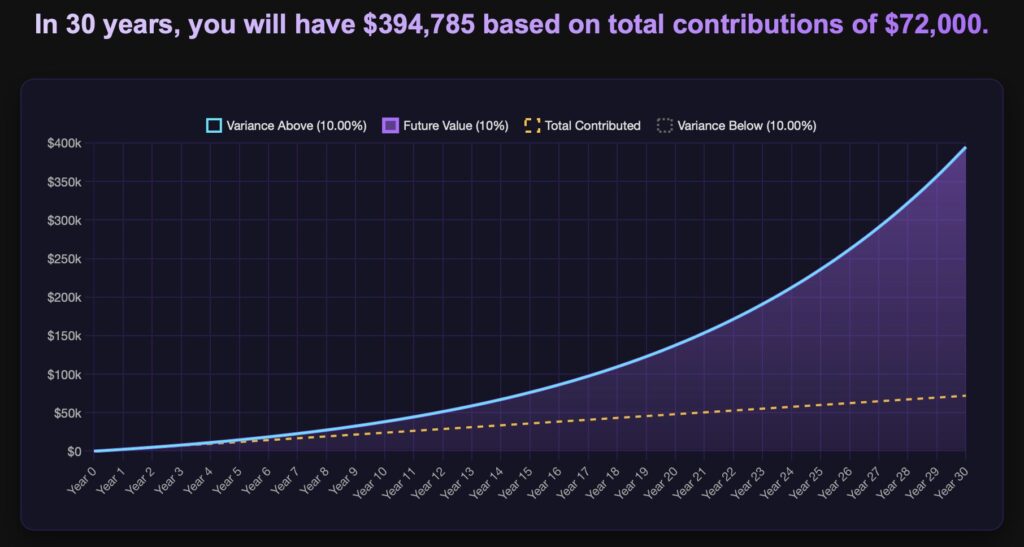
    If you invested just that $200 each month for the next 30 years, you would have $394,785! 

    And, that’s based on contributing only $72,000 of your own money. The rest is interest you earned for doing nothing.

    Take a second to let that sink in: You’d have nearly $400,000 in your investment account all because you created a Budget After Thinking

    If that doesn’t motivate you to make some thoughtful adjustments to your spending, I don’t know what will.

    Now is the perfect time to invest in your financial education.

    If you’re thinking about giving up on your future goals, there’s no better time than now to invest in your financial education.

    Whether we like it or not, money touches every facet of our lives. 

    When you take control of your money, you’ll see that your productivity at work improves. 

    Your relationships outside of work will improve. 

    I’d even go so far as to say that you’ll start to believe in yourself more. You may even find the courage to follow a different path in life you hadn’t previously explored.

    By the way, if most of your peers are giving up, think of the opportunities out there for anyone willing to learn personal finance.

    If less people are motivated to work hard, imagine what a strong work ethic can do for you.

    If less people are looking to buy a home, think about the homes that might be available if you make it a goal to buy one.

    When other people spend and spend in the present day, think of the foundation you can build by investing in the future.

    Yes, there are some of us who will give up and never try to build for the future because of these present day challenges.

    You could be one of those people.

    Or, you can make it more of a priority to build your financial foundation.

    After all the years you’ve spent in school to earn the right to practice law, my gut tells me you’re the type of person willing to put in the work.

    Don’t give up on your financial future.

    Invest in your personal finance education and thrive when others quit.

  • Pay Attention to the Little Stuff to Reach Your Money Goals

    Pay Attention to the Little Stuff to Reach Your Money Goals

    Being good with money starts with the little stuff.

    What I’ve learned teaching personal finance is that too many of us want to race right to the finish line. We want to skip ahead to mile 26 without completing the rest of the marathon.

    Money doesn’t work that way. There’s no magic switch to skip over the hard part. The little stuff matters.

    Picture the young lawyer who graduates with $100,000 in student loan debt. Absent some unlikely windfall, it’s going to take years of consistent payments to eliminate that debt.

    No matter how badly the young lawyer wants that debt to go away, he’s going to carry it for a while. There’s simply no fast way to eliminate hundreds of thousands of dollars of debt.

    But, there are faster ways.

    I’ll show you exactly what I mean below using the Think and Talk Money Student Loan Calculator.

    What you’ll notice is that every $20… $30… $50… decision can make a big impact on your overall financial picture.

    This isn’t to say that you shouldn’t spend your money on stuff that makes you happy today. What it means is that you should spend that money knowing how meaningful it could be down the road if used for your financial goals.

    Of course, this is easier said than done. When you’re staring down six-figures of debt, focusing on the little stuff may not seem that exciting. But, if you can make these types of small adjustments now, you can buy back years of your life.

    Focusing on the little stuff is how you get ahead.

    This discussion is not just for lawyers paying off student loans. The same idea applies if you’re trying to pay off credit card debt, save up to buy a home, or invest for your kid’s college.

    There are no fast ways to accomplish these goals.

    But, there are faster ways.

    In my opinion, too many of us don’t want to do the little stuff that will accelerate our financial journeys. We don’t take advantage of these faster ways.

    Instead of making intentional money decisions on a consistent basis, we spend mindlessly and hope to get bailed out with a huge bonus later on.

    That’s too risky. What if that bonus never comes? You’ve formed bad habits and set yourself up for trouble.

    If this sounds like you, you’re not alone. Too many Americans behave this way when it comes to spending instead of saving.

    Would it surprise anyone to learn that most Americans are not satisfied with the amount they have saved?

    According to a recent survey from Yahoo Finance/Marist Poll:

    • Only 10% of households are completely satisfied with the amount of money they have saved.
    • Only 20% reported saving more in 2024 than in 2023.

    To me, these numbers prove that we aren’t doing the little stuff when it comes to our money.

    Unfortunately, these results aren’t surprising at all. They closely mirror the stats I first showed my students in my financial wellness class back in 2021.

    What happens when we don’t do the little stuff?

    Let’s look at another stat that illustrates what happens when we don’t do the little stuff:

    • About 33% of households would not be able to pay their bills or expenses for one month, if faced with a sudden loss of income.
    • This number rises to 38% of Gen Z and 41% of Millennials who report they could not pay their bills for even a month. 

    What do these numbers really mean?

    1 in 3 people currently reading this post, in the comfort of their homes they have worked so hard for, would not be able to afford those homes for even one month if they suddenly lost their jobs. It’s worse for Gen Z and Millennials.

    Put another way, maybe you’re on the train commuting to work while reading this. How many people are in the train car with you? 30 or so?

    Pick out 10 passengers, really look at their faces.

    They’re just like you, typically responsible people, working a job to provide for themselves and their families. If these 10 people suddenly lost their jobs, they wouldn’t be able to pay their bills next month.

    That’s scary.

    Count me in the group of people not completely satisfied with their savings.

    If you read these stats and are honestly not worried about your savings, you are in the minority and are doing a tremendous job managing your personal finances. 

    Keep up the good work and please let us know in the comments below what strategies are working for you.

    On the other hand, if you’re being honest with yourself, you’re most likely in the 90% of people that are not completely satisfied with their savings. 

    Count me in this group.

    From 2017 to 2024, my wife and I prioritized using all of our available money to acquire real estate. The downside was that left us limited funds for savings.

    We now have work to do to build our savings back up. Instead of presently shopping for investment properties, we are now focused on paying down mortgage debt and increasing our savings. 

    Most people attribute their low savings to rising cost of living.

    What is the most common explanation given by people that have so little saved? The rising cost of living across the nation:

    • Nearly 66% of Americans believe that the cost of living for the average family is not affordable in their area.

    Millennials and Gen X are the most worried about the cost of living, with more than 70% of each group feeling unprepared. 64% of Gen Z and 59% of Baby Boomers likewise feel unprepared.

    Cost of living includes necessary expenses like housing, food, transportation, and healthcare. In other words, Now Money.

    There are any number of reasons we can point to that are combining to drive up the cost of living, like limited housing inventory, higher interest rates, and more expensive groceries.

    Our goal should be to focus on what we can control. That means the little stuff.

    Let’s explore one way to pay more attention to the little stuff.

    grocery store is a great place to save even a little bit of money to make big differences in the long run with your finances.
    Photo by nrd on Unsplash

    So, what exactly can we do to focus on the little stuff?

    When it comes to establishing good money habits, don’t overcomplicate it. There’s nothing wrong with starting small.

    A good place to start is with how much money you’re spending on food, whether that means restaurants or groceries.

    Why start with food?

    There are endless options when it comes to spending money on food. We can choose to spend a lot, or a little, or somewhere in between.

    Curious how much the average American spends on dining out?

    According to a recent survey from CNET:

    The average adult spends $59.19 per week, which adds up to $236.76 per month and a whopping $2,832 a year. Some age groups spend even more.

    Of all generations surveyed, millennials (born roughly between 1981 and 1996) spend the most on restaurants and takeout. The average millennial spends $86.55 per week on takeout, which comes out to $346.20 per month and $4,154.40 a year. 

    Dining out is not the only area to target when it comes to how much you spend on food. CNET also found that we waste a lot of groceries that we end up throwing out:

    The average US adult wastes a significant amount of money on food from the grocery store that never gets used. An average of $31.25 weekly is spent on groceries that aren’t cooked or eaten, amounting to $125 per month and $1,500 a year. 

    For today’s example, let’s focus on this one area of consumption to see how the little stuff can make a big impact on our finances.

    How the little stuff can take years off your loan payments.

    Let’s focus just on that $125 per month on wasted food from the grocery store. It may not seem like a lot of money to waste, but it adds up.

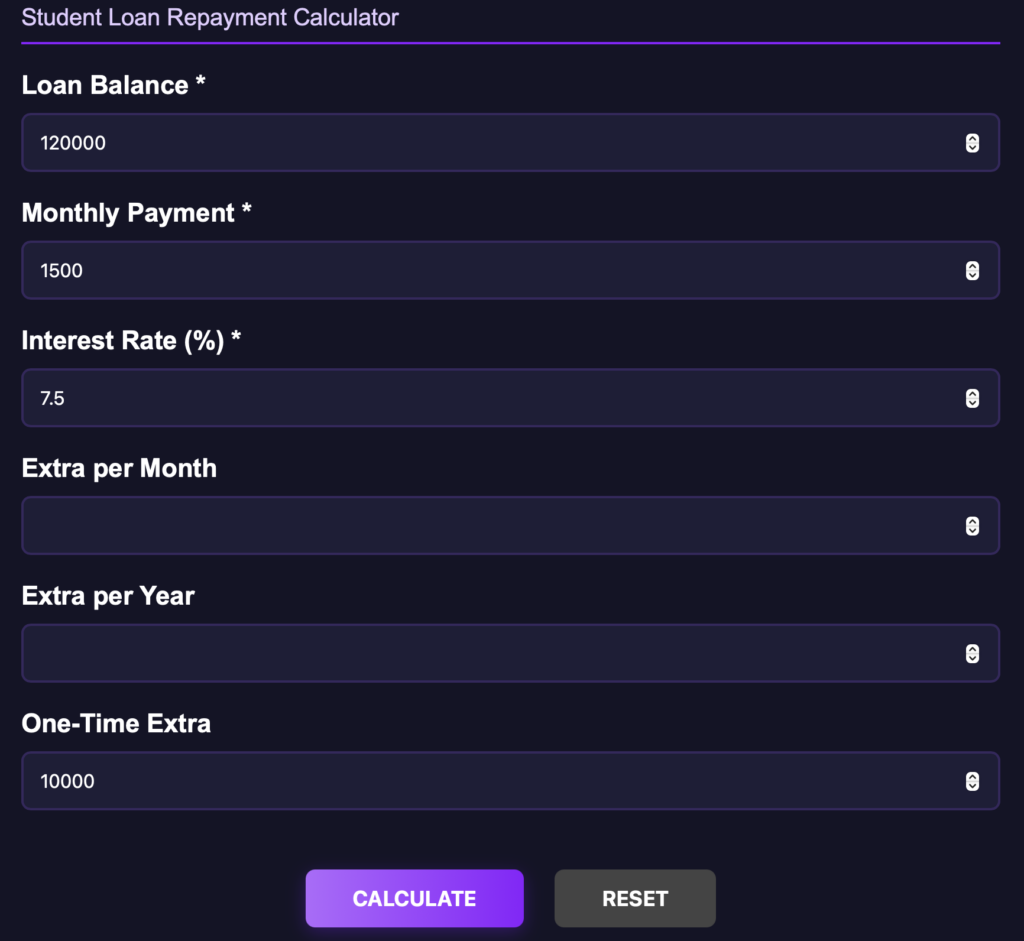
    Let’s revisit our recent law school graduate with $100,000 in student loan debt. Let’s assume he has a 7.5% interest rate and currently pays $1,200 per month.

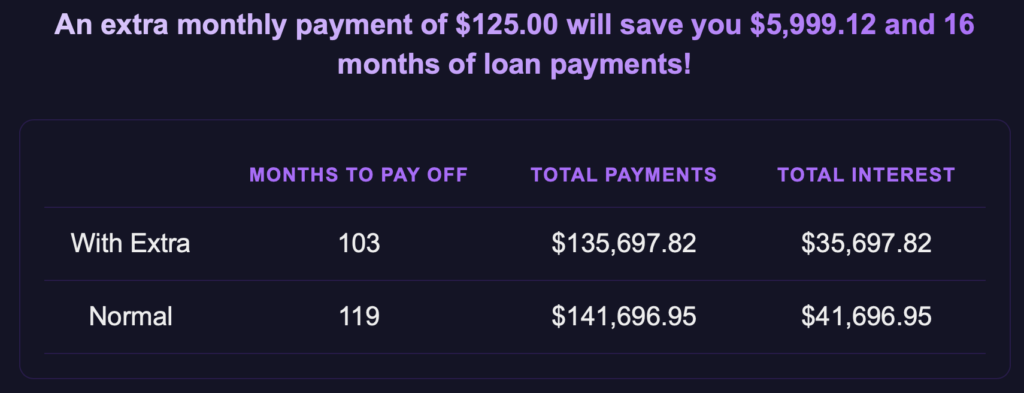
    Using the Think and Talk Money Student Loan Calculator, we can see that with no additional payments, it will take him 9 years and 11 months (119 months) to pay off his loans. He will pay a total of $141,696.

    Now, what if he can make an additional payment of $125 per month just by paying more attention to what he’s buying at the grocery store?

    With an extra monthly payment of $125, he could eliminate his loans 16 months faster and save $5,999 in total payments.

    even small extra payments make a huge difference in paying off debt faster using the Think and Talk Money student loan payoff calculator.

    Think about that.

    That’s more than a year of his life back without having to worry about loan payments. All he had to do was pay attention to the little stuff at the grocery store.

    What if you make a series of little decisions like this with your money?

    Let’s take it one step further. Let’s say our recent law grad also decides to spend $100 less on dining out each month. That’s only $25 per week, which is about what one lunch and one coffee cost these days.

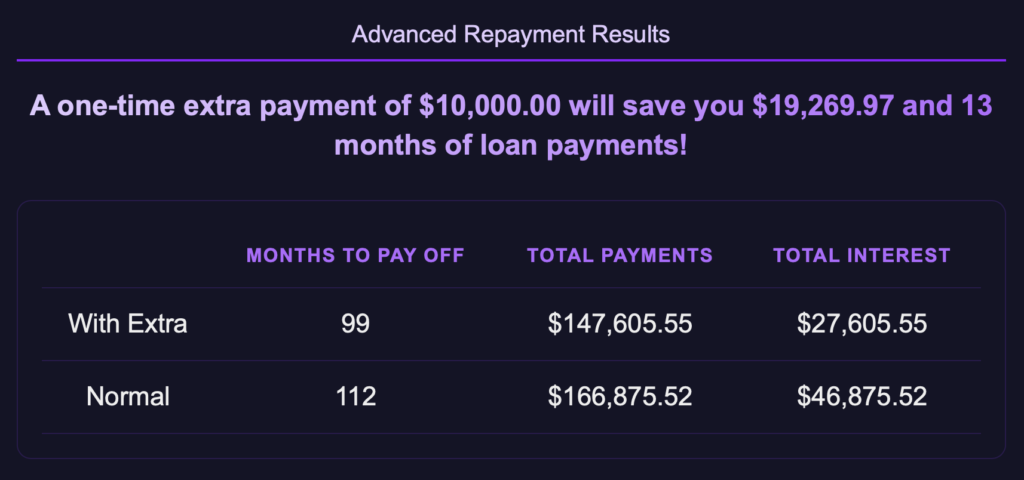
    By adding that $100 per month on top of the $125 he saved at the grocery store, he can shave off more than two years of loan payments and save $9,657.

    This example illustrates how consistently paying attention to the little stuff can pay massive dividends down the road.

    In this case, small adjustments with food can lead to thousands in savings and accelerate your journey to financial freedom.

    Pay attention to the little stuff to accomplish your financial goals.

    The big takeaway here is that achieving your financial goals starts with the little stuff. There’s no secret weapon or magic wand. You can’t finish mile 26 without completing miles 1-25.

    Just like with our recent law grad with six-figure debt, start small and reap the benefits down the road.

    Like we said earlier: there’s no fast way to achieve your money goals. But, there are faster ways.

    Paying attention to the little stuff may not be exciting, but it works.

    If you know a better way, I’d love to hear about it in the comments below.

  • Better to Buy 10 Businesses or Stick with Compound Interest?

    Better to Buy 10 Businesses or Stick with Compound Interest?

    I read an article the other day where the author says he’s not going to save another dime for retirement. He reasoned that waiting for compound interest to kick in takes way too long.

    He found a better way, he claimed.

    Instead of investing in the markets long term, he’s going to buy small businesses that generate cash flow. He gave an example of buying a website for $10,000 that kicks off $400 per month.

    That’s money in his pocket right now that he can spend in early retirement. He figures that owning ten small business like that is a faster and better path to retirement than traditional investments.

    When you buy businesses, your cash flow increases. When you invest in stocks, only your net worth increases. Since you can’t retire off your net worth, you’re better off owning businesses.

    The author suggested that everyone can do this and should be doing this. In his opinion, investing for cash flow is much more important than investing for long term net worth.

    Do you want to own and manage ten businesses?

    Interesting philosophy. I hope it works for him.

    Personally, I won’t be following his lead.

    For starters, how are you supposed to select, acquire, and operate ten small businesses? Is that even possible? If it is, it sounds like a major headache. As attorneys, we have enough headaches in our day jobs.

    On top of that, I don’t buy his main concept that owning ten businesses will allow you to retire early. To me, owning ten businesses sounds like ten jobs and a lot of work.

    As attorneys, we already have a demanding job and a lot of work. If you don’t want to work as an attorney anymore but want to keep working, maybe this is an idea you want to explore. If you want to retire and not work, this doesn’t sound like the ticket to me.

    Finally, this scheme sounds risky. How many small businesses would I have to buy to land on 10 that actually generate cash flow?

    According to the US Bureau of Labor, 18% of small businesses fail within their first year, 50% fail after five years, and approximately 65% fail by their tenth year. What are the odds that I’m going to own ten successful businesses that stick around long enough to fund my retirement? Way too risky for me.

    In the end, the internet is full of schemes like this one promising a better and faster way to retire. Some of them might even work!

    I’m not interested in going down this path. I’m sticking with the personal finance concepts that have worked for generations.

    For today’s conversation, that means investing early and often to benefit from the magic of compound interest.

    It’s not sexy. It’s not exciting. But, it works.

    Here’s why.

    Business Consulting meeting working and brainstorming new business project finance investment concept which seems like a lot more work than investing and relying on compound interest.
    Photo by Christin Hume on Unsplash

    Invest early and often to benefit from the magic of compound interest.

    Compound interest is the interest you earn on interest. 

    How’s that for a confusing definition?

    Fortunately, the idea of compound interest makes a lot more sense with a simple example.

    Let’s say you make an initial investment contribution of $1,000. Let’s assume that you earn 10% interest each year on that investment. We will also assume that you re-invest your investment gains. 

    After the first year, your initial contribution of $1,000 earns $100 in interest (10% of $1,000). That means after one year, you have $1,100 in your investment account.

    Because we are re-investing our gains, that means that at the start of year two, you have $1,100 to invest: $1,000 from your initial contribution plus the $100 earned in interest.

    If you earn the same 10% interest on that $1,100 investment, you will have $1,210 at the end of year two. 

    Notice that in year two, you earned $110 in interest, whereas in year one you earned $100 in interest. That’s because in year 2, you earned interest on the interest your previously earned. 

    This is the key point about compound interest: you earned more money in year two, even though the interest rate remained the same and you did not contribute any additional money.

    That’s how compound interest works. Compound interest is earning interest on interest you’ve previously earned.

    Importantly, you don’t have to work harder or make the right decisions like you would if you owned a small business. With compound interest, you make more money as time goes on by doing nothing.

    So, why is compound interest so powerful?

    Earning an additional $10 in interest year two may not seem like a lot. 

    Over the long run, those additional earnings add up.

    Let’s look at an illustration from the Think and Talk Money Compound Interest Calculator of what happens to that initial $1,000 contribution over a 30-year period:

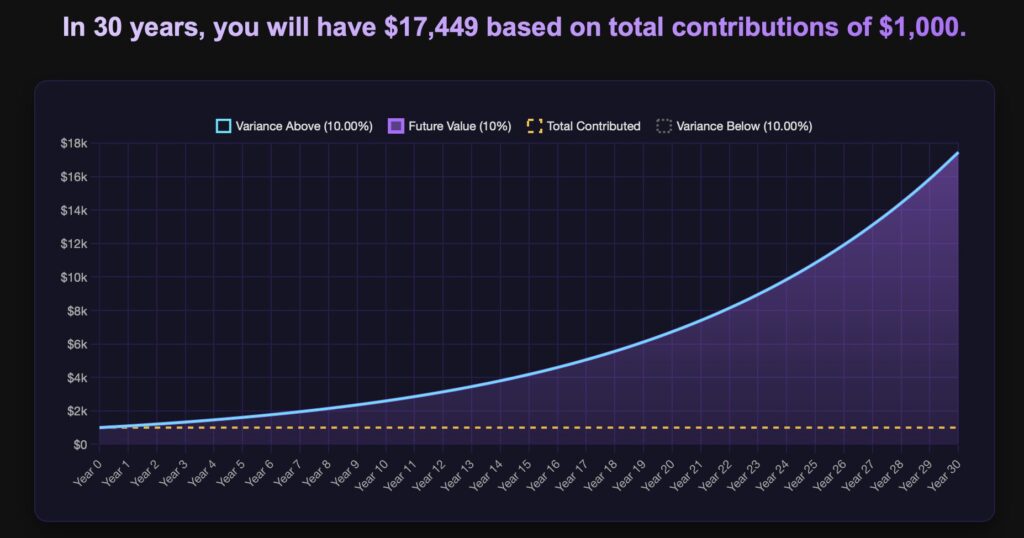
    In 30 years, you will have a total of $17,449.40. That’s a pretty good result from total contributions of only $1,000. 

    However, for this example, that total is not the important part. The important part is to visualize how compound interest worked its magic to get that result.

    Look closely as the two lines on the graph. The dotted line that doesn’t change represents your initial $1,000 contribution.

    The blue line represents the amount of money you have over time.

    Notice how in the first 10 years or so, the dotted line and the blue line mirror each other pretty closely. Around year 12, you start to see some separation between the two lines. 

    While the dotted line stays flat, the blue line begins to arc upwards. That’s because all that interest you earned during the previous decade has been earning interest. Your investment begins to accelerate upwards without any additional contributions from you.

    By the end of year 30, look at how steep the blue line is jetting upwards.

    Like I said, compound interest is not sexy. But given enough time, it works incredibly well.

    Look at the specific amount of money you’d earn each year in this hypothetical.

    When you use the Compound Interest Calculator, you can also see how much more interest you earn each year as time goes on. Just click the button that says “Show/Hide Data Table.”

    As we mentioned earlier, you earned $100 in interest during year 1. Then, you earned $110 in interest during year 2. That’s a good, but modest, increase.

    During year 12, you earned $285.31 in interest. That’s significantly more than you earned in the early years, all without any additional contributions on your part.

    During year 30, you earned $1,586.31 in interest! 

    The more time that you stay invested, the more money you’ll earn as compound interest works its magic.

    That’s the power of compound interest.

    Invest early and often to be a millionaire with very little effort on your part.

    Compound interest is so powerful that it can make you a millionaire with very little effort on your part. All it takes is time and consistency.

    Compared to owning ten small businesses, that sounds much easier.

    Let’s look at another example to see how you can easily become a millionaire if you invest early and often.

    Let’s say you begin your career after going to law school or grad school at age 25. During your first year working, you saved up $3,000 and decided to invest in a low cost index fund.

    You also make a plan to contribute an additional $300 per month to your investment account for the next 40 years, setting yourself up to retire at age 65.

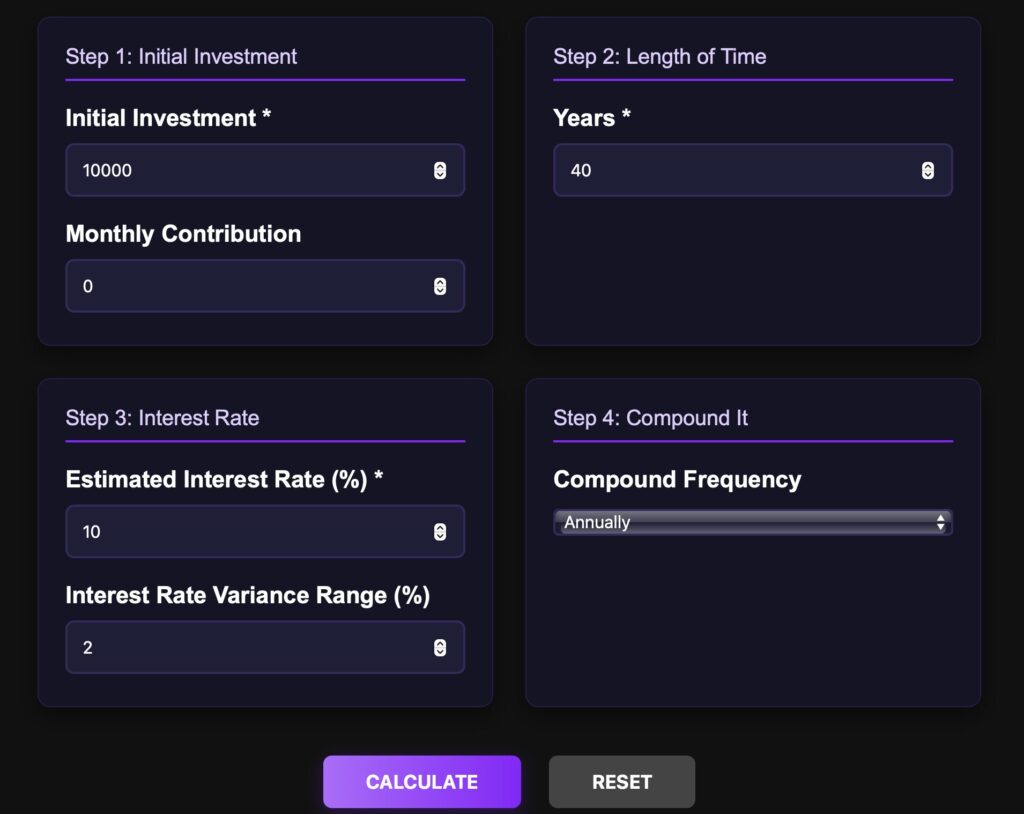
    We’ll also assume you earn the same 10% interest from our prior example, and you don’t make any withdrawals from your account.

    To provide a fuller picture, we’ll also factor in a 2% variance rate, meaning you can see what would happen if you only earned 8% interest and also if you earned 12%.

    Now, let’s see the results.

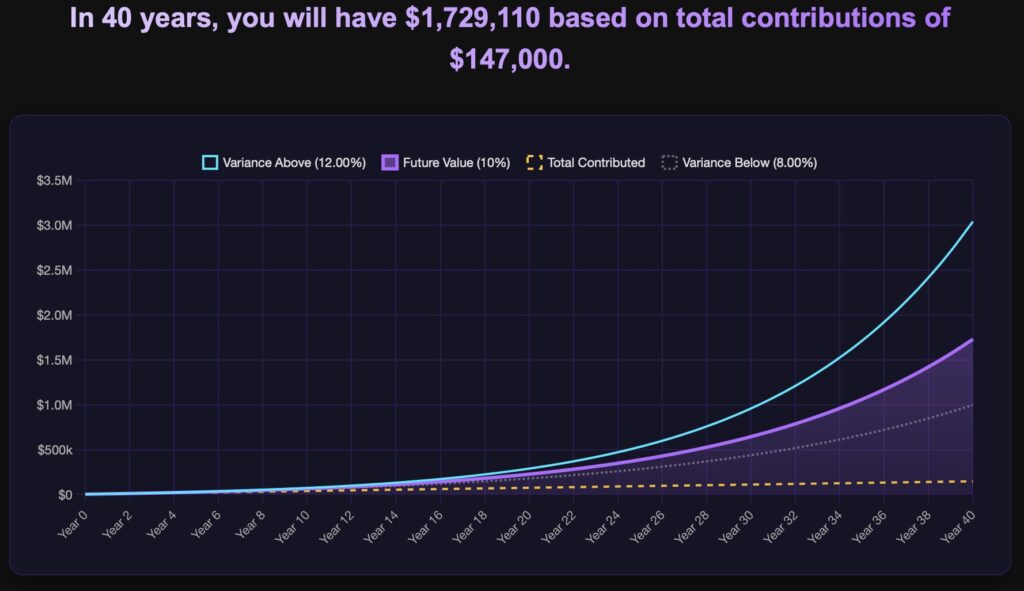
    By the time you reach retirement age, you’ll have $1,729,110.97 in your retirement account at 10% interest.

    That amount increases to $3,040,682 with 12% returns and drops to $997,777 with 8% returns. 

    That’s after contributing only $3,000 initially and $300 per month after that.

    Put another way, your total contributions of only $147,000 turns into $1,729.110.97 by the end of your career. Even if the market performs below historical averages, you would still have nearly $1 million.

    Take a look at the graph and notice the similarities to our prior example.

    You’ll notice this graph looks almost identical to our prior example, even with the additional contributions that you make over time. 

    You can once again see that the lines mirror each other closely for the first 10-15 years. 

    Then, the dotted line stays relatively flat while the investment lines gradually arc up before skyrocketing towards the end.

    Now, there’s no way to predict exactly when you’ll start to notice the magic of compound interest. There are too many variables at play.

    The point is that given enough time, your personal investment trajectory should look similar because of compound interest. 

    You can play with your own numbers in an investment calculator like this one to match your personal situation.

    If you’ve created a Budget After Thinking, you may be able to invest much more than $300 per month.

    No matter what initial contribution you make and what interest rate you assume, you should notice a similar investment picture over the long run.

    When I say investing is the easy part, this is what I mean. 

    I just showed you how an early contribution of $3,000 and regular contributions of $300 can turn into more than $1.7 million.

    You don’t have to understand the math behind compound interest. 

    You just have to trust that it works. 

    Then, invest early and often.

    Given enough time, assuming normal, historical market conditions, your investments will gradually increase before shooting up in the later years.

    Read that sentence again. “Given enough time” is the key phrase. 

    The magic behind compound interest is time. 

    The earlier you can start investing, the better off you will be.

    Since we can’t control investment returns, I prefer to focus on what we can control when it comes to investing. 

    We can control when we start investing and how long we invest for.

    By making regular contributions over a long period of time, compound interest ensures that your wealth will grow.

    Invest early and often.

    People smarter than you and me preach the power of compound interest.

    Warren Buffett, the world’s greatest investor, fully appreciates the power of compound interest. He’s famous for saying that his favorite holding period for an asset is “forever”. 

    Buffet’s not literally saying that there’s never a time or reason to sell an asset, like a a stock. He’s simply making the point that compound interest benefits people who stay invested over the long term.

    If the world’s greatest investor isn’t impressive enough for you, how about the world’s greatest thinker?

    Albert Einstein is often credited with this famous quote about compound interest:

    Compound interest is the eighth wonder of the world. He who understands it, earns it. He who doesn’t, pays it.

    You don’t have to be as smart as Buffet or Einstein to benefit from compound interest. 

    You just have to invest early and often.

    Lawyers: would you rather manage ten businesses, or let your money quietly grow in the background thanks to compound interest?

    Let us know in the comments below.

  • How the Jay Leno Rule Turbocharged my Net Worth

    How the Jay Leno Rule Turbocharged my Net Worth

    Jay Leno: former host of The Tonight Show and famous comedian.

    Rob Gronkowski: Super Bowl champion and celebrity spokesperson.

    Matt Adair: just like them.

    At least, in one way.

    The three of us follow the same money philosophy when it comes to how we earn and spend.

    This philosophy has become known as the “Jay Leno Rule.”

    Here’s how the Jay Leno Rule works, as explained by the man himself in an interview with CNBC:

    From the moment he entered the working world, “I always had two incomes,” [Leno] explains to CNBC. “I’d bank one and I’d spend one.”

    And he made sure to spend the smaller amount. 

    “When I was younger, I would always save the money I made working at the car dealership and I would spend the money I made as a comedian,” he says. ”When I started to get a bit famous, the money I was making as a comedian was way more than the money I was making at the car dealership, so I would bank that and spend the car dealership money.”

    “When I got ‘The Tonight Show,’ I always made sure I did 150 [comedy show] gigs a year so I never had to touch the principal,” Leno says. “I’ve never touched a dime of my ‘Tonight Show’ money. Ever.”

    ″So many people get to be the age I’m at now and they’ve got nothing because they just blew it all,” he says. “I put my money in a hammock and say, ‘You relax. I’m going to go work.’ And when I come back, I put some more money in the pile. 

    “It sounds ridiculous, but if everything ends tomorrow, I know I’ll be fine.”

    The Jay Leno Rule is such a simple and powerful money philosophy.

    The Jay Leno Rule boils down to three simple steps:

    • Earn income from multiple sources.
    • Spend only the money from one income source, preferably the smaller one.
    • Save and invest the rest.

    If you can employ this strategy, you can create significant wealth for you and your family.

    I’ve been following the Jay Leno Rule since 2011 when I started with my law firm and got my first job teaching at a law school. More on that below.

    First, let’s revisit Leno’s story.

    When we think of Leno today, we think of the famous and wealthy host of The Tonight Show. His net worth is estimated to be $450 million. He could buy anything he wants.

    But, read his story again. He developed good money habits before he got famous. He earned two incomes from working at a car dealership plus doing standup comedy shows and always saved one of those incomes.

    Don’t gloss over that part. Leno established a strong financial foundation early in his career, before he started making a ton of money.

    Because he had established the habit, he continued earning multiple salaries, even after his income soared with The Tonight Show. That’s impressive.

    Leno’s story shows why practicing good money habits is so important early in our careers.

    You’ll also notice that Leno took nothing for granted: “if everything ends tomorrow, I know I’ll be fine.”

    Leno wasn’t referring to the world ending. He was talking about losing his job. He meant that if is income went away, he had saved enough that he didn’t have to worry about it.

    That is freedom.

    brown football representing rob Gronkowski who never spent his NFL money and now is financially free.
    Photo by Sarah Elizabeth on Unsplash

    Rob Gronkowski follows the Jay Leno Rule.

    NFL legend Rob Gronkowski applied the Jay Leno Rule during his career as an NFL superstar and celebrity endorser. He explained his money philosophy recently on the “Bussin’ with the Boys” podcast:

    “I didn’t know how long the NFL was gonna last. I was a second-round pick, so it was like a four-year, $4 million deal, and I was like, if I can play this contract out, I’ll be set for life.

    I just always wanted to save it, and I just used my money that I was getting off the field to just spend it on whatever I needed to spend it on. Technically, I have not spent any of my NFL money.”

    Gronk is a very smart man. Just like Leno, he established the habit of saving one of his sources of income early in his career.

    Again like Leno, he didn’t take his career for granted. He didn’t fool himself into thinking that his high salary would always be coming in. Even if he got injured or failed to perform during his initial contract, he would be just fine.

    Imagine how much confidence that gave him on and off the field. Because he knew he was set financially, he did not have added pressure to perform. He could be himself and play the sport that he loved without worrying about his next contract.

    There’s no doubt in my mind that feeling of financial freedom helped him perform at his best on his way to winning four Super Bowls.

    How I’ve applied The Jay Leno Rule to build significant wealth.

    Just like Gronk, I have applied the Jay Leno Rule since I first earned multiple income streams in 2011.

    Back then, I had just left my first job after law school as a judicial law clerk and started at my law firm. It was also the first year I taught a law school course.

    My primary financial goal at the time was to pay off my student loan debt. The Jay Leno Rule helped me do just that in a fraction of the time it otherwise would have taken.

    Executing the strategy was easy. When I received my monthly paycheck from teaching, I immediately made an extra payment on my loans. It gave me an emotional boost to put that money to good use before I was tempted to blow it on something else.

    I wasn’t earning a lot teaching back then, but every bit helped to accelerate my debt payoff.

    You can play around with my Student Loan Payoff Calculator and see for yourself how even small extra payments can make a huge difference.

    I did the same thing with any bonus I received: as soon as it hit my account, I used it to pay off my loans.

    The Jay Leno Rule works because it forces you to save money.

    We know that our saving rate is the one thing we can truly control on our way to financial independence.

    Even though most of us would agree that we should be saving more money, sometimes it’s easier said than done. That’s where Jay Leno’s Rule is so helpful. If you commit to the philosophy, you’ll be forced to automatically save your supplemental income.

    Once you commit to the philosophy, the execution is easy.

    As soon as the money hits your checking account, you move it to one of your savings or investment accounts, or use it to pay off debt. Do this right away so you don’t get tempted to spend the money elsewhere.

    This is exactly what I continue to do today because I knew that if the money sat in my checking account, it would slowly disappear.

    One other tip: don’t include this money in your Budget After Thinking. Pretend you never even had the money. This is a money mindset trick that will help you solidify the habit.

    Because my teaching paychecks and bonuses were irregular, I did not factor them into my budget. It might sound silly, but I just pretended that extra money wasn’t really mine. As soon as it came in, I put it to good use.

    Help yourself out by pretending your supplemental income isn’t even yours. This applies to side hustles, bonuses, windfalls, etc.

    Use this extra money to advance your financial goals and continue living off of your salary.

    The key to establishing the habit is starting early in your career, like Leno and Gronk did. It’s important to do this before you become dependent on spending the supplemental income.

    I have used the Jay Leno Rule since 2011 to turbocharge my net worth.

    As the years went on, my wife and I have added income streams and continue to use the Jay Leno Rule. Here’s a snapshot of our income streams:

    • My salary as an attorney
    • Bonuses earned as an attorney
    • My wife’s salary as an attorney (until 2025)
    • Chicago Rental Property 1
    • Chicago Rental Property 2
    • Chicago Rental Property 3
    • Colorado Rental Property
    • Law School Course 1: Financial Wellness for Lawyers
    • Law School Course 2: Moot Court & Appellate Advocacy S.1
    • Law School Course 3: Moot Court & Appellate Advocacy S.2

    Adhering to the Jay Leno Rule, my wife and I have only ever spent our salaries as attorneys. The rest of the income we earn goes directly to our financial goals.

    Since 2011, we’ve built significant wealth by applying this simple strategy. Our financial goals evolved, but the strategy remained the same: earn multiple sources of income, live off of one source, invest the rest.

    Early in my career, my primary financial goal was to get out of debt. Whenever I earned a bonus or a paycheck from teaching, I immediately transferred the money out of my checking account to pay down the debt.

    Within a few years, my debt was gone.

    But, I didn’t stop applying the Jay Leno Rule just because I was out of debt.

    I had already done the hard part and established the habit of using any supplemental income for financial goals. That made it easy to then use any supplemental income to build up my assets.

    That meant I could more aggressively invest in the stock market and more quickly acquire rental properties.

    Today, my wife and I continue to apply the Jay Leno Rule. Any income from bonuses or side hustles goes immediately to paying off debt or to fueling our investments.

    At first, I didn’t fully appreciate the impact the Jay Leno Rule had on my finances. That’s how personal finance works. It takes time for compound interest to work its magic.

    Now, I’m seeing the results from the “forced savings.”

    And, I’m so grateful that I learned the Jay Leno Rule early in my career.

    person in yellow jacket running down a road showing what it means to hustle to financial freedom.
    Photo by Oskar Smethurst on Unsplash

    I’ve had side hustles for just about my entire career as a lawyer.

    My first side hustle was as an adjunct professor at a local law school, teaching just one class. I made hardly any money when I started teaching. It didn’t matter to me. I wasn’t dependent on the money to feed my lifestyle.

    I was playing the long game. Because I got my foot in the door and did a good job, the school took notice. At my peak, I was asked to teach four classes. That meant I earned a lot more and could put all that extra income to financial goals. 

    At the same time, I also launched a rental property business with my wife. We now manage 11 rental units in Chicago and Colorado.

    By the way, earning more money does not only apply to side hustles.

    There are always ways to make more money within your primary job. 

    For example, can you earn a larger bonus by performing better?

    Can you ask your employer for more responsibilities and a corresponding raise?

    Or, can you earn additional money by generating business for your company? 

    It’s no secret that lawyers have the ability to earn more money if they generate business. That means bringing in clients.

    How can you find these clients?

    You can make it a priority to go to more events where you might meet potential clients. 

    You could launch a blog or create other content to help people find you and know what you do.

    Either one of these pursuits could be your side hustle.

    There are endless opportunities for anyone that is motivated and is looking to earn more money.

    And when you earn and invest that additional money, you’re on your way to financial independence without having to sacrifice the things that make your daily life enjoyable.

    If you take on a side hustle, don’t forget the Jay Leno Rule.

    I recommend that every young lawyer take on a side hustle or look to earn supplemental income. And, when you start earning extra money, don’t spend it. Apply the Jay Leno Rule.   

    Never forget that when it comes to side hustles or supplemental income, it’s what you do with that extra money that makes it worth it.

    A side hustle is another time commitment, after all. If you’re going to take on the responsibility, make sure it counts.

    Before you consider a side hustle, have a plan in place for why you want additional money.

    Are you looking to pay down debt faster?

    Save for a wedding?

    Invest in your first rental property?

    To help you think through why you might want a side hustle, check out these three posts:

    BTW, you’re not too busy or important for a side hustle.

    Some lawyers reading this will automatically think, “I’m way too busy to even think about another job.”

    In my personal finance class for law students, we spend a lot of time challenging that notion. Very few people- and I mean very few- are too important or too busy to take on a side hustle.

    You may think you’re one of those “too important” people. I would challenge you to assess whether you’re confusing “too important” with “too stressed.”

    Setting that conundrum aside, the ideal side hustle is something you enjoy doing that can earn you extra money at the same time. Some examples my students have come up with in class include:

    • Bartending. Entice your friends to come to your bar by offering cheap drinks. You get to hang out with them and get paid at the same time.
    • Fitness instructor. Instead of paying $48 for the spin class you love, become the instructor and get paid to lead the class.
    • Dog Walker. If you love dogs and don’t currently have one of your own, what better way to fill that void in your life while making money. The same applies to babysitting.
    • Home Baker. Make homemade treats with your kids and sell them to parents who don’t have the time.

    The point is there are always ways to make more money by doing things you like to do anyways. Even if you’re busy. You just have to exert some mental energy to figure out how.

    a mug on a desk indicating that we an all have a side hustle to reach financial freedom.
    Photo by Garrhet Sampson on Unsplash

    This idea of being “too busy” reminds me of a conversation my dad and I had when I was in high school.

    Growing up, my siblings and I were busy kids. Sports, clubs, performances, classes, you name it. I made a remark to my dad about it at one point.

    He responded that being busy wasn’t a bad thing because you don’t have time to fool around. When you have no choice other than to stay focused, you actually perform better in all facets of life.

    You’re not thrown off by distractions because you’re locked in on accomplishing your goals. Back then, that meant going to class followed by soccer or basketball practice, a quick dinner, some homework and bed. I didn’t have any time for fooling around.

    The same is true today.

    I take care of business as best I can, while prioritizing my family and my health, and don’t have a lot of time to goof around.

    I can see your eye rolls through your screen.

    This guys is nuts. He’s a workaholic. He has no life.

    The people who know me best would beg to differ.

    They might even tell you that I’m pretty good at spending my working hours doing what is meaningful to me. And, that I spend my personal time with the people who are meaningful to me.

    If you want to get ahead financially, you really only have two options.

    At the end of the day, there are really only two ways to get ahead financially: spend less money and/or make more money.

    Of course, if you really want to get ahead financially, earning more money at the same time you’re spending less money is a dominate combination.

    This is what Jay Leno and Gronk did. It’s also what I did.

    I was talking to a friend recently. He wants to improve his financial situation. After all of life’s expenses, he doesn’t have much left to invest and get ahead.

    We talked about how there are no shortcuts. He either needed to start making more money or needed to spend less. It wasn’t what he wanted to hear at first. He wanted a quick fix.

    Money doesn’t work that way, even if you win the lottery, inherit a large sum of money, or earn a huge bonus. If you don’t have a strong foundation, that money will disappear as soon as you get it.

    If you take on a side hustle, you can use every dollar you earn to get ahead. Since this is new money you’re earning, you shouldn’t need it to fund your life’s expenses

    Avoid the temptation of using that money on things you don’t really want anyways.

    One more tip: use a financial calculator to see how much faster you’ll reach your goals if you’re able to throw additional money at them each month. Track and watch your net worth grow.

    If you’re not ready for a side hustle, the same logic applies anytime you earn a bonus or commission at your primary job. Put that money to good use by paying down your debt.

    Start using the Jay Leno Rule and never look back.

    This concept of living off of my salary and not spending any bonus or side hustle income is one of the biggest reasons for my net worth today.

    I recommend anyone striving for financial independence make the same commitment to not spend your supplemental income.

    The hard part is getting past the initial temptation to spend your bonus money. If you can convince yourself that you don’t need the money right now to live the good life, you will be significantly better off down the road.

    One of my favorite experiences teaching personal finance to law students involved a side hustle story. A couple of years ago, a student approached me during a break and told me about his credit card debt. It had been weighing heavily on him.

    After our discussion about side hustles, he committed himself to driving for DoorDash and using the income to pay off his credit card balance.

    Six months later he sought me out to share that the plan worked. His side hustle allowed him to pay off his credit card in less than six months. All while working a full-time job and attending law school par-time.

    I couldn’t have been happier.

    Jay Leno would certainly have approved.

    Do you adhere to the Jay Leno Rule?

    Has it helped accelerate your progress towards financial independence?

    Let us know in the comments below.

  • Ignore Courthouse Stock Tips: Start with the Fundamentals

    Ignore Courthouse Stock Tips: Start with the Fundamentals

    The other day I was talking to some lawyers I know at court while waiting for the judge to come out.

    Per usual, we started chatting.

    What are Da Bears going to do in the offseason?

    Is the weather ever going to get above freezing?

    Any good trips coming up?

    That kind of thing.

    During our conversation, a couple of the lawyers shared that they were enjoying my posts and weekly emails. Always nice to hear.

    After a few minutes, the conversation evolved into a discussion about how the markets were doing. One of the lawyers mentioned a new stock he was looking at after watching a segment on CNBC.

    As the nearest (only?) personal finance professor standing around, they asked me for my opinion.

    I don’t know if they liked my answer.

    Let me explain.

    At the beginning of my personal finance course, I always ask my students what they want to learn about.

    This conversation in court reminded me of a common theme I’ve noticed about teaching personal finance.

    At the beginning of my course, I always ask my students what they want to learn about.

    The most common response is something like, “I want to learn how to invest.”

    OK, not a bad goal.

    Investing is a crucial component of financial wellness.

    However, learning to invest is not where our personal financial journeys begin.

    Here’s how the scene usually plays out in my class:

    When my students ask me a question about how to start investing, I tend to respond with a question of my own:

    “How much savings does your budget generate each month?”

    Yes, I know. It’s so annoying to answer a question with a question.

    This particular question usually leads to a double dose of annoyance from my students.

    My students are first annoyed that I ignored their question about investing.

    They didn’t come to me to talk about something boring, like budgeting. They want to know about the exciting stuff, like investing in the stock market.

    What I’ve noticed is that after this initial annoyance fades away, another form of annoyance sets in.

    My students get annoyed because they can’t actually answer the question.

    They realize they have no idea how much money they’re saving each month because they don’t have a budget.

    Do you see the problem?

    What’s the point in learning how to invest… if you don’t actually have any money leftover in your budget to invest?

    This is what I tried to explain to the lawyers standing around in court the other day.

    They nodded along politely, but they really just wanted to know my thoughts on the hot stock tip.

    Instead of worrying about stock tips, make sure your personal finances are in order.

    My goal here is not to dissuade you from investing in the stock market.

    I am a big proponent of investing. Every lawyer should be investing to create optionality in life.

    My goal is to help you establish a strong foundation so you don’t fall backwards as soon as you start seeing investment gains.

    One of the biggest personal finance mistakes I see is people trying to rush the process without starting from a strong foundation.

    Personal finance is all about the progression:

    In the Think and Talk Money blog, we initially covered each of those topics in order from top to bottom. There was a method behind the madness.

    First, we talked extensively about the mental side of money. Without having your money mindset in the right place, nothing else matters.

    We then spent a lot of time talking about personal finance fundamentals, like budgeting, saving, and handling credit and debt responsibly. 

    Only after having our personal finance foundation in place did we talk about more fun concepts like investing in the stock market and owning real estate.

    Of course, there’s a reason we’ve covered these topics in this order. 

    If your money mindset is not in the right place, you won’t be able to stay on budget. 

    If you can’t stay on budget, you’ll likely fall into debt. 

    When you’re falling deeper and deeper into debt, it doesn’t make a lot of sense to prioritize investing.

    At that point, hot stock tips are totally worthless to you.

    two women sitting by the window talking about investing when they really need to learn about the basics of personal finance.
    Photo by Christina @ wocintechchat.com M on Unsplash

    Why bother with stock tips if any investment gains are just going to disappear?

    Let’s focus on that last point for a minute. 

    What sense does it make to invest in the latest hot stock if you’ve never proven to yourself that you can use those investment gains responsibly?

    Sure, you may get a quick emotional high from being right about a stock.

    But, why take that risk just to have any gains disappear because you don’t have a strong personal finance foundation in place?

    Imagine you happen to get lucky enough to buy and sell a stock at just the right time to make $20,000 in just a few months.

    It’s not easy to earn that much. It takes some good luck, not to mention the risk involved.

    Now, if you blow the $20,000 you earned on things you don’t even care about, what was the point? 

    Why take on the risk and do the work if the money will all be gone just as quickly as you received it?

    Unfortunately, this is how many people go through life. They work hard, make good money, and then have nothing to show for it.

    I don’t want that to be your fate. I want you to have a plan for your money before you earn it. 

    That means sticking to the fundamentals that consistently move you closer to living freely on your terms.

    Most of us don’t know where our next dollar is going. 

    The reason most people never get ahead with their finances is because they don’t have a plan for where their next dollar is going. 

    Their income hits their checking account, they spend it on this or that, and pretty soon that money has disappeared. They haven’t used the money to advance any of their priorities.

    It’s just gone.

    To me, this is one of the most important money mistakes that we need to fix right away. We definitely need to fix it before we put our money at risk in the markets.

    If not, you’re likely to make the same mistakes, just with more money to lose.

    Having a plan for our money, before we earn it, is essential if we want to reach our goals. With a plan, we can eliminate the disappearing dollars and have the confidence that our money is being used to serve our purposes.

    How do you create a plan for your money before you earn it?

    You need to have a budget.

    If you don’t currently have a budget that results in excess money at the end of each month, I encourage you to start there before embracing the latest stock tip.

    How to create a Budget After Thinking.

    The key to budgeting is to eliminate disappearing dollars by creating a plan for Now Money, Life Money, and Later Money.

    Your Later Money is the whole key. That’s what you’ll eventually use to accelerate your journey to financial freedom by investing in stocks or buying real estate.

    1. Now Money

    Now Money is what you need to pay for basic life expenses. 

    These expenses include housing, transportation, groceries, utilities (like internet and electricity), household goods (like toilet paper), and insurance. 

    These are expenses that you can’t avoid and should be relatively fixed each month.

    2. Life Money

    Life Money is what you are going to spend every month on things and experiences in life that you love. 

    This bucket includes dining out, concerts, vacations, subscriptions, gifts, and anything else that brings you joy. 

    We can’t be afraid to spend this money. This bucket is usually what makes life fun and exciting. The key is to think and talk so you are spending this money consistently on things that matter to you.

    3. Later Money

    Later Money is what you are saving, investing, or using to pay off debt. 

    This bucket includes long term goals, such as retirement plan contributions (like a 401k or Roth IRA), college savings for your kids (like a 529 plan), emergency savings and paying off student loan or credit card debt. 

    This bucket also includes any shorter term goals, like saving for a wedding or a downpayment for a house. 

    Most fun of all, this bucket includes any investments you make to more quickly grow your wealth, like investing in real estate or the stock market.

    Later Money is the key category that fuels your ultimate life goals, like financial independence. The more you fuel this category, the faster you can reach your goals.

    Businesswoman talking to her colleagues while standing in office lobby indoors about personal finance fundamentals for lawyers.
    Photo by Vitaly Gariev on Unsplash

    Why a Budget After Thinking works for lawyers when other budgeting systems fail.

    It’s not for me or anyone else to tell you what to do with your money. That’s why I don’t tell you to save 20% of your income or only spend 50% on fixed expenses. 

    In my experience teaching personal finance, that advice just doesn’t work, especially not for young lawyers with entry-level salaries and massive student loan debt. 

    The truth is fixed spending rules sound good until you actually try to implement them. 

    In reality, when you base your entire budgeting strategy on arbitrary rules like “save 20%,” you’re likely to realize that target is out of reach. 

    You would have to cut so much from other areas that your budget would be oppressively restrictive. The result is you’ll get frustrated and quit your budget.

    I have a different approach. One that actually works for lawyers.

    With a Budget After Thinking, the central purpose is to evaluate your current spending habits, no matter your starting point. Once you understand where your money is going, you can implement thoughtful adjustments that match your lifestyle and financial goals. 

    No hard and fast rules. 

    Just individual thought and discretion with a focus on creating real money to invest.

    When you have strong fundamentals in place, investing becomes fun.

    Being good with money doesn’t have to be stressful. Once you have the fundamentals in place, you’ll start to see how each dollar you earn gets you one step closer to financial freedom.

    That’s when investing is fun. Whether the markets go up or down, you stick to the plan. You consistently feed your accounts knowing that over the long run, you’ll be in great shape.

    So, before you embrace the next hot stock tip from the lawyers standing around the courthouse, make sure that your personal finances are in order. 

    When investment gains come in, you want to make sure they don’t go right out.

    Otherwise, the effort, stress, and risk of investing is not worth it. Any dollar you earn is likely to disappear as quickly as it comes in.

    To prevent that from happening, establish good money habits first. 

    In the end, you’ll be so happy that you did.

    Let me know what you think by dropping a comment below.

  • The FI Police Won’t Like How Much I Spend on Housing

    The FI Police Won’t Like How Much I Spend on Housing

    If I have one critique about the financial independence community, it’s that certain segments can be awfully judgy.

    This is especially true when it comes to how people choose to spend their money.

    If you choose to spend money on a big house, a fast car, or heaven forbid… a latte… watch out for the Financial Independence Police.

    They will tell you you’re doing it all wrong, and you’ll never reach financial freedom spending like that.

    I disagree.

    More to the point, I don’t find judgments like that productive, especially when I teach personal finance to lawyers.

    Instead, I do my best to encourage my students to spend their money based on their own values, not anyone else’s. Yes, there always tradeoffs. But, those tradeoffs are yours alone to make.

    In today’s post, I wanted to explore this concept as it relates to my own spending decisions.

    Spoiler alert! The FI Police won’t like how much I spend on housing.

    Let’s dive in, starting with how the average American spends his money.

    The average American spends the most in three categories: housing, transportation and food.

    According to the U.S. Bureau of Labor Statistics, Americans tend to spend the most money each month on housing (33.4%), transportation (17%), and food (12.9%).

    Those three categories equate to nearly 63% of the typical American’s budget. This is not to say that you should base your spending on these averages. Everyone is different.

    But, conventional wisdom goes that by focusing on just those three categories, most people can make major strides towards financial independence.

    Scott Trench from BiggerPockets Money has been championing this idea for years. Check out his book Set for Life to read more about the impact you can make on your finances by targeting just these three areas.

    Personally, I spend way more on housing than the typical American.

    Look out! Here comes the FI Police!

    Before they lock me up and throw away the key, hear me out. There are some intentional reasons why my wife and I spend more on our house, some financial and some emotional.

    And, I’ve never been closer to financial independence.

    More on that below.

    First, let’s remind ourselves about that intersection between money and emotions and why it’s so important to make individual decisions when it comes to our money.

    There are no hard and fast rules on how you should spend your money.

    In The Art of Spending Money, bestselling author Morgan Housel explores the relationship between spending money and happiness.

    Housel’s primary thesis is that there are no hard and fast rules on how you should spend your money. What you may value is different from what I may value. 

    For that reason, we should all make individual spending choices based on what matters the most to us. To go along with that, we should not spend money to impress other people. When we do that, we will never find happiness.

    In Housel’s estimation, seeking external validation based on material possessions is a one-way ticket to a miserable life.

    It’s hard to disagree with that.

    Here’s a passage about spending habits that resonated with me:

    The people I know who’ve used money best have inconsistent spending habits. They spend a lot of money on this, and very little on that. They value this, and couldn’t care less about that. They’re independent thinkers, forcing their money to work for them, not the other way around.

    This was such a brilliant observation that it inspired me to write about how I spend my money. That’s the focus of today’s post.

    What you can learn from other people’s spending habits.

    As you read about my spending habits, remember Housel’s advice:

    We all value different things and experiences. That means we naturally should be spending money on different things and experiences.

    Of course, you may appreciate some of my spending decisions. On the flip side, you may think other spending decisions are foolish.

    That’s OK. No FI Police to worry about here.

    The point is not for me to tell you, “Spend money like me if you want to be wealthy.”

    The idea is that by hearing my perspective, you might be inspired to evaluate your own spending habits and think about whether you want to make any adjustments.

    And, that right there is the whole key to budgeting.

    Why a Budget After Thinking works for young lawyers when other budgeting systems fail.

    It’s not for me or anyone else to tell you what to do with your money. Housel knows a thing or two about money and just wrote an entire book premised upon that message.

    That’s why I don’t tell you to save 20% of your income or only spend 50% on fixed expenses.

    In my experience teaching personal finance, that advice just doesn’t work for young lawyers with entry-level salaries and massive student loan debt.

    The truth is fixed spending rules sound good until you actually try to implement them.

    In reality, when you base your entire budgeting strategy on arbitrary rules like “save 20%,” you’re likely to realize that target is out of reach.

    You would have to cut so much from other areas that your budget would be oppressively restrictive. The result is you’ll get frustrated and quit your budget.

    I have a different approach. One that actually works for young lawyers.

    With a Budget After Thinking, the central purpose is to evaluate your current spending habits, no matter your starting point. Once you understand where your money is going, you can implement thoughtful adjustments that match your lifestyle and financial goals.

    No hard and fast rules.

    Just individual thought and discretion.

    And, that leads us to my self-evaluation on how I spend money.

    Note: for budgeting purposes, I do not include bonuses in my income. Any bonus money I earn goes straight to investments. Call it the “Jay Leno Rule.” More on that in a future post.

    Housing takes up about 40% of my budget.

    Similar to most Americans, housing is my biggest monthly expense.

    Where I’m different is that I spend more of my monthly budget on housing than most.

    The funny thing is my answer would have been the exact opposite if I wrote this post in 2024.

    From 2018-2024, I had zero housing costs. We lived in apartments within buildings that we owned. The rent we collected covered all of our housing expenses. That allowed us to save a lot of money, most of which we invested in more rental properties.

    In 2024, we moved into our “forever home” just outside Chicago. For the first time in our married life, we had housing expenses to pay on our own.

    Housing now takes up about 40% of my monthly budget.

    Here are some reasons why we choose to spend more on housing.

    My wife and I are comfortable spending a decent amount on housing at this stage of our lives. We made that decision intentionally and haven’t regretted it for a second.

    Here are some of the financial reasons why we choose to spend more on housing:

    • We lived in small apartments for free until I was almost 40-years-old. If you average out our housing costs including that time period, we’re well below the American average.
    • We have already reached Coast FIRE. That means we’ve already saved enough for a comfortable retirement, opening up more money to spend today. To see if you’re in the same boat, you can use the TATM Coast FIRE calculator.
    • Additionally, we have enough saved to cover college for 2 of our 3 kids. Again, more money to spend elsewhere. You can see if you’re on track with the TATM 529 College Savings Calculator.
    • Finally, refer back to the Jay Leno Rule mentioned above. We don’t spend our bonuses, just our regular paycheck. If we included bonuses, that 40% figure would drop significantly.

    In terms of emotional reasons, here’s why we choose to spend more on housing:

    • Our family is growing. We now have three young kids. The neighborhood is full of families, and the schools are great. This is the exact time in life to prioritize a home for my family.
    • We can walk to parks, shops, and restaurants. It’s also an easy commute downtown for me.
    • We simply like spending time at home. Call me a homebody. As a family of five, we spend a lot of time amusing ourselves at home.
    • On top of that, just about every weekend, we host friends or family at our house, something we prefer to going out.

    The point is: we spend more than average on our home, but it’s more than worth it to us.

    The tradeoff is that because housing eats up a big chunk of our budget, we intentionally don’t spend as much in other areas. That ensures we stay on track to financial independence.

    Let’s explore that further.

    Matthew Adair picking up a big box from warehouse reflecting what he spends money on and doesn't like it or not like it but has to do it.

    Transportation takes up only 3% of my monthly budget.

    Spending decisions always have ripple effects. In my case, that plays out when you look at my housing expenses in relation to other areas, like transportation expenses.

    Here’s what I mean:

    We spend a decent amount on our house, but because of the house we chose, we don’t spent a lot on transportation.

    I walk to the train station for my commute downtown. We walk our kids to school. For date night, my wife and I walk into town for dinner.

    Most of our weekly driving is to the grocery store (2 miles away) or to kids’ activities (all close by). On the weekends, we tend to visit grandparents (25 miles away or less), which also means free entertainment.

    In total, we just don’t drive very much. When we do drive, we don’t go very far.

    All told, we spend about 3% of our monthly budget on transportation.

    That includes car insurance, gas, maintenance, and train passes.

    We do not have a car payment. One of our cars is now 10-years-old and the other we bought two years ago. We don’t plan on replacing either vehicle anytime soon.

    Food eats up about 7% of my monthly budget.

    Do you see what I did there?

    As a family of five, our grocery bills keep getting bigger. Kids gotta eat, right?

    Most of our food budget is used at the grocery store. We shop at Costco, Mariano’s and Trader Joes.

    We eat most of our meals at home. I bring my lunch to work every day. Same for coffee.

    So, most of our food budget is for groceries rather than dining out.

    As for dining out, this just isn’t a big part of our lives or budget. I owe a lot of that to having young kids who sort of take all the fun out of restaurants, but also that we like eating at home (see above).

    When we do dine out, we tend to keep it casual. We do pizza night weekly at a neighborhood Italian restaurant. Maybe carryout a couple times per month.

    My wife and I are hoping to incorporate more date nights this year. Not always the easiest thing with three kids under six at home.

    If you add up date nights and socializing with friends, we dine out maybe 2-3 times per month.

    Add it all up and food eats up about 7% of our monthly budget.

    In total, 50% of my monthly budget goes to housing, transportation, and food.

    In total, we spend 50% of our budget on housing, transportation, and food. That’s less than the typical American (63%).

    However, compared to the typical American (33%), we spend more on housing (40%). We make up for it by spending less on transportation and food.

    What would the FI Police have to say about that?

    In my opinion, there’s no right way or wrong way to do it. We try to be intentional about each choice we make, understanding the ripple effects on the rest of our budget.

    The end result is that by keeping our spending in check in these three major categories, even with spending more on housing, we have more funds available for fun and for financial goals.

    What else do I spend money on?

    The remaining 50% of our budget goes mainly towards discretionary spending and financial goals.

    I’ve previously outlined my current financial goals. Click here to read more.

    Today, I’ll give an overview of how I spend the rest of my money.

    I am a “Buy Once, Cry Once” consumer.

    I am definitely a “Buy Once, Cry Once” person. That means I’m happy paying more upfront for a quality item that will last to avoid the repeated costs and frustration of replacing cheaper items.

    That applies to clothing, furniture, recreational items, gadgets, and everything else. For example, I’d rather spend more on a single nice sport coat that will last me decades instead of three cheaper ones that will need to be replaced.

    As another example, we’ve been in our house for less than two years and are taking our time getting furniture to fill it up. I’d rather buy one new dresser that will last until the kids are off to college instead of three new dressers that I’ll need to replace.

    The tradeoff is that certain rooms look emptier for longer. I laughed when we hosted a party and some guests made fun of the smallish TV we have in the family room.

    My wife and I are fine with that. We don’t like clutter. We don’t like shopping. This spending philosophy matches our personalities perfectly.

    We spend money on travel and the kids.

    As a family, we like to take trips to our two favorite places, Colorado and Florida. While traveling with a family of five can be expensive, we use points to keep our costs as low as possible.

    To that end, we primarily use the Chase Sapphire Reserve to earn points and pay for travel.

    Besides traveling, we spend a good amount on kids’ activities: ski lessons, piano lessons, swimming lessons, soccer, dance, Girl Scouts… and that’s just what comes to mind for my oldest daughter.

    Yikes.

    As a side note, if you ever needed a reason to learn strong personal finance fundamentals when you’re young, re-read that previous sentence. It’s important to take ownership of your money decisions right now. It only gets more complicated as you progress through life.

    I don’t mind spending on the kids so they can try new experiences. It’s fun to watch them have fun, socialize and learn new skills.

    Christmas tree and presents reflecting some self-evaluation followed by thoughtful adjustments, which is the backbone of his Budget After Thinking system.

    My love language is gift giving.

    Have you ever looked up your “love language?”

    I think mine is gift giving. I like buying gifts for my wife and kids, more than I like getting things for myself.

    That means plenty of opportunities to spend money with four birthdays and seemingly unlimited holidays throughout the year.

    I particularly enjoy when I think of a gift idea months ahead of time and visualize the moment when I give it to the person.

    These gifts don’t have to cost a lot of money, by the way. Ask my father-in-law about the garbage bags I gifted him. I planned that one for months. I think I enjoyed it more than he did…

    We spend intentionally on everything else without tracking every penny.

    Besides these expenses, we spend intentionally on things and experiences as they present themselves throughout the year.

    To stay on budget, we track just two simple numbers using the TATM Budget After Thinking Template™️.

    We’ve learned enough about our spending habits that we no longer need to track every penny. When we want to buy something, we buy it and focus on just those two simple numbers.

    For example, I got really into planting trees in the backyard last spring.

    Trees can be expensive, but I enjoyed putting them in the ground and watching them grow throughout the season. Plus, when I would buy a couple trees, I’d make sure to hold off on other big purchases that month.

    As another example, the kids are really into Halloween and Christmas decorations for the house. Each year, I tell my kids they can pick out one new decoration. This year, it was a giant skeleton. It brought them so much joy.

    Holiday decorations like that are another seasonal expenditure that we’re happy to take on with a little advanced planning.

    So, how do you spend your money?

    This was a fun and valuable post to write.

    It forced me to self-evaluate my spending decisions, and I’m generally happy with where I’m at.

    That hasn’t always been the case.

    When I started on my financial independence journey, my spending was a mess. It took some time and discipline to get on the right track.

    What I learned is that once you make those thoughtful adjustments, the results can be life changing.

    I encourage you to take a look at your owning spending habits.

    If you’ve never thought about budgeting before, you can learn all about my Budget After Thinking philosophy here. You’ll find a custom-built budgeting template and links to a number of posts to help you get started.

    When you evaluate your habits, you may be in a similar boat as me or a completely different boat.

    Either way, let me know in the comments below or reach out if you have any questions.

    That’s what makes thinking and talking money fun.

  • Read The Art of Spending Money by Morgan Housel

    Read The Art of Spending Money by Morgan Housel

    On my journey to financial independence, I’ve read close to 100 personal finance books. To kick off the new year, I just finished The Art of Spending Money by Morgan Housel.

    If the name sounds familiar, you might recognize Housel as the bestselling author of The Psychology of Money, one of my favorite money mindset books.

    Housel exemplifies what I look for in a personal finance book. My favorite books motivate me to think about the relationship between life and money.

    I think of this type of book as a “money mindset book.”

    For a list of my favorite money mindset books, click here.

    What you’ll notice about these books is that they share a common theme. Each book will inspire you to use money as a tool to build a life that is personally meaningful.

    My favorite money mindset books emphasize that money is emotional.

    One of the ways these books do that is by exploring the emotional side of money. In other words, they don’t just talk about the numbers and math of personal finance. Money is so much more than a spreadsheet.

    That not only makes the books more interesting to read, it also makes them so much more practical in the real world.

    Nobody does this better than Housel.

    See, I am striving to build the best life possible for my family. To do that, I need to learn more than just the numbers.

    I need to be good at not only making money, but also using that money to build a life on my terms. That requires finding a balance, which can be tricky.

    To help strike that balance, I’ve studied how others have done it, like Housel. Then, I can take what I learn and implement those lessons into my own life. 

    As a personal finance professor, I can also share these lessons with law students and young lawyers.

    My favorite money mindset books view money as a tool and nothing more.

    We talk about it all the time. Money is nothing more than a tool you can use to build a life on your terms.

    My favorite money mindset books hammer this point home. Housel hammers this point home with a sledge hammer.

    By the way, you can get a sense of what building a life on your own terms means by reviewing my personal Tiara Goals for Financial Freedom.

    Each of the money mindset books I’ve read has helped me develop these core life philosophies. Importantly, these books have helped me acquire and use money in alignment with those core beliefs.

    A good money mindset book might teach you how to acquire money. The best money mindset books will teach you how to use that money to live your best life.

    Perhaps no book that I’ve read does that better than today’s money mindset book: The Art of Spending Money by Morgan Housel.

    Housel is no stranger to the financial independence community.

    As mentioned at the top, Housel’s bestselling book, The Psychology of Money, has long been featured on my list of The Best Money Mindset Books.

    In The Psychology of Money, Housel writes about how people make decisions with their money in the real world. Housel agrees with one of our main themes at Think and Talk Money:

    Money is emotional. 

    We can all be shown data and spreadsheets and understand what we should do. But, that’s usually not enough to change our behavior.

    Housel is here to help with that. In The Psychology of Money, he takes core personal finance lessons and translates those lessons into regular life concepts.

    Additionally, Housel teaches us the different ways people think about money. Then, he offers his perspective on how we can make better sense of money through our own life experiences.

    Read The Psychology of Money. This money mindset book will help you understand the relationship between money and happiness.

    The Art of Spending Money is the natural sequel.

    The Art of Spending Money advances Housel’s message about the relationship between money and happiness, this time with an emphasis on spending.

    Of course, Housel excels at illustrating the interconnection between money and our emotions.

    In his newest book, Housel’s primary thesis is that there are no hard and fast rules on how you should spend your money. What you may value is different from what I may value.

    For that reason, we should all make individual spending choices based on what matters the most to us. To go along with that, we should not spend money to impress other people. When we do that, we will never find happiness.

    In Housel’s estimation, seeking external validation based on material possessions is a one-way ticket to a miserable life.

    It’s hard to disagree with that.

    Here’s a passage about spending habits that resonated with me:

    The people I know who’ve used money best have inconsistent spending habits. They spend a lot of money on this, and very little on that. They value this, and couldn’t care less about that. They’re independent thinkers, forcing their money to work for them, not the other way around.

    This was such a brilliant observation that I’ve been thinking about whether this is how I spend my money. I like to think that it is. Stay tuned for a follow-up post on this topic.

    Money can’t buy happiness, but it can make a happy person… happier.

    Housel also writes that while money can’t buy happiness, it can be leveraged in a way to enhance your life if you are already happy.

    Think of it like gasoline on a fire. Gasoline won’t start a fire on its own. But if a fire already exits, gasoline can be used to make it bigger.

    This relates back to using money as a tool. When you use your money like you would use a screwdriver, you can make the task at hand easier. You control the tool and use it to your advantage.

    That’s how money can be used to enhance your pre-existing happiness.

    The Art of Spending Money by Morgan Housel is one of the best money mindset books and encourages you to think individually and spend money on what matters the most to you, not anyone else.

    Housel shares entertaining stories to highlight his points.

    Housel is at his best as a writer when sharing stories about people in his life, historical icons, and modern day figures.

    One of my favorites is the anecdote he shares about Kevin Costner and the origin story of the legendary movie, Dances with Wolves. Truly incredible.

    Here’s another anecdote that I’ll never forget about money and raising children:

    John D. Rockefeller–then the richest man in the world–once walked into the Waldorf Astoria hotel in New York City. He needed a room while his home was being remodeled.

    He asked the hotel agent for the cheapest room available. The agent said, “Mr. Rockefeller, surely we can get you something better. When your son stays here he takes the Presidential Suite.”

    Rockefeller responds, “Yes, but my son has something I’ve never had: a rich father.”

    As lawyers, we have the opportunity to make a lot of money in our careers. That’s not something to boast about or be ashamed of. It’s just a fact. We can’t ignore that fact when it comes to teaching our children about money.

    How you earn is as important as how much you earn.

    OK, one more passage from Housel that jumped off the page at me that I need to share.

    This is a personal finance blog for lawyers, right?

    A lawyer who works one hundred hours a week and hates their job may have an urge to spend frivolously in an attempt to compensate for the misery of how their paycheck was earned. Never have I seen money burn a hole in someone’s pocket faster than an investment banker receiving their annual bonus. After twelve months of Excel modeling until 3 a.m., you have an urge to prove to yourself that it was worth it, offsetting what you sacrificed.

    Does that one strike a nerve?

    If it does, that might just be teaching you something about both your job and your relationship with money.

    And, if I had to guess, that’s Housel’s main purpose in writing The Art of Spending Money.

    You might not like everything that he has to say. I found myself wanting to push back on some of his opinions. You know what That’s how it should be.

    I think Housel would agree that he would rather have us think critically about his viewpoint than blindly accept his opinions as gospel.

    That holds especially true when it comes to life and money. This is your life. It’s your money. You need to explore that dynamic relationship for yourself.

    When it comes to money, Housel encourages us to think for ourselves.

    Housel wants us to explore our personal and emotional relationship with money so we can make intentional spending choices.

    He’s not here to tell you what to do with your money. Neither am I.

    He uses examples and relatable stories that will make you think about your money and spending decisions.

    Yes, he shares his perspective to help get our wheels turning. But, he encourages us to think for ourselves.

    In other words, don’t do something because he’s doing it. He wouldn’t want that. Do it because you’ve thought about what you value the most and what kind of life you want to live.

    The corollary to that point: don’t spend money hoping that it will impress other people. It won’t.

    Spend money on what matters the most to you. For Housel and many others in the financial independence community, that means buying your freedom.

    There is no material possession in the world more valuable than that.

    Read The Art of Spending Money. This money mindset book will help you spend money in line with what matters most to you.

    Have you read The Art of Spending Money?

    What did you think?

    Let us know in the comments below.

  • Money is Just a Tool: My 2026 Money and Life Goals

    Money is Just a Tool: My 2026 Money and Life Goals

    What I love most about studying and teaching personal finance is the interconnection between money and life.

    We talk about it all the time in the blog.

    Money is just a tool to be wielded to get what you really want in life. Money is not the destination, it’s the vehicle to help get you there.

    With that in mind, here are my money and life goals for 2026.

    By the way, this is the first year I’m sharing more than just my financial goals. My aim is to help you think about how money and life connect in your own situation.

    2026 Money and Life Goals

    1. Pay off remaining HELOC debt.
    2. Save 6 Months in my Parachute Money.
    3. Run the NYC Marathon in 4 hours.
    4. Expand the TATM Resource Library.
    5. Create the first TATM online course.
    6. Refocus my best energy on my family.

    1. Pay off remaining HELOC debt

    For years, my wife and I used HELOCs to help acquire rental properties. Now that we’re not actively looking to acquire more properties, our goal is to eliminate this HELOC debt.

    This is a carryover goal from 2025. Last year, we set out to eliminate the debt entirely. In the end, we managed to pay off 71% of the remaining balance. 

    While not the end result we targeted, I’m happy with this outcome. Any year that you eliminate 71% of a debt burden is a tremendous year.

    Because we made so much progress on this goal in 2025, I anticipate that at our current saving rate, we’ll have the HELOC debt fully paid off by the end of 2026. 

    It will be an incredible feeling to have this debt load off of our shoulders. We’ve been carrying it for too long now.

    Once this debt is eliminated for good, I can focus on more fun goals.

    I look forward to updating my net worth in the TATM Net Worth Tracker™️. It excites me to think about my assets growing, instead of just seeing debt shrink.

    Think and Talk Money Net Worth Tracker is a purple and white spreadsheet and the only thing you need to measure your progress towards financial independence.

    2. Save 6 Months of Parachute Money.

    Your emergency savings account is the most important savings account in personal finance.

    I like to refer to emergency savings as Parachute Money.

    Last year, my goal was to have four months of living expenses saved up in my Parachute Money account. This year, I’m upping the goal to six months.

    Why six months?

    Most personal finance experts recommend three to six months. Much of it depends on your current income situation and overall comfort level.

    I have income from my primary job, rental properties, and part-time teaching. I could probably get away with only a few months in emergency savings.

    However, I now have three young kids. That raises the stakes. I need to make sure they are protected should financial disaster strike.

    Taking all that into account, six months of emergency savings feels like the right target for me.

    In 2025, for the first time in a few years, we saved 1.5 months of Parachute Money. 

    This was another “failure” that I don’t view as a failure at all.

    When it comes to emergency savings, my challenge has been that I’ve been so focused on eliminating HELOC debt that this goal has typically been pushed aside.

    This year, with the HELOC debt dwindling, we’ve set out to make emergency savings more of a priority.

    By the end of 2026, this is another goal that we should be able to complete because of what we accomplished this year.

    3. Run the NYC Marathon in 4 hours.

    I’m 41-years-old. It occurred to me a few months back that the last time I really challenged myself physically was when I played club basketball in college. That was 20 years ago.

    Oof.

    While I’ve done a decent job of regularly exercising over the years, I’ve never really challenged myself. I’ve kind of just gone through the motions without a specific target in mind.

    This year, I’m changing that.

    So, why the NYC Marathon?

    I listened to a podcast recently where the host encouraged people to think back to what they enjoyed doing as kids and make that a part of their adult lives. Doing so can help improve our overall happiness in life.

    I love this advice.

    As a kid, I liked to play sports. I liked to compete. Running endurance was always one of my strengths. I was never a fast sprinter, but I could run for days without getting winded.

    As an adult, I like running. My normal exercise routine includes going for 2-3 jogs per week. Plus, I’ve always thought about running a marathon, but never made it an actual goal.

    Until now.

    For my first marathon, I had always planned on running in Chicago. It’s one of the seven world majors and a terrific event. Of course, I love Chicago.

    As it happens, my brother-in-law is getting married the weekend of the Chicago marathon, so I pivoted to New York.

    Choosing the NYC Marathon led to a great example of using money as a tool.

    What’s interesting is that my decision to run the NYC Marathon led to a great example of what I mean about using money as a tool to get what you want out of life.

    Here’s the story:

    Over the holidays, I mentioned to an experienced runner that I was going to run New York for my first marathon.

    He told me it was a bad idea. It would be too expensive. I’d have to buy flights and pay for a hotel. I’d also have to register through an expensive charity because so many people enter the race lottery.

    For a few minutes, he told me all the reasons I couldn’t do the NYC Marathon.

    I politely listened… and then booked my hotel in New York as soon as I got home.

    Money is a tool.

    This year, I’m using that tool to run a marathon, something I’ve wanted to do for a while now. Something that will be a personal challenge. Something that allows me to compete like I did as a kid.

    The sound of all of that makes me happy.

    If I’m not going to use money to improve my health and accomplish something I’ve always wanted to do, what would I ever use it for?

    This is exactly what I mean when I encourage you to use money to get what you really want in life.

    Any marathon runners out there, please reach out! I’d love to hear your stories.

    4. Expand the TATM Resource Library.

    In creating Think and Talk Money, my aim is to share the content of the personal finance course I’ve been teaching law students and lawyers for years.

    I dedicated 2025 to that aim by blogging 2-3 times per week.

    In 2026, the plan is to continue blogging, while also sharing the personal finance tools and resources that have helped me and so many others.

    To that end, we now have a TATM Resource Library designed to help you chart out and achieve all of your money goals.

    The TATM Resource Library includes five online calculators.

    TATM Resource Library includes 5 online financial calculators that are completely free to use.

    These five calculators are 100% free to use.

    I specifically chose to create these five calculators because I find them to be extremely motivating on my own journey to financial independence.

    I’ve heard the same from the students and lawyers I have shared them with in the past.

    I encourage you to use these calculators to help formulate your own plan to financial independence:

    1. Compound Interest Calculator to visualize the magic of compound interest over time.
    2. Student Loan Payoff Calculator where you can see big savings with even small extra loan payments.
    3. Credit Card Payoff Calculator where you can see how quickly you can pay off debt using debt snowball or debt avalanche.
    4. Coast Fire Calculator where you can find out if you already have enough saved for retirement.
    5. 529 College Savings Calculator where you can estimate how much you need to save for your child’s college education.

    The TATM Resource Library includes the only two spreadsheets you’ll ever need.

    In addition to the five calculators, you can also download the only two spreadsheets you’ll ever need to stay on top of your finances:

    1. TATM Net Worth Tracker™️
    2. TATM Budget After Thinking Template™️

    If you don’t track your net worth or don’t know where your money is going each month, I recommend you check out these templates.

    TATM Net Worth Tracker™️

    This is the template I’ve personally used for years. It’s easy to use and customizable for your individual situation.

    There’s no better way to measure your progress towards financial freedom.

    TATM Budget After Thinking Template™️

    This custom template utilizes my Budget After Thinking framework to simplify the budgeting process.

    I’ve learned through years of teaching personal finance that people quit on budgeting when it’s unnecessarily complicated.

    There’s no reason to make budgeting a process you hate. I designed my system to make budgeting easy, and most importantly, only a temporary commitment.

    How is that possible?

    Using the TATM Budget After Thinking Template™️, you’ll learn enough about your spending habits in six months that you can create a lasting budget that actually works for you.

    At that point, you’ll only need to track two simple numbers to stay on course and achieve your financial goals.

    5. Create the first TATM online course.

    I’ve taught personal finance to law students and lawyers for years, and I’m energized about sharing my course material online.

    So, in addition to building out the TATM Resource Library, I plan to release the first TATM online course in 2026.

    Admittedly, I wouldn’t be taking this step if it weren’t for the positive feedback I’ve received from students over the years.

    Here’s a sampling of what I mean:

    “Really worthwhile course! Prof Adair made a lot of sensitive money-related subjects very accessible and comfortable to talk about, and seems super passionate about the content and helping his students.”

    “Should be taught twice a semester probably, so everyone can have a chance to take it.”

    “Prof. Adair is very welcoming and relatable. He cares a lot about his students and what he is teaching. He is clearly very knowledgeable in this area and was able to answer everyone’s questions. I am so grateful for his passion to spend the weekend with us!”

    “Killed it! Honestly, this may be the most important class I have taken in law school.”

    I’m humbled by these sorts of comments and can’t wait to share my course with the TATM community.

    6. Refocus my best energy on my family.

    two kids looking at the ocean reminding me to refocus my best energy on my family.

    I saved my most important goal for last.

    This one is a hard goal to measure. I’m sure the “goal police” will take issue with such a vague idea.

    Well, it’s my blog. And, it’s my goal.

    The truth is my other goals don’t matter without this one.

    Similar to my Tiara Goals for Financial Freedom, I view this goal as more of an overarching, continuous force in my life, rather than striving for a particular finish line.

    This is the type of goal that I will remind myself of every day.

    For starters, it will help me be a better husband. I want to refocus my best energy for more quality time with my wife.

    As just one example, that means more date nights.

    As any parent with young kids knows, date nights can be hard to come by. In 2026, I want to change that. No more (or at least not as much) ships passing in the night.

    I also want to refocus my best energy on my kids.

    My kids turn 6, 4, and 1 this year. These years are flying by way too fast.

    My oldest daughter is the best chatter I know. She can happily chat for hours, just ask her aunts and grandmas.

    There isn’t a person alive who asks me harder questions. “Does space ever end? Is an elephant bigger than my room? Can you drive to South America?”

    My son is the sweetest boy in the world. My wife and I ask ourselves just about every day, “How did we get so lucky?”

    He’s also a total jokester. Nobody makes me laugh harder. In the car the other day, I quizzed him:

    “You and your sister are two of my four favorite things in the whole world. Can you name my two other favorite things?”

    Without missing a beat, he responded “Costco and Chick-fil-A.”

    Then, there’s my baby girl. She smiles ear-to-ear whenever I walk in the room.

    If I don’t smile back at her right away, she’ll say “Hey Dada, Hey Dada, Hey Dada” until I do. Then, she’ll erupt in the biggest smile you’ve ever seen. There is no better feeling.

    All in all, I know how lucky I am. I just want to be better at remembering it every single day.

    These are the good old days.

    Good luck to everyone on achieving your own 2026 money and life goals.

    Those are my goals for 2026. I’ll keep you all posted throughout the year on my progress.

    I love hearing from TATM readers.

    Your goals will surely be different than my goals. By talking about them, maybe we can help each other.

    Keep me posted on your progress along the way.

    If I can be of any help, don’t hesitate to reach out.

    The best way to reach me is to sign up for my weekly newsletter and then reply to any email.

    Or, you can leave a comment below.

  • You Use GPS But You Don’t Track Your Net Worth?

    You Use GPS But You Don’t Track Your Net Worth?

    When was the last time you drove to a new place without using GPS?

    It’s hard to even imagine, right? Driving without GPS and just hoping you get where you need to go?

    It’s so unthinkable, it’s almost laughable.

    I still use GPS to go places I’ve been to plenty of times before. Even when I’m 90% sure I know where I’m going, I like the comfort of knowing I’m heading the right way.

    I like knowing that I’m making progress on the way to my destination.

    15 miles to go. Great, be there in about 20 minutes.

    I also like knowing ahead of time when I need to turn.

    Turn right in .5 miles. OK, need to switch lanes.

    Most helpfully, I like being notified promptly if I start heading in the wrong direction. That way, I can make an adjustment before I get too far off course.

    Make a U-turn. Oops, missed my exit.

    Driving with GPS is so helpful it’s become part of my normal routine. The same for you, I’m sure?

    Without GPS, I might be able to find my way. But, it’s so much harder.

    Do I need GPS to drive my car?

    No.

    Is it possible to get where I’m going without it?

    Sure.

    But, it’s so much harder.

    I guess I could write down directions before leaving the house and hope I don’t miss a turn?

    Maybe throw a map in the car?

    Stop at a gas station and ask for directions?

    I don’t love these options but, in theory, they should work.

    But, in reality, nobody is putting in all that effort in today’s world. We make it easy on ourselves by using GPS. It’s the best way to get where we want to go.

    You see where I’m going with this?

    Using GPS is the equivalent of tracking your net worth on your road to financial independence.

    You wouldn’t leave the house on an epic road trip without GPS.

    So, why would you work so hard to make money if you don’t keep track of what you’re doing with it?

    Almost everyone uses GPS and hardly anyone tracks their net worth.

    A recent survey found that more than 90% of drivers admit that they rely on GPS.

    This does not surprise me at all. Nobody is busting out the map or stopping at gas stations for directions anymore.

    You know what does surprise me?

    Nearly 70% of Americans don’t track their net worth!

    Think about that.

    We are more concerned with getting lost in the car than we are getting lost with our money.

    That’s a problem.

    An easily fixable problem.

    Why you need to track your net worth.

    Think and Talk Money Net Worth Tracker is a purple and white spreadsheet and the only thing you need to measure your progress towards financial independence.

    I recommend everybody, no matter where you are in your financial journey, track your net worth.

    By tracking your net worth, you can quickly see if you are making good money decisions or need to make adjustments.

    There’s no better way to learn how much money you’re keeping after a month of making money.

    Without knowing your net worth, you risk years going by without making any measurable progress on your financial goals.

    You may want to switch careers, buy a house, send your kids to college, or simply retire early.

    Or, you may not know exactly what it is that you want. That’s completely normal.

    Being good with money and giving yourself options is still the key.

    The best way to give yourself options is to know where you currently are and forecast where you’re going. You do that by tracing your net worth.

    Tracking your net worth is easy.

    Think and Talk Money Net Worth Tracker is a purple and white spreadsheet and the only thing you need to measure your progress towards financial independence.

    By the way, tracking your net worth is not a major time commitment.

    It takes me less than 30 minutes each month to track and discuss what I consider to be one of the most important metrics in personal finance.

    That’s all the time it takes to know if I am progressing towards my most important financial goals.

    If you don’t know your net worth, now is the time to start tracking it.

    If you need help getting started, you can check out the TATM Net Worth Tracker™️.

    What do you get with the TATM Net Worth Tracker™️?

    Think and Talk Money Net Worth Tracker is a purple and white spreadsheet and the only thing you need to measure your progress towards financial independence.

    The TATM Net Worth Tracker™️ is based off of the template I’ve personally used for years and shared with hundreds of lawyers and law students in my personal finance course.

    You’ll get everything you need to track your net worth in less time than it takes to drink a cup of coffee.

    What you’ll get:

    • Fully customizable template to track your net worth every month for the next 10 years.
    • Total privacy: no need to share your private banking information with a 3rd Party App.
    • Instructions and links explaining why it’s so important to track your net worth.
    • Visuals on how your net worth grows over time with automatically generated graphs.

    As a practicing attorney and law professor… with a real estate business, a personal finance education company, and three young kids… I’m all about using good tools to make things as easy as possible for myself.

    The TATM Net Worth Tracker™️ is as easy as it gets.

    Now is the perfect time to start tracking your net worth.

    If you don’t currently track your net worth, now is the perfect time to get started.

    Not convinced?

    Maybe the GPS analogy isn’t working for you?

    OK, think of tracking your net worth in terms of keeping score during a basketball game.

    If you don’t know the score of the game, you don’t know if your strategy is working. You don’t know if you need to make adjustments before time runs out.

    The same applies to tracking your next worth. The point is to educate yourself on your current financial situation so you can make adjustments while there is still time.

    Do you track your net worth?

    Have you been tracking it for a while? Can you imagine not tracking your net worth anymore?

    Let us know in the comments below.

    Testimonials from my personal finance course.

    • “To begin, thank you very much for teaching this seminar. I cannot believe how ill-equipped I was to address budgeting, managing my debt, and saving for my future… Classes like this should be a graduation requirement for all students.”
    • “This was a great and very important class for people to take… I think Professor Adair’s course should be a required class, especially for full-time students who are usually just out or recently out of college.”
    • “This course addressed a huge need in education.  I am so happy that my law school sees this and is doing something to address this need.”
    • “Thank you so much for teaching the personal finance class this weekend!  I couldn’t have thought of a better class to take as a 3L thinking about life after law school.”
    •  “This class gave me clarity on many issues including financial mistakes I made that I didn’t even know were mistakes… I have degrees in both business and economics, and I worked in financial advisement at Morgan Stanley.”
    • “I absolutely loved the course!  It will help me the rest of my life and I hope the school continues to have it!  Thank you, Professor Adair.” 
  • Failing to Reach a Money Goal Does Not Make You a Failure

    Failing to Reach a Money Goal Does Not Make You a Failure

    Money goals are all about having a plan ahead of time so your dollars don’t disappear.

    If I could synthesize all of personal finance into one message, that would be it.

    Make a plan. No disappearing dollars.

    This is essentially all that budgeting is.

    Put a little effort into learning where your money is going. Then, evaluate whether you need to make any adjustments. I call this a Budget After Thinking (BAT) .  

    Having a BAT in place ahead of time means you know where every dollar is going before you earn it. At the end of each month, all you need to do is make your transfers to each account.

    That’s how you stay on budget with only two simple numbers.

    Focusing on just two numbers, you can rest easy knowing that you’re making progress towards your personal finance goals.

    This takes the anxiety out of trying to figure it out after the money has already hit your checking account.

    And, it eliminates the risk that the money sits in your checking account and slowly disappears because of mindless spending choices.

    The bottom line is that if you don’t have a plan in place, it’s going to be very difficult to accomplish your goals.

    As 2025 winds to a close, I wanted to share how I did with my money goals this year.

    Here are the three money goals my wife and I came up with in early 2025:

    1. Pay off the HELOC debt. Our first goal was to continuing paying down HELOC debt that we used to help acquire some of our rental properties. Now that we’re not actively looking for more rentals, we’re focused on paying back these loans.
    2. Build up our emergency savings. Our second goal was to build up our emergency savings. We mostly ignored our emergency savings between 2017 and 2024 as we focused on buying investment properties. It was risky and led to some touch-and-go moments that we’d like to avoid moving forward.
    3. Fully fund college for our second kid. Our third goal was to boost our contributions to our kids’ 529 college savings accounts. We have three kids. We previously hit our savings goal for our first kid. This year, we were focused on our second kid.

    In the end, I did not accomplish two of my three money goals.

    Does that make 2025 a failure?

    No way!

    This year was far from a failure. It might have been our best year ever. I’ll explain below.

    What’s interesting is the goal we did achieve was the lowest priority of the three at the beginning of the year. I’ll talk about that, too.

    Before we get to that, I want to first talk about failure.

    Failing to complete a goal does not make you a failure.

    I realized years ago that failing to complete a goal does not mean that I am a failure. Goals are about making progress, not just the end result.

    If you put in the effort and make progress toward a desired result, any progress should be viewed as a success.

    In theory, we all know this.

    Here’s an example:

    Think about a woman who sets a goal to finish a 10k in less than an hour. She’s never run that far or that fast before.

    She trains for months in pursuit of her goal. It’s not easy. There are training runs she wants to skip. Her legs ache and her body is sore. But, she sticks with it.

    On the big day, she gives it her all and finishes the race in one hour and 2 minutes.

    Two minutes too slow.

    Is she a failure because she didn’t finish in less than an hour?

    Of course not.

    This woman ran further than she’s ever run before. She’s stronger and more fit than she was before training.

    On top of that, she now has a new baseline to start from. She can evaluate her process and learn from what she accomplished.

    If she wants to, she can sign up for another 10k with all the knowledge and improved fitness she gained this time around.

    By just about every measure, she’s a success. Goals are about the process and not just the result.

    Keep this little example in mind when you review your own goals.

    We are harder on ourselves than we are with other people.

    Throughout life, we tend to be harder on ourselves than we are on other people. This is especially true when we fall short of accomplishing all of our goals.

    I want to encourage you to reframe how you evaluate your goals. Instead of focusing just on the result, think about how far you progressed from where you started.

    This part can be difficult.

    Years ago, I would get down on myself for not hitting all of my targets. It took some time to realize that even when I didn’t hit my target, I still had a successful year.

    Here’s a personal example, sticking with the running theme.

    A few years ago I made a goal to run 500 miles for the year. In the end, I ran something like 460 miles.

    At first, I was very hard on myself. I concluded that I failed because I did not reach 500 miles.

    Then, I evaluated why I fell short.

    I realized that I was making great progress before I was sidelined with an injury for a couple of months. I did my best to make up for the lost time but couldn’t quite recover.

    Looking back, the fact that I got close and didn’t give up entirely was a good thing, not a failure.

    I was proud that I continued to make progress, even after a setback.

    By the end of the year, running 460 miles was an accomplishment despite falling short of the ultimate goal.

    Nowadays, this is exactly how I evaluate all of my goals, whether they’re fitness goals, money goals or any other type of goal.

    person in red hoodie standing on snowy mountain showing that ambitious goals do not make you a failure even if you don't hit them.
    Photo by Joshua Earle on Unsplash

    I set ambitious targets knowing that I might not hit them.

    If I don’t complete all my goals, I don’t let myself think that I’m a failure.

    Instead, I evaluate my progress and the actions I took to reach my target. If I fall short, I try to understand what happened so I can learn for next time.

    Sometimes, I fall short because I made an unrealistic goal. Other times, it might just be that I got close but not all the way across the finish line.

    There have also been times when my goal was simply a bad goal, meaning something I didn’t actually care about.

    Regardless, I review my motivation and my effort so I can recalibrate for the following year.

    With this process in mind, let’s take a look at how I did with my 2025 money goals.

    How did I do with my 2025 money goals?

    I failed to achieve my three money goals for 2025.

    But, this year was not a failure.

    Not even close.

    As I look back on my 2025 money goals, I’m thrilled with my progress.

    1. Pay off the HELOC debt

    For years, my wife and I used HELOCs to help acquire rental properties. Now that we’re not actively looking to acquire more properties, our goal is to eliminate this HELOC debt.

    Admittedly, this was a very ambitious goal to accomplish in one year. Especially considering the other two goals on this list.

    In the end, we paid off 71% of our HELOC balance.

    While not the end result we targeted, I’m happy with this outcome. Any year that you eliminate 71% of a debt burden is a tremendous year.

    Because we made major progress on this goal in 2025, I anticipate that at our current saving rate, we’ll have the HELOC debt fully paid off by the end of 2026. 

    It will be an incredible feeling to have this debt load off of our shoulders. We’ve been carrying it for too long now.

    Once this debt is eliminated for good, I can focus on more fun goals. I can watch my accounts grow, instead of just seeing debt shrink.

    That excites me.

    How to pay off debt on a budget.

    By the way, I don’t regret using HELOC debt to help purchase investment properties and build our portfolio.

    That said, at this stage in my life, I’m ready for that debt to be gone.

    If you are similarly working towards paying off debt, check out my top 10 strategies for paying off debt on a budget:

    My top 10 strategies for how to pay off debt on a budget.

    1. Write down your Tiara Goals.
    2. Create a Budget After Thinking so the debt stops growing.
    3. Prioritize Later Money funds for debt.
    4. Apply our Top 10 strategies for staying on budget.
    5. Talk to your people about paying down debt.
    6. Track your net worth and saving rate for small wins.
    7. Pick a strategy and stick with it: Debt Snowball v. Debt Avalanche.
    8. Think about loan consolidation.
    9. Get a side hustle.
    10. Don’t let yourself fall backwards.

    Throughout the year, I was focused on prioritizing funds for debt, using the debt snowball approach, and not letting myself fall backwards.

    For a deep dive on each of the 10 strategies, check out my full post on paying off debt on a budget:

    2. Build up our emergency savings.

    Your emergency savings account is the most important savings account in personal finance. I like to refer to emergency savings as Parachute Money.

    My goal is to have four months of living expenses saved up in my Parachute Money account.

    Why four months?

    Most personal finance experts recommend three to six months. Much of it depends on your current income situation and overall comfort level.

    I have income from my primary job, rental properties, and part-time teaching. Taking all that into account, four months of emergency savings feels like the sweet spot to me.

    So, how did I do with this goal?

    Well, it was another “failure” that I don’t view as a failure at all.

    When it comes to emergency savings, my challenge has been that I’ve been so focused on eliminating HELOC debt that this goal has typically been pushed aside.

    This year, I set out to make emergency savings more of a priority.

    I’m happy to share that for the first time in a few years, we now have an emergency savings account with 1.5 months of living expenses.

    It’s not the four months we targeted, but once again, we made good progress.

    By the end of 2026, this is another goal that we should be able to check off because of what we accomplished this year.

    3. Fully fund college for our second kid.

    Using the Think and Talk Money 529 College Savings Calculator, I figured out how much money we would need to invest this year in our son’s 529 savings account to fully fund his college.

    The 529 Savings Calculator showed us that with investments of $37,972 this year, we could fully fund his in-state tuition at the University of Illinois (our premier in-state university).

    Here’s what the results look like from the calculator:

    think and talk money 529 college savings calculator showing how much you need to save for your kid's college.

    When my wife and I saw these results, we realized that we could make it happen, if we made it a priority.

    So that’s what we did.

    We made it a priority to fully fund our son’s college account.

    And, I’m happy to report that we completed this goal.

    The tradeoff was that we did not make as much progress on our HELOC debt or our emergency savings.

    The funny thing is this was the lowest priority goal of ours when the year started.

    In the end, it’s the only one we accomplished. How did that happen?

    Well, our emotions took over.

    This is an example of why I always say that money is emotional.

    When my wife and I chose to fund our son’s college savings account, we knew that would mean we’d fall short on our other goals.

    We were more than OK with that tradeoff.

    My wife and I received a powerful emotional boost by prioritizing our son’s college. We can now cross this item off the “to-do” list once and for all.

    See, most “financial experts” would have advised us to eliminate our debt and build an emergency savings before targeting college savings for our kids.

    Well, most experts ignore that money is emotional.

    We don’t live in a spreadsheet.

    When my wife and I talked about doing this for our little boy, the decision was easy.

    There’s nothing we wouldn’t do for him. I smile every time I think about what the future may have in store for him.

    How did you do with your 2025 money goals?

    As you look back on your 2025 goals, don’t beat yourself up if you didn’t reach your ultimate target.

    We all need to give ourselves some grace. Any and all progress is an accomplishment and something to build upon.

    As you look ahead to 2026, evaluate what you learned about yourself in 2025.

    Soon, I’ll share my 2026 money goals. You can already guess my first two goals: eliminating the HELOC debt once and for all and hitting that 4-month emergency savings target.

    If you’ve never set money goals before, my process might help you get started.

    How did you do with your 2025 money goals?

    What did you learn about yourself?

    Let us know in the comments below.

  • Why Wouldn’t You Want to be Good With Money?

    Why Wouldn’t You Want to be Good With Money?

    Do you want to be good with money?

    It’s not a trick question.

    I absolutely want to be good with money.

    Money is the tool that will allow me to spend more time with my family.

    It will allow me to spend more time pursuing meaningful work.

    When I’m not exerting mental energy stressing about money, I can exert that mental energy on my relationships and passions.

    So, do I want to be good with money?

    Absolutely, I do!

    People who want to be good with money sometimes get a bad rap.

    Unfortunately, there’s a common misconception that people who care about money are bad people. Or, it makes you greedy.

    In fact, I was called a “Greedy Dragon” earlier this year by an online troll because I own rental properties. I actually took that one as a compliment because I love dragons.

    To that point, have you ever noticed how clichés about money often feature a cocky guy driving a sports car and wearing a fancy suit?

    That kind of depiction is so wrong it makes me huff. Like, out loud, huff. 

    The reality is that guy doesn’t want to be good with money at all. As soon as he earns money, he spends it on liabilities like clothes and cars. His main focus is on what people think of him, not his financial security.

    Of course, that’s not what being good with money is about. Not even close.

    You probably know people who think about money like this. These same people think that money is evil and so is anyone who has it.

    People who think that money is somehow evil don’t understand what money is.

    They make excuses for why they don’t invest in their own financial wellness. They convince themselves that there are more important things to think about than money.

    The flawed logic goes something like: “That guy only thinks about money. I have better things to worry about. Besides, I don’t need money to be happy. I don’t even like material things.”

    Since you’re reading a personal finance blog, I’m guessing that you don’t share that attitude. You’ve most likely come to recognize that being good with money is an essential life skill.

    You also recognize that being “good with money” is not the same thing as “making a lot of money.”

    A lot of lawyers make good money but aren’t good with money.

    I know plenty of lawyers who make a lot of money. That doesn’t mean they’re good with money. Far from it.

    This is a problem because our profession can be very taxing. We tend to work long hours under stressful conditions.

    This means time away from our families. It means less time available to exercise, cook healthy meals, and sleep. You already know how important these things are to a healthy life.  

    Sadly, the nature of our profession means that lawyers have high rates of alcohol abuse and depression.

    In a prominent study, the American Bar Association and the Hazelden Betty Ford Foundation found rates of alcohol abuse and depression among lawyers are among the highest of any career field in the U.S.

    Studying nearly 13,000 attorneys, the authors concluded:

    Substantial rates of behavioral health problems were found, with 20.6% screening positive for hazardous, harmful, and potentially alcohol-dependent drinking. Men had a higher proportion of positive screens, and also younger participants and those working in the field for a shorter duration… 

    Levels of depression, anxiety, and stress among attorneys were significant, with 28%, 19%, and 23% experiencing symptoms of depression, anxiety, and stress, respectively.

    The authors further concluded:

    Attorneys experience problematic drinking that is hazardous, harmful, or otherwise consistent with alcohol use disorders at a higher rate than other professional populations. Mental health distress is also significant.

    As a lawyer, and someone who comes from a big family of lawyers, these conclusions terrify me.

    red fancy car representing whether you want to be good with money which means investing in your financial wellness.
    Photo by Serge Kutuzov on Unsplash

    Personal financial stress on top of professional stress is a recipe for disaster. 

    Now, I don’t know how to address all of the reasons why lawyers are struggling. I don’t think any one person has the answers.

    But, I want to do my part.

    What I do know is that layering our personal finance stress on top of our professional stress is a recipe for disaster.

    That’s why I’m so passionate about teaching financial wellness to law students and lawyers. 

    Here’s the way I see it: if I can help alleviate your money stress at home, you won’t be distracted by that money stress when you’re at work.

    That means you can more efficiently and productively serve your clients.

    Not only does that benefit your clients and your firm, it benefits you.

    How?

    When you can work free of personal distractions, you can work more efficiently and productively. The end game is that you have more energy and time for your relationships and passions outside of work.

    And, that’s what being good with money is all about.

    Does any of that sound evil to you?
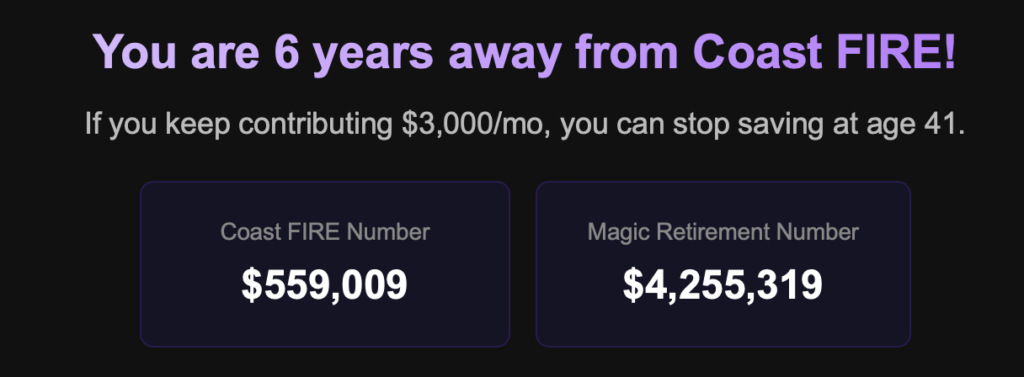
    So, what can you do if you want to work your financial wellness?
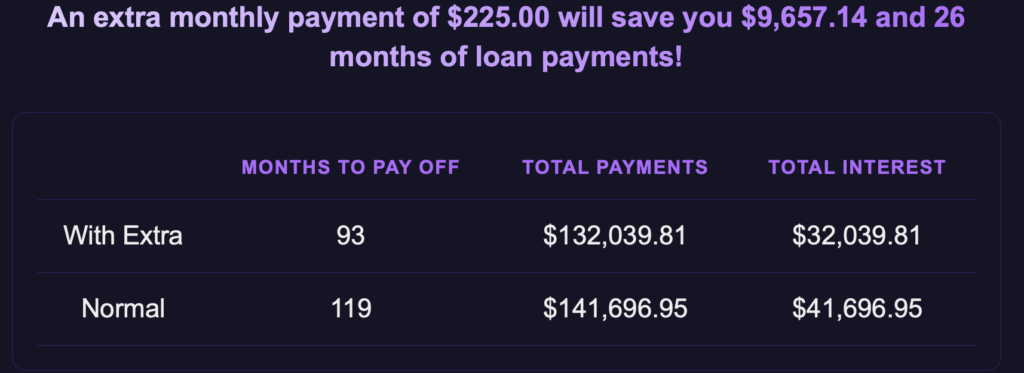
    You’re in the right place.

    I have a three-step plan to get you on your way.

    Step 1: Foster a positive money mindset.

    The first step is to foster a positive money mindset. Without establishing why you want to be good with money, none of the specific skills and recommendations will matter.

    Too many people want to jump right to investing and buying rental properties. Financial wellness doesn’t work like that.

    You need to start at the beginning. That means money mindset.

    In my blog, I write regularly about money mindset. You can learn all about developing a strong money mindset by reading my posts here.

    Additionally, if you are interested in checking out one of my favorite money mindset books, you can find my top recommendations here.

    Step 2: Find out where all your money is going.

    The next step is to evaluate where your money is actually going each month. Once you know where your money is going, you can come up with a realistic plan that moves you closer to reaching your financial goals.

    I call this process your Budget After Thinking.

    For a step-by-step guide on how to create a Budget After Thinking, read my post here and follow-up posts here and here.

    You might be wondering what makes my budget process different from any other budget.

    My budgeting philosophy is premised upon your actual spending habits and realistic adjustments. 

    In other words, forget about aiming for predetermined, generic goals like saving 20% of your income.

    I’ve taught enough law students and lawyers to know that these rigid, predetermined targets don’t work.

    With massive student loan debt and soaring costs of living, generic savings targets just don’t work.

    If you aim for some predetermined amount, you’ll end up cutting out everything you like spending money on to the point where you will resent your budget. Then, you’ll give up on your budget and fall back to your old habits.

    The beauty of creating a Budget After Thinking is that it is based upon a baseline budget of your actual, current spending habits.

    In evaluating your current habits, you can then make thoughtful and realistic adjustments to that budget that will actually last. Through this process, you can accomplish the main goal of generating more fuel for your ultimate financial goals.

    And that leads us to the third and final step to begin establishing strong personal finance skills.

    Step 3: Use financial calculators for concrete motivation.

    Online Calculators are some of the most powerful motivational tools for developing financial wellness.

    Check out our Think and Talk Money calculators for concrete motivation to allocate more of your monthly income to your financial goals.

    When you play around with these calculators, you will quickly see how even seemingly small adjustments to your Budget After Thinking will pay massive dividends in the long run.

    Remember, the goal of your Budget After Thinking is to generate more fuel for your future goals. What exactly does that mean?

    This is where using a good financial calculator pays off. 

    For example, let’s say you cut $200 of spending per month and invested that money in an S&P 500 index fund with average historical returns of 10%.

    Look at the results using the Think and Talk Money Compound Interest Calculator:

    If you invested just that $200 each month for the next 30 years, you would have $394,785!

    And, that’s based on contributing only $72,000 of your own money. The rest is interest you earned for doing nothing.

    Take a second to let that sink in: You’d have nearly $400,000 in your investment account all because you created a Budget After Thinking.

    If that doesn’t motivate you to make some thoughtful adjustments to your spending, I don’t know what will.

    Now is the perfect time to invest in your financial wellness.

    Now is the time to think back on the past year and remember all your wins. But, don’t forget about your mistakes. Those mistakes are how we learn.

    If you’re not confident with your personal finances, there’s no better time than now to start developing your skills.

    Whether we like it or not, money touches every facet of our lives. 

    When you take control of your money, you’ll see that your productivity at work improves.

    Your relationships outside of work will improve. 

    I’d even go so far as to say that you’ll start to believe in yourself more. You may even find the courage to follow a different path in life you hadn’t previously explored.

    It all starts with wanting to be good with money.

    Are you ready?

  • Use a Calculator to Help Make Big Money Decisions

    Use a Calculator to Help Make Big Money Decisions

    Let’s say you receive a year-end bonus of $10,000.

    You essentially have four choices for what do with that money:

    • Choice 1: Do nothing.
    • Choice 2: Spend it now.
    • Choice 3: Invest it for retirement.
    • Choice 4: Pay down student loan debt.

    Let’s explore each option using two Think and Talk Money calculators to help with our decision: (1) Compound Interest Calculator and (2) Student Loan Calculator.

    You may be surprised by the results.

    @thinkandtalkmoney

    Check out the online calculators at thinkandtalkmoney.com #moneytok #personalfinance

    ♬ original sound – Thinkandtalkmoney

    Choice 1: Do nothing.

    You may not have a plan for what to do with $10,000. When you don’t have a plan, the default is to let the money sit in your checking account until you need it.

    This is a bad idea.

    Those dollars will disappear faster than you think. I don’t need a calculator to tell me that.

    The worst part is you won’t have anything to show for it. You’ll just wake up one day in the near future and wonder what happened to your bonus.

    Whatever you want to do with your money, put some thought into it ahead of time. Come up with a plan.

    In the end, being good with money is nothing more than consistently making thoughtful, intentional choices.

    Choice 2: Spend it now.

    I don’t hate the idea of spending some of your hard-earned money. If you’ve thought about it and are making intentional decisions, go for it. 

    Maybe you’ve had your eyes on a new sofa, a bigger TV, or a trip to Scottsdale.

    When you spend on things or experiences that bring you joy, that’s a good use of your money.

    We talk about it all the time: being good with money is not about a life of deprivation.

    If this is the direction you’re leaning, what if you chose to spend some of the money and then save/invest/pay down debt with the rest?

    That way, you get some immediate satisfaction and also stay on track to reach your long-term financial goals.

    In this instance, I would recommend spending no more than half of the money and then using the rest for your financial goals.

    What should you do if you’re pursuing multiple long-term financial goals?

    When you have multiple long-term financial goals, such as investing for retirement and paying off debt, the question becomes: which goal is a better use of your money?

    This is a common conundrum for many of us.

    The answer will oftentimes combine math and emotions. That’s what makes personal finance so fascinating. That’s what makes life so fascinating.

    Based on my own experiences and in teaching personal finance to law students, I’ve found that financial calculators can be a very useful tool in making these decisions.

    I’ve also found that financial calculators can motivate people to take action in ways that words alone usually fail.

    I could tell you all about the magic of compound interest. That might be enough for you to take action.

    Even more powerful is when you see the potential results of your money decisions for yourself. That’s where a good financial calculator comes in.

    With that in mind, let’s use a couple of Think and Talk Money calculators to explore what would happen if you invested the $10,000 or used the money to pay down debt.

    Seeing these results may motivate you to put your money to work for you, rather than spending it.

    Choice 3: Invest it for retirement.

    For this example, let’s say you are 27 years-old, which means you have 40 years until you reach the standard retirement age of 67.

    We’ll also assume that you earn an average annual return of 10%, consistent with the historical average returns of the S&P 500.

    We’ll also plan for an interest rate variance range of 2%, which means you will see your potential returns at 8%, 10% and 12%.

    Here’s what it looks like when you plug those assumptions into the Think and Talk Money Compound Interest Calculator:

    Now, here’s what your results look like:

    After 40 years, you would have $452,592 at a 10% interest rate. Remember, that’s your total balance without ever making another contribution.

    You can also see that you would have $217,245 if you earned an 8% annual return. Your balance jumps up to $930,509 if you earned a 12% return.

    Now, you can evaluate the results and make an informed decision.

    Knowing that $10,000 today projects to nearly a half million dollars at retirement age may make this an easy decision for you.

    One important note: when studying your results, pay attention to the shape of the compound interest graph. 

    Compound interest takes time to work its magic. That’s why your $10,000 investment doesn’t skyrocket right away. In fact, it can take a couple of decades or longer for compound interest to show its true power. This is why it’s important to invest early and often.

    Choice 4: Pay down student loan debt.

    Let’s continue our previous assumption that you are 27 years-old. Now, we’ll add it some additional assumptions regarding student loans.

    Let’s assume you have $120,000 in loans and your monthly payment is $1,500. Let’s also assume that your interest rate is 7.5%.

    With the Think and Talk Money Student Loan Calculator, you can see how much money and time you will save by making extra payments.

    Here’s what it looks like when you plug in a one-time extra payment of $10,000:

    Now, let’s look at how much money and time you saved by making this one-time payment:

    This one-time payment of $10,000 saved you $19,269.97.

    It also knocked off 13 months of loan payments from your payoff schedule. 

    Focus on just those 13 months for a moment. By making this one choice to use your $10,000 bonus to pay down debt, you bought yourself more than a year of freedom from paying off loans.

    That is an incredibly freeing feeling.

    Not only will your debt be eliminated more than a year faster, you’ll also be able to prioritize your other financial goals a year faster.

    Think about how exciting it will be to repurpose the $1,500 you had been paying toward debt each month.

    Once again, that’s an incredible feeling. 

    Play around with your own numbers in the Think and Talk Money calculators.

    If you’re anything like me and the law students I’ve taught over the years, financial calculators can be powerful motivational tools.

    As we saw with our examples today, you will receive outsized benefits in the future if you can just stay disciplined with your spending today.

    Using the Think and Talk Money calculators, you may decide to prioritize investing for retirement. Or, you may be driven to eliminate your loans faster.

    Take some time to play around with the calculators using your own financial situation. You will be amazed at the progress you can make towards your goals with even slight adjustments.

    You may even be motivated to take action with your bonus to accomplish your long-term financial goals.

    Have you used financial calculators before?

    Were you surprised by the results?

    Let us know in the comments below.

  • Why it’s Important to Invest in Your Financial Wellness

    Why it’s Important to Invest in Your Financial Wellness

    “Should I invest in real estate?”

    “Maybe I should I buy Apple stock?”

    “I could boost my emergency savings.

    Or, put a little more into my Roth IRA.

    What about a 529 plan?”

    When it comes to investment decisions, we all want to make the right decisions. We work hard for our money and know that investing for the future is important.

    We just don’t always know what the right decision is.

    @thinkandtalkmoney

    With all this investing advice out there, don’t forget to invest in yourself. #thinkandtalkmoney #financialwellnessforlawyers

    ♬ original sound – Thinkandtalkmoney

    With so much marketing from big banks and investment companies, not to mention the financial media, the options can seem overwhelming.

    Well, what if you decided to drown out the noise and take matters into your own hands?

    What if the best thing to invest in was not a stock or a rental property?

    What if the best thing to invest in was staring right back at you every time you look in the mirror?

    Instead of spending your whole life investing in other companies and other people, what if you decided to invest in yourself?

    For my money, there’s no better investment you’ll ever make.

    Subscribe Here to Join our Newsletter!
    Name

    We all invest in ourselves when we go to school.

    Investing in yourself is something you’ve long done, even if you didn’t always realize it.

    As a lawyer, doctor, consultant, etc., you’ve already made a major investment in yourself through your education.

    Following high school, lawyers commit to another 7 years of education before they can start practicing. Doctors can take twice that long.

    For consultants and other professionals, it’s not uncommon to return to school for an M.B.A., oftentimes while still working a full-time job.

    All this education and training comes at a steep price. Most of us take on huge amounts of debt in exchange for our careers.

    The point is that none of us are strangers to investing in ourselves. And, for the most part, we’ve all benefitted because we made major investments in ourselves.

    The problem is that a certain point, we stopped investing in ourselves.

    So, this leads us to the question of the day:

    When was the last time you invested in yourself?

    What are ways you can invest in yourself?

    There is no shortage of ways to invest in yourself. Just as a few examples, you could:

    What do all of these self-investment options have in common?

    They require very little capital.

    In other words, you can invest in yourself for a relatively small amount of money.

    And, the potential upside is practically unlimited.

    a group of people in graduation gowns reminding us to invest in ourselves.
    Photo by Rosalind Chang on Unsplash

    The cost to invest in yourself is very low.

    When you invest in yourself, the cost of entry is very low.

    Books are inexpensive. Blogs and podcasts typically offer free and timely content.

    Even if you only learn one new idea or strategy from a book or blog post, the cost to learn that idea or strategy is basically zero.

    This makes investing in yourself a near risk-free investment.

    Let’s talk about the value in attending professional seminars for a minute.

    Every professional field, in every corner of the world, offers seminars.

    Law firms and businesses recognize the importance of seminars and will oftentimes pay the registration fee for its employees.

    What happens when you attend seminars? Not only do you learn skills to help you excel in your career, you also meet people.

    Meeting the right person can make your career. You just need to invest in yourself by registering for the seminar.

    Online courses are an inexpensive and effective way to invest in yourself.

    The same low cost and effective way to invest in yourself that applies to seminars also holds true for online courses.

    There’s one crucial advantage to taking an online course:

    If in-person seminars aren’t your thing, you can take an online course from the comfort of your home or office, at your own pace.

    Many courses offer valuable insight based on the instructor’s personal experiences and acquired knowledge. This learning format can feel more intimate and relatable.

    Additionally, online courses may provide the opportunity to meet the instructor and other participants. That gives you the chance to ask questions pertaining to your personal situation. You also get the advantage of building your network, like if you attended a seminar.

    One last note about online courses: before you balk at the price, think back to what you paid for law school.

    Law school costs hundreds of thousands of dollars. Many lawyers spend years in debt to pay off that education.

    Now, compare what you paid to attend law school to the cost of completing an online course.

    A quality online course will cost a fraction of what it cost to obtain your degree.

    If you were willing to take out loans and pay hundreds of thousands of dollars to become a lawyer, why not invest a bit more in yourself to continue developing your skills?

    Investing in yourself does not only relate to your career.

    Investing in yourself is not limited to just acquiring skills or connections beneficial to your career.

    As one example, I recently committed to running the New York City Marathon in 2026. I’ve never run a marathon before. I’ve never even run a half marathon before. I’m essentially clueless in how to properly train.

    So what did I do?

    I searched for marathon tips on the internet.

    My search led me to Marathon Handbook. It’s a terrific resource.

    There are free articles and training plans for beginners and experienced runners. There is also a paid online course, which I plan to take in the coming weeks.

    The thing is, if I’m going to take on the challenge and time commitment of training for a marathon, I want to do it the right way.

    I want to learn from other people’s experiences. I don’t want to make preventable mistakes. I’m happy to pay for that knowledge and insight.

    This logic applies whether you are training for a marathon or hoping to develop any other skill. Investing a little bit of money upfront can lead to massive benefits down the road.

    Personal finance is one of the most important areas of self-improvement.

    Investing in your physical wellness is important. Hardly anything could be more important.

    You know what else is important to invest in?

    Your financial wellness.

    I’ll even go so far as to say that investing in your own financial wellness is the best investment you’ll ever make. 

    Don’t believe me?

    Just look up “lottery winners who go broke.

    And that leads us to an important point on timing:

    It’s not just what you learn when it comes to personal finance. It’s when you learn it.

    The best time to learn personal finance is BEFORE you start making real money.

    If you win the lottery, you want personal finance knowledge and skills in place before you receive the money.

    The same is true as we begin our careers or start to advance in our careers and start making more money.

    If you didn’t learn personal finance skills at the beginning of your career, that’s OK. The next best time to learn is right now.

    The worst thing to do is to wait until you have a high income before you learn about money.

    If you wait, you’re going to end up like the lottery winners who go broke.

    mirror in a quiet room symbolizing that we need to invest in ourselves at think and talk money.
    Photo by Lowell So on Unsplash

    The potential rate of return for learning personal finance is greater than any other investment.

    Whether you subscribe to a money blog, listen to podcasts, read books, or pay for an online course, the return on that investment is potentially infinite.

    This especially holds true for anyone willing to pay hundreds of thousands of dollars for an education.

    Paying another $1,500 to $2,000 for a quality financial wellness course ensures that the investment in your career will not be wasted.

    To me, that makes it a no-brainer to invest in your financial wellness.

    What’s the point in working so hard to make money if you’re not going to be knowledgeable or disciplined enough to keep it?

    When you have money and understand personal finance, you control the circumstances.

    When you empower yourself to make intentional choices with your money, something incredible happens.

    You gain a new confidence as your walk through life.

    You stop worrying endlessly about money.

    Trust me, it’s a relief to know that all the money you’re earning at work is not being wasted.

    The best part of investing in your financial wellness is that you’ll be on your way to financial independence.

    That means the freedom to pursue work that is meaningful to you and the freedom to spend more time with people who are meaningful to you. 

    Could there be a better investment than that?

  • Step-by-Step Guide to Buy Your First Rental Property

    Step-by-Step Guide to Buy Your First Rental Property

    Whenever I teach personal finance to law students, I begin by asking the class what they hope to learn.

    Without fail, I get a response that goes something like:

    “I want to invest in real estate, but I have no idea where to even begin.”

    If you’ve ever felt the same way, you’re in the right place.

    @thinkandtalkmoney

    I own 11 rental properties and counting. thinkandtalkmoney.com

    ♬ original sound – Thinkandtalkmoney

    Today, I’ll walk you through my step-by-step guide to buy your first rental property.

    If you can follow these steps (in order), you will be in great shape to acquire your first rental property.

    And, if I can be of any assistance as you begin your search for a rental property, please feel free to connect via socials or by replying to one of my weekly emails.

    You can sign up for my email list here. I personally respond to every email.

    Step-by-Step Guide to Buy Your First Rental Property

    1. Use common sense and your own life experience to develop your target criteria.
    2. Pick an initial location that matches your criteria.
    3. Learn the common, important attributes of properties in your area.
    4. Study the average rent for units in that area.
    5. Ballpark how much you’ll need to spend for an attractive property.
    6. Work with a real estate broker to test your findings.
    7. Contact a mortgage broker and determine your budget.
    8. Return to your search and do basic deal analysis.
    9. Start touring the properties that look good on paper.
    10. Determine if the numbers will work in your area.

    1. Use common sense and your own life experience to develop target criteria.

    Don’t believe anyone who tells you he has a one-size-fits-all solution for evaluating properties. Every market is different. What works in Chicago won’t necessarily work in Los Angeles. 

    That said, there is certainly some advice that applies across the board.

    For starters, regardless of what market you’re in, you can and should use common sense and your own life experiences to evaluate rental properties.

    Don’t overcomplicate this part.

    Before you do anything else, think about what you would personally want in a rental property.

    Forget about complex formulas and deal metrics. We’ll get to the numbers soon enough.

    Start with a basic question:

    Before anything else, write down a list of the most important features that you would want in an apartment. Then, use that list as a guide to finding the right kind of properties.

    By the way, using your own common sense is one of the best parts about investing in real estate. You don’t need an advanced degree or a background in real estate.

    We all have some idea of what makes a neighborhood a good place to live. The same goes for what makes an apartment a good apartment. 

    We may not always agree on what those things are, and that’s OK. It may be for a simple reason, like we are not targeting the same potential tenant pool.

    The bottom line is you should absolutely use your common sense and life experiences to help formulate your investing strategy. 

    Ask yourself what you would want in an apartment. Don’t waste your time running the numbers on any property that doesn’t match your criteria.

    2. Pick an initial location that matches your criteria.

    There are potential investment properties in every part of the country. Before you start looking at individual properties, you first need to select an area you want to invest in.

    Based on your own life experiences, you are probably already drawn towards certain parts of the country. You may even have a good sense for different neighborhoods within certain cities that match your general criteria.

    From there, you should do some preliminary research online to confirm what you think you know about specific areas.

    For example, I know through my own life experiences that many recent graduates from the Midwest move to Chicago after college. The question then becomes: where do these young professionals tend to live in Chicago?

    To find out, I might Google something like “best coffee shops (or restaurants/bars/nightlife) in Chicago.”

    Likewise, if you’re targeting families, you might search for “best schools” or “best parks.”

    Performing this kind of basic research is how my wife and I stumbled upon the Logan Square neighborhood in Chicago.

    The truth is that when we first started looking for rental properties in 2017, we knew very little about Logan Square, even though we both always lived in Chicago or the Chicagoland area.

    So, we did some basic internet research on where young professionals want to live in Chicago. It didn’t take long to land on Logan Square because we kept finding articles like this from TimeOut: “It’s official: Logan Square is one of the coolest neighborhoods in the world.

    Combined with our personal experiences, these types of articles gave us confidence to take a closer look at Logan Square.

    Now, we have 10 apartments in Logan Square.

    gray lighthouse on islet with concrete pathway at daytime representing my step-by-step guide to finding your first rental property.
    Photo by William Bout on Unsplash

    3. Learn the common, important attributes of properties in your area.

    Once you’ve picked an area to focus on, use an app like Redfin or Zillow to create a broad search for that area. You should filter your search based on the criteria you established above.

    Take some time to casually study the listings in that area. At this point in the process, don’t worry about running the numbers. You’re still in learning mode.

    If you study enough listings in a particular location, you’ll start to notice certain features that separate the premium properties from the mediocre properties.

    For example, you may notice that the more attractive properties all have in-unit washer/dryer. Or, you may learn that the attractive properties all seem to have wood floors and stainless steel appliances.

    Your goal is to understand the common and important property attributes in that area because those are the features potential tenants will expect to find.

    Think of it like this: you don’t want to buy the only property on the block that doesn’t have in-unit washer/dryer. Even if you buy that property at a good price, you’ll struggle to find good tenants if the expectation is to have in-unit washer/dryer.

    It’s not an exhaustive list, but here are some of the key attributes we’ve learned are important to young professionals renting in Chicago:

    1. Location, location, location. Proximity to the L and social life (coffee shops, restaurants, bars, etc.) are crucial. Most of the young professionals we rent to are still in the “going out” phase of life. They want to live in fun neighborhoods so they can enjoy themselves when they’re not working. They typically stay in our apartments for 2-3 years, oftentimes before buying a place of their own and “settling down.”
    2. Taxes. Property taxes can eat away your cash flow. We have high property taxes in Chicago across the board, but taxes vary widely from neighborhood to neighborhood. I look for properties in areas that have more attractive taxes.
    3. Big bedrooms. One of the most common questions I get when I do apartment showings is, “Can I fit a king size bed in here?” People love big beds these days. This can be a challenge considering Chicago’s standard 25-foot wide lot. I look for properties with a minimum bedroom size of 10 x 10.
    4. Outdoor space. Young professionals want to have outdoor space, even if they never use it. When I was a renter, I always wanted an apartment with a balcony for my grill. It didn’t matter to me that I only used it a handful of times each year. Maybe having outdoor space made me feel more grown up?
    5. Parking. Even though Chicago is a very public transit-friendly city, people still like having cars. Because most young professionals aren’t using their cars every day, they want to keep it safe in a dedicated parking space.

    When we shop for a rental property, we look for as many of these features as possible. We don’t expect to check every box because it’s nearly impossible to find a property that has all of these features (at least at a price that makes sense).

    4. Study the average rent for units in that area.

    Before you commit to a particular area, you need to know what kind of rent payments you might expect.

    You can usually find rental information directly on the listing. You may see the actual rent for that property or the projected rent. For this part of the process, this estimate is good enough to get a basic sense of what you may be able to charge.

    Word of caution: it’s not unheard of for these rental estimates to be exaggerated in the listings.

    As you get to know your market better, you’ll know whether the projected rent is accurate. Plus, you’ll have a real estate broker on your team who can validate the numbers. More on that below.

    Finally, studying the average rent goes hand in hand with the previous step of learning the important attributes of rental properties in your area.

    For example, you may discover that a renovated 3 bed, 1 bath apartment with in-unit washer/dryer and a parking space rents for around $2,500. Similar units without parking may go for $2,300. Units that have not been updated may rent for $1,800.

    Your mission is to differentiate between the property attributes that seem to increase the potential rent in your area from the attributes that don’t add much value.

    For instance, we’ve learned that dedicated parking spots are important in Logan Square. However, renters don’t seem to care very much if the parking spot is in a garage or a parking pad.

    For that reason, we don’t care too much whether a rental property has a garage, as long as there is dedicated parking available.

    5. Ballpark how much you’ll need to spend for an attractive property.

    By this point in the process, you’ll have a good idea of what constitutes an attractive property in your target area. You’ll also have a good idea of what these properties rent for.

    Next, you can ballpark how much you’ll need to spend to purchase one of these attractive properties.

    When I refer to attractive properties, I mean one that has most (but probably not all) of the features that you are looking for and still commands a decent rent. By “decent rent,” I mean not the absolute highest and also not the lowest for the area.

    Additionally, the property should be priced reasonably for the market. That means it likely won’t be the most expensive property or the cheapest property.

    The goal here is to have a general idea of how much good properties cost in your target area. With this information, you can then decide if it’s an area you want to target, or if you want to explore other locations.

    One point that’s worth repeating: don’t expect to find a property that has every one of your key features. If you’re waiting on such a property to hit the market, you’re likely to be disappointed for one of two reasons.

    First, you’ll likely end up overpaying for that property. If you overpay, you’ll struggle to earn cash flow. As investors, cash flow is crucial.

    Or, you won’t ever buy a property because your expectations are too high. Investing in real estate is all about trade-offs. The fun part of the gig is deciding what trade-offs make sense.

    Remember, you’re not searching for your picture-perfect, dream home. You’re searching for an asset that puts money in your pocket.

    6. Work with a real estate broker to test your findings.

    Now that you’ve educated yourself on your target market, it’s time to seek out the assistance of an experienced real estate broker.

    A good broker will talk with you about what you’ve learned and offer additional guidance on your target market.

    Also, a good broker will:

    • Send you properties that match your goals.
    • Tour properties with you to help identify any red flags.
    • Negotiate on your behalf to ensure you get the best possible price.
    • Connect you with other key members of your team.
    • Steer you away from making poor choices.

    Don’t make the mistake of jumping right to this step without completing steps 1-5.

    It’s important to have done your homework on your target market before talking to brokers. That’s because you need to know enough to have informed conversations with potential brokers.

    You don’t have to know all the answers. But, you have to know enough to ask the right questions.

    And, you have to know enough to recognize if your broker is giving you misguided advice.

    hand holding compass representing my step-by-step guide to finding your first rental property.
    Photo by Aron Visuals on Unsplash

    7. Contact a mortgage broker and determine your budget.

    Mortgage lending is big business. Just about every person out there needs a mortgage to buy a home or an investment property. As a result, there are a lot of banks and companies out there who want your business.

    To be sure, not all mortgages are created equal. 

    And, not all brokers, banks, and lending companies are created equal.

    That’s why your job as an investor is to find a mortgage broker who truly has your best interests in mind. 

    That means working with someone who wants what’s best for you and your family, not what’s best for him and his family.

    Plus, because rental property investing is a long-term game, you want someone on your team who’s also in it for the long run.

    A good mortgage broker will:

    • Recommend the best loan for your goals. 
    • Stop you from borrowing more than you really can afford.
    • Help get your loan approved. 
    • Explain the numbers. 
    • Not let you refinance until the time is right. 

    In sum, a good mortgage broker understands exactly what you’re trying to accomplish with each purchase. You can be straight with him and he can be straight with you. 

    8. Return to your search and do basic deal analysis.

    Now that you have a real estate broker and a mortgage broker on your team, you can start to analyze deals that match your criteria in your target area.

    Don’t let this part of the process intimidate you.

    In fact, running the numbers on potential deals should be easy:

    Rest assured, you’ve already done the hard part of educating yourself on the key assumptions you’ll need to make to properly analyze deals.

    Now, you just need to plug those numbers into a simple spreadsheet or online calculator.

    For a step-by-step example on how to run the numbers, check out my post here.

    9. Start touring the properties that look good on paper.

    After running the preliminary numbers on properties that match your criteria, you should have a smaller list of properties that seem like real contenders.

    These are the properties that you should tour.

    Again, you want to make sure you don’t jump ahead to this step without having completed the other steps.

    That’s because it’s impractical (if not impossible) to tour every property that appeared in your initial search. By running the numbers first, you can weed out the properties that would be a waste of time to see in person.

    After touring a property, you should then update your preliminary analysis based on what you learned.

    For example, maybe you learned that the bedrooms are smaller than advertised. Maybe the finishes aren’t as nice as in the pictures.

    The point is that after seeing a property in person, you may determine that you previously overestimated what the unit will rent for.

    You also will have a better idea of what you think the property is worth.

    A final word here: some investors are content buying properties without touring them in person.

    Personally, I would never buy a property without walking through it first. I want to see for myself what condition the property is in and make my own assessment of what it could rent for.

    10. Determine if the numbers will work in your target area.

    The final step is to put together everything that you learned in steps 1-9 to determine if it’s a good idea to invest in your target area.

    If you like what you’ve learned, you can stay disciplined and wait until you find an attractive property to offer on.

    On the other hand, you may find that your initial target area is not ripe for investment.

    That’s OK. It’s certainly better to find that out before you commit hundreds of thousands of dollars to a poor investment.

    Before my wife and I settled on Logan Square, we went through this process and ruled out a number of other promising neighborhoods.

    By putting in the effort to complete steps 1-9, we learned that the math simply did not work in certain parts of the city.

    In some neighborhoods, the properties were just too expensive to earn positive cash flow. Then, in other areas, the rent was not high enough to justify the purchase price or high taxes.

    In the end, we determined that Logan Square had the right combination of attractive properties and decent rents.

    Step-by-Step Guide to Buy Your First Rental Property

    1. Use common sense and your own life experience to develop your target criteria.
    2. Pick an initial location that matches your criteria.
    3. Learn the common, important attributes of properties in your area.
    4. Study the average rent for units in that area.
    5. Ballpark how much you’ll need to spend for an attractive property.
    6. Work with a real estate broker to test your findings.
    7. Contact a mortgage broker and determine your budget.
    8. Return to your search and do basic deal analysis.
    9. Start touring the properties that look good on paper.
    10. Determine if the numbers will work in your area.

    Like any new skill in life, implementing this step-by-step guide takes some time and effort in the beginning.

    The upshot is that if you can follow these steps, you’ll get that first rental property and have the skills to acquire additional properties when you’re ready.

    If I can be of any assistance as you begin your search for a rental property, please feel free to connect via socials or by replying to one of my weekly emails.

    You can sign up for my email list here. I personally respond to every email.

  • Four Easy Holiday Shopping Tips to Stay on Budget

    Four Easy Holiday Shopping Tips to Stay on Budget

    When I teach personal finance to law students, I always ask them to share their biggest money worries with me. I encourage them to think about long-term and short-term financial concerns. 

    I’ve taught for enough years now that I’ve come to expect a handful of common responses.

    For example, long-term, law students are obviously worried about student loans. No surprise there. 

    Student loans can feel heavy and can be a major drag on our finances. That’s why paying off debt is a point of emphasis in my course.

    Regarding short-term money worries, one response comes up more than any other: how to budget for inconsistent expenses that pop up throughout the year.

    This worry is highlighted during the holiday season.

    My students commonly worry about buying gifts during the holiday season.

    I totally get it.

    During the holiday season, we tend to spend more money than we do during other times of year. This can be very stressful. The challenge is coming up with a plan to handle this temporary increase in spending. 

    Think about it: throughout the rest of the year, people don’t tend to worry about buying gifts as part of their regular monthly budget. 

    That’s because we can typically handle the occasional birthday or anniversary gift within our Budget After Thinking

    Usually, staying on budget is as simple as making a quick tradeoff: buy a gift for my mom’s birthday instead of going out to dinner this weekend.

    Sure, you have to “sacrifice” dinner out with your friends, but that’s a one-time decision that allows you to stay on budget and get a gift for mom.

    However, things all change when it comes to spending during the holiday season. 

    The trade-off is not so simple as skipping one dinner out.

    During the holiday season, we’re not just shopping for mom. We have significant others, kids, nieces/nephews, parents, and siblings. 

    And, don’t forget about gifts for your kids’ teachers, the babysitter, your assistant at the office, and anyone else who helps make your life easier throughout the year.

    You get the idea.

    Expenditures balloon during the holiday season. If you’re not prepared, this can cause a lot of unnecessary stress.

    If this sounds familiar to you, don’t beat yourself up. Inconsistent expenses, like holiday shopping, are challenging for even the most dedicated budgeters. 

    The truth is there’s nothing worse than dedicating yourself to your budget for 11 months out of the year only to blow it during the holiday season.

    Let’s not let that happen.

    Today, I’ll share four tips to help you stay on budget and avoid common spending pitfalls during the holiday season.

    First, let’s talk about budget busters.

    Holiday Shopping Tip No. 1: Plan ahead for budget busters.

    Holiday shopping is an example of inconsistent, but unavoidable, spending that I refer to as budget busters.

    Generally, budget busters are any inconsistent expenditures, good or bad, that can derail your finances if not properly planned for.

    Good budget busters might include trips, weddings, and of course, holiday shopping. 

    Bad budget busters include unexpected car repairs, home repairs, or medical expenses.

    The key with budget busters is that you need to plan ahead.

    Holiday shopping is the easiest budget buster to plan for- we know that these expenses are going to occur every year from the end of November (Black Friday) through New Year’s Eve. 

    With the proper planning, you can handle holiday shopping so it doesn’t become a budget buster for you.

    Here’s how you do it.

    Galleries lafayette with big Christmas tree illustrating the challenges of staying on budget during the holiday season and why you need my four tips to stay on budget for the holiday season.
    Photo by Ruben Laudicina on Unsplash

    Plan for budget busters as line items in your Budget After Thinking.

    I recommend including two separate line items for budget busters in your Budget After Thinking

    Have one line item in your Now Money category (bad budget busters) and one line item in your Life Money category (good budget busters).

    Holiday shopping is part of your Life Money category.

    You likely won’t end up spending your budget buster money every month. That’s a good thing.

    For example, let’s say you allocate $200 per month to your Life Money budget buster category.

    By the end of the year, if you haven’t spent the money elsewhere, you’ll have $2,400 saved up to help you cover holiday shopping expenses. 

    The key is that each month that you don’t spend your budget buster money, transfer it to your savings account so it’s there when you need it, like when it’s time to buy holiday gifts.

    This is an important step. You don’t want to let that hard-earned money sit in your checking account. Those dollars will disappear long before Black Friday.

    By transferring them to savings, those dollars will be at your disposal when needed.

    What kind of savings account am I talking about?

    Be sure to have a separate savings account for budget busters. It’s always a good idea to keep your savings separate from your everyday spending.

    Ideally, you should open up a savings account at a different bank than your checking account. This helps isolate those funds so those dollars don’t disappear and are available come holiday season.

    There are lots of good options for high-yield, online savings accounts. I used to bank with CapitalOne, but then they burned me and thousands of other customers. Never again.

    I now use BMO Alto for my savings account. They offer a good interest rate and a no-frills product. Very simple and straightforward.

    Come holiday season, I can use the budget buster money I had saved throughout the year in my BMO Alto account to cover me if I overspend.

    Holiday Shopping Tip No. 2: Cut back in November and January.

    If you overspend in December, don’t get discouraged and give up. Before all your hard budgeting work goes to waste, take the month of January to course correct. 

    For example, if you overspent by $300 in December, make it a priority to underspend by $300 in January.

    Even better is if you can also intentionally underspend in November anticipating higher spending in December.

    For instance, if you want to have $500 more to spend in December, cut back $250 of spending in November and another $250 in January.

    The key is to make sure you address the overspending issue in November and January and not let too much more time go by without course-correcting. If you wait, you’ll just never get around to addressing it.

    Is this easier said than done? 

    Well, sure. It’s always easier to say you’re going to do something. The hard part is following through. It takes discipline.

    What will drive that discipline? 

    Your ultimate life motivations that we talk so much about (and will always continue to talk about). Without that clear vision of your ideal life in front of you, no budget will ever last.

    If your ultimate life motivations are not important enough for you to cut back on spending for a month or two, you need to revisit those motivations.

    Tip No. 3: Make a game out of it, like the $500 Challenge.

    If you go overboard with holiday shopping in December, don’t get down on yourself. You’re human. It happens.

    In January, it’s time to play a game that I call “The $500 Challenge.” 

    My wife and I started playing The $500 Challenge years ago. The game was simple. Each of us had to limit our Life Money for the month to just $500. Whoever spent the least that month, won the game.

    I’ve never won the game. My wife is… competitive. I cope by lying to myself that she wins because I enjoy paying on date nights. 

    We’ve played this game many times to course-correct after a high spending month.

    January is the perfect time of year for this game since the holidays in December often result in overspending.

    life size white hippo plush toy illustrating the challenges of staying on budget during the holiday season and why you need my four tips to stay on budget for the holiday season.
    Photo by Mai Truong on Unsplash

    The $500 Challenge has many benefits.

    When we succeeded playing The $500 Challenge, we’d be right back on track for our goals.

    Even if we couldn’t quite stay under $500 (never an issue for my wife), this game still reminded us to prioritize the experiences and things in life that truly mattered to us.

    My favorite part of the game was it forced us to get creative with our nights out. One of my favorite date nights was a product of the $500 challenge. 

    We had just moved to our new neighborhood. It was a Friday night. People were out and the city was bumping, per usual in summertime Chicago. We set out for a walk to explore with only one rule: we had $20 to spend or less on dinner for two.

    We weren’t going to waste that money on an Uber, so we just started walking. A couple miles later, having learned all about our new surroundings, we ended up at a casual restaurant we had never been to. 

    We ordered a plate of nachos to share off the happy hour menu. We even had enough money left for one of us to wash it down with a cold beer. The nachos were great and the vibe was perfect. The check, with tip? 19 bucks.

    We walked home, which helped digest our dinner, and went to bed feeling light in the belly and heavy in the wallet.

    The $500 Challenge is the perfect way to get back on track in January after overspending in December.

    Tip No. 4: Buy it on Black Friday, but only if it’s on sale.

    About 10 years ago, my mom bought me a jacket for a birthday present. It was the exact jacket I wanted. How did she know, I asked her.

    “You mentioned it when we were downtown four months ago.” 

    Four months ago!

    I shouldn’t have been surprised. My mom has one of those steel trap memories. 

    If you only met her for five minutes and then saw her again two years later, don’t be surprised when she asks about your consulting gig, your trip to New Orleans, and that blue dress that she really liked.

    I learned from my mom’s gift strategy and now apply it to holiday shopping. I don’t have her memory, but I do have a phone with a notes function. 

    When my kids see something that they want from Santa, I make a note in my phone. I do the same thing when my wife or I see something that we might want.

    On Black Friday, I pull out my list and start online shopping.

    Many of the items I could have purchased earlier are on sale during Black Friday. If it’s not on sale, I can decide if I still want to buy it. Most times, I pass on the full-price items. 

    The benefit of this strategy is that I can sit down with my laptop in a controlled environment knowing that I have a certain amount to spend. Once I hit my spending limit, I stop shopping. 

    By waiting until Black Friday, I can buy more gifts for the same amount of money.

    I can also take my time to think about whether I still want that item. More times than not, I no longer want whatever it was that tempted me in the moment.

    Compare this strategy to randomly buying full-priced gifts throughout the month where it’s difficult to even know how much you’re spending.

    By keeping a list and waiting to shop until Black Friday, you can save money, get more gifts, and stay on budget. 

    Don’t let holiday shopping stress you out.

    With the proper planning, you don’t have to let holiday shopping stress you out.

    Like with most personal finance concepts, the key is to think and make intentional choices. 

    When you put a little effort in ahead of time, you can stay on budget and continue progressing towards your life goals.

    Do you plan ahead for holiday shopping?

    What are your favorite strategies to say on budget?

    Let us know in the comments below.

  • Backdoor Roth IRA: What Lawyers Need to Know

    Backdoor Roth IRA: What Lawyers Need to Know

    If you’re a lawyer reading a personal finance blog, I’m going to assume that you are already maxing out your 401(k).

    That’s a good start.

    But, if you’re interested in financial independence, you need to be doing more.

    @thinkandtalkmoney

    Want to contribute to your Roth IRA, but your income is too high? Consider a backdoor Roth IRA. #thinkandtalkmoney

    ♬ original sound – Thinkandtalkmoney

    For high earners who read personal finance blogs, maxing out a 401(k) plan is just the beginning.

    On top of maxing out a 401(k) plan, I recommend lawyers also max out an HSA.

    Maxing out a 401(k) and HSA is a powerful combination.

    But, you can still do more.

    The reality is there are only so many tax-advantaged investment account types that you can contribute to. It’s important to take advantage of these accounts whenever possible.

    So, once you’ve maxed out both your 401(k) and HSA, the next step is to consider maxing out a Roth IRA.

    When you can fully fund each of these three accounts, you’re well on your way to financial independence.

    Now before you tune out because you don’t make enough money to contribute to all three accounts, hear me out.

    If you follow a traditional career trajectory for a lawyer, you will earn more money in the future.

    When you do, you want to know what to do with that additional cash so it doesn’t go to waste, like contributing to a Roth IRA.

    The thing is, there’s a catch that all lawyers need to know about when it comes to earning a good income and benefiting from Roth IRAs.

    That’s what we’re going to explore today.

    There’s a catch when it comes to high earners funding a Roth IRA.

    When it comes to contributing to a Roth IRA, there’s a catch that high earners need to be aware of.

    Because of the amazing tax advantages, there are income limits associated with who may contribute to a Roth IRA. More on these limits below.

    My assumption is that if you earn enough money to max out a 401(k) and HSA, and still have funds available for a Roth IRA, you likely exceed these income limits.

    Today, we’ll talk about the common strategy that high earners use to get around these income limits. The strategy is known as a “Backdoor Roth IRA conversion.”

    With many lawyers earning raises and bonuses towards year-end, this is the perfect time to consider a Backdoor Roth conversion.

    The last thing you want to happen is for that extra, hard-earned money to go to waste.

    Plus, if you prioritized other financial goals earlier in the year, it’s not too late to circle back to your retirement planning goals, like maxing out a Roth IRA.

    Before we talk about the Backdoor Roth IRA, let’s take a look at why you should consider investing in a Roth IRA in the first place.

    A Roth IRA provides double tax benefits.

    A Roth IRA is a type of retirement account that provides double tax benefits. 

    The first major tax benefit is that you don’t have to pay any taxes when you withdraw from a Roth IRA (after age 59 1/2). This is the most notable advantage of investing in a Roth IRA.

    The second major tax benefit of investing in a Roth IRA is that, just like a 401(k), your earnings grow tax-free. That means more investment growth through the magic of compound interest.

    The combination of tax-free withdrawals and tax-free growth means double tax benefits. This is why so many savvy investors, who can afford to do so, choose to max out their Roth IRA.

    Back door representing that every lawyer seeking financial independence needs to make a Roth IRA contribution, even if it means doing a Backdoor Roth IRA conversion.
    Photo by Adrian Handschu on Unsplash

    The key difference from a 401(k) or traditional IRA is that you make after-tax contributions to a Roth IRA.

    With a Roth IRA, you make after-tax contributions. That means you don’t get any immediate tax breaks, unlike when you contribute to a 401(k).

    Even so, the two major tax benefits we just discussed make it extremely valuable to contribute to a Roth IRA.

    What does it mean to make after-tax contributions to a Roth IRA?

    Typically, a lawyer paid as a W-2 employee will fund a Roth IRA with money that gets deposited into his checking account from his paycheck.

    That means he already paid taxes on that income through withholdings on his paycheck. So, the money that gets deposited into his checking account is considered “after-tax” money.

    Once that money hits his checking account, he gets to decide what to do with it.

    The basic decision is pretty simple: he can spend the money or he can save it.

    If he chooses to save the money, investing in a Roth IRA is one of the best ways to do it.

    Why lawyers should open a Roth IRA besides the double tax benefits.

    For a number of reasons, it’s a good idea for every lawyer to consider funding a Roth IRA in addition to his 401(k).

    For starters, there are contribution limits to funding employer-sponsored retirement accounts, like a 401(k).

    Essentially, you may need more money in retirement than just what your 401(k) plan will provide. Investing in a Roth IRA at the same time is a way to boost your retirement income.

    For another reason, 401(k) plans and Roth IRAs are treated differently from a tax perspective, as we just discussed. 

    Many retirees like having a Roth IRA in addition to their 401(k) so they have access to some tax-free money in retirement.

    Include me in this camp. I agree that it is beneficial to have some tax-free income in retirement from a Roth IRA to go along with your taxable income from a 401(k).

    Finally, Roth IRAs also provide better flexibility for when you have to withdraw your money and how you can pass your funds onto your heirs.

    For example, you can withdraw your Roth IRA contributions tax-free and penalty-free at any time. This flexibility is a huge advantage of a Roth IRA.

    Note: There are penalties if you make withdrawals from your earnings before the age of 59 1/2.

    For another example, unlike traditional IRAs, Roth IRAs don’t have required minimum distributions (RMDs).

    Add all these benefits together and you’ll see why so many lawyers choose to fund a Roth IRA.

    Roth IRA contribution and income limits.

    As with other tax-advantaged retirement accounts, like a 401(k), there are annual contribution limits for Roth IRAs.

    Recently, the IRS raised the 2026 annual contribution limits for Roth IRAs to $7,500, up from $7,000 in 2025. The IRA “catch-up” contribution limit also increased to $1,100 in 2026.

    Pertinent for today’s conversation, there are also income limits for contributing to a Roth IRA.

    As explained by the IRS:

    The income phase-out range for taxpayers making contributions to a Roth IRA is increased to between $153,000 and $168,000 for singles and heads of household, up from between $150,000 and $165,000 for 2025. 

    For married couples filing jointly, the income phase-out range is increased to between $242,000 and $252,000, up from between $236,000 and $246,000 for 2025. The phase-out range for a married individual filing a separate return who makes contributions to a Roth IRA is not subject to an annual cost-of-living adjustment and remains between $0 and $10,000.

    As a lawyer, there’s a good chance you exceed these income limits. If you’re not there already, you soon will if you follow a typical career trajectory.

    That’s where the Backdoor Roth IRA strategy comes into play.

    Back door representing that every lawyer seeking financial independence needs to make a Roth IRA contribution, even if it means doing a Backdoor Roth IRA conversion.
    Photo by Kaitlan Balsam on Unsplash

    What is a Backdoor Roth IRA?

    “Backdoor Roth IRA” describes a strategy used by lawyers and other high-income earners who can’t contribute to a Roth IRA because their income is too high.

    Because high-income earners are not permitted to contribute directly to a Roth IRA, this strategy involves contributing to a traditional IRA and then converting it to a Roth.

    Even though the name implies you’re doing something sneaky, Backdoor Roth IRA conversions are completely permissible.

    In fact, every major financial institution, like VanguardFidelity, and Charles Schwab, has a step-by-step guide on how to perform a Backdoor Roth conversion on its website.

    The Back Door IRA process involves two steps.

    Step 1: Make a nondeductible contribution to a traditional IRA. That means you don’t get an upfront tax break.

    Step 2: Convert that contribution to a Roth IRA.

    That’s all there is to it. You can perform the conversion yourself through your investment platform. I personally use Vanguard.

    Notably, there are no income limits for converting a traditional IRA to a Roth IRA.

    And, since the initial contribution is made with after-tax dollars, when executed properly, you shouldn’t owe additional taxes on the conversion.

    This process is easier than it sounds. Just be sure to precisely follow the step-by-step guides offered by the financial institution that you invest with.

    Finally, as always, be sure to check with your tax advisor or financial advisor before performing a Backdoor Roth conversion.

    Do you take advantage of a Backdoor Roth IRA?

    Maxing out your 401(k) is a good start.

    Maxing out your 401(k) and HSA is even better.

    If you also max out your Roth IRA, whether directly or through a Backdoor Roth conversion, that’s next level.

    As a lawyer earning a high income, there’s really no excuse for not maxing out each of these three accounts.

    If you make good money and are falling short, you should revisit your budget. You also should spend some time thinking about what financial independence might mean for you and your family.

    The end of the year and the holiday season are great times to think and make adjustments to move you closer to financial freedom.

    What do you think of the Backdoor Roth?

    Have you contributed through the backdoor in the past?

    Planning to contribute again this year?

    Let us know in the comments below.

  • Year End Checklist: Make Your Charitable Contributions Now

    Year End Checklist: Make Your Charitable Contributions Now

    The holiday season is upon us.

    As W-2 employees, now is the time to strategize what we can do before January 1 to optimize our taxes.

    Let’s be honest: throughout the year, most W-2 employees don’t think very much about their taxes.

    As a side, that’s one of the major differences between W-2 employees and business owners or real estate investors. If you own a business or own rental properties, you are always thinking about ways to lower your taxable income. More on that below.

    OK, getting back to W-2 employees:

    When was the last time you took a look at your actual pay statement?

    Most of us working W-2 jobs have direct deposit, meaning our paychecks are automatically deposited into our bank accounts. On pay day, all we have to do is wake up, open our banking app, and confirm we got paid. 

    When we do this, all we see is our net pay, or take-home pay. Our net pay is what we earn after all deductions are subtracted from our gross pay. 

    Deductions reduce our taxable income and may include voluntary contributions to our 401(k) and HSA.

    That’s all nice so far.

    Not so nice is that our paychecks are further reduced by mandatory tax withholdings. 

    For high earning lawyers and professionals, taxes can easily reduce our W-2 income by 25%-40%.

    The question as year-end approaches is: can we take any steps now as W-2 employees to reduce our taxable income?

    The short answer is: yes, but the options are limited.

    Let’s dive in.

    Do you expect to take the standard deduction or itemized deductions?

    Before we look at the options to reduce your taxable income, the first question is whether you plan to take the standard deduction or itemized deduction.

    The standard deduction is an amount set by the IRS that reduces your taxable income and likely your tax bill. Here are the standard deductions for tax year 2025 and 2026:

    How does the standard deduction reduce your taxable income?

    Let’s say you are single and made $100,000 in 2025. If you take the standard deduction, you can reduce your income to $84,250. That means you only owe taxes on $84,250 instead of $100,000.

    Assuming you elected typical tax withholdings from your paycheck throughout the year, you should get a tax refund upon filing your tax return.

    Besides the standard deduction, the other option to reduce your taxble income is to itemize your deductions.

    When you choose to itemize, the IRS allows you to claim deductions for expenses like mortgage interest, state and local taxes you paid, and gifts to charity.

    Here’s a draft of Schedule A (Form 1040) which shows the common deductions if you itemize:

    Importantly, if you take the standard deduction, you cannot also itemize your deductions. It’s one or the other.

    So, before you start thinking about ways to lower your taxable income, you first need to decide if you’ll save more money by itemizing.

    Generally speaking, most W-2 employees take the standard deduction. It’s the easiest way to file your taxes and provides the biggest refund for most typical W-2 employees.

    On the other hand, if you have a mortgage, pay a good amount in state and local taxes, and/or make sizable charitable contributions, you may benefit from itemizing.

    Donate to charity before the year ends to increase your itemized deduction.

    Let’s say you and your tax professional decide you would benefit from itemizing. Maybe you reached that conclusion because the amount you pay in mortgage interest plus state and local taxes already surpasses the standard deduction.

    If that’s the case, you may be wondering if there is anything you can do to further reduce your taxable income this year.

    As you can see on Schedule A, the options for reducing your taxable income as a W-2 employee are limited.

    You cannot control what you’ll pay in mortgage interest (that’s already determined). The same goes for your state and local taxes.

    As a high earning attorney or professional covered by health insurance, it’s unlikely you’ll qualify for the medical expenses deduction.

    The bottom line is that the only realistic option to reduce your taxable income as a W-2 employee is to make additional charitable contributions.

    That leads us to today’s year-end tip.

    Consider making additional charitable donations in 2025 if you want to reduce your taxable income.

    This doesn’t mean that you have to donate more money that you previously budgeted for. You can simply accelerate the timing of when you make those contributions so you receive tax benefits this year.

    For example, let’s say you budgeted for and typically donate $100 per month to your favorite charity. If you wanted to reduce your taxable income for 2025, you could instead make a lump sum contribution for $1,200 before the year ends.

    The benefit is that you can claim a larger tax deduction for 2025 and get some of that money back as part of your tax refund. How much you get back depends on a variety of factors, most notably your tax bracket.

    At the same time, your favorite charity benefits from your full donation sooner.

    It’s a win-win for you and the charity.

    an orange gift box with a red bow reflecting the best way for W-2 employees to reduce their taxable income.
    Photo by Ubaid E. Alyafizi on Unsplash

    As employees, we are accustomed to having significant taxes withheld from our paychecks.

    As a W-2 employee, if you were hoping for more ways to reduce your taxable income… don’t look at me.

    The tax code favors business owners and real estate investors.

    We’ve become so accustomed to paying taxes as W-2 employees that none of this should surprise us. Taxes are just part of the bargain when you’re an employee.

    In contrast, owning rental real estate comes with massive tax benefits.

    I earn income through W-2 employment and rental properties. 

    As a W-2 employee and a real estate investor, I know firsthand that not all income is created equal.

    My W-2 income is heavily taxed every month. I have very few ways to reduce my taxable income, like we just saw above.

    On the other hand, I have a number of completely legal ways to reduce my rental property income.

    Real estate investors benefit from massive tax benefits

    The federal government has long encouraged investment in real estate. People need places to live, work, and socialize.

    The government long ago decided to reward investors who take on the risk of providing these opportunities.

    These incentives come largely in the form of tax benefits.

    To accomplish its goal, the government allows real estate investors to deduct certain rental property expenses from their income.

    When you earn rental income, you must report this income on your tax return. Rental income is treated the same as ordinary income.

    However, the major difference between rental income and W-2 income is that there are a number of completely legal ways to deduct certain expenses from your rental income.

    Common rental property expenses may include mortgage interest, property tax, operating expenses, depreciation, and repairs. We’ll touch on a few of these deductions below.

    With all of these available deductions, the end result is that most savvy real estate investors pay little, or nothing, in taxes on their rental income each year.

    Yes, you read that right.

    I’ll say it again, just to be clear:

    Most savvy real estate investors legally pay nothing in taxes on their rental income each year.

    Would you rather have rental income or W-2 income?

    This post is not meant to be a primer on income taxes, but we can use a very basic tax bracket calculator to highlight the distinction between rental income and W-2 income.

    I currently receive both types of income so readily appreciate the difference in how each form of income is taxed.

    Let’s say you live in Illinois and are a high-earning lawyer or professional making a gross annual income of $250,000. Based on 2024’s federal tax rates, you will owe $53,015 in federal income tax. That’s 21% of your income.

    an example of how much you'll pay in taxes if you earn $250,000 as a W-2 employee.
    Source: taxact.com

    Illinois is one of the 42 states that also levies a state income tax. Illinois levies a flat state income tax of 4.95%. For our example, that means an additional $12,375 in taxes each year.

    In total, a W-2 employee earning $250,000 in Illinois pays $65,390, or nearly 26%, in income taxes each year.

    Again, this is not meant to be a tax primer. And yes, most W-2 employees take the standard deduction, meaning they’ll get a small refund when they file their tax returns. 

    Still, there’s no getting around the reality that when you’re a W-2 employee, you have limited options to reduce your taxable income. 

    In the end, you will pay a significant percentage of your income to the government every year.

    Real estate investors have a number of legal tax deductions at their deposal. 

    On the other hand, a real estate investor earning $250,000 in rental income likely pays very little, or even nothing, in income taxes.

    How is that possible?

    We already mentioned that the government allows real estate investors to deduct rental expenses.

    For today’s purposes, I’ll highlight one key deduction that shows just how much the government wants to encourage real estate investment:

    Depreciation.

    What is Depreciation?

    Depreciation is an accounting method that allows real estate investors to deduct some of the cost of owning a property over time.

    This accounting process is not a trick and is completely legal.

    Calculating your property’s depreciation can get complicated and is best left to the tax professionals.

    In general terms, if you own residential rental property and use standard depreciation like me, you can deduct the cost of owning that property over 27.5 years. 

    Each year, you can then reduce your rental income by that annual depreciation.

    Here’s an example to help illustrate how depreciation works.

    Let’s say you buy a rental property for $500,000, and the closing costs are $10,000. The property’s in excellent shape so no capital improvements are needed. 

    That means your total initial cost for this rental property is $510,000.

    When you buy a rental property, you are actually buying the land and the building. Your city, county or town’s assessor typically attaches a value to each the land and the building.

    For depreciation purposes, only the value of the building is depreciable. The land is not.

    In our example, let’s say the land was valued at $110,000. You are not allowed to depreciate the value of the land.

    So, your depreciable basis is the initial cost of the property less the land value:

    For residential rental properties, you can spread out that depreciable basis over 27.5 years to figure out the annual depreciation.

    What this means is that you can deduct $14,545.45 from your rental income each year. 

    Combined with the other available deductions, you can see why real estate investors end up paying very little, or nothing at all, in rental income taxes each year.

    Note: If you sell your rental property, you are responsible for paying depreciation recapture tax, which is a topic for another day. To keep it simple, depreciation recapture is a non-factor for this conversation for many reasons. The most important reason for that is because you have to pay this tax even if you never claimed depreciation on your tax return.

    Don’t forget to make your charitable gifts if you itemize your taxes.

    I firmly believe every lawyer should only at least one rental property to accelerate his path to financial independence.

    If you’re not a real estate investor, you may want to consider this conversation on taxes as you plan your financial goals for 2026.

    Maybe a rental property is in your future.

    For now, if you are a W-2 employee, consider making additional charitable donations in 2025 if you want to reduce your taxable income.

    Charitable gifts may just be the only way to reduce the amount you pay in taxes this year.

    Do you take the standard deduction or itemize?

    If you itemize, do you know of other ways for a typical W-2 employee to reduce his taxable income?

    Let us know in the comments below.

  • On Track to Max Out Your Retirement Accounts This Year?

    On Track to Max Out Your Retirement Accounts This Year?

    Hey, want to hear something exciting?

    The IRS just gave us an early gift for 2026: higher maximum contribution limits for retirement accounts, like a 401(k) or Roth IRA!

    If that doesn’t excite you… you’re reading the wrong blog.

    For those of us who read (and write) personal finance blogs, maxing out our retirement accounts is a top priority.

    Remember, our saving rate is the one thing we can truly control when it comes to investing.

    Once we’ve committed ourselves to improving our saving rate, the next big question is what we should do with the money we’re saving.

    That leads us to today’s refresher on the two most popular types of retirement accounts: the 401(k) and the Roth IRA.

    With many lawyers and professionals earning raises and bonuses towards year-end, this is the perfect time to check in on your annual retirement contributions.

    The last thing you want to happen is for that extra, hard-earned money to go to waste.

    Plus, if you prioritized other financial goals earlier in the year, it’s not too late to increase your contributions in 2025 to the maximum level.

    This is exactly what I did recently. Having made good progress on my other 2025 money goals, I adjusted my 401(k) contributions to hit the maximum for 2025.

    A 401(k) is likely the first investment account you will have.

    401(k) plans are employer-sponsored retirement plans.

    Employees can elect to participate in their company’s 401(k) plan and choose from a variety of investment options, usually mutual funds and index funds.

    Most of us get our first exposure to the stock market through a 401(k) plan. The main exception is if you had a parent or relative open an investment account for you before you started working full-time.

    There are four major reasons to invest in a 401(k) plan.

    Let’s take a look at four major reasons to invest in a 401(k) plan.

    1. You can invest with pre-tax dollars. 

    When you invest in a traditional 401(k) plan, you are contributing pre-tax dollars. This is a great way to lower your taxable income in the year you contribute.

    For example, if you earn $100,000 per year and choose to contribute $10,000 to your 401(k), you have reduced your taxable income to $90,000. That’s an immediate tax savings for you.

    At the same time, you can invest that entire $10,000 without having to pay any taxes on that amount in the year you contribute.

    That means more money for investments rather than taxes. When you have more money invested, you can obviously earn more in returns. That’s the magic of compound interest.

    2. Your contributions are automatic. 

    Once enrolled in a 401(k) plan, your employer will automatically deduct money from your paycheck and invest it directly into your investment selections. 

    Because the money never hits your checking account, you won’t be tempted to spend it on things you don’t really care about.

    You also don’t have to worry about consistently making transfers into your account because it will happen automatically.

    It’s like having a forced savings account where you don’t have to do anything at all. It doesn’t get easier than that.

    Adirondack chairs representing retirement and that you still have time to meet your 2025 retirement goals.
    Photo by Aaron Burden on Unsplash

    3. Your earnings grow tax-free. 

    In addition to not being taxed on your contributions like we discussed above, you also won’t be taxed on your earnings.

    That’s a double tax advantage that acts to magnify the power of compound interest.

    Keep in mind that you will be taxed when you make withdrawals later on.

    Let that marinate for a minute. If you start contributing in your 20s and don’t withdraw from your 401(k) until your 60s, that’s 40 years of tax-free, compounded growth.

    This is a major incentive to invest in a 401(k), even more so than the ability to reduce your taxable income in the year you contribute.

    Rest assured, if you’re maxing out your 401(k), you can just roll your eyes the next time you hear someone complaining about taxes.

    You shouldn’t worry because you have investments that will grow for decades without any tax liabilities.

    4. Your employer may offer a match. 

    Many employers today offer a match to incentivize employees to contribute to their 401(k) plans.

    To qualify for the match, you must be participating in your company’s plan and make contributions yourself. The match is usually a percentage of your overall salary, usually between 3-6%. 

    For example, if you contribute 5% of your salary, your company may match you with an additional 5% contribution. 

    If your company offers a match, it’s a no-brainer to take advantage of that match.

    This benefit is so good that the employer match is often described as “free money.”

    I agree with the sentiment, but I don’t like the term “free money.”

    That’s because it implies that you have not earned that money as an employee for your company. If you’re a lawyer or professional, you spend countless hours away from your family to work a hard job. The employer match is compensation for your efforts.

    I prefer to think of the company match as a bonus you’ve rightfully earned. 

    The key is to accept that earned bonus by ensuring you are meeting the minimum requirements to qualify.

    401(k) Contribution Limits for 2026

    The IRS recently increased the maximum contribution that an individual can make in 2026 to a 401(k) plan. The new limits are $24,500, up from $23,500 this year.

    That means people earning $100,000 in 2026 can reduce their taxable income by nearly 25% if they max out the contribution. That’s huge, immediate savings.

    People aged 50 and over may be able to contribute even more, up to $8,000 more next year, up from $7,500 this year.

    Additionally, people between the ages of 60 and 63 will be allowed catch-up retirement plan contributions of up to $11,250 annually.

    A Roth IRA is another key retirement account that offers double tax benefits.

    A Roth IRA is another type of retirement account that also provides double tax benefits. 

    Unlike a 401(k), you make after-tax contributions to your Roth IRA. That means you don’t get any immediate tax breaks.

    However, you don’t have to pay any taxes when you withdraw the money (after age 59 1/2). This is the major perk of a Roth IRA.

    Additionally, just like a 401(k), your Roth IRA grows tax-free.

    As another bonus, you can withdraw your contributions tax-free and penalty-free at any time. Keep in mind there are penalties if you make withdrawals from your earnings before the age of 59 1/2.

    Why think about opening a Roth IRA?

    For many investors, it’s not a bad idea to consider opening a Roth IRA in addition to your 401(k). 

    For starters, there are contribution limits to each account. You may need more money in retirement than just what your 401(k) plan will provide. Investing in a Roth IRA at the same time is a way to boost your retirement income.

    For another reason, as discussed, 401(k) plans and Roth IRAs are treated differently from a tax perspective.

    Many retirees like having a Roth IRA in addition to their 401(k) so they have access to some tax-free money in retirement.

    Include me in that camp. I agree that it is beneficial to have some tax-free income in retirement from a Roth IRA to go along with your taxable income from a 401(k).

    You can open a Roth IRA with any number of investment companies, like VanguardFidelity, and Charles Schwab.

    map and passports representing what is possible in the future if you max out your retirement accounts.
    Photo by Charlotte Noelle on Unsplash

    Roth IRA Contribution and Income Limits for 2026

    Just like with the 401(k), the IRS also raised the 2026 annual contribution limits for Roth IRAs. The limits in 2026 increased to $7,500, up from $7,000 this year.

    The IRA “catch-up” contribution limit also increased to $1,100 in 2026.

    There is a catch when it comes to Roth IRAs. Because of the amazing tax advantages, there are income limits associated with who may contribute to a Roth IRA.

    As explained by the IRS for 2026:

    The income phase-out range for taxpayers making contributions to a Roth IRA is increased to between $153,000 and $168,000 for singles and heads of household, up from between $150,000 and $165,000 for 2025.

    For married couples filing jointly, the income phase-out range is increased to between $242,000 and $252,000, up from between $236,000 and $246,000 for 2025. The phase-out range for a married individual filing a separate return who makes contributions to a Roth IRA is not subject to an annual cost-of-living adjustment and remains between $0 and $10,000.

    Are you on track to hit your retirement planning goal for 2025?

    There are only so many ways to invest in tax-advantaged accounts. The most savvy investors make sure that they are receiving as many tax benefits as possible.

    The 401(k) and Roth IRA are two of the most popular, and two of the only, ways to invest for retirement with incredible tax advantages. That’s why they are so important to fund during your working years.

    If you want to max out your accounts, there is still time in 2025, especially if you recently earned a raise or a bonus. Put that hard-earned money to good use. Don’t let the dollars disappear.

    Then, as 2026 begins, with the new limits in place, you may want to adjust your contributions so you can continue to hit the max level in your 401(k) and Roth IRA.

    Have you checked in on your retirement contributions lately?

    Are you planning to increase your contributions to hit the max level in 2025?

    What about in 2026?

    Let us know in the comments below.

  • Budget Busters are the Most Expected Expense of All

    Budget Busters are the Most Expected Expense of All

    Are you the type that gets mad at traffic?

    What about the type that gets mad at airport security lines?

    I was in an airport security line recently where multiple lines were merging into one when I heard a guy say to another traveler who he thought cut in front of, “I’m in line, too!”

    Clearly, he’s the type who gets mad in airport security lines.

    This always puzzles me.

    You know there’s going to be traffic. There’s always traffic.

    You know airport security lines are chaotic.

    Why do we let these things bother us?

    My theory is that because we didn’t plan ahead. We didn’t check the directions before leaving the house to avoid traffic. Or, we didn’t get to the airport early enough to not stress about security lines.

    The point is that you can’t stop traffic from happening just like you can’t avoid security lines at the airport.

    But, with the right planning, these inconveniences don’t have to ruin your day.

    What does this have to do with personal finance?

    Well, traffic and security lines are unavoidable.

    That doesn’t mean you have to like them. You just have to accept that they are part of life and things you can handle.

    You know what else is unavoidable?

    Budget busters.

    What are budget busters?

    Budget busters are any inconsistent expenditures, good or bad, that can derail your finances if not properly planned for.

    Good budget busters might include trips, weddings, and holiday/birthday gift shopping.

    Bad budget busters include unexpected car repairs, home repairs, or medical expenses.

    The key with budget busters is that you need to plan ahead. That’s because even though we know budget busters will happen, we just don’t know when they will occur.

    When I teach personal finance to young lawyers, this is one of the major areas of concern when it comes to budgeting. It is not uncommon for people to worry about how they’re going to pay for inconsistent, big ticket items.

    Remember, budget busters don’t have to be for only “bad” things, like repairing a furnace. More on that below.

    Budget busters can also be for fun things, like being a bridesmaid in your best friend’s wedding, which can easily cost you thousands of dollars.

    With the proper planning, you can handle these inconsistent expenses, good or bad.

    If you don’t plan ahead, budget busters will make you mad in the same way people get mad at traffic and airport security lines.

    Budget busters are not unexpected expenses.

    You may sometimes see budget busters referred to as “unexpected expenses.”

    Nope, that’s wrong.

    Budget busters may be inconsistent, but they are not unexpected.

    It’s more accurate to say that budget busters are 100% expected expenses. We just don’t know exactly when they’re going to occur.

    Like with traffic and lines at the airport, budget busters are inevitable. It’s up to each of us to plan ahead to minimize the inconvenience and stay on track with our finances.

    I don’t make many guarantees around here. This is one I’m comfortable making:

    I guarantee that each of us will face potential budget busters throughout the year.

    In fact, I just experienced a potential budget buster on a cold November morning in Chicagoland.

    gray nest thermostat displaying 63 indicating that budget busters are the most expected aspect of your budget
    Photo by Dan LeFebvre on Unsplash

    I had a potential budget buster recently when I replaced a furnace.

    A couple of weeks ago, on a cold November morning in Chicagoland, I woke up with a broken furnace.

    It was certainly inconvenient and potentially a huge drag on my finances. The final cost to replace my furnace was more than $10,000.

    As much as I didn’t enjoy this expenditure, it was not an unexpected expense. My furnace was 20-years-old. We knew it was going to need replacing at some point. It was only a matter of time.

    That’s why it’s just not accurate to label replacing my furnace as an “unexpected expense.”

    No, I didn’t know when my furnace was going to break. But, I knew it was going to happen eventually. Because it was already 20 years-old, I knew it was probably going to happen sooner than later.

    Luckily, my wife and I had made it a priority this year to build up our emergency savings. We did not know what we would need the savings for, but we fully expected that something would pop up.

    I say “luckily” because in prior years, we would have been scrambling to find the cash to replace a furnace. That’s because we had prioritized buying investment properties at the expense of funding our savings account.

    That was a risk that made sense while we were growing our portfolio. Now, we’re more focused on protecting what we’ve built. Hence, prioritizing the emergency savings account.

    Because we have been steadily funding our emergency savings account this year, we just moved the money over to our checking account and paid for the furnace.

    We didn’t have to rely on credit cards or lines of credit to provide heat for our family.

    I even made a game out of it to take a bit of the sting out of this big expense.

    Plan for budget busters as line items in your Budget After Thinking.

    I recommend including two separate line items for budget busters in your Budget After Thinking.

    Have one line item in your Now Money category (bad budget busters) and one line item in your Life Money category (good budget busters).

    You likely won’t end up spending your budget buster money every month. That’s a good thing.

    The key is that each month that you don’t spend your budget buster money, transfer it to your savings account so it’s there when you need it.

    This is an important step. You don’t want to let that hard-earned money sit in your checking account. Those dollars will disappear.

    By transferring them to savings, those dollars will be at your disposal when needed.

    What kind of savings account am I talking about?

    Denver DIA Security Check Point representing that there's no reason to get mad at budget busters because they are completely expected and require planning.
    Photo by Scott Fillmer on Unsplash

    Be sure to have a separate savings account for emergencies, like budget busters.

    It’s a very good idea to keep your savings separate from your everyday spending. That means having a savings account and a checking account.

    Of course, the most important savings account you need is an emergency savings account. This is what I used to pay for my furnace.

    Ideally, you should open up a savings account at a different bank than your checking account. This helps isolate those funds so those dollars don’t disappear.

    There are lots of good options for high-yield, online savings accounts. I used to bank with CapitalOne, but then they burned me and thousands of other customers. Never again.

    I now use BMO Alto for my emergency savings account. They offer a good interest rate and a no frills product. Very simple and straightforward.

    Don’t be mad at budget busters.

    With the proper planning, you don’t have to be mad a budget busters.

    Include budget busters as line items in your Budget After Thinking.

    Open up an emergency savings account at a different bank than your primary checking account.

    When inconsistent expenses pop up, you’re covered.

    Save your frustration for traffic and security lines.

    Have you dealt with budget busters in the past?

    Were you prepared to deal with them? Or, do you wish you had planned better?

    Let us know in the comments below.