
Tag: young lawyers

  • Recent Law Grads: Continue Living Like a Law Student

    Recent Law Grads: Continue Living Like a Law Student

    Law school graduation season is upon us. Whenever I open LinkedIn these days, I’m greeted by pictures of my students in their graduation gowns holding diplomas and posing with family members.

    If you’re a new law school graduate, enjoy your time celebrating with friends and family. When you have a moment to catch your breath, take some time to reflect on how far you’ve come since you started law school. Besides what you learned in class, I bet you’ve learned a lot about yourself since your first day as a 1L.

    So, are you sick of all the advice you’re getting about starting your legal careers?

    Let me guess some of the advice you’ve been getting lately:

    1. Your reputation is everything. The legal world is smaller than it seems, and reputations travel fast.
    2. You’re still learning. Don’t expect to know what you’re doing right away. Practicing law is a different skill set than most of what you do in law school.
    3. Find mentors early. Learn from people ahead of you. Good mentors can help you avoid preventable mistakes.
    4. Be easy to work with. Lawyers who are pleasant to work with tend to build stronger careers over time.
    5. Your first job does not define your entire career. Legal careers are far less linear than they appear in law school.

    All good advice. Interestingly, much of it has very little to do with the law itself, right?

    If you’ll humor me, I have one more piece of advice to add to the list:

    Continue living like a law student.

    This is advice that I wish I listened to when I graduated.

    Instead, I spent years digging out of the hole I created for myself because of my poor money decisions. To this day, I still think about all the mental energy I exerted trying to get my finances in order in my 20s.

    The problem was I did not continue living like a law student. Here’s what happened.

    When I graduated law school, I did not continue living like a law student.

    As soon as I started making money after law school, I started spending on things I really didn’t need.

    About a year after I graduated, I moved into an apartment by myself. I started spending more freely on my social life. I took taxis (no Ubers back then) when I could easily have hopped on the bus or walked.

    At the time, I was a judicial law clerk making around $70,000 per year. That’s the equivalent of roughly $109,000 in 2026 dollars.

    Despite a decent income, it was because I was careless with my money that I fell into credit card debt so quickly after beginning my career as an attorney.

    On top of my poor spending choices, I had student loan debt. Because I had debt and hardly any assets to my name, my net worth was a negative number.

    Every month that went by, my debt grew because of my thoughtless spending choices. That meant my net worth fell deeper into negative territory.

    Looking back, my problem was that I spent money that I didn’t have and justified it based on my career potential. That was a mistake.

    What I should have done was continue living like a law student until I was on more solid ground.

    One way to help you think about living like a law student is to make your spending decisions based on your wealth, not on your income.

    Let’s explore what that means in the context of a new big law lawyer.

    Continue living like a law student by spending money based on your wealth, not your income.

    Let’s say you are starting in big law upon passing the bar. At the current salary scale, that means you’re making $225,000 in salary, plus another $25,000 or so in bonuses. We’ll call it $250,000 in total compensation.

    That’s a lot of money. 

    It’s so much money, in fact, that you might convince yourself you can make some lifestyle changes.

    For starters, you figure it’s time to leave the old law school roommates behind and move into a nicer, but smaller apartment by yourself.

    Even though the tradeoff for living by yourself is paying more in rent, you justify it because your income is so high.

    Besides paying more in rent, you can’t help but order in more meals now that you’re earning a high income. You’re working long hours, after all. Who has time to cook?

    Even though you survived on frozen chicken breasts in law school, that won’t cut it anymore now that you’re a practicing attorney.

    Finally, you start taking Ubers to get around town. It’s only $15 per ride, and you make more than $20,000 per month (before taxes).

    Even though you took the bus or the “L” home in law school, you can afford a ride! Uber it is.

    As a fresh graduate, you may be thinking that you would never spend money like that. I hope you’re right.

    Unfortunately, this is exactly what happens to a lot of new lawyers, including me, because we mistake a high income for a high net worth.

    picture of student graduating illustrating that Recent law graduates: continue living like a law student.
    Photo by Patty Brito on Unsplash

    Don’t mistake a high income for a high net worth.

    Earlier, I said “That’s a lot of money” when introducing the big law starting salary.

    And, it is.

    But, what I should have said was, “That’s a lot of income.”

    See, earning a lot of money is not the same as having a lot of money.

    There’s a key difference.

    Income is temporary. There’s no guarantee that your income will always be there. People lose their jobs all the time. People also switch careers, which can result in lower income. 

    Wealth is your financial foundation. When you earn money and don’t spend it, you can build wealth.

    Of course, when we talk about wealth, we are talking about all of your assets minus your liabilities. This is your net worth.

    When your liabilities are greater than your assets, you have a negative net worth, like I did when I graduated law school. By the way, the same is true for most people when they graduate law school.

    A high income is not a bad thing, but it can be a wasted thing. 

    A high income means you have a lot of money coming in.

    That’s not a bad thing, but it can be a wasted thing.

    What you do with that money is what determines your wealth and financial progress.

    If you use your high income to acquire assets, you are winning the game. The same goes for paying off your liabilities.

    If you use your high income to buy expensive things, you’ll be stuck in place. At the end of the year, you’ll likely be in no better shape than someone making a fraction of what you make.

    That’s why I prefer to think about how much money I keep each year, instead of how much I make.

    It’s why my advice to you is to continue living like a law student for as long as you need to until your overall financial situation improves.

    But, I thought high earners deserve to splurge!

    You may think that as a new lawyer earning $250,000 per year, you deserve to splurge on life’s finer things. Does your thought process change if you acknowledge that your net worth is a negative number?

    Think about it: most new lawyers leave law school with hundreds of thousands of dollars in debt. They also have little to no assets. That means they have a negative net worth. 

    Should someone with a negative net worth really be splurging on a fancy apartment?

    If that person is looking to build a solid financial foundation, the answer is obviously, “No.”

    This person should continue living like a law student and spending in accordance with his net worth, not his income.

    By the way, is it really so bad to continue living the way you have been for just a few more years? Are you truly miserable? I doubt that most of you are.

    You can take significant steps forward on your financial journey by just doing the same things you had been doing throughout law school. Keep your same apartment. Don’t update your entire wardrobe. Cook the frozen chicken breast.

    Instead of inflating your lifestyle, use that high income to acquire assets and eliminate liabilities. A high income means you can pay off your debt faster. It means you can build up your emergency savings and fund your investment accounts sooner.

    As you take those steps, you’ll see your net worth climb, and you’ve earned the right to start spending more.

    We all know that it’s bad to live beyond our means. The problem is we don’t evaluate our means properly.

    You don’t have to be a personal finance expert to know that living beyond your means is a bad idea.

    Most of us intuitively understand that we should live within our means. Actually doing so can prove to be more problematic.

    Part of the explanation may be that we don’t think of our spending in terms of our net worth.

    We may not appreciate that if we are spending extravagantly while our net worth is still low, or even negative, we are living beyond our means. It doesn’t matter what our income level is.

    That’s why I recommend recent law graduates spend based on their level of wealth (net worth) instead of their income.

    Of course, this lesson applies to all of us, not just recent graduates. 

    This is challenging for lawyers and professionals who feel compelled to keep up with the Joneses

    When you’re making $750,000 per year, you may think you need to buy the $100,000 luxury car. Or, you may not hesitate to spend $10,000 to upgrade your family’s plane tickets to first class.

    But, can you really justify that level of spending when your net worth does not match up with your income? 

    What happens if that income goes away?

    Instead, you should prioritize saving and investing until your net worth justifies that higher spending threshold.

    picture of student graduating illustrating that Recent law graduates: continue living like a law student.
    Photo by Cole Keister on Unsplash

    Spending money based on your wealth does not spending from your wealth.

    When I say spend money based on your wealth, I don’t mean that you should spend from your wealth.

    In other words, this is not a post on spending down your wealth in retirement.

    Rather, what I mean is that you should consider your net worth before deciding how much of your income you are comfortable spending. 

    For example, if you earn $250,000 per year from your job and have a negative or low net worth, you should continue living like a law student.

    If you earn $250,000 per year and have a net worth of $1M, you would be justified in splurging from time-to-time.

    If you earn $250,000 per year and have a net worth of $10M, you shouldn’t worry about spending extravagantly with that income. Why?

    The reality is that your investment earnings on $10M will far exceed your $250,000 income from work.

    Even a 5% investment return on $10M would earn $500,000 per year, double what you earn from your job. You actually might start thinking about why you still have that job in the first place.

    These numbers are just for illustration purposes. Still, the idea is that your spending decisions should factor in your net worth at least as much, if not more so, than your income.

    Continue living like a law student when it comes to spending. 

    Whenever you are evaluating your current financial position, especially your spending decisions, I recommend that you focus on your wealth at least as much as your income.

    That’s why my number one tip for recent law graduates is to continue living like a law student.

    Income is temporary. It can go away at any moment.

    If you are fortunate enough to earn a high income straight out of law school, use that high income to acquire assets and pay down liabilities. That means you’ll have to avoid spending extravagantly until your level of wealth can justify it.

    Wealth is foundational. Yes, there will be drops in the markets and your net worth can decrease. That is to be expected. 

    However, if you focus on spending in line with your net worth, you’ll naturally adjust your spending if your net worth temporarily drops. When it rises again, you can justify spending more. The key is to be flexible.

    If you can think in these terms, you will build a strong financial foundation that will give you choices down the road.

    At the end of the day, financial independence is all about choices. 

    The lawyers who create choices for themselves will be the ones who don’t have to worry about money as they move through life.

    They will be the ones with true wealth that supports extravagant spending, if they choose. 

    Lawyers: what is the best tip you received upon graduating law school? What advice do you wish you received back then?

    Let us know in the comments below.

  • Two Simple Questions to Evaluate Your Financial Position

    Two Simple Questions to Evaluate Your Financial Position

    I’ve been a student of personal finance for nearly two decades and have taught personal finance since 2021. Since I started Think and Talk Money in 2024, I’ve offered my opinions on what I consider to be the most important concepts in personal finance.

    After more than 150 blog posts, I’m still surprised at what opinions I share that generate the most pushback. For example, I recently gave you two simple questions to ask yourself to evaluate your current financial position:

    1. What happens if something goes wrong, like you lose your job or you have an unexpected medical expense?
    2. Can you take advantage if an incredible investment opportunity presented itself?

    My recommendation was that if you didn’t like your options when considering these questions, it’s a good sign that you should think about building a financial fortress. Building a fortress means having cash on hand. If you don’t have cash on hand, you’re not in a strong financial position, regardless of how much you earn or how many assets you own.

    People did not like hearing that they needed to keep cash on hand.

    I was surprised at how much pushback I received on this notion of keeping cash on hand. Some readers thought keeping cash on hand was not a productive use of money. Another reader challenged the idea that cash was important for investment opportunities.

    You can read my full post on keeping sufficient cash reserves here. In essence, cash is your first line of defense to protect your family. Cash covers you in times of medical or other emergencies, or if you lose your job.

    Unfortunately, that’s happening to a lot people these days as big tech reallocates resources to developing AI. Meta (Facebook) recently announced it’s cutting 10% of its workforce. Oracle is similarly cutting thousands of jobs to focus on AI. Having cash on hand keeps you afloat when your income dries up.

    To put it succinctly, cash is your safety net so you don’t lose all that you’ve built when times are tough.

    Cash is not just about playing defense. Cash also lets you take advantage of unexpected investment opportunities. These opportunities could be anything from buying stocks to buying into a business or law firm. This is sometimes referred to as “keeping your powder dry.” When you have cash, you can act decisively and with confidence.

    Think of cash on hand as a survival tool.

    Author Nick Maggiulli wrote about a similar concept in his recent blog post, “Survival is the Only Success.” Here’s what Maggiulli had to say after discussing millionaires and billionaires who had shockingly lost their fortunes:

    All of these falls from grace illustrate a deeper truth—survival is the only success. It doesn’t matter what you do in life if you can’t sustain it. You could make $100 million, but if you end up in a prison cell or broke, who cares? That’s not success. In fact, it’s the opposite.

    ***

    But they didn’t stop. Why? Because greed is a hell of a drug. Greed drives people to behave in absolutely irrational ways. It drives some people to risk everything for just a little bit more. It’s the most negatively asymmetric payoff you could imagine—the upside is capped, but the downside is unlimited.

    And yet people still make this trade all the time. There are people out there doing it right now. They may look successful today, but they won’t hold onto their success.

    Like Maggiulli, when I talk about having cash on hand, it’s because I want you to survive. Who knew survival was such a controversial issue?

    As attorneys, we should be even more motivated to survive than most. We’ve invested so much money and time into our educations and our careers. It would be a shame to see all that we’ve worked for disappear because we got greedy.

    Keeping cash on hand is the antidote to greed. Yes, you’ll give up some potential investment returns. But, you will have gained peace of mind that you can survive and keep what you’ve already acquired.

    The deeper you are into your career, the more you’ll start thinking about survival.

    17 years into my career as an attorney, this is where I currently find myself. I’ve worked hard to get to where I’m at today, and I don’t want it to all be for nothing. That’s why I am currently dedicated to saving up three years of cash.

    If you’re a new lawyer, you may not feel the same way. Trust me, you will.

    If surviving sounds controversial to you, please drop a comment below and let me know your preferred alternative.

    On the other hand, if surviving sounds important to you, consider building up your cash reserves.

    You don’t need to sell all of your assets and move to an all cash position. Investing is still as important as ever. However, don’t lose sight of preserving what you’ve created. Plus, as your career progresses and your assets increase in value, you have more to lose.

    If, like me, you are hoping to build up your cash reserves, it all starts with knowing where your next dollar earned is going.

    man making a fire indicating that cash is a survival tool.
    Photo by Ian Keefe on Unsplash

    Most of us don’t know where our next dollar is going. 

    The reason a lot of lawyers struggle to build up a cash reserve is because they don’t have a plan for where their next dollar is going. 

    Their income hits their checking account, they spend it on this or that, and pretty soon that money has disappeared. They haven’t used the money to advance any of their priorities, like building a fortress. 

    The money is just gone.

    To me, this is one of the most important money mistakes that we need to fix right away. If not, as your earnings increase, you’ll continue making the same mistakes, just with more money to lose.

    Having a plan for our money, before we earn it, is essential if we want to build our cash reserves. With a plan, we can eliminate those disappearing dollars with confidence that our money is being used to serve our purposes.

    So, how do you create a plan for your money before you earn it?

    You need to have a budget.

    Don’t think you’re too sophisticated or make too much money for a budget.

    Some people hear the word “budget” and immediately tune out. They think they’re too sophisticated or make too much money to worry about budgeting. Or, they don’t want to create a budget because they’re afraid of what it might reveal about their spending habits. Don’t be like these people.

    If you truly want to take control of your finances, there’s no getting around this first step. I’ve read hundreds of personal finance books, listen to money podcasts and read blogs every week, and continue to learn from the leaders in this field. In all my years studying and teaching personal finance, I’ve yet to find any credible person who believes you can reach your financial goals without first creating a budget.

    All of your most important money decisions stem from your budget. No, you don’t have to budget forever. No, you don’t have to be a servant to the spreadsheet. Once you have a plan in place that’s working, you likely won’t need to continue tracking your spending.

    But, to take control of your finances, you need to know where your money is going. It’s as simple as that.

    How to set up a budget that creates excess cash.

    The first step in generating excess cash is to evaluate where your money is actually going each month. Once you know where your money is going, you can come up with a realistic plan and make thoughtful adjustments that puts your money to good use.

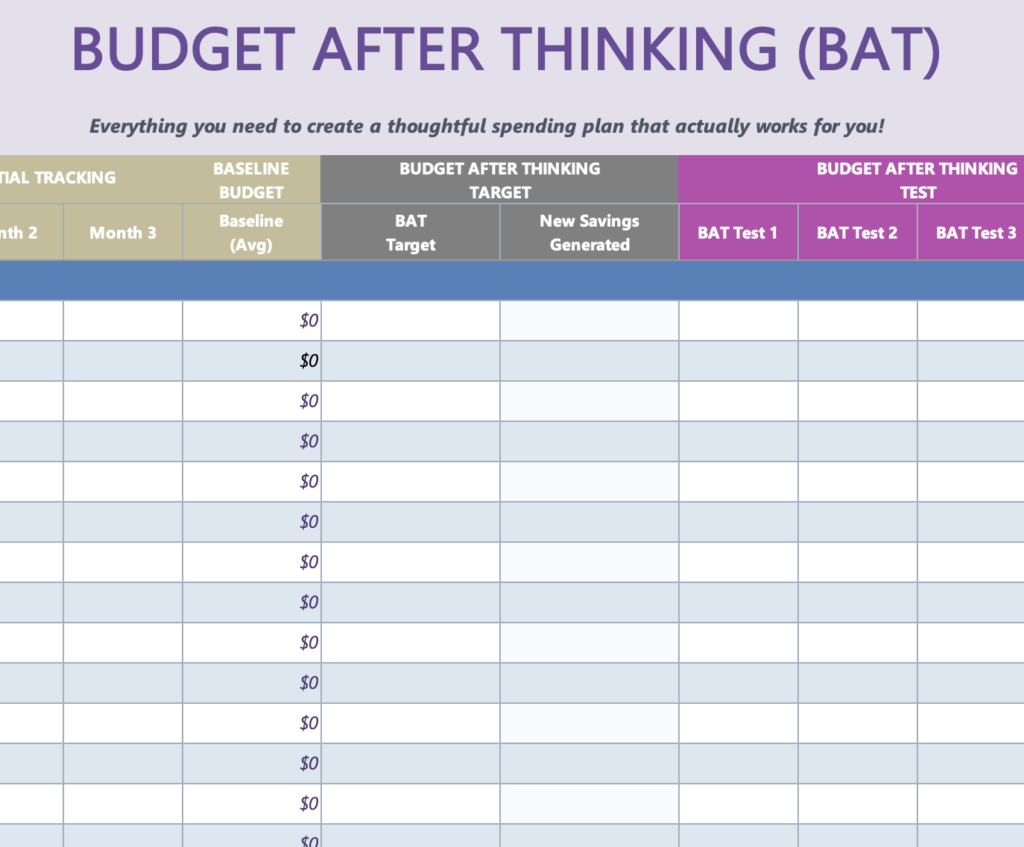
    I call this process a Budget After Thinking.

    budget after thinking spreadsheet to help lawyers realize where their money is going.

    The best part of creating a budget? You would be amazed at the confidence you can build if you can stick to a simple plan for your money.

    For a step-by-step guide on how to create a Budget After Thinking, read my post here and follow-up posts here and here.

    My budgeting philosophy is premised upon your actual spending habits and realistic adjustments. In other words, forget about aiming for predetermined, generic goals like saving 20% of your income. 

    I’ve taught enough law students and lawyers to know that these rigid, predetermined targets don’t work. With massive student loan debt and soaring costs of living, generic savings targets just aren’t helpful. 

    If you aim for some predetermined amount, you’ll end up cutting out everything you like spending money on to the point where you will resent your budget. Then, you’ll give up on your budget and fall back to your old habits.

    The beauty of creating a Budget After Thinking is that it is based upon a baseline budget of your actual, current spending habits. 

    In evaluating your current habits, you can then make thoughtful and realistic adjustments to that budget that will actually last. Through this process, you can accomplish the main goal of generating more fuel for your ultimate financial goals. That might mean building up your cash fortress or investing for long term goals.

    Two simple questions to evaluate your financial position.

    Let’s revisit our two simple questions:

    1. What happens if something goes wrong, like you lose your job or you have an unexpected medical expense?
    2. Can you take advantage if an incredible investment opportunity presented itself?

    The more cash you have on hand, the better you’ll feel about your answers to these two questions. That doesn’t mean you should stop investing, but it does mean that you can reallocate some of your excess money to savings.

    When you have cash, you can survive without losing all that you’ve built up. You can thrive by taking advantage of unexpected opportunities. In other words, create excess cash to survive and thrive.

    This concept is particularly important if you’re at all concerned about the current state of world affairs.

    If you’re not a fan of cash, drop a comment below and let me know more about your approach.

  • Build a Financial Fortress for Security and Optionality

    Build a Financial Fortress for Security and Optionality

    Warren Buffett, Mark Cuban, Kevin O’Leary, Jamie Dimon, and so many other billionaires share the same fundamental money belief:

    Having cash on hand is a necessity. If you don’t have cash on hand, you’re not in a strong financial position, regardless of how much you earn or how many assets you own.

    Let’s start with Cuban, who has long advocated for the importance of having cash on hand.

    Matthew Adair, founder of think and talk money in front of Edinburgh castle symbolizing how we should think about our money and protecting what we have
    Photo by Daniel Mačura on Unsplash

    Cuban says cash is king.

    As early as 2008, he wrote on his blog:

    The first step to getting rich is having cash available. You arent saving for retirement. You are saving for the moment you need cash. Buy and hold is a sucker’s game for you. This market is a perfect example. Right at the very moment when cash creates unbelievable opportunity, those who followed the buy and hold strategy have no cash. [T]hey can’t or wont sell into markets this low, that kills the entire point of buy and hold.

    Those who have put their money in CDs sleep well at night and definitely have more money today than they did yesterday. And because they are smart, disciplined shoppers, their personal rate of inflation is within their means. Cash is king for those wanting to get rich.

    In Cuban’s eyes, you can’t become and stay wealthy without having cash available to deploy when opportunity knocks.

    Mr. Wonderful says you need cash to protect what you’ve built up.

    Kevin O’Leary aka “Mr. Wonderful” of Shark Tank fame agrees. He believes that to be considered rich, you need $5 million in liquidity (cash or treasury bills). In a recent interview, he explained that $5 million is the magic number because that would earn $250,000 in pre-tax income at current interest rates, which is enough for any family to survive on.

    While $5 million cash is out of reach for just about all of us, O’Leary’s reasoning is simple and applies universally. If you don’t have cash available, you’re one calamity away from losing everything you’ve built up. When all your money is tied up in real estate, a business, or other investments, you have no protection when things go wrong.

    Buffett says cash is like oxygen.

    Warren Buffett believes that cash is so important that it’s like oxygen. He explained to CNBC:

    [Cash is] at certain levels necessary, but cash is not a good asset… You do need oxygen, and if you’re ever without it for four or five minutes, you will learn… And cash is that way. So you always need to have it available, because you do not know what will happen.

    Like breathing, Buffett views having cash as a necessity, even if he would prefer to have his money compounding in investments.

    None of us know what’s going to happen in the future. Having cash available is the best way to prepare for whatever happens.

    Dimon says to build a financial fortress.

    Jamie Dimon, CEO of JP Morgan Chase, credits the success of his bank to maintaining a “fortress balance sheet.” That means ensuring his bank was prepared to withstand any challenges by maintaining liquidity (cash on hand) and never getting over leveraged (too much debt).

    Dimon stayed true to this philosophy even when the industry criticized him for being too conservative. The result of his fortress strategy is that JP Morgan Chase has grown to become the biggest US bank by a significant margin.

    So, what can we learn from these billionaires when it comes to our personal finances?

    It can all be boiled down to one core idea:

    Keep cash on hand to build a financial fortress.

    What does it mean to build a financial fortress?

    Building a fortress with sufficient cash on hand serves two main purposes:

    1. You can protect yourself from disaster. This type of cash is known in personal finance as Emergency Savings.

    2. You can take advantage of opportunities. That may mean investment opportunities or life opportunities, like switching careers. I refer to this type of cash as Parachute Money.

    When you have both Emergency Savings and Parachute Money, you’ve built a financial fortress.

    At that point, you are in complete control of your finances and your life. If you want to have ultimate security and optionality in life, you need to build a fortress.

    Today, we’ll look at what it means to build a financial fortress by keeping sufficient cash on hand.

    First, let’s think about protecting everything we have worked so hard for.

    The medieval walls of the village of Montagnana symbolizing how we should think about our money and protecting what we have
    Photo by Edoardo Bortoli on Unsplash

    Build a fortress for protection with an emergency savings account.

    The first step to building a financial fortress is having an emergency savings account. This is your ultimate security blanket for whatever life throws at you. When the billionaires are talking about having cash on hand to protect yourself from disaster, this is the account they’re talking about.

    For example, if you lose your job and the corresponding income, your emergency savings will keep you and your family afloat until you’re working again.

    The idea is to use your savings so you don’t have to pull from your long-term investments or rely on credit cards.

    Keep in mind that your emergency savings is not just for when you lose your job. Your emergency savings will also protect you in times of emergency (brilliant, huh?), like unexpected medical bills or expensive home repairs.

    The idea remains the same: instead of pulling from your investments or falling into debt, you will have cash available in your savings account to cover your needs.

    Listen to the billionaires: fully funding an emergency savings account is a crucial step in protecting what you have built up.

    Aim for 3-6 months of Now Money saved for emergencies.

    In your  Budget After Thinking, Now Money represents the consistent, reoccurring expenses that you need to pay every month to take care of yourself and your family. 

    Aim for building up 3-6 months of your Now Money saved in a dedicated emergency savings account. That said, if you’re in a more volatile industry, you may be better served striving for 9-12 months of emergency savings.

    Why only focus on Now Money instead of your full monthly spending?

    Since you will only be using this money in times of emergency, you can, and should, forego some of life’s luxuries until you get back on track.

    The same is true for fueling your Later Money goals. Take a pause until you sort out whatever it was that caused you to spend your emergency savings in the first place.

    In short, having cash on hand in a separate emergency savings account represents your first line of defense when you lose your source of income or have a major unexpected expense.

    But, having cash on hand is not only about playing defense. It’s also about being opportunistic when the moment is right. That’s where Parachute Money comes in.

    Build a fortress to create opportunities with Parachute Money.

    Parachute Money is one of my favorite concepts in all of personal finance.

    The analogy goes like this:

    Pretend your life is like flying on an airplane.

    For whatever reason, you decide it’s time to get off this airplane. Maybe conditions outside of your control have forced you to jump. Or, maybe you’ve decided that it’s time to take control and make a change. 

    Either way, you’re ready to jump. 

    All you need is a parachute.

    You have a choice between the only two parachutes on the plane.

    The first parachute has only one string (or line) connecting the canopy to the harness . You think to yourself, “This doesn’t seem very safe. What if that one string breaks? That would end very badly for me.”

    Then, you look at the second parachute. 

    The second parachute has 10 strings. You say to yourself, “OK, this one looks much safer. If one string breaks, the parachute still has nine other strings to keep me safe. Even if something goes wrong with one or two strings, I would glide safely to the ground.”

    It’s obvious which one of these parachutes to choose, right?

    So, what does a parachute have to do with money?

    Each of your income sources, plus your cash on hand, is like a string on your parachute.

    The central idea of Parachute Money is to create multiple sources of income and have sufficient cash on hand so you have optionality in life.

    Picture each source of income and your cash on hand as separate strings on your parachute. The more strings on the parachute, the stronger it is.

    With Parachute Money, if one of your sources of income dries up, like when you lose your job, you are more than covered with your other income sources and cash on hand.

    Of course, the more sources of income and cash you have, the stronger your personal financial position is.

    Parachute Money includes your primary job, any side hustles, any income generating assets, and your cash savings. It also includes the income of your significant other, if you share finances.

    Billionaires know how important flexibility and optionality are. That’s why they prioritize having cash available, even if that means taking a more conservative approach to investing at times.

    Just like the billionaires mentioned above, when you have cash to deploy, you can take advantage of investment opportunities. You also have the option to make big life changes, like switching jobs, without risking your family’s well-being.

    The key to Parachute Money: give yourself options with various assets, income sources, and cash on hand.

    Personally, I have my primary job as a mesothelioma and personal injury attorney, invest in the stock market, own rental properties, and serve as an adjunct law school professor. I’m also more determined than ever to build up my cash savings to solidify my financial fortress.

    brown concrete castle on top of mountain symbolizing how we should think about our money and protecting what we have
    Photo by Daniel Mačura on Unsplash

    How much cash on hand do you need to build a fortress?

    We talked about how 3-6 months of emergency savings is a good target for most people. That should be ample time to get back on track if you lose your source of income or face an economic emergency.

    But, how much cash on hand do you need to solidify your fortress? Remember, emergency savings is just the first step in building ultimate financial security.

    Like most money decisions, this is a personal choice you need to make after thinking and talking with your loved ones. I can’t tell you how much you need for your fortress, but I can tell you what I’m doing.

    Personally, I am striving for three years of cash saved up to solidify my fortress.

    Why three years worth of savings?

    My thinking is that three years of savings is more than enough money to provide for my family if disaster strikes. At the same time, three years of savings provides me enough cash to deploy if an incredible investment opportunity presents itself.

    One year of savings does not feel comfortable to me. I have three young kids and four investment properties. I need to be prepared for anything.

    Two years of savings might be sufficient, but it still feels a little uncomfortable to me. Three years of savings feels just right.

    The reason I’m not saving more than three years in cash is because I don’t want to miss out on the long-term benefits of compound interest by having more money tied up in cash instead of investments.

    For the billionaires, three years of cash savings might not be enough. For the average lawyer, three years of cash savings may sound like too much. Evaluate your personal situation and do what feels right to you.

    When you combine emergency savings and parachute money, you have built a fortress.

    The ultimate level of financial success comes from having an emergency savings account for protection and parachute money for optionality.

    No matter what happens with the economy, you are protected in a variety of ways. When other people are worried about losing their jobs, you will be thinking about options.

    If you haven’t prioritized an emergency savings account or parachute money, let the current uncertainty in the world serve as a reminder of how important these concepts are.

    As just one example, Meta (Facebook) just announced plans to lay off 10% of its workforce next month, with more layoffs to come. Whether you are in the tech industry or an attorney or a consultant, there’s no guarantee that your job will last forever.

    The overall economic outlook is hazy at best right now. Ask five “experts” what the economy will look like in two years and you’re likely to get five different answers.

    It’s up to each of us to build in multiple layers of protection in our financial lives to avoid disaster and to prepare for opportunity.

    That’s why I’m building a financial fortress.

    Do you have an emergency savings account? Parachute money? 

    How strong is your fortress?

    Let us know in the comments below.

  • How Lawyers Can Think About Investing While in Debt

    How Lawyers Can Think About Investing While in Debt

    The Wall Street Journal recently wrote about the complicated financial lives of dentists. Reading the article, it was hard not to see the similarities in the financial challenges that we face as lawyers.

    Among America’s swelling ranks of moderate millionaires, few have more complex personal balance sheets than dentists.

    They earn high incomes, have built valuable businesses and have benefitted from the rising stock market of the past decade and a half. But they often graduate with significant student loan debt and spend years tying up money in building their practices.

    High incomes?

    Years of effort building our careers?

    Significant student loan debt?

    This article could just as easily been written about lawyers.

    The article continues:

    Entering their professional ives in a financial hole often leaves an indelible mark on the way dentists invest. Some take on risky self-directed investments, while others are forced to minimize their retirement savings until they pay off other obligations.

    This article serves as a reality check for anyone thinking that they’ll never have to worry about money if they simply obtain an advanced degree. To the contrary, choosing to take on student loans is a major decision that will impact your personal finances for years.

    The article also illustrates one of the most difficult money decisions that lawyers have to make: should we invest while in debt?

    Today, we’ll explore why I think it’s a good idea to start investing even if you’re paying off debt.

    It’s good to pay off debt and it’s good to invest.

    Same as the dentists featured in the WSJ article, It’s not uncommon for lawyers to have hundreds of thousands of dollars in debt.

    I regularly get questions about investing while in debt from law students who take my personal finance class. By the way, it’s not just lawyers with student loan debt who face this question. Maybe you have mortgage debt, medical debt, or consumer debt. Perhaps you’ve used a HELOC to buy investment property like I have.

    Regardless of the type of debt, I understand the urge to eliminate that debt as quickly as possible. Still, is it the best idea to avoid investing for the future until that debt is gone?

    I don’t think so.

    Obviously, we know two things to be true at once:

    Debt can be bad. 

    Investing can be good. 

    So, should we focus on eliminating the bad thing or doing more of the good thing?

    It’s not easy to serve two masters at once. How do we plan for the future while worrying about past debts?

    The way I see it? 

    You don’t have to choose only one door to walk through. 

    You can invest while in debt. But, striking the right balance can be tricky.

    The choice to pay down debt or invest for the future is tricky.

    Whatever the case may be, the choice to pay down debt faster or invest for the future is tricky. 

    For people feeling the heavy burden of debt, the idea of investing for some future goal can seem a little bit comical. I completely understand. 

    If you’re facing monthly debt payments for the next 10 years, you may not be ready to think about retirement 50 years from now.

    Trust me, I get it. 

    I know firsthand how heavy debt can feel. 

    In my 20s, I had both student loan debt and credit card debt. It was not fun to carry that debt burden. I’ll never forget the incredible feeling of accomplishment when I paid off those debts. I felt so much lighter. 

    I now have HELOC debt that I’m focused on paying off. That HELOC debt stems from buying five properties in seven years. My real estate portfolio is now exactly where I want it to be, so I’ve shifted from acquisition mode to debt-reduction mode.

    Just about every day, I think about how good it’s going to feel to have that HELOC debt paid off.

    The point is: you don’t have to convince me why you may want to focus on paying off debt. I understand completely.

    However, I think it’s worth considering the advantages of investing at the same time you’re paying off debt. You don’t have to go all-in on paying off debt or all-in on investing. You can strike a balance.

    Four main reasons to invest while in debt.

    There are four main reasons to consider when thinking about whether you should invest even though you’re in debt.

    If you’re not investing at all because you’re focused on debt, these four reasons should give you something to think about.

    blue and white toothbrush in clear glass jar representing that lawyers and dentists have similar financial challenges at the beginning of our careers.
    Photo by The Humble Co. on Unsplash

    1. Invest while in debt because of the psychological side of money decisions. 

    It feels good to see your investment accounts grow. This is especially true when you are accustomed to looking at huge debt balances on your laptop or phone screen. 

    Yes, it feels good to see those debt balances shrink. It also feels really good to see your investment accounts grow.

    As a lawyer, you work hard for your money. You spend a lot of hours away from home so you can work and make a living. You deserve to experience the fruits of your labor. 

    When your career is stressing you out, it can be very uplifting to observe a growing investment account balance month-to-month.

    2. Invest while in debt to develop the habit.

    It’s important to get in the habit of investing as early as possible in your careers. Once you start investing, even if it’s only $25 per month, you are creating a habit. This is the type of habit that will pay off immensely in the long run.

    Humans have a tendency to resist change. That’s why it’s difficult to break bad habits. This tendency also works in our favor when we have established good habits, like investing. We tend to just keep doing what we’ve always done.

    When you’ve established the good habit of investing, it’s easy to increase your contributions as you earn more money. The same is true when you’ve eliminated all your debt. You can easily use the money you had been putting towards debt for your already-established investments. 

    That’s because your accounts will already be set up. All you need to do is increase your monthly investment contributions.

    This makes it easier to solidify and benefit from the good habit you’ve cultivated.

    3. Invest while in debt because of compound interest.

    Compound interest is the most powerful force in all of personal finance. The earlier you start investing, the more benefit you’ll get from compound interest.

    You can check out more about the power of compound interest in my post on investing early and often.

    I also encourage you to use the Think and Talk Money Compound Interest Calculator to see for yourself how even small, consistent contributions will have a major impact on your finances in the long run.

    4. Invest while in debt because of the math.

    Even though money decisions are closely connected to our emotions, the math of investing can be hard to ignore. If you prefer to make money decisions primarily based on the math, here’s what you can do.

    We’ve talked before about how the S&P 500 has historically earned an average annual return of 10%. Of course, there’s no guarantee that you will earn 10% if you invest. You may earn less or you may earn more. Still, based on the historical data, it’s a reasonable estimate.

    You can then compare that 10% return to the amount you’re paying in debt interest.

    For example, let’s say you created a Budget After Thinking that opened up an extra $200 in your monthly budget to allocate towards either student loan debt or retirement.

    You’ll next want to look up your current student loan interest rates. For illustration purposes, the current interest rate for undergraduate federal loans is 6.39%. The current interest rate for graduate and professional students is 7.94%.

    Then, visit the TATM Resource Library and use a calculator to help make your decision about whether to invest the $200 or put that money to debt. 

    If you put the money to debt, you’ll obviously pay off that debt faster. You can read more about how to easily do these calculations in my post on Debt Snowball vs. Avalanche.

    Likewise, you can use an investment calculator to see how much that $200 will grow in an investment account over the long run. You can see how to do these calculations in my post on risk as the cost to invest.

    Armed with the math, you can then make a decision that makes the most sense to you. 

    You may value getting out of debt faster. Or, you may be motivated by the larger balance in your retirement account. 

    It may come down to how high the interest rate is on your student loans. The higher your interest rate is, the more sense it makes to prioritize paying off that loan.

    The point is that there are mathematical reasons to start investing even while paying off debt.

    One final note about the math: your student loan interest rate is effectively locked in (unless you have a variable rate). On the other hand, your investment return rate is only a projection. That makes a difference. 

    It means that when you are in debt, you are guaranteed to be charged interest every month. In contrast, there are no guarantees you will make money when you invest. As you make your decisions, don’t ignore this key difference.

    Lost in the maze epresenting that lawyers and dentists have similar financial challenges at the beginning of our careers like whether to invest of pay down debt.
    Photo by Burst on Unsplash

    I prefer to allocate 75% to debt and 25% to investments.

    When you consider these four main reasons, you may be convinced that it makes sense to invest even while paying off debt. 

    So, the obvious next question becomes: how much money should you put towards debt and how much should you invest?

    The ratio that works for me is 75% towards debt and 25% towards investment goals. In other words, if I had $1,000 to allocate in my budget for debt and investments, I would use $750 for debt and $250 for investments.

    I used this ratio when I had student loan debt and continue to use it to eliminate my HELOC debt.

    This 75-25 ratio gives me the dual benefit of paying off my debt faster while also seeing my investment accounts grow over time. Once my debts are paid off, I will have already established the good habit of investing. In the meantime, I’m currently benefitting from compound interest and the math of investment returns.

    The reason I lean more towards debt is because I don’t like the feeling of being weighed down by debt. It’s hard to feel completely free when you are carrying the burden of debt. That’s why I am currently prioritizing paying off HELOC debt. 

    That said, I’m not willing to entirely delay investing for the future. The 75-25 ratio is a good balance for me and helps me accomplish multiple goals.

    75-25 has worked well for me. Having reached my 40s, I’m very happy that I did not neglect my investments entirely while dealing with debt.

    Don’t agonize about finding the perfect ratio between debt and investments.

    Whatever balance works for you, keep one important tip in mind:

    Don’t agonize about finding the perfect balance between debt reduction and investing for the future. 

    Take a step back and think about it for a moment:

    Paying off debt is great.

    Investing for the future is also great.

    If you’re doing both of these things in some fashion, you’re already making great money choices!

    If you’re able to pay off debt and invest at the same time, you most likely have already created a successful Budget After Thinking. You have proven that you can stay disciplined enough to allocate funds to your Later Money goals each month. 

    You have already done the hardest part.

    I consider this whole conversation of putting money towards debt or investments a win-win decision. There’s no reason to stress yourself out in search of the perfect balance. You’re already winning.

    Find a balance between debt and investments that works for you and stick to it. You really can’t go wrong. Either way, you are making progress on your money goals.  

    Some day in the future your debt will be paid off. 

    The bottom line is, one way or the other, you are going to pay off your debt. That’s assuming you are a reasonably responsible person on a typical career trajectory. 

    If you have student loans, it might feel like you will never get out of debt. I assure you that you will. 

    To put it in perspective, if you are on a standard repayment plan, you’ll be debt-free in 10 years. For most students, that equates to being debt-free sometime in your 30s.

    My guess is that by the time you retire, you won’t even remember how much debt you had or exactly when you paid it off. The only reason I remember when I paid off my debt is because I’ve been keeping a money journal since 2011.

    On the other hand, towards the end of your career, you will very much be aware of how much money you have saved for retirement. You will be counting on that money to allow you to step away from full-time employment. 

    As hard as it is to do when you’re in debt, try and picture that older version of yourself who is nearing retirement. That older version of yourself will be very grateful that you had the discipline to start investing even while paying off debt.

    That’s why I allocate 75% of my available funds to debt and 25% to investments. When my debt is gone, I’ll put the full 100% to investments.

    So, what do you think?

    Are you currently investing while paying off debt?

    What other factors went into your decision besides the four main reasons discussed above?

    Let us know in the comments below.

  • Get Comfortable Embracing Reasonable Investment Risk

    Get Comfortable Embracing Reasonable Investment Risk

    Two young coworkers, Mike and Elissa, start the same job at the same time making the same amount of money.

    While still many years away, Mike and Elissa both know that they should invest early and often for retirement.

    They each decide to fund a retirement account with an initial contribution of $2,500. They are also dedicated to making contributions of $250 every month until they retire.

    Both plan to retire in 40 years while they’re in their 60s.

    There’s one major difference between Mike and Elissa. 

    They view risk differently.

    Because they view risk differently, one of them will end up with six times more money in retirement.

    Let’s see how that happens.

    Mike doesn’t like risk.

    Mike doesn’t like risk. He wants to be able to sleep at night knowing that his hard-earned money is safe and sound in the bank. He can’t stand the idea of potentially losing money from one month to the next.

    Even though Mike doesn’t like risk, he knows that saving money is important. In fact, he’s a bit obsessive about tracking his accounts using the TATM Net Worth Tracker™️.

    When Mike wakes up in the morning, he likes to check his bank accounts while he drinks his coffee. He gets a jolt out of opening up his mobile banking app and seeing exactly how much money he has.

    Because Mike doesn’t want to take any chances, he decides to stash all of his retirement savings in a savings account that earns an average annual return of 3%. 

    Mike is lucky because this is a pretty generous return for a savings account based on historical savings account interest rates.

    Elissa is more comfortable with reasonable risk.

    Elissa is more comfortable with reasonable risk. Upon starting her career, Elissa was smart enough to know what she didn’t know about money. Because she had never learned basic personal finance skills, she was determined to put in a little bit of effort early on to set herself up for a prosperous future.

    Elissa was a frequent reader of Think and Talk Money. She listened to financial independence podcasts. Elissa even read JL Collins’ book on investing, The Simple Path to Wealth.

    Through the process of educating herself about personal finance, Elissa started thinking about what she really wanted out of life. Since she was young and had just started her career, it wasn’t easy to come up with a good answer. 

    Still, Elissa knew that whatever she wanted to do in life, investing was an important part of her financial journey. If she wanted to create more time for herself down the road, she would need passive income from investments to sustain her.

    So, after doing her homework, Elissa decided to invest her money in a low cost S&P 500 index fund. 

    While she appreciated that there are no guarantees when it comes to investing, Elissa had learned that the S&P 500 has historically earned an average annual return of 10%.

    Unlike Mike, Elissa only checked her accounts once per month when she updated her TATM Net Worth Tracker™️. Elissa slept fine at night because she knew time was on her side.

    Let’s see how Mike and Elissa turned out 40 years later.

    Using the Think and Talk Money Compound Interest Calculator, let’s see how much money Mike and Elissa will have in their retirement accounts after 40 years.

    The way I’ve framed our hypothetical, you can probably guess who ends up with more money. What may surprise you is just how much of a gap there is.

    Remember, both Mike and Elissa started with the same initial contribution of $2,500, made the same $250 monthly contributions, and invested for the same 40 year period.

    The only difference between their two journeys was that Elissa was more comfortable with risk.

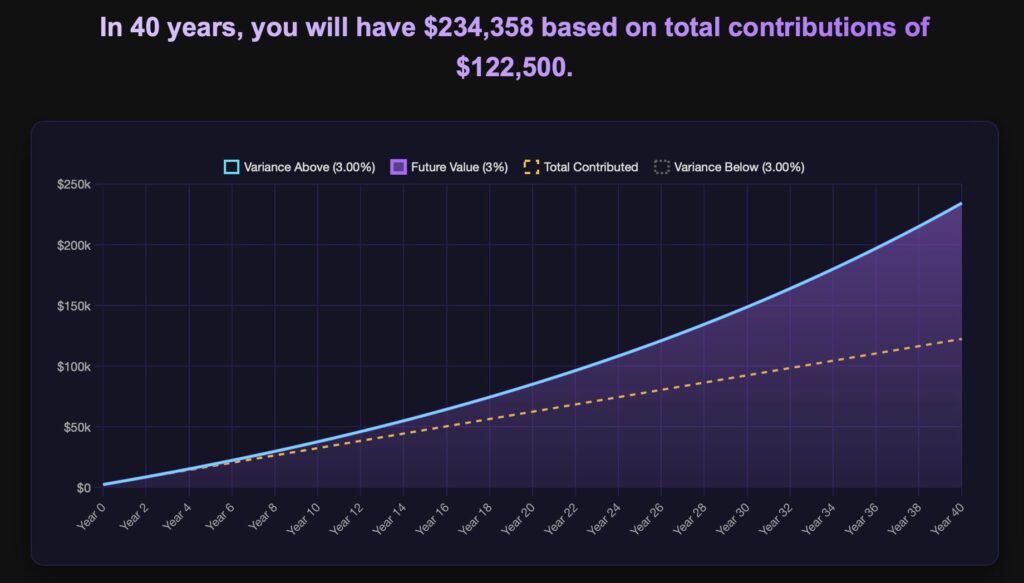
    After 40 years, Mike has $234,358.

    Use the Think and Talk Money Compound Interest Calculator to motivate you to invest and take on the risk even in uncertain times.

    After 40 years, Mike will have contributed a total of $122,500 to his retirement savings account. 

    At a 3% interest rate, Mike will have $234,358 after 40 years.

    In other words, Mike has just about doubled the value of his total contributions in his account.

    Not bad, Mike.

    Now, let’s check out Elissa’s account.

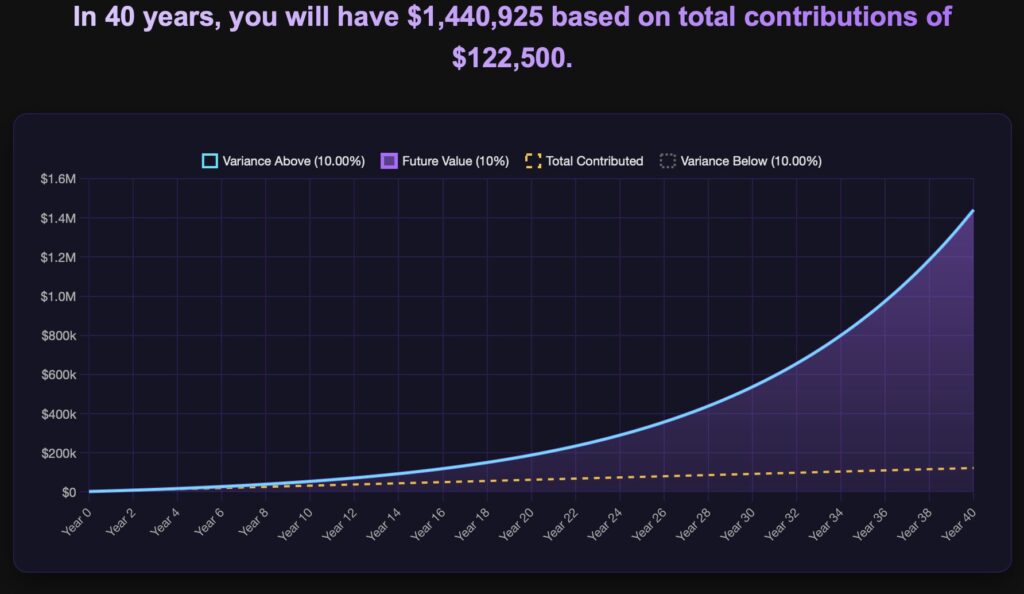
    After 40 years, Elissa has $1,440,925.

    Use the Think and Talk Money Compound Interest Calculator to motivate you to invest and take on the risk even in uncertain times.

    Elissa likewise contributed $122,500. After 40 years, at a 10% interest rate, Elissa’s retirement account will have a total of $1,440,925.

    Wow, Elissa!

    Elissa’s retirement account is worth 10 times more than what she personally contributed. Mike failed to even double his money.

    Recall in this hypothetical, Elissa did the exact same things as Mike, with one key difference. Elissa educated herself in basic personal finance concepts and was more comfortable taking on reasonable risk.

    Because Elissa was comfortable taking on some risk, her retirement savings were worth more than six times as much as Mike’s savings. Put another way, she has more than a million dollars more than what Mike has!

    person jumping from cliff to cliff illustrating the concept of reasonable investment risk for young people as shown by the Think and Talk Money Compound Interest Calculator.
    Photo by Micah & Sammie Chaffin on Unsplash

    Look at compound interest in action.

    One last thing: take a look at the pictures of Mike and Elissa’s investments over time. Notice the gaps between each of lines on the graphs. The blue lines represent the total account value, and the dotted lines represent only the contributions.

    While they each benefited from compound interest, Elissa benefited exponentially more. 

    Look at how Mike’s blue line stayed much closer to the dotted line. Because he wasn’t earning as much overall interest, he didn’t have as much money to multiply from compound interest.

    On the other hand, Elissa’s blue line mirrored her dotted line closely for the first 12-15 years. Then, the gap widened before the blue line skyrocketed over the final decade or so. 

    That’s the power of compound interest kicking in.

    So, what can we learn from Mike and Elissa?

    The point of this hypothetical is to reinforce the concept of risk when it comes to investing.

    We’ve all heard the saying, “You don’t get something for nothing.”

    That motto applies to investing as much as anything else. There is always risk involved in investing.

    The question is how do you react to that risk.

    Some people are so fearful of that risk that they don’t invest at all, like our friend, Mike. 

    Other people are so desperate to get rich quickly that they take wild risks.

    The people that tend to reach and sustain financial independence are the ones who educate themselves and become comfortable with taking on reasonable risk. This is what Elissa did.

    Think of risk as the cost to invest.

    If you want to reach true financial independence or any other financial goal, it’s going to cost you something. 

    Think of risk as the cost to invest.

    Sure, there are lawyers out there who may reach financial independence on a massive salary, even with poor financial habits. 

    For the vast majority of us, we’re going to have to get comfortable with investing and taking on reasonable risk.

    If you’re on the fence about taking on reasonable risk, now’s a good time to think about your ultimate life goals. Embrace the reasons for why you’re investing. Think about what would motivate you to open yourself up to reasonable risk. For me, it’s having ultimate optionality in life.

    It never hurts to remind yourself what you are hoping to achieve in the future. When you know what that thing is, it’s much easier to pay the cost of risk.

    When you understand reasonable risk, you know that market fluctuations are a good thing.

    Warren Buffett once said, “Look at market fluctuations as your friend rather than your enemy; profit from folly rather than participate in it.”

    This wisdom is important to remember today as multiple wars are being fought around the world and nobody truly knows where the economy is headed.

    Recently, I’ve talked to people still early in their careers who are selling stocks and moving into “safer” positions, like precious metals and cash. Setting aside whether these asset classes are in fact safer, I think it’s a mistake for young lawyers to get out of the stock market right now when they have decades of investment horizon ahead.

    Right now the market is fluctuating. That is completely normal. As Buffett says, this might be a great time to lean into the stock market. When the market goes down, if you consistently invest in broad-based index funds, you can purchase stocks on sale. That’s what Buffett means by profiting from other people’s folly instead of participating in it.

    This is why it’s important to think of reasonable risk in terms of decades, not weeks or months.

    When you look at Elissa and Mike’s future outlook, who would you rather be? 

    It’s not really a hard question, right?

    It’s not only that Elissa has a bigger bank account. What matters even more is that she has created options for herself. 

    Elissa should be in position to do whatever she wants at that point in her life, within reason.

    Mike won’t be.

    The takeaway is that when you have decades ahead of you, let risk work in your favor. Let other people panic and sell their assets when the market is dropping. Ignore the noise. You can’t time the market. Stay invested for the long-term by embracing the risk.

    Readers: are you naturally more inclined to act like Mike or Elissa when it comes to investing?

    If you’re more like Mike, have you thought about what outcome in life would make it worth taking on some reasonable risk?

    Does it feel more difficult to stay invested when the market is dropping?

    Have you tried flipping the script by telling yourself that stocks are on sale when the market drops?

    Let us know in the comments below.

  • My Advice: Sometimes You Gotta Spend the Money

    My Advice: Sometimes You Gotta Spend the Money

    The financial independence community sometimes gets a bad rap for encouraging excessive saving at the expense of present day spending.

    The reputation is not entirely undeserved.

    I listened to a podcast once where the guest admitted to the folly of trying to replicate Trader Joe’s trail mix by buying each of the ingredients individually and mixing them himself.

    I thought to myself, “This is what financial independence is about?”

    That never sat right with me.

    The podcast guest was happy enough to admit that the meager savings from making his own trail mix was not worth his time or energy. Still, if there was ever one aspect of the financial independence community that turned me off, it was advice like “make your own trail mix.”

    He was not alone in promoting what I considered excessive frugality. The word “miser,” referring to someone extremely stingy with money, comes up regularly in criticisms of people pursuing financial independence at all costs.

    To this day, I’ve never connected with the voices that promote extreme saving at the expense of present day convenience and fulfillment.

    I’ve also come to learn that this type of personal finance advice doesn’t work for lawyers.

    Advice like “make your own trail mix” doesn’t work for lawyers.

    As lawyers, we invest a lot of time (and money) into our education and careers. It’s no secret that we work long, stressful hours. One of the tradeoffs for all the hours we put in is that we have the opportunity to earn high incomes.

    Considering we work long hours and earn good money, advice like “make your own trail mix” isn’t very helpful. It’s not worth saving a few pennies in exchange for our limited free time when we could be doing the things that make us happy. When we’re not working, our time and energy should be better spent elsewhere, like being with our family, socializing with friends, or relaxing.

    What I’ve learned teaching personal finance to lawyers is that we are generally not interested in saving every penny possible until we can quit our jobs. This makes sense to me. Putting that much constraint and pressure on ourselves does not sound like a fulfilling existence.

    The lawyers that I work with know they need to save for retirement. At the same time, they want to use some of their hard-earned money for a better existence today.

    That’s why I recommend that lawyers spend money in ways that increase happiness, convenience and time. One of the best ways to practice this type of intentional spending is to create a Budget After Thinking.

    When you follow a Budget After Thinking, you give yourself permission to spend on things that make you happy today, while still achieving your long-term goals.

    Personally, shopping at Costco is an example of spending money today that brings me happiness, convenience, and time.

    A detailed close-up view of a mixed nuts and dried fruits snack, showing natural textures and colors. Ideal for healthy eating, nutrition, and food background concepts and illustrating why sometimes you gotta spend the money.
    Photo by Monaz Nazary on Unsplash

    What I learned about spending money by shopping at Costco.

    This past Sunday afternoon, my wife and I took the kids to Costco. I was thinking about all this while we walked through the store loading up our two carts.

    It was a nice family outing. We killed a couple of hours, the kids had fun, and we have food and supplies to last us for a month.

    On average, we shop at Costco once per month. We get our staple items (toilet paper, ground beef, coffee, etc.) and always end up with a few things not on our shopping list. On this weekend’s trip, the kids talked their way into Kit Kat chocolate bunnies (didn’t even know they made those) and enough AA and AAA batteries to power an airplane.

    The thing about shopping at Costco: no matter your best intentions walking into the store, the final bill is always big. Somehow, the cart always fills up. What a business!

    Anyone who shops at Costco will instantly know what I’m talking about.

    I’m no longer shocked or disappointed with the final bill. When my wife jokingly asks what the total is, my answer is always the same, “A lot.”

    What I’ve learned is that despite spending a lot of money at Costco, I view this as money well spent. We usually pick up some fun items that are relatively inexpensive and make us and the kids happy. Plus, because we load up on essential items to get us through the month, we don’t spend much time or money each week at the grocery store.

    Even though the final bill is always big, I view shopping at Costco as an example of intentionally spending money in a way that increases happiness, convenience, and time.

    Which leads me to one of the most important money lessons I’ve ever learned:

    Sometimes, you gotta spend the money.

    Sometimes, you gotta spend the money.

    Personal finance is not only about saving. Yes, saving is crucial to achieving our long-term goals. But, I don’t recommend that we save so dogmatically that we make ourselves miserable along the way.

    As lawyers, we work hard and we work a lot. If all we did was save every penny we earned in hopes of quitting our jobs one day, we would quickly burnout.

    Instead of making your own trail mix, remember this piece of advice:

    Sometimes, you gotta spend the money.

    Buy the direct flights.

    Costco is only one such example of when it makes sense to spend the money. I spend a lot of money at Costco each visit. But, we enjoy our family outings and get most of the essential items we need for the month in one trip. That’s money well-spent on happiness, convenience and time.

    If my goal was to save every penny possible, I wouldn’t feel the same way about Costco.

    Not a Costco shopper? Here’s another recent example when I decided to just spend the money.

    My brother-in-law’s wedding is in Scottsdale this fall. When I booked our flights, I could have saved real money by connecting in Denver or Los Angeles instead of flying direct to Phoenix. But, at what other cost?

    Anyone ever flown across the country with young kids?

    A four-hour flight with three young kids is hard enough. My wife has it especially tough with the baby on her lap the entire flight. By the time we land, it feels like we just worked out for 4 hours.

    The last thing in the world that we need is to extend the adventure with a connecting flight, even if it saves real money. My priority is to arrive in Arizona feeling energized and excited to celebrate this once-in-a-lifetime event with my family.

    Sometimes, you gotta spend the money.

    boy shopping for stuffies indicating sometimes you gotta spend the money.

    Personal finance is tied to our emotions.

    Humans are emotional creatures. Of course, we can rationally look at examples and charts and won’t dispute the long term magic of compound interest. At the same time, we have emotions and feelings that need to be tended to now.

    At Think and Talk Money, we regularly explore how personal finance is tied to our emotions. There’s nothing wrong with admitting that in certain situations, the right choice is to spend the money.

    Traveling is a good example of spending money to increase happiness. In fact, the happiness effect has been well-documented when it comes to traveling. People get a happiness boost in planning the trip, then taking the trip, and finally remembering all the fun things they did on the trip.

    That’s why so many people “love to travel.” It brings them happiness before, during, and after the trip.

    Personal finance is about how we spend money today, not just in the future.

    Personal finance is not just about long term goals, like saving for retirement. Just as important, personal finance is about how we spend our money in the present.

    It’s not realistic to expect people to put off all happiness until some unknown time in the future. It is realistic to make reasonable choices now to ensure a better future.

    What might be a reasonable spending choice for one person may be totally unreasonable for someone else. That’s perfectly fine. Still, we all need to make those choices for ourselves.

    What I’m suggesting is that if you’re spending most of your time each week at your job, like most of us lawyers do, shouldn’t we think about using some of the money we earn so we can elevate our present day lives? 

    The key is understanding what those things are, so we actually spend our money in pursuit of those things.

    That’s the essence of what it means when I say, “s , you gotta spend the money.”

    So, what’s a recent example of where you decided to spend the money?

    Let us know in the comments below.

  • Young Lawyers: What to Do When the Market Slides

    Young Lawyers: What to Do When the Market Slides

    The stock market has been sliding so far in 2026.

    As of this writing, the S&P 500 is down 3.3% in 2026 and the Dow is down 3.8%.

    The market can change suddenly, for better or worse. Nobody knows what’s going to happen. Don’t believe anyone who tells you otherwise.

    During times like this, it’s important for all of us, and especially young lawyers, to remember the fundamentals of investing.

    I was asked recently, “What am I doing with my portfolio while markets are falling in early 2026?”

    Despite how chaotic it may seem in the world today, this is not a difficult question for me to answer. 

    I’m not doing anything.

    I invest in the stock market to help achieve my long-term goals. My two main long-term goals are to save for college and to save for retirement. 

    Each objective is so far away that time is on my side.

    Our oldest child is six-years-old, so I have 12-13 years until she even begins college. Over the past two years, we super-funded a 529 college savings plan for my oldest daughter and my son. We plan to do the same for our baby girl.

    I fully anticipate that the market is going to go up and down over the next two decades while my kids are in school. That’s part of the process.

    As for retirement, I have even more time in front of me. Same as what we just talked about with saving for college, I fully expect the market is going to go up and down many times before I retire.

    Time is on my side. That’s why I’m doing nothing.

    Like you, I don’t enjoy seeing my portfolio drop so suddenly.

    It’s not fun to read the headlines right now. My brain seems to jump to the worst case scenario. Maybe you do the same thing. As lawyers, we’re trained to think of the worst case scenario, right?

    This is one of the reasons why I only look at my portfolio once per month when I track my net worth.

    To remind myself to hold steady during the down times, I think of a study that examined what would happen if an investor missed the 10 best days for the market in each decade since 1930. 

    As summed up by CNBC:

    Looking at data going back to 1930, the firm found that if an investor missed the S&P 500′s 10 best days each decade, the total return would stand at 28%. If, on the other hand, the investor held steady through the ups and downs, the return would have been 17,715%.

    These results illustrate how risky it would be for me to try to time the market. The last thing I want to do is miss the upswing. I have no idea when it’s coming. 

    But, time is on my side. 

    I’m going to be in the market when that upswing eventually comes. It may not be until years from now. That works for me and my investment horizon.

    Think of it this way: the market is on sale right now.

    One other mental hack that’s helping me right now:

    I’m telling myself that the market is on sale. How so? I can buy the exact same stocks today for less money than they would have cost even a few days ago. I do love a good sale.

    In the end, no matter how bad things seem right now, I plan to continue making regular contributions to each of my investment accounts. 

    Since I’m investing for the long run, I’ll let the market do its thing while I’m off doing my own things.

    Disclaimer: Your situation may be different. I am not an investment advisor. Do your homework and make the best decisions for your personal situation.

    What is my personal investing strategy?

    When it comes to investing in the markets, I’m about as boring as can be. 

    My wife and I invest primarily in index funds. We are not active traders. We don’t seek out the newest, hottest stocks.

    All we do is make regular contributions to our various investment accounts and let the markets take care of the rest.

    As an example, for my daughter’s 529 plan, we chose a passive investment option that’s a mix of stock index funds and bond index funds.

    Our portfolio automatically rebalances over time based on my daughter’s projected first year of college. Essentially, the closer we get to her first year in school, the more conservative our portfolio becomes.

    We chose a similar option for our other kids’ 529 plans. It’s boring but it works.

    Why index funds?

    I wrote a post detailing the 7 reasons why I love index funds. Here’s a preview:

    1. Anybody can do it
    2. No wasted mental energy
    3. Low fees
    4. Automatic diversification
    5. The closest thing to predictability
    6. I don’t have stock FOMO
    7. Good enough for Buffett, good enough for me

    Like so many others in the financial independence community, I fell in love with index funds after reading J.L. Collins’ book The Simple Path to Wealth. You can read my full review of The Simple Path to Wealth in my post here.

    Even if you work with a financial advisor, it’s crucial to educate yourself so you can make informed decisions, especially in times of economic uncertainty like we’re in right now. As Collins explains, benign neglect of your finances is never the solution.

    By the way, it’s not just Collins urging us to invest in broad based index funds. So does the single greatest investor of our lifetimes, if not ever: Warren Buffett.

    In 2013, Buffett famously instructed that after he dies, his wife’s cash should be split 10% in short-term government bonds and “90% in a very low-cost S&P 500 index fund.”

    Good enough for Buffett, good enough for me.

    For more on index fund investing, check out our full series on investing.

    man sitting on bench during sunset showing that when markets decline it's important to chill and not make sudden investing mistakes.
    Photo by Free Walking Tour Salzburg on Unsplash

    How much money should you put towards each of your financial goals?

    Between saving for emergenciessaving for college, and saving for retirement, there are a lot of options. In addition, you may have other short term goals, like paying for a wedding or a house. Or, you may want to invest in real estate.

    So, how do you determine how much to allocate to each goal?

    There’s no perfect answer here. 

    The first thing you should do is to spend some quality time formulating your version of Tiara Goals for Financial Freedom.

    Then, let those goals inspire conversations with your people to help you make the best decisions. This is exactly how my wife and I came up with our financial goals for this year.

    It also helps to attach specific targets to your financial goals, like we did when we estimated how much you should be saving to pay for college.

    Once you know what you’re striving for, it’s time to commit to a Budget After Thinking. The primary focus of a Budget After Thinking is to generate fuel for the most important goals in your life.

    Are you saving too much for retirement?

    Spend enough time on the internet, and you’ll get many different answers about how much to save for retirement. There are just too many variables in play to generally answer this question, like what kind of retirement you want and when you want to retire.

    My perspective on retirement savings evolved after reading Die with Zero by Bill Perkins.

    In Die with Zero, Perkins suggests that many of us are saving too much for retirement at the expense of using that money to live our best lives now. 

    Perkins’ book is one of the most compelling personal finance books I’ve read in a long time, and I highly recommend it.

    Perkins is not suggesting that saving for retirement isn’t important. He’s saying that the hard data shows that most of us are over-saving.

    Believe it or not, you may be closer than you think to achieving your retirement goals.

    That’s a very powerful realization.

    Think about the options you can create for yourself if you no longer need to save a hefty chunk of your paycheck for retirement.

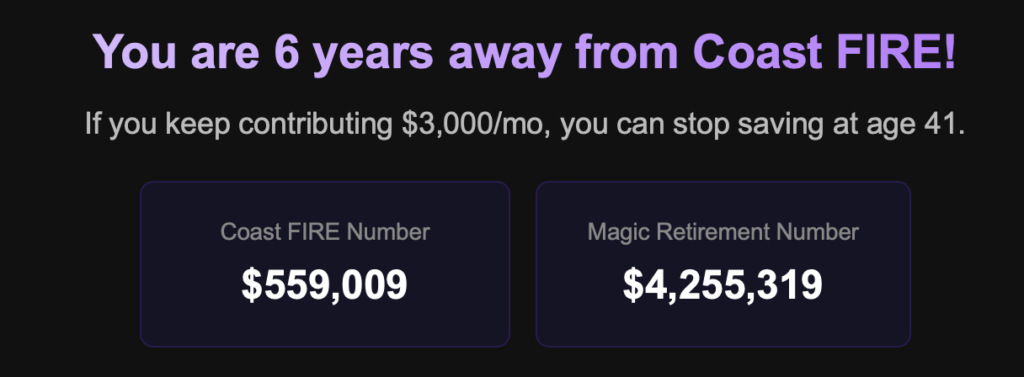
    Personally, after reading Die with Zero, I used the Think and Talk Money Coast FIRE calculator to estimate my projected retirement savings. As Perkins would have expected, at our then-savings rate, my wife and I risked over-saving for retirement. In other words, we have reached Coast FIRE.

    With that realization, I made some adjustments and am now targeting my other financial goals at a faster rate. I’m also not skipping out on any experiences that appeal to me because of fears about retirement.

    What is Coast FIRE?

    Coast FIRE relates to Perkins’ thesis that many of us are over-saving for retirement.

    The central idea behind Coast FIRE is to aggressively fund your retirement accounts early in your career so you won’t have to save for retirement as you get older.

    For lawyers more established in their careers, Coast FIRE represents the idea that all those earlier years of saving means you no longer need to worry about retirement. You can sit back and let compound interest do its thing. Your retirement years are covered.

    This is the essence of Coast FIRE: knock out retirement planning early on to create more career and life flexibility later. Coast FIRE does not mean you can stop working altogether. It means that you no longer need to save for retirement.

    Why is achieving Coast FIRE so beneficial?

    Because once you hit your projected magic retirement number, you no longer need to fund your retirement accounts. With retirement covered, you can reallocate those funds to other financial or life goals. That means you have more optionality in life.

    For example, you won’t need to earn as much money if you’re not allocating a big chunk of your income to retirement. That opens up the possibility of switching jobs or working fewer hours. It also means that you can focus more dollars on your present-day self.

    Achieving Coast FIRE also means that you can focus on adding present day liquidity to your portfolio. Liquidity means having cash and investments immediately available in case you need it. Increasing liquidity is an important step for maximizing optionality in your life.

    On top of that, when markets are dropping, knowing that you have cash-on-hand can give you a lot of confidence to ride out the dip.

    How do you figure out if you have achieved Coast FIRE?

    The easiest way to determine if you’ve reached Coast FIRE is to use an online calculator, like the Think and Talk Money Coast FIRE Calculator.

    Here’s an example.

    Let’s say you are 35-years-old and plan to retire at age 65. After 9 years of working at a law firm, you have $400,000 saved up in your various retirement accounts. You also currently contribute $3,000 per month to your retirement accounts.

    Your goal is to have $200,000 annually to spend in retirement.

    We’ll assume an average annual return of 10% (on par with the historical results of the S&P 500). We’ll also factor in a 3% inflation rate (the historical average in the United States). Finally, we’ll assume a safe withdrawal rate of 4.7% in light of the updated “4% Rule.”

    Now, we’ll plug these numbers in the Think and Talk Money Coast FIRE Calculator.

    Based on the above variables, your Coast FIRE number is $559,009. 

    Think and Talk Money Coast FIRE Calculator showing you're closer to retirement than you probably think.

    What does this mean?

    At your current saving rate, you will have $559,009 saved up and will reach Coast FIRE in six years. That means that at the age of 41, you will no longer need to fund your retirement.

    The big win is that the $3,000 you had been saving for retirement can be repurposed for other life goals or experiences.

    Yes, you need to keep earning money to sustain your present lifestyle. However, you have the option to pursue a lower paying, lower stress job because your retirement years are already covered.

    Note: Your FI number (magic retirement number) is significantly higher: $4,255,319. That’s how much money you’ll need saved up by the time you turn 65 in our example to spend $200,000 annually in retirement and not run out of money. Because of compound interest, your balance should grow to that amount without any additional contributions after age 41.

    When markets are falling, stick to investing fundamentals.

    If you are a young lawyer with a long investment horizon, you shouldn’t be concerned when markets are falling like they recently have been.

    Time is on your side. Stick to the fundamentals.

    I prefer to invest in broad based index funds, like Collins and Buffett recommend. Regardless of markets rising or falling, I make regular contributions and let compound interest work its magic.

    Because I have already achieved Coast FIRE, I am now focused on building more liquidity, which translates into more optionality.

    It’s not as much fun to track my net worth these days, but the cyclical nature of the markets is part of the process we need to accept.

    Young lawyers: what do you tell yourself when markets are falling, knowing you have a long horizon?

    Does it help stay the course if you talk to your people?

    Let us know in the comments below.

  • How the Jay Leno Rule Turbocharged my Net Worth

    How the Jay Leno Rule Turbocharged my Net Worth

    Jay Leno: former host of The Tonight Show and famous comedian.

    Rob Gronkowski: Super Bowl champion and celebrity spokesperson.

    Matt Adair: just like them.

    At least, in one way.

    The three of us follow the same money philosophy when it comes to how we earn and spend.

    This philosophy has become known as the “Jay Leno Rule.”

    Here’s how the Jay Leno Rule works, as explained by the man himself in an interview with CNBC:

    From the moment he entered the working world, “I always had two incomes,” [Leno] explains to CNBC. “I’d bank one and I’d spend one.”

    And he made sure to spend the smaller amount. 

    “When I was younger, I would always save the money I made working at the car dealership and I would spend the money I made as a comedian,” he says. ”When I started to get a bit famous, the money I was making as a comedian was way more than the money I was making at the car dealership, so I would bank that and spend the car dealership money.”

    “When I got ‘The Tonight Show,’ I always made sure I did 150 [comedy show] gigs a year so I never had to touch the principal,” Leno says. “I’ve never touched a dime of my ‘Tonight Show’ money. Ever.”

    ″So many people get to be the age I’m at now and they’ve got nothing because they just blew it all,” he says. “I put my money in a hammock and say, ‘You relax. I’m going to go work.’ And when I come back, I put some more money in the pile. 

    “It sounds ridiculous, but if everything ends tomorrow, I know I’ll be fine.”

    The Jay Leno Rule is such a simple and powerful money philosophy.

    The Jay Leno Rule boils down to three simple steps:

    • Earn income from multiple sources.
    • Spend only the money from one income source, preferably the smaller one.
    • Save and invest the rest.

    If you can employ this strategy, you can create significant wealth for you and your family.

    I’ve been following the Jay Leno Rule since 2011 when I started with my law firm and got my first job teaching at a law school. More on that below.

    First, let’s revisit Leno’s story.

    When we think of Leno today, we think of the famous and wealthy host of The Tonight Show. His net worth is estimated to be $450 million. He could buy anything he wants.

    But, read his story again. He developed good money habits before he got famous. He earned two incomes from working at a car dealership plus doing standup comedy shows and always saved one of those incomes.

    Don’t gloss over that part. Leno established a strong financial foundation early in his career, before he started making a ton of money.

    Because he had established the habit, he continued earning multiple salaries, even after his income soared with The Tonight Show. That’s impressive.

    Leno’s story shows why practicing good money habits is so important early in our careers.

    You’ll also notice that Leno took nothing for granted: “if everything ends tomorrow, I know I’ll be fine.”

    Leno wasn’t referring to the world ending. He was talking about losing his job. He meant that if is income went away, he had saved enough that he didn’t have to worry about it.

    That is freedom.

    brown football representing rob Gronkowski who never spent his NFL money and now is financially free.
    Photo by Sarah Elizabeth on Unsplash

    Rob Gronkowski follows the Jay Leno Rule.

    NFL legend Rob Gronkowski applied the Jay Leno Rule during his career as an NFL superstar and celebrity endorser. He explained his money philosophy recently on the “Bussin’ with the Boys” podcast:

    “I didn’t know how long the NFL was gonna last. I was a second-round pick, so it was like a four-year, $4 million deal, and I was like, if I can play this contract out, I’ll be set for life.

    I just always wanted to save it, and I just used my money that I was getting off the field to just spend it on whatever I needed to spend it on. Technically, I have not spent any of my NFL money.”

    Gronk is a very smart man. Just like Leno, he established the habit of saving one of his sources of income early in his career.

    Again like Leno, he didn’t take his career for granted. He didn’t fool himself into thinking that his high salary would always be coming in. Even if he got injured or failed to perform during his initial contract, he would be just fine.

    Imagine how much confidence that gave him on and off the field. Because he knew he was set financially, he did not have added pressure to perform. He could be himself and play the sport that he loved without worrying about his next contract.

    There’s no doubt in my mind that feeling of financial freedom helped him perform at his best on his way to winning four Super Bowls.

    How I’ve applied The Jay Leno Rule to build significant wealth.

    Just like Gronk, I have applied the Jay Leno Rule since I first earned multiple income streams in 2011.

    Back then, I had just left my first job after law school as a judicial law clerk and started at my law firm. It was also the first year I taught a law school course.

    My primary financial goal at the time was to pay off my student loan debt. The Jay Leno Rule helped me do just that in a fraction of the time it otherwise would have taken.

    Executing the strategy was easy. When I received my monthly paycheck from teaching, I immediately made an extra payment on my loans. It gave me an emotional boost to put that money to good use before I was tempted to blow it on something else.

    I wasn’t earning a lot teaching back then, but every bit helped to accelerate my debt payoff.

    You can play around with my Student Loan Payoff Calculator and see for yourself how even small extra payments can make a huge difference.

    I did the same thing with any bonus I received: as soon as it hit my account, I used it to pay off my loans.

    The Jay Leno Rule works because it forces you to save money.

    We know that our saving rate is the one thing we can truly control on our way to financial independence.

    Even though most of us would agree that we should be saving more money, sometimes it’s easier said than done. That’s where Jay Leno’s Rule is so helpful. If you commit to the philosophy, you’ll be forced to automatically save your supplemental income.

    Once you commit to the philosophy, the execution is easy.

    As soon as the money hits your checking account, you move it to one of your savings or investment accounts, or use it to pay off debt. Do this right away so you don’t get tempted to spend the money elsewhere.

    This is exactly what I continue to do today because I knew that if the money sat in my checking account, it would slowly disappear.

    One other tip: don’t include this money in your Budget After Thinking. Pretend you never even had the money. This is a money mindset trick that will help you solidify the habit.

    Because my teaching paychecks and bonuses were irregular, I did not factor them into my budget. It might sound silly, but I just pretended that extra money wasn’t really mine. As soon as it came in, I put it to good use.

    Help yourself out by pretending your supplemental income isn’t even yours. This applies to side hustles, bonuses, windfalls, etc.

    Use this extra money to advance your financial goals and continue living off of your salary.

    The key to establishing the habit is starting early in your career, like Leno and Gronk did. It’s important to do this before you become dependent on spending the supplemental income.

    I have used the Jay Leno Rule since 2011 to turbocharge my net worth.

    As the years went on, my wife and I have added income streams and continue to use the Jay Leno Rule. Here’s a snapshot of our income streams:

    • My salary as an attorney
    • Bonuses earned as an attorney
    • My wife’s salary as an attorney (until 2025)
    • Chicago Rental Property 1
    • Chicago Rental Property 2
    • Chicago Rental Property 3
    • Colorado Rental Property
    • Law School Course 1: Financial Wellness for Lawyers
    • Law School Course 2: Moot Court & Appellate Advocacy S.1
    • Law School Course 3: Moot Court & Appellate Advocacy S.2

    Adhering to the Jay Leno Rule, my wife and I have only ever spent our salaries as attorneys. The rest of the income we earn goes directly to our financial goals.

    Since 2011, we’ve built significant wealth by applying this simple strategy. Our financial goals evolved, but the strategy remained the same: earn multiple sources of income, live off of one source, invest the rest.

    Early in my career, my primary financial goal was to get out of debt. Whenever I earned a bonus or a paycheck from teaching, I immediately transferred the money out of my checking account to pay down the debt.

    Within a few years, my debt was gone.

    But, I didn’t stop applying the Jay Leno Rule just because I was out of debt.

    I had already done the hard part and established the habit of using any supplemental income for financial goals. That made it easy to then use any supplemental income to build up my assets.

    That meant I could more aggressively invest in the stock market and more quickly acquire rental properties.

    Today, my wife and I continue to apply the Jay Leno Rule. Any income from bonuses or side hustles goes immediately to paying off debt or to fueling our investments.

    At first, I didn’t fully appreciate the impact the Jay Leno Rule had on my finances. That’s how personal finance works. It takes time for compound interest to work its magic.

    Now, I’m seeing the results from the “forced savings.”

    And, I’m so grateful that I learned the Jay Leno Rule early in my career.

    person in yellow jacket running down a road showing what it means to hustle to financial freedom.
    Photo by Oskar Smethurst on Unsplash

    I’ve had side hustles for just about my entire career as a lawyer.

    My first side hustle was as an adjunct professor at a local law school, teaching just one class. I made hardly any money when I started teaching. It didn’t matter to me. I wasn’t dependent on the money to feed my lifestyle.

    I was playing the long game. Because I got my foot in the door and did a good job, the school took notice. At my peak, I was asked to teach four classes. That meant I earned a lot more and could put all that extra income to financial goals. 

    At the same time, I also launched a rental property business with my wife. We now manage 11 rental units in Chicago and Colorado.

    By the way, earning more money does not only apply to side hustles.

    There are always ways to make more money within your primary job. 

    For example, can you earn a larger bonus by performing better?

    Can you ask your employer for more responsibilities and a corresponding raise?

    Or, can you earn additional money by generating business for your company? 

    It’s no secret that lawyers have the ability to earn more money if they generate business. That means bringing in clients.

    How can you find these clients?

    You can make it a priority to go to more events where you might meet potential clients. 

    You could launch a blog or create other content to help people find you and know what you do.

    Either one of these pursuits could be your side hustle.

    There are endless opportunities for anyone that is motivated and is looking to earn more money.

    And when you earn and invest that additional money, you’re on your way to financial independence without having to sacrifice the things that make your daily life enjoyable.

    If you take on a side hustle, don’t forget the Jay Leno Rule.

    I recommend that every young lawyer take on a side hustle or look to earn supplemental income. And, when you start earning extra money, don’t spend it. Apply the Jay Leno Rule.   

    Never forget that when it comes to side hustles or supplemental income, it’s what you do with that extra money that makes it worth it.

    A side hustle is another time commitment, after all. If you’re going to take on the responsibility, make sure it counts.

    Before you consider a side hustle, have a plan in place for why you want additional money.

    Are you looking to pay down debt faster?

    Save for a wedding?

    Invest in your first rental property?

    To help you think through why you might want a side hustle, check out these three posts:

    BTW, you’re not too busy or important for a side hustle.

    Some lawyers reading this will automatically think, “I’m way too busy to even think about another job.”

    In my personal finance class for law students, we spend a lot of time challenging that notion. Very few people- and I mean very few- are too important or too busy to take on a side hustle.

    You may think you’re one of those “too important” people. I would challenge you to assess whether you’re confusing “too important” with “too stressed.”

    Setting that conundrum aside, the ideal side hustle is something you enjoy doing that can earn you extra money at the same time. Some examples my students have come up with in class include:

    • Bartending. Entice your friends to come to your bar by offering cheap drinks. You get to hang out with them and get paid at the same time.
    • Fitness instructor. Instead of paying $48 for the spin class you love, become the instructor and get paid to lead the class.
    • Dog Walker. If you love dogs and don’t currently have one of your own, what better way to fill that void in your life while making money. The same applies to babysitting.
    • Home Baker. Make homemade treats with your kids and sell them to parents who don’t have the time.

    The point is there are always ways to make more money by doing things you like to do anyways. Even if you’re busy. You just have to exert some mental energy to figure out how.

    a mug on a desk indicating that we an all have a side hustle to reach financial freedom.
    Photo by Garrhet Sampson on Unsplash

    This idea of being “too busy” reminds me of a conversation my dad and I had when I was in high school.

    Growing up, my siblings and I were busy kids. Sports, clubs, performances, classes, you name it. I made a remark to my dad about it at one point.

    He responded that being busy wasn’t a bad thing because you don’t have time to fool around. When you have no choice other than to stay focused, you actually perform better in all facets of life.

    You’re not thrown off by distractions because you’re locked in on accomplishing your goals. Back then, that meant going to class followed by soccer or basketball practice, a quick dinner, some homework and bed. I didn’t have any time for fooling around.

    The same is true today.

    I take care of business as best I can, while prioritizing my family and my health, and don’t have a lot of time to goof around.

    I can see your eye rolls through your screen.

    This guys is nuts. He’s a workaholic. He has no life.

    The people who know me best would beg to differ.

    They might even tell you that I’m pretty good at spending my working hours doing what is meaningful to me. And, that I spend my personal time with the people who are meaningful to me.

    If you want to get ahead financially, you really only have two options.

    At the end of the day, there are really only two ways to get ahead financially: spend less money and/or make more money.

    Of course, if you really want to get ahead financially, earning more money at the same time you’re spending less money is a dominate combination.

    This is what Jay Leno and Gronk did. It’s also what I did.

    I was talking to a friend recently. He wants to improve his financial situation. After all of life’s expenses, he doesn’t have much left to invest and get ahead.

    We talked about how there are no shortcuts. He either needed to start making more money or needed to spend less. It wasn’t what he wanted to hear at first. He wanted a quick fix.

    Money doesn’t work that way, even if you win the lottery, inherit a large sum of money, or earn a huge bonus. If you don’t have a strong foundation, that money will disappear as soon as you get it.

    If you take on a side hustle, you can use every dollar you earn to get ahead. Since this is new money you’re earning, you shouldn’t need it to fund your life’s expenses

    Avoid the temptation of using that money on things you don’t really want anyways.

    One more tip: use a financial calculator to see how much faster you’ll reach your goals if you’re able to throw additional money at them each month. Track and watch your net worth grow.

    If you’re not ready for a side hustle, the same logic applies anytime you earn a bonus or commission at your primary job. Put that money to good use by paying down your debt.

    Start using the Jay Leno Rule and never look back.

    This concept of living off of my salary and not spending any bonus or side hustle income is one of the biggest reasons for my net worth today.

    I recommend anyone striving for financial independence make the same commitment to not spend your supplemental income.

    The hard part is getting past the initial temptation to spend your bonus money. If you can convince yourself that you don’t need the money right now to live the good life, you will be significantly better off down the road.

    One of my favorite experiences teaching personal finance to law students involved a side hustle story. A couple of years ago, a student approached me during a break and told me about his credit card debt. It had been weighing heavily on him.

    After our discussion about side hustles, he committed himself to driving for DoorDash and using the income to pay off his credit card balance.

    Six months later he sought me out to share that the plan worked. His side hustle allowed him to pay off his credit card in less than six months. All while working a full-time job and attending law school par-time.

    I couldn’t have been happier.

    Jay Leno would certainly have approved.

    Do you adhere to the Jay Leno Rule?

    Has it helped accelerate your progress towards financial independence?

    Let us know in the comments below.