
Tag: law students

  • My Advice: Sometimes You Gotta Spend the Money

    My Advice: Sometimes You Gotta Spend the Money

    The financial independence community sometimes gets a bad rap for encouraging excessive saving at the expense of present day spending.

    The reputation is not entirely undeserved.

    I listened to a podcast once where the guest admitted to the folly of trying to replicate Trader Joe’s trail mix by buying each of the ingredients individually and mixing them himself.

    I thought to myself, “This is what financial independence is about?”

    That never sat right with me.

    The podcast guest was happy enough to admit that the meager savings from making his own trail mix was not worth his time or energy. Still, if there was ever one aspect of the financial independence community that turned me off, it was advice like “make your own trail mix.”

    He was not alone in promoting what I considered excessive frugality. The word “miser,” referring to someone extremely stingy with money, comes up regularly in criticisms of people pursuing financial independence at all costs.

    To this day, I’ve never connected with the voices that promote extreme saving at the expense of present day convenience and fulfillment.

    I’ve also come to learn that this type of personal finance advice doesn’t work for lawyers.

    Advice like “make your own trail mix” doesn’t work for lawyers.

    As lawyers, we invest a lot of time (and money) into our education and careers. It’s no secret that we work long, stressful hours. One of the tradeoffs for all the hours we put in is that we have the opportunity to earn high incomes.

    Considering we work long hours and earn good money, advice like “make your own trail mix” isn’t very helpful. It’s not worth saving a few pennies in exchange for our limited free time when we could be doing the things that make us happy. When we’re not working, our time and energy should be better spent elsewhere, like being with our family, socializing with friends, or relaxing.

    What I’ve learned teaching personal finance to lawyers is that we are generally not interested in saving every penny possible until we can quit our jobs. This makes sense to me. Putting that much constraint and pressure on ourselves does not sound like a fulfilling existence.

    The lawyers that I work with know they need to save for retirement. At the same time, they want to use some of their hard-earned money for a better existence today.

    That’s why I recommend that lawyers spend money in ways that increase happiness, convenience and time. One of the best ways to practice this type of intentional spending is to create a Budget After Thinking.

    When you follow a Budget After Thinking, you give yourself permission to spend on things that make you happy today, while still achieving your long-term goals.

    Personally, shopping at Costco is an example of spending money today that brings me happiness, convenience, and time.

    A detailed close-up view of a mixed nuts and dried fruits snack, showing natural textures and colors. Ideal for healthy eating, nutrition, and food background concepts and illustrating why sometimes you gotta spend the money.
    Photo by Monaz Nazary on Unsplash

    What I learned about spending money by shopping at Costco.

    This past Sunday afternoon, my wife and I took the kids to Costco. I was thinking about all this while we walked through the store loading up our two carts.

    It was a nice family outing. We killed a couple of hours, the kids had fun, and we have food and supplies to last us for a month.

    On average, we shop at Costco once per month. We get our staple items (toilet paper, ground beef, coffee, etc.) and always end up with a few things not on our shopping list. On this weekend’s trip, the kids talked their way into Kit Kat chocolate bunnies (didn’t even know they made those) and enough AA and AAA batteries to power an airplane.

    The thing about shopping at Costco: no matter your best intentions walking into the store, the final bill is always big. Somehow, the cart always fills up. What a business!

    Anyone who shops at Costco will instantly know what I’m talking about.

    I’m no longer shocked or disappointed with the final bill. When my wife jokingly asks what the total is, my answer is always the same, “A lot.”

    What I’ve learned is that despite spending a lot of money at Costco, I view this as money well spent. We usually pick up some fun items that are relatively inexpensive and make us and the kids happy. Plus, because we load up on essential items to get us through the month, we don’t spend much time or money each week at the grocery store.

    Even though the final bill is always big, I view shopping at Costco as an example of intentionally spending money in a way that increases happiness, convenience, and time.

    Which leads me to one of the most important money lessons I’ve ever learned:

    Sometimes, you gotta spend the money.

    Sometimes, you gotta spend the money.

    Personal finance is not only about saving. Yes, saving is crucial to achieving our long-term goals. But, I don’t recommend that we save so dogmatically that we make ourselves miserable along the way.

    As lawyers, we work hard and we work a lot. If all we did was save every penny we earned in hopes of quitting our jobs one day, we would quickly burnout.

    Instead of making your own trail mix, remember this piece of advice:

    Sometimes, you gotta spend the money.

    Buy the direct flights.

    Costco is only one such example of when it makes sense to spend the money. I spend a lot of money at Costco each visit. But, we enjoy our family outings and get most of the essential items we need for the month in one trip. That’s money well-spent on happiness, convenience and time.

    If my goal was to save every penny possible, I wouldn’t feel the same way about Costco.

    Not a Costco shopper? Here’s another recent example when I decided to just spend the money.

    My brother-in-law’s wedding is in Scottsdale this fall. When I booked our flights, I could have saved real money by connecting in Denver or Los Angeles instead of flying direct to Phoenix. But, at what other cost?

    Anyone ever flown across the country with young kids?

    A four-hour flight with three young kids is hard enough. My wife has it especially tough with the baby on her lap the entire flight. By the time we land, it feels like we just worked out for 4 hours.

    The last thing in the world that we need is to extend the adventure with a connecting flight, even if it saves real money. My priority is to arrive in Arizona feeling energized and excited to celebrate this once-in-a-lifetime event with my family.

    Sometimes, you gotta spend the money.

    boy shopping for stuffies indicating sometimes you gotta spend the money.

    Personal finance is tied to our emotions.

    Humans are emotional creatures. Of course, we can rationally look at examples and charts and won’t dispute the long term magic of compound interest. At the same time, we have emotions and feelings that need to be tended to now.

    At Think and Talk Money, we regularly explore how personal finance is tied to our emotions. There’s nothing wrong with admitting that in certain situations, the right choice is to spend the money.

    Traveling is a good example of spending money to increase happiness. In fact, the happiness effect has been well-documented when it comes to traveling. People get a happiness boost in planning the trip, then taking the trip, and finally remembering all the fun things they did on the trip.

    That’s why so many people “love to travel.” It brings them happiness before, during, and after the trip.

    Personal finance is about how we spend money today, not just in the future.

    Personal finance is not just about long term goals, like saving for retirement. Just as important, personal finance is about how we spend our money in the present.

    It’s not realistic to expect people to put off all happiness until some unknown time in the future. It is realistic to make reasonable choices now to ensure a better future.

    What might be a reasonable spending choice for one person may be totally unreasonable for someone else. That’s perfectly fine. Still, we all need to make those choices for ourselves.

    What I’m suggesting is that if you’re spending most of your time each week at your job, like most of us lawyers do, shouldn’t we think about using some of the money we earn so we can elevate our present day lives? 

    The key is understanding what those things are, so we actually spend our money in pursuit of those things.

    That’s the essence of what it means when I say, “s , you gotta spend the money.”

    So, what’s a recent example of where you decided to spend the money?

    Let us know in the comments below.

  • Young Lawyers: What to Do When the Market Slides

    Young Lawyers: What to Do When the Market Slides

    The stock market has been sliding so far in 2026.

    As of this writing, the S&P 500 is down 3.3% in 2026 and the Dow is down 3.8%.

    The market can change suddenly, for better or worse. Nobody knows what’s going to happen. Don’t believe anyone who tells you otherwise.

    During times like this, it’s important for all of us, and especially young lawyers, to remember the fundamentals of investing.

    I was asked recently, “What am I doing with my portfolio while markets are falling in early 2026?”

    Despite how chaotic it may seem in the world today, this is not a difficult question for me to answer. 

    I’m not doing anything.

    I invest in the stock market to help achieve my long-term goals. My two main long-term goals are to save for college and to save for retirement. 

    Each objective is so far away that time is on my side.

    Our oldest child is six-years-old, so I have 12-13 years until she even begins college. Over the past two years, we super-funded a 529 college savings plan for my oldest daughter and my son. We plan to do the same for our baby girl.

    I fully anticipate that the market is going to go up and down over the next two decades while my kids are in school. That’s part of the process.

    As for retirement, I have even more time in front of me. Same as what we just talked about with saving for college, I fully expect the market is going to go up and down many times before I retire.

    Time is on my side. That’s why I’m doing nothing.

    Like you, I don’t enjoy seeing my portfolio drop so suddenly.

    It’s not fun to read the headlines right now. My brain seems to jump to the worst case scenario. Maybe you do the same thing. As lawyers, we’re trained to think of the worst case scenario, right?

    This is one of the reasons why I only look at my portfolio once per month when I track my net worth.

    To remind myself to hold steady during the down times, I think of a study that examined what would happen if an investor missed the 10 best days for the market in each decade since 1930. 

    As summed up by CNBC:

    Looking at data going back to 1930, the firm found that if an investor missed the S&P 500′s 10 best days each decade, the total return would stand at 28%. If, on the other hand, the investor held steady through the ups and downs, the return would have been 17,715%.

    These results illustrate how risky it would be for me to try to time the market. The last thing I want to do is miss the upswing. I have no idea when it’s coming. 

    But, time is on my side. 

    I’m going to be in the market when that upswing eventually comes. It may not be until years from now. That works for me and my investment horizon.

    Think of it this way: the market is on sale right now.

    One other mental hack that’s helping me right now:

    I’m telling myself that the market is on sale. How so? I can buy the exact same stocks today for less money than they would have cost even a few days ago. I do love a good sale.

    In the end, no matter how bad things seem right now, I plan to continue making regular contributions to each of my investment accounts. 

    Since I’m investing for the long run, I’ll let the market do its thing while I’m off doing my own things.

    Disclaimer: Your situation may be different. I am not an investment advisor. Do your homework and make the best decisions for your personal situation.

    What is my personal investing strategy?

    When it comes to investing in the markets, I’m about as boring as can be. 

    My wife and I invest primarily in index funds. We are not active traders. We don’t seek out the newest, hottest stocks.

    All we do is make regular contributions to our various investment accounts and let the markets take care of the rest.

    As an example, for my daughter’s 529 plan, we chose a passive investment option that’s a mix of stock index funds and bond index funds.

    Our portfolio automatically rebalances over time based on my daughter’s projected first year of college. Essentially, the closer we get to her first year in school, the more conservative our portfolio becomes.

    We chose a similar option for our other kids’ 529 plans. It’s boring but it works.

    Why index funds?

    I wrote a post detailing the 7 reasons why I love index funds. Here’s a preview:

    1. Anybody can do it
    2. No wasted mental energy
    3. Low fees
    4. Automatic diversification
    5. The closest thing to predictability
    6. I don’t have stock FOMO
    7. Good enough for Buffett, good enough for me

    Like so many others in the financial independence community, I fell in love with index funds after reading J.L. Collins’ book The Simple Path to Wealth. You can read my full review of The Simple Path to Wealth in my post here.

    Even if you work with a financial advisor, it’s crucial to educate yourself so you can make informed decisions, especially in times of economic uncertainty like we’re in right now. As Collins explains, benign neglect of your finances is never the solution.

    By the way, it’s not just Collins urging us to invest in broad based index funds. So does the single greatest investor of our lifetimes, if not ever: Warren Buffett.

    In 2013, Buffett famously instructed that after he dies, his wife’s cash should be split 10% in short-term government bonds and “90% in a very low-cost S&P 500 index fund.”

    Good enough for Buffett, good enough for me.

    For more on index fund investing, check out our full series on investing.

    man sitting on bench during sunset showing that when markets decline it's important to chill and not make sudden investing mistakes.
    Photo by Free Walking Tour Salzburg on Unsplash

    How much money should you put towards each of your financial goals?

    Between saving for emergenciessaving for college, and saving for retirement, there are a lot of options. In addition, you may have other short term goals, like paying for a wedding or a house. Or, you may want to invest in real estate.

    So, how do you determine how much to allocate to each goal?

    There’s no perfect answer here. 

    The first thing you should do is to spend some quality time formulating your version of Tiara Goals for Financial Freedom.

    Then, let those goals inspire conversations with your people to help you make the best decisions. This is exactly how my wife and I came up with our financial goals for this year.

    It also helps to attach specific targets to your financial goals, like we did when we estimated how much you should be saving to pay for college.

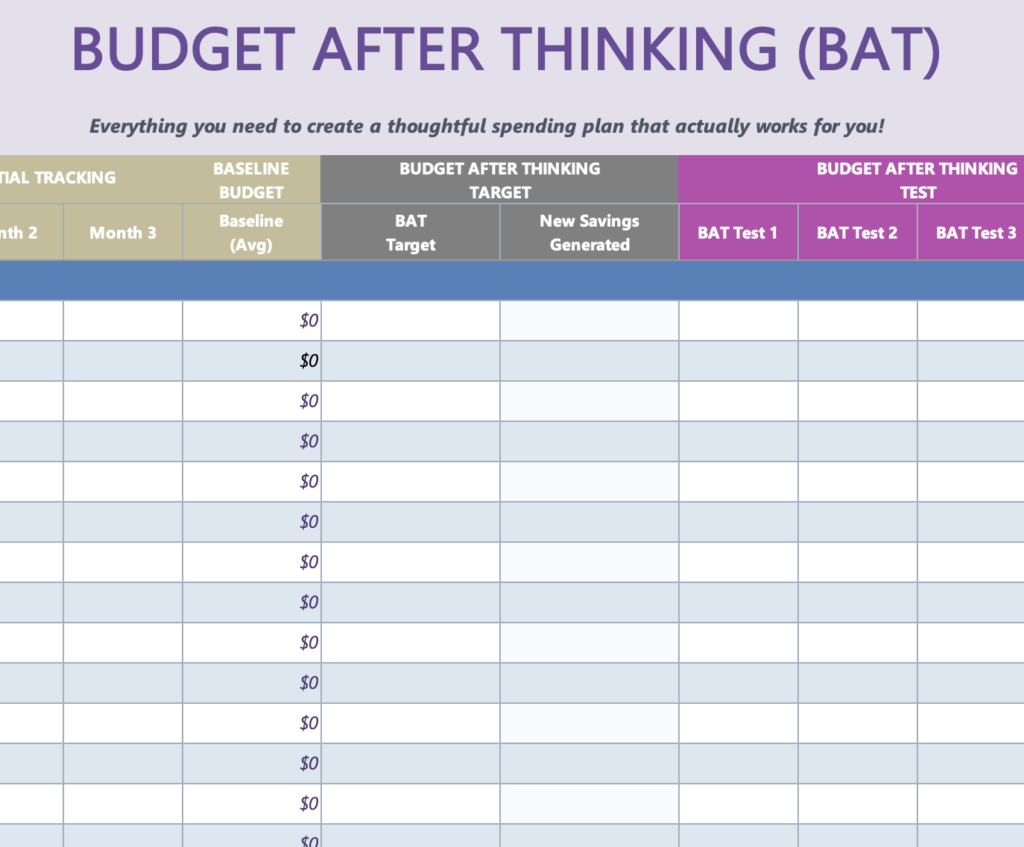
    Once you know what you’re striving for, it’s time to commit to a Budget After Thinking. The primary focus of a Budget After Thinking is to generate fuel for the most important goals in your life.

    Are you saving too much for retirement?

    Spend enough time on the internet, and you’ll get many different answers about how much to save for retirement. There are just too many variables in play to generally answer this question, like what kind of retirement you want and when you want to retire.

    My perspective on retirement savings evolved after reading Die with Zero by Bill Perkins.

    In Die with Zero, Perkins suggests that many of us are saving too much for retirement at the expense of using that money to live our best lives now. 

    Perkins’ book is one of the most compelling personal finance books I’ve read in a long time, and I highly recommend it.

    Perkins is not suggesting that saving for retirement isn’t important. He’s saying that the hard data shows that most of us are over-saving.

    Believe it or not, you may be closer than you think to achieving your retirement goals.

    That’s a very powerful realization.

    Think about the options you can create for yourself if you no longer need to save a hefty chunk of your paycheck for retirement.

    Personally, after reading Die with Zero, I used the Think and Talk Money Coast FIRE calculator to estimate my projected retirement savings. As Perkins would have expected, at our then-savings rate, my wife and I risked over-saving for retirement. In other words, we have reached Coast FIRE.

    With that realization, I made some adjustments and am now targeting my other financial goals at a faster rate. I’m also not skipping out on any experiences that appeal to me because of fears about retirement.

    What is Coast FIRE?

    Coast FIRE relates to Perkins’ thesis that many of us are over-saving for retirement.

    The central idea behind Coast FIRE is to aggressively fund your retirement accounts early in your career so you won’t have to save for retirement as you get older.

    For lawyers more established in their careers, Coast FIRE represents the idea that all those earlier years of saving means you no longer need to worry about retirement. You can sit back and let compound interest do its thing. Your retirement years are covered.

    This is the essence of Coast FIRE: knock out retirement planning early on to create more career and life flexibility later. Coast FIRE does not mean you can stop working altogether. It means that you no longer need to save for retirement.

    Why is achieving Coast FIRE so beneficial?

    Because once you hit your projected magic retirement number, you no longer need to fund your retirement accounts. With retirement covered, you can reallocate those funds to other financial or life goals. That means you have more optionality in life.

    For example, you won’t need to earn as much money if you’re not allocating a big chunk of your income to retirement. That opens up the possibility of switching jobs or working fewer hours. It also means that you can focus more dollars on your present-day self.

    Achieving Coast FIRE also means that you can focus on adding present day liquidity to your portfolio. Liquidity means having cash and investments immediately available in case you need it. Increasing liquidity is an important step for maximizing optionality in your life.

    On top of that, when markets are dropping, knowing that you have cash-on-hand can give you a lot of confidence to ride out the dip.

    How do you figure out if you have achieved Coast FIRE?

    The easiest way to determine if you’ve reached Coast FIRE is to use an online calculator, like the Think and Talk Money Coast FIRE Calculator.

    Here’s an example.

    Let’s say you are 35-years-old and plan to retire at age 65. After 9 years of working at a law firm, you have $400,000 saved up in your various retirement accounts. You also currently contribute $3,000 per month to your retirement accounts.

    Your goal is to have $200,000 annually to spend in retirement.

    We’ll assume an average annual return of 10% (on par with the historical results of the S&P 500). We’ll also factor in a 3% inflation rate (the historical average in the United States). Finally, we’ll assume a safe withdrawal rate of 4.7% in light of the updated “4% Rule.”

    Now, we’ll plug these numbers in the Think and Talk Money Coast FIRE Calculator.

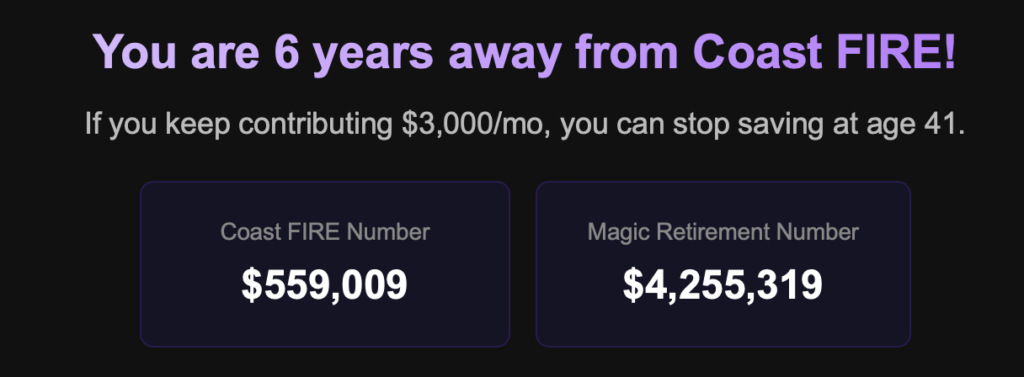
    Based on the above variables, your Coast FIRE number is $559,009. 

    Think and Talk Money Coast FIRE Calculator showing you're closer to retirement than you probably think.

    What does this mean?

    At your current saving rate, you will have $559,009 saved up and will reach Coast FIRE in six years. That means that at the age of 41, you will no longer need to fund your retirement.

    The big win is that the $3,000 you had been saving for retirement can be repurposed for other life goals or experiences.

    Yes, you need to keep earning money to sustain your present lifestyle. However, you have the option to pursue a lower paying, lower stress job because your retirement years are already covered.

    Note: Your FI number (magic retirement number) is significantly higher: $4,255,319. That’s how much money you’ll need saved up by the time you turn 65 in our example to spend $200,000 annually in retirement and not run out of money. Because of compound interest, your balance should grow to that amount without any additional contributions after age 41.

    When markets are falling, stick to investing fundamentals.

    If you are a young lawyer with a long investment horizon, you shouldn’t be concerned when markets are falling like they recently have been.

    Time is on your side. Stick to the fundamentals.

    I prefer to invest in broad based index funds, like Collins and Buffett recommend. Regardless of markets rising or falling, I make regular contributions and let compound interest work its magic.

    Because I have already achieved Coast FIRE, I am now focused on building more liquidity, which translates into more optionality.

    It’s not as much fun to track my net worth these days, but the cyclical nature of the markets is part of the process we need to accept.

    Young lawyers: what do you tell yourself when markets are falling, knowing you have a long horizon?

    Does it help stay the course if you talk to your people?

    Let us know in the comments below.

  • Pay Attention to the Little Stuff to Reach Your Money Goals

    Pay Attention to the Little Stuff to Reach Your Money Goals

    Being good with money starts with the little stuff.

    What I’ve learned teaching personal finance is that too many of us want to race right to the finish line. We want to skip ahead to mile 26 without completing the rest of the marathon.

    Money doesn’t work that way. There’s no magic switch to skip over the hard part. The little stuff matters.

    Picture the young lawyer who graduates with $100,000 in student loan debt. Absent some unlikely windfall, it’s going to take years of consistent payments to eliminate that debt.

    No matter how badly the young lawyer wants that debt to go away, he’s going to carry it for a while. There’s simply no fast way to eliminate hundreds of thousands of dollars of debt.

    But, there are faster ways.

    I’ll show you exactly what I mean below using the Think and Talk Money Student Loan Calculator.

    What you’ll notice is that every $20… $30… $50… decision can make a big impact on your overall financial picture.

    This isn’t to say that you shouldn’t spend your money on stuff that makes you happy today. What it means is that you should spend that money knowing how meaningful it could be down the road if used for your financial goals.

    Of course, this is easier said than done. When you’re staring down six-figures of debt, focusing on the little stuff may not seem that exciting. But, if you can make these types of small adjustments now, you can buy back years of your life.

    Focusing on the little stuff is how you get ahead.

    This discussion is not just for lawyers paying off student loans. The same idea applies if you’re trying to pay off credit card debt, save up to buy a home, or invest for your kid’s college.

    There are no fast ways to accomplish these goals.

    But, there are faster ways.

    In my opinion, too many of us don’t want to do the little stuff that will accelerate our financial journeys. We don’t take advantage of these faster ways.

    Instead of making intentional money decisions on a consistent basis, we spend mindlessly and hope to get bailed out with a huge bonus later on.

    That’s too risky. What if that bonus never comes? You’ve formed bad habits and set yourself up for trouble.

    If this sounds like you, you’re not alone. Too many Americans behave this way when it comes to spending instead of saving.

    Would it surprise anyone to learn that most Americans are not satisfied with the amount they have saved?

    According to a recent survey from Yahoo Finance/Marist Poll:

    • Only 10% of households are completely satisfied with the amount of money they have saved.
    • Only 20% reported saving more in 2024 than in 2023.

    To me, these numbers prove that we aren’t doing the little stuff when it comes to our money.

    Unfortunately, these results aren’t surprising at all. They closely mirror the stats I first showed my students in my financial wellness class back in 2021.

    What happens when we don’t do the little stuff?

    Let’s look at another stat that illustrates what happens when we don’t do the little stuff:

    • About 33% of households would not be able to pay their bills or expenses for one month, if faced with a sudden loss of income.
    • This number rises to 38% of Gen Z and 41% of Millennials who report they could not pay their bills for even a month. 

    What do these numbers really mean?

    1 in 3 people currently reading this post, in the comfort of their homes they have worked so hard for, would not be able to afford those homes for even one month if they suddenly lost their jobs. It’s worse for Gen Z and Millennials.

    Put another way, maybe you’re on the train commuting to work while reading this. How many people are in the train car with you? 30 or so?

    Pick out 10 passengers, really look at their faces.

    They’re just like you, typically responsible people, working a job to provide for themselves and their families. If these 10 people suddenly lost their jobs, they wouldn’t be able to pay their bills next month.

    That’s scary.

    Count me in the group of people not completely satisfied with their savings.

    If you read these stats and are honestly not worried about your savings, you are in the minority and are doing a tremendous job managing your personal finances. 

    Keep up the good work and please let us know in the comments below what strategies are working for you.

    On the other hand, if you’re being honest with yourself, you’re most likely in the 90% of people that are not completely satisfied with their savings. 

    Count me in this group.

    From 2017 to 2024, my wife and I prioritized using all of our available money to acquire real estate. The downside was that left us limited funds for savings.

    We now have work to do to build our savings back up. Instead of presently shopping for investment properties, we are now focused on paying down mortgage debt and increasing our savings. 

    Most people attribute their low savings to rising cost of living.

    What is the most common explanation given by people that have so little saved? The rising cost of living across the nation:

    • Nearly 66% of Americans believe that the cost of living for the average family is not affordable in their area.

    Millennials and Gen X are the most worried about the cost of living, with more than 70% of each group feeling unprepared. 64% of Gen Z and 59% of Baby Boomers likewise feel unprepared.

    Cost of living includes necessary expenses like housing, food, transportation, and healthcare. In other words, Now Money.

    There are any number of reasons we can point to that are combining to drive up the cost of living, like limited housing inventory, higher interest rates, and more expensive groceries.

    Our goal should be to focus on what we can control. That means the little stuff.

    Let’s explore one way to pay more attention to the little stuff.

    grocery store is a great place to save even a little bit of money to make big differences in the long run with your finances.
    Photo by nrd on Unsplash

    So, what exactly can we do to focus on the little stuff?

    When it comes to establishing good money habits, don’t overcomplicate it. There’s nothing wrong with starting small.

    A good place to start is with how much money you’re spending on food, whether that means restaurants or groceries.

    Why start with food?

    There are endless options when it comes to spending money on food. We can choose to spend a lot, or a little, or somewhere in between.

    Curious how much the average American spends on dining out?

    According to a recent survey from CNET:

    The average adult spends $59.19 per week, which adds up to $236.76 per month and a whopping $2,832 a year. Some age groups spend even more.

    Of all generations surveyed, millennials (born roughly between 1981 and 1996) spend the most on restaurants and takeout. The average millennial spends $86.55 per week on takeout, which comes out to $346.20 per month and $4,154.40 a year. 

    Dining out is not the only area to target when it comes to how much you spend on food. CNET also found that we waste a lot of groceries that we end up throwing out:

    The average US adult wastes a significant amount of money on food from the grocery store that never gets used. An average of $31.25 weekly is spent on groceries that aren’t cooked or eaten, amounting to $125 per month and $1,500 a year. 

    For today’s example, let’s focus on this one area of consumption to see how the little stuff can make a big impact on our finances.

    How the little stuff can take years off your loan payments.

    Let’s focus just on that $125 per month on wasted food from the grocery store. It may not seem like a lot of money to waste, but it adds up.

    Let’s revisit our recent law school graduate with $100,000 in student loan debt. Let’s assume he has a 7.5% interest rate and currently pays $1,200 per month.

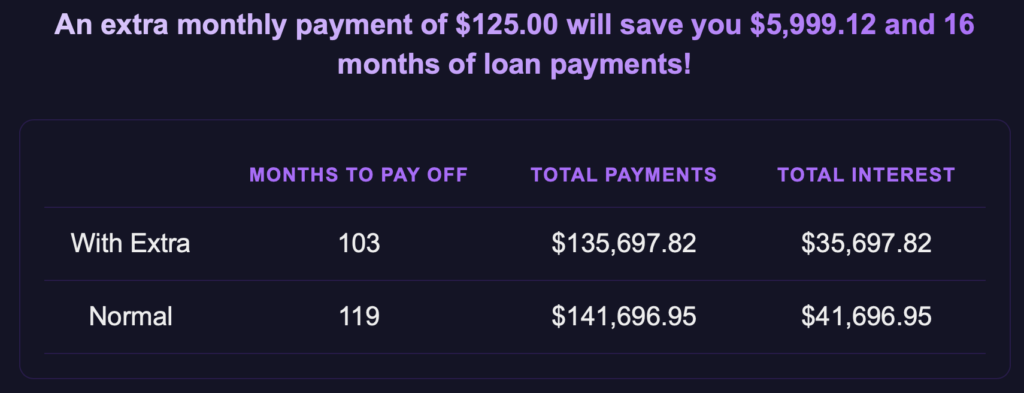
    Using the Think and Talk Money Student Loan Calculator, we can see that with no additional payments, it will take him 9 years and 11 months (119 months) to pay off his loans. He will pay a total of $141,696.

    Now, what if he can make an additional payment of $125 per month just by paying more attention to what he’s buying at the grocery store?

    With an extra monthly payment of $125, he could eliminate his loans 16 months faster and save $5,999 in total payments.

    even small extra payments make a huge difference in paying off debt faster using the Think and Talk Money student loan payoff calculator.

    Think about that.

    That’s more than a year of his life back without having to worry about loan payments. All he had to do was pay attention to the little stuff at the grocery store.

    What if you make a series of little decisions like this with your money?

    Let’s take it one step further. Let’s say our recent law grad also decides to spend $100 less on dining out each month. That’s only $25 per week, which is about what one lunch and one coffee cost these days.

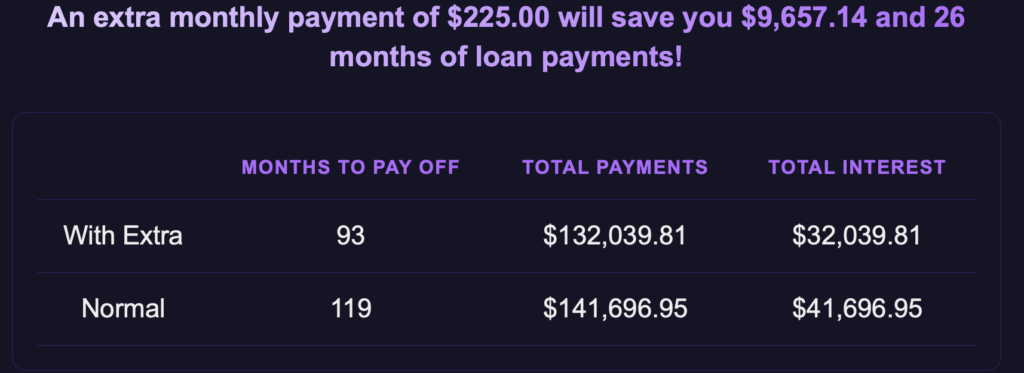
    By adding that $100 per month on top of the $125 he saved at the grocery store, he can shave off more than two years of loan payments and save $9,657.

    This example illustrates how consistently paying attention to the little stuff can pay massive dividends down the road.

    In this case, small adjustments with food can lead to thousands in savings and accelerate your journey to financial freedom.

    Pay attention to the little stuff to accomplish your financial goals.

    The big takeaway here is that achieving your financial goals starts with the little stuff. There’s no secret weapon or magic wand. You can’t finish mile 26 without completing miles 1-25.

    Just like with our recent law grad with six-figure debt, start small and reap the benefits down the road.

    Like we said earlier: there’s no fast way to achieve your money goals. But, there are faster ways.

    Paying attention to the little stuff may not be exciting, but it works.

    If you know a better way, I’d love to hear about it in the comments below.