
Tag: lawyers

  • Two Simple Questions to Evaluate Your Financial Position

    Two Simple Questions to Evaluate Your Financial Position

    I’ve been a student of personal finance for nearly two decades and have taught personal finance since 2021. Since I started Think and Talk Money in 2024, I’ve offered my opinions on what I consider to be the most important concepts in personal finance.

    After more than 150 blog posts, I’m still surprised at what opinions I share that generate the most pushback. For example, I recently gave you two simple questions to ask yourself to evaluate your current financial position:

    1. What happens if something goes wrong, like you lose your job or you have an unexpected medical expense?
    2. Can you take advantage if an incredible investment opportunity presented itself?

    My recommendation was that if you didn’t like your options when considering these questions, it’s a good sign that you should think about building a financial fortress. Building a fortress means having cash on hand. If you don’t have cash on hand, you’re not in a strong financial position, regardless of how much you earn or how many assets you own.

    People did not like hearing that they needed to keep cash on hand.

    I was surprised at how much pushback I received on this notion of keeping cash on hand. Some readers thought keeping cash on hand was not a productive use of money. Another reader challenged the idea that cash was important for investment opportunities.

    You can read my full post on keeping sufficient cash reserves here. In essence, cash is your first line of defense to protect your family. Cash covers you in times of medical or other emergencies, or if you lose your job.

    Unfortunately, that’s happening to a lot people these days as big tech reallocates resources to developing AI. Meta (Facebook) recently announced it’s cutting 10% of its workforce. Oracle is similarly cutting thousands of jobs to focus on AI. Having cash on hand keeps you afloat when your income dries up.

    To put it succinctly, cash is your safety net so you don’t lose all that you’ve built when times are tough.

    Cash is not just about playing defense. Cash also lets you take advantage of unexpected investment opportunities. These opportunities could be anything from buying stocks to buying into a business or law firm. This is sometimes referred to as “keeping your powder dry.” When you have cash, you can act decisively and with confidence.

    Think of cash on hand as a survival tool.

    Author Nick Maggiulli wrote about a similar concept in his recent blog post, “Survival is the Only Success.” Here’s what Maggiulli had to say after discussing millionaires and billionaires who had shockingly lost their fortunes:

    All of these falls from grace illustrate a deeper truth—survival is the only success. It doesn’t matter what you do in life if you can’t sustain it. You could make $100 million, but if you end up in a prison cell or broke, who cares? That’s not success. In fact, it’s the opposite.

    ***

    But they didn’t stop. Why? Because greed is a hell of a drug. Greed drives people to behave in absolutely irrational ways. It drives some people to risk everything for just a little bit more. It’s the most negatively asymmetric payoff you could imagine—the upside is capped, but the downside is unlimited.

    And yet people still make this trade all the time. There are people out there doing it right now. They may look successful today, but they won’t hold onto their success.

    Like Maggiulli, when I talk about having cash on hand, it’s because I want you to survive. Who knew survival was such a controversial issue?

    As attorneys, we should be even more motivated to survive than most. We’ve invested so much money and time into our educations and our careers. It would be a shame to see all that we’ve worked for disappear because we got greedy.

    Keeping cash on hand is the antidote to greed. Yes, you’ll give up some potential investment returns. But, you will have gained peace of mind that you can survive and keep what you’ve already acquired.

    The deeper you are into your career, the more you’ll start thinking about survival.

    17 years into my career as an attorney, this is where I currently find myself. I’ve worked hard to get to where I’m at today, and I don’t want it to all be for nothing. That’s why I am currently dedicated to saving up three years of cash.

    If you’re a new lawyer, you may not feel the same way. Trust me, you will.

    If surviving sounds controversial to you, please drop a comment below and let me know your preferred alternative.

    On the other hand, if surviving sounds important to you, consider building up your cash reserves.

    You don’t need to sell all of your assets and move to an all cash position. Investing is still as important as ever. However, don’t lose sight of preserving what you’ve created. Plus, as your career progresses and your assets increase in value, you have more to lose.

    If, like me, you are hoping to build up your cash reserves, it all starts with knowing where your next dollar earned is going.

    man making a fire indicating that cash is a survival tool.
    Photo by Ian Keefe on Unsplash

    Most of us don’t know where our next dollar is going. 

    The reason a lot of lawyers struggle to build up a cash reserve is because they don’t have a plan for where their next dollar is going. 

    Their income hits their checking account, they spend it on this or that, and pretty soon that money has disappeared. They haven’t used the money to advance any of their priorities, like building a fortress. 

    The money is just gone.

    To me, this is one of the most important money mistakes that we need to fix right away. If not, as your earnings increase, you’ll continue making the same mistakes, just with more money to lose.

    Having a plan for our money, before we earn it, is essential if we want to build our cash reserves. With a plan, we can eliminate those disappearing dollars with confidence that our money is being used to serve our purposes.

    So, how do you create a plan for your money before you earn it?

    You need to have a budget.

    Don’t think you’re too sophisticated or make too much money for a budget.

    Some people hear the word “budget” and immediately tune out. They think they’re too sophisticated or make too much money to worry about budgeting. Or, they don’t want to create a budget because they’re afraid of what it might reveal about their spending habits. Don’t be like these people.

    If you truly want to take control of your finances, there’s no getting around this first step. I’ve read hundreds of personal finance books, listen to money podcasts and read blogs every week, and continue to learn from the leaders in this field. In all my years studying and teaching personal finance, I’ve yet to find any credible person who believes you can reach your financial goals without first creating a budget.

    All of your most important money decisions stem from your budget. No, you don’t have to budget forever. No, you don’t have to be a servant to the spreadsheet. Once you have a plan in place that’s working, you likely won’t need to continue tracking your spending.

    But, to take control of your finances, you need to know where your money is going. It’s as simple as that.

    How to set up a budget that creates excess cash.

    The first step in generating excess cash is to evaluate where your money is actually going each month. Once you know where your money is going, you can come up with a realistic plan and make thoughtful adjustments that puts your money to good use.

    I call this process a Budget After Thinking.
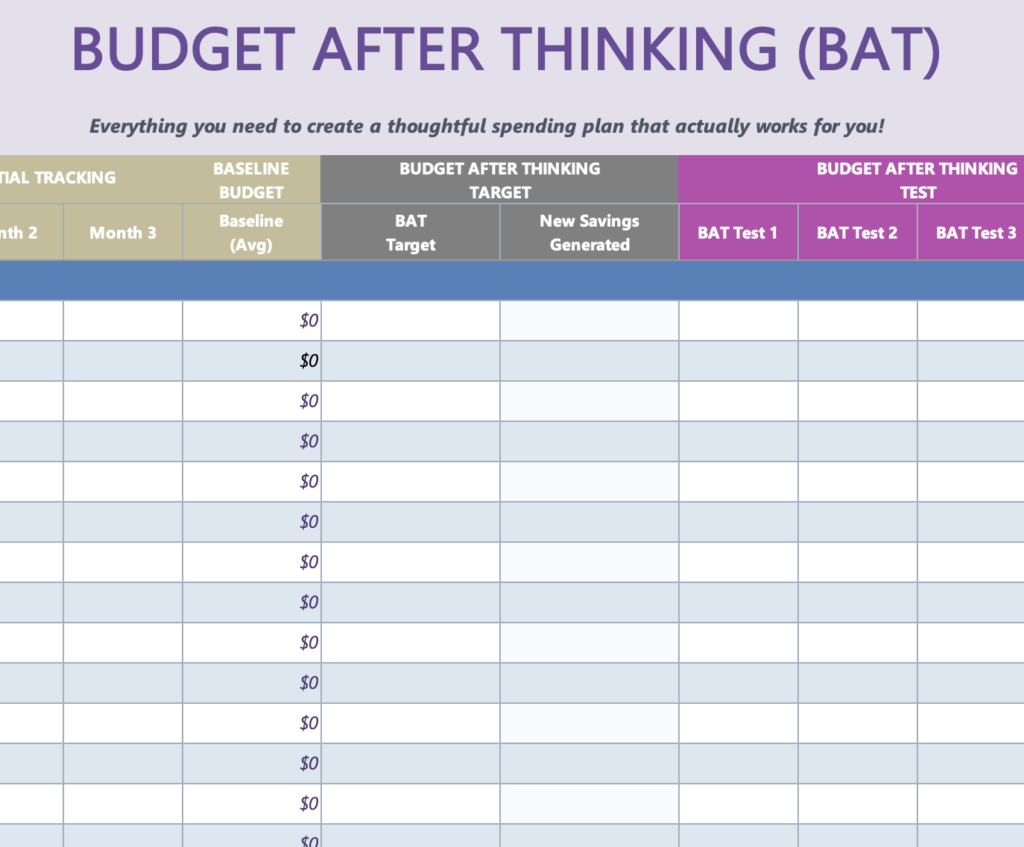
    budget after thinking spreadsheet to help lawyers realize where their money is going.

    The best part of creating a budget? You would be amazed at the confidence you can build if you can stick to a simple plan for your money.

    For a step-by-step guide on how to create a Budget After Thinking, read my post here and follow-up posts here and here.

    My budgeting philosophy is premised upon your actual spending habits and realistic adjustments. In other words, forget about aiming for predetermined, generic goals like saving 20% of your income. 

    I’ve taught enough law students and lawyers to know that these rigid, predetermined targets don’t work. With massive student loan debt and soaring costs of living, generic savings targets just aren’t helpful. 

    If you aim for some predetermined amount, you’ll end up cutting out everything you like spending money on to the point where you will resent your budget. Then, you’ll give up on your budget and fall back to your old habits.

    The beauty of creating a Budget After Thinking is that it is based upon a baseline budget of your actual, current spending habits. 

    In evaluating your current habits, you can then make thoughtful and realistic adjustments to that budget that will actually last. Through this process, you can accomplish the main goal of generating more fuel for your ultimate financial goals. That might mean building up your cash fortress or investing for long term goals.

    Two simple questions to evaluate your financial position.

    Let’s revisit our two simple questions:

    1. What happens if something goes wrong, like you lose your job or you have an unexpected medical expense?
    2. Can you take advantage if an incredible investment opportunity presented itself?

    The more cash you have on hand, the better you’ll feel about your answers to these two questions. That doesn’t mean you should stop investing, but it does mean that you can reallocate some of your excess money to savings.

    When you have cash, you can survive without losing all that you’ve built up. You can thrive by taking advantage of unexpected opportunities. In other words, create excess cash to survive and thrive.

    This concept is particularly important if you’re at all concerned about the current state of world affairs.

    If you’re not a fan of cash, drop a comment below and let me know more about your approach.

  • How Lawyers Can Think About Investing While in Debt

    How Lawyers Can Think About Investing While in Debt

    The Wall Street Journal recently wrote about the complicated financial lives of dentists. Reading the article, it was hard not to see the similarities in the financial challenges that we face as lawyers.

    Among America’s swelling ranks of moderate millionaires, few have more complex personal balance sheets than dentists.

    They earn high incomes, have built valuable businesses and have benefitted from the rising stock market of the past decade and a half. But they often graduate with significant student loan debt and spend years tying up money in building their practices.

    High incomes?

    Years of effort building our careers?

    Significant student loan debt?

    This article could just as easily been written about lawyers.

    The article continues:

    Entering their professional ives in a financial hole often leaves an indelible mark on the way dentists invest. Some take on risky self-directed investments, while others are forced to minimize their retirement savings until they pay off other obligations.

    This article serves as a reality check for anyone thinking that they’ll never have to worry about money if they simply obtain an advanced degree. To the contrary, choosing to take on student loans is a major decision that will impact your personal finances for years.

    The article also illustrates one of the most difficult money decisions that lawyers have to make: should we invest while in debt?

    Today, we’ll explore why I think it’s a good idea to start investing even if you’re paying off debt.

    It’s good to pay off debt and it’s good to invest.

    Same as the dentists featured in the WSJ article, It’s not uncommon for lawyers to have hundreds of thousands of dollars in debt.

    I regularly get questions about investing while in debt from law students who take my personal finance class. By the way, it’s not just lawyers with student loan debt who face this question. Maybe you have mortgage debt, medical debt, or consumer debt. Perhaps you’ve used a HELOC to buy investment property like I have.

    Regardless of the type of debt, I understand the urge to eliminate that debt as quickly as possible. Still, is it the best idea to avoid investing for the future until that debt is gone?

    I don’t think so.

    Obviously, we know two things to be true at once:

    Debt can be bad. 

    Investing can be good. 

    So, should we focus on eliminating the bad thing or doing more of the good thing?

    It’s not easy to serve two masters at once. How do we plan for the future while worrying about past debts?

    The way I see it? 

    You don’t have to choose only one door to walk through. 

    You can invest while in debt. But, striking the right balance can be tricky.

    The choice to pay down debt or invest for the future is tricky.

    Whatever the case may be, the choice to pay down debt faster or invest for the future is tricky. 

    For people feeling the heavy burden of debt, the idea of investing for some future goal can seem a little bit comical. I completely understand. 

    If you’re facing monthly debt payments for the next 10 years, you may not be ready to think about retirement 50 years from now.

    Trust me, I get it. 

    I know firsthand how heavy debt can feel. 

    In my 20s, I had both student loan debt and credit card debt. It was not fun to carry that debt burden. I’ll never forget the incredible feeling of accomplishment when I paid off those debts. I felt so much lighter. 

    I now have HELOC debt that I’m focused on paying off. That HELOC debt stems from buying five properties in seven years. My real estate portfolio is now exactly where I want it to be, so I’ve shifted from acquisition mode to debt-reduction mode.

    Just about every day, I think about how good it’s going to feel to have that HELOC debt paid off.

    The point is: you don’t have to convince me why you may want to focus on paying off debt. I understand completely.

    However, I think it’s worth considering the advantages of investing at the same time you’re paying off debt. You don’t have to go all-in on paying off debt or all-in on investing. You can strike a balance.

    Four main reasons to invest while in debt.

    There are four main reasons to consider when thinking about whether you should invest even though you’re in debt.

    If you’re not investing at all because you’re focused on debt, these four reasons should give you something to think about.

    blue and white toothbrush in clear glass jar representing that lawyers and dentists have similar financial challenges at the beginning of our careers.
    Photo by The Humble Co. on Unsplash

    1. Invest while in debt because of the psychological side of money decisions. 

    It feels good to see your investment accounts grow. This is especially true when you are accustomed to looking at huge debt balances on your laptop or phone screen. 

    Yes, it feels good to see those debt balances shrink. It also feels really good to see your investment accounts grow.

    As a lawyer, you work hard for your money. You spend a lot of hours away from home so you can work and make a living. You deserve to experience the fruits of your labor. 

    When your career is stressing you out, it can be very uplifting to observe a growing investment account balance month-to-month.

    2. Invest while in debt to develop the habit.

    It’s important to get in the habit of investing as early as possible in your careers. Once you start investing, even if it’s only $25 per month, you are creating a habit. This is the type of habit that will pay off immensely in the long run.

    Humans have a tendency to resist change. That’s why it’s difficult to break bad habits. This tendency also works in our favor when we have established good habits, like investing. We tend to just keep doing what we’ve always done.

    When you’ve established the good habit of investing, it’s easy to increase your contributions as you earn more money. The same is true when you’ve eliminated all your debt. You can easily use the money you had been putting towards debt for your already-established investments. 

    That’s because your accounts will already be set up. All you need to do is increase your monthly investment contributions.

    This makes it easier to solidify and benefit from the good habit you’ve cultivated.

    3. Invest while in debt because of compound interest.

    Compound interest is the most powerful force in all of personal finance. The earlier you start investing, the more benefit you’ll get from compound interest.

    You can check out more about the power of compound interest in my post on investing early and often.

    I also encourage you to use the Think and Talk Money Compound Interest Calculator to see for yourself how even small, consistent contributions will have a major impact on your finances in the long run.

    4. Invest while in debt because of the math.

    Even though money decisions are closely connected to our emotions, the math of investing can be hard to ignore. If you prefer to make money decisions primarily based on the math, here’s what you can do.

    We’ve talked before about how the S&P 500 has historically earned an average annual return of 10%. Of course, there’s no guarantee that you will earn 10% if you invest. You may earn less or you may earn more. Still, based on the historical data, it’s a reasonable estimate.

    You can then compare that 10% return to the amount you’re paying in debt interest.

    For example, let’s say you created a Budget After Thinking that opened up an extra $200 in your monthly budget to allocate towards either student loan debt or retirement.

    You’ll next want to look up your current student loan interest rates. For illustration purposes, the current interest rate for undergraduate federal loans is 6.39%. The current interest rate for graduate and professional students is 7.94%.

    Then, visit the TATM Resource Library and use a calculator to help make your decision about whether to invest the $200 or put that money to debt. 

    If you put the money to debt, you’ll obviously pay off that debt faster. You can read more about how to easily do these calculations in my post on Debt Snowball vs. Avalanche.

    Likewise, you can use an investment calculator to see how much that $200 will grow in an investment account over the long run. You can see how to do these calculations in my post on risk as the cost to invest.

    Armed with the math, you can then make a decision that makes the most sense to you. 

    You may value getting out of debt faster. Or, you may be motivated by the larger balance in your retirement account. 

    It may come down to how high the interest rate is on your student loans. The higher your interest rate is, the more sense it makes to prioritize paying off that loan.

    The point is that there are mathematical reasons to start investing even while paying off debt.

    One final note about the math: your student loan interest rate is effectively locked in (unless you have a variable rate). On the other hand, your investment return rate is only a projection. That makes a difference. 

    It means that when you are in debt, you are guaranteed to be charged interest every month. In contrast, there are no guarantees you will make money when you invest. As you make your decisions, don’t ignore this key difference.

    Lost in the maze epresenting that lawyers and dentists have similar financial challenges at the beginning of our careers like whether to invest of pay down debt.
    Photo by Burst on Unsplash

    I prefer to allocate 75% to debt and 25% to investments.

    When you consider these four main reasons, you may be convinced that it makes sense to invest even while paying off debt. 

    So, the obvious next question becomes: how much money should you put towards debt and how much should you invest?

    The ratio that works for me is 75% towards debt and 25% towards investment goals. In other words, if I had $1,000 to allocate in my budget for debt and investments, I would use $750 for debt and $250 for investments.

    I used this ratio when I had student loan debt and continue to use it to eliminate my HELOC debt.

    This 75-25 ratio gives me the dual benefit of paying off my debt faster while also seeing my investment accounts grow over time. Once my debts are paid off, I will have already established the good habit of investing. In the meantime, I’m currently benefitting from compound interest and the math of investment returns.

    The reason I lean more towards debt is because I don’t like the feeling of being weighed down by debt. It’s hard to feel completely free when you are carrying the burden of debt. That’s why I am currently prioritizing paying off HELOC debt. 

    That said, I’m not willing to entirely delay investing for the future. The 75-25 ratio is a good balance for me and helps me accomplish multiple goals.

    75-25 has worked well for me. Having reached my 40s, I’m very happy that I did not neglect my investments entirely while dealing with debt.

    Don’t agonize about finding the perfect ratio between debt and investments.

    Whatever balance works for you, keep one important tip in mind:

    Don’t agonize about finding the perfect balance between debt reduction and investing for the future. 

    Take a step back and think about it for a moment:

    Paying off debt is great.

    Investing for the future is also great.

    If you’re doing both of these things in some fashion, you’re already making great money choices!

    If you’re able to pay off debt and invest at the same time, you most likely have already created a successful Budget After Thinking. You have proven that you can stay disciplined enough to allocate funds to your Later Money goals each month. 

    You have already done the hardest part.

    I consider this whole conversation of putting money towards debt or investments a win-win decision. There’s no reason to stress yourself out in search of the perfect balance. You’re already winning.

    Find a balance between debt and investments that works for you and stick to it. You really can’t go wrong. Either way, you are making progress on your money goals.  

    Some day in the future your debt will be paid off. 

    The bottom line is, one way or the other, you are going to pay off your debt. That’s assuming you are a reasonably responsible person on a typical career trajectory. 

    If you have student loans, it might feel like you will never get out of debt. I assure you that you will. 

    To put it in perspective, if you are on a standard repayment plan, you’ll be debt-free in 10 years. For most students, that equates to being debt-free sometime in your 30s.

    My guess is that by the time you retire, you won’t even remember how much debt you had or exactly when you paid it off. The only reason I remember when I paid off my debt is because I’ve been keeping a money journal since 2011.

    On the other hand, towards the end of your career, you will very much be aware of how much money you have saved for retirement. You will be counting on that money to allow you to step away from full-time employment. 

    As hard as it is to do when you’re in debt, try and picture that older version of yourself who is nearing retirement. That older version of yourself will be very grateful that you had the discipline to start investing even while paying off debt.

    That’s why I allocate 75% of my available funds to debt and 25% to investments. When my debt is gone, I’ll put the full 100% to investments.

    So, what do you think?

    Are you currently investing while paying off debt?

    What other factors went into your decision besides the four main reasons discussed above?

    Let us know in the comments below.

  • Get Comfortable Embracing Reasonable Investment Risk

    Get Comfortable Embracing Reasonable Investment Risk

    Two young coworkers, Mike and Elissa, start the same job at the same time making the same amount of money.

    While still many years away, Mike and Elissa both know that they should invest early and often for retirement.

    They each decide to fund a retirement account with an initial contribution of $2,500. They are also dedicated to making contributions of $250 every month until they retire.

    Both plan to retire in 40 years while they’re in their 60s.

    There’s one major difference between Mike and Elissa. 

    They view risk differently.

    Because they view risk differently, one of them will end up with six times more money in retirement.

    Let’s see how that happens.

    Mike doesn’t like risk.

    Mike doesn’t like risk. He wants to be able to sleep at night knowing that his hard-earned money is safe and sound in the bank. He can’t stand the idea of potentially losing money from one month to the next.

    Even though Mike doesn’t like risk, he knows that saving money is important. In fact, he’s a bit obsessive about tracking his accounts using the TATM Net Worth Tracker™️.

    When Mike wakes up in the morning, he likes to check his bank accounts while he drinks his coffee. He gets a jolt out of opening up his mobile banking app and seeing exactly how much money he has.

    Because Mike doesn’t want to take any chances, he decides to stash all of his retirement savings in a savings account that earns an average annual return of 3%. 

    Mike is lucky because this is a pretty generous return for a savings account based on historical savings account interest rates.

    Elissa is more comfortable with reasonable risk.

    Elissa is more comfortable with reasonable risk. Upon starting her career, Elissa was smart enough to know what she didn’t know about money. Because she had never learned basic personal finance skills, she was determined to put in a little bit of effort early on to set herself up for a prosperous future.

    Elissa was a frequent reader of Think and Talk Money. She listened to financial independence podcasts. Elissa even read JL Collins’ book on investing, The Simple Path to Wealth.

    Through the process of educating herself about personal finance, Elissa started thinking about what she really wanted out of life. Since she was young and had just started her career, it wasn’t easy to come up with a good answer. 

    Still, Elissa knew that whatever she wanted to do in life, investing was an important part of her financial journey. If she wanted to create more time for herself down the road, she would need passive income from investments to sustain her.

    So, after doing her homework, Elissa decided to invest her money in a low cost S&P 500 index fund. 

    While she appreciated that there are no guarantees when it comes to investing, Elissa had learned that the S&P 500 has historically earned an average annual return of 10%.

    Unlike Mike, Elissa only checked her accounts once per month when she updated her TATM Net Worth Tracker™️. Elissa slept fine at night because she knew time was on her side.

    Let’s see how Mike and Elissa turned out 40 years later.

    Using the Think and Talk Money Compound Interest Calculator, let’s see how much money Mike and Elissa will have in their retirement accounts after 40 years.

    The way I’ve framed our hypothetical, you can probably guess who ends up with more money. What may surprise you is just how much of a gap there is.

    Remember, both Mike and Elissa started with the same initial contribution of $2,500, made the same $250 monthly contributions, and invested for the same 40 year period.

    The only difference between their two journeys was that Elissa was more comfortable with risk.

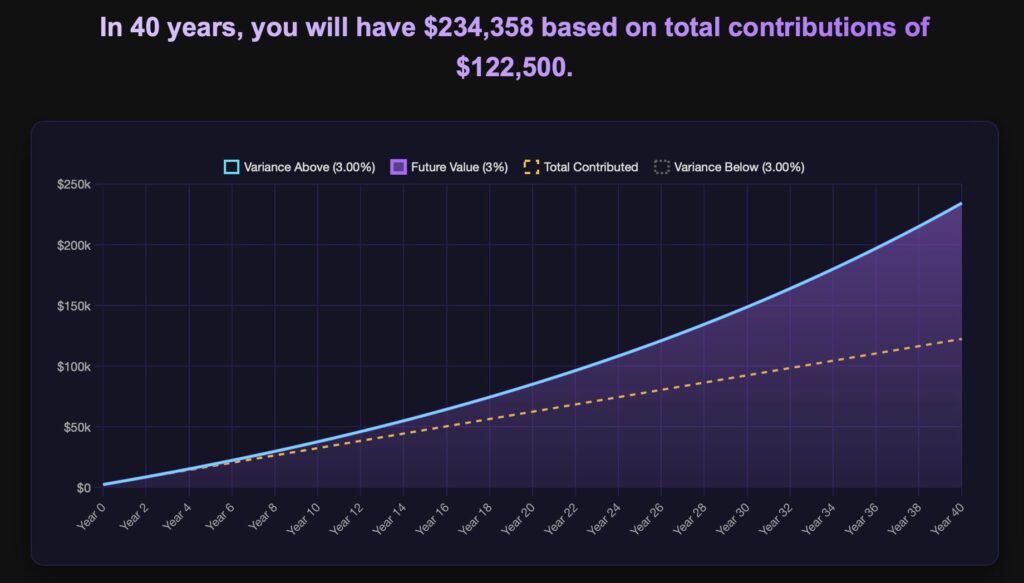
    After 40 years, Mike has $234,358.

    Use the Think and Talk Money Compound Interest Calculator to motivate you to invest and take on the risk even in uncertain times.

    After 40 years, Mike will have contributed a total of $122,500 to his retirement savings account. 

    At a 3% interest rate, Mike will have $234,358 after 40 years.

    In other words, Mike has just about doubled the value of his total contributions in his account.

    Not bad, Mike.

    Now, let’s check out Elissa’s account.

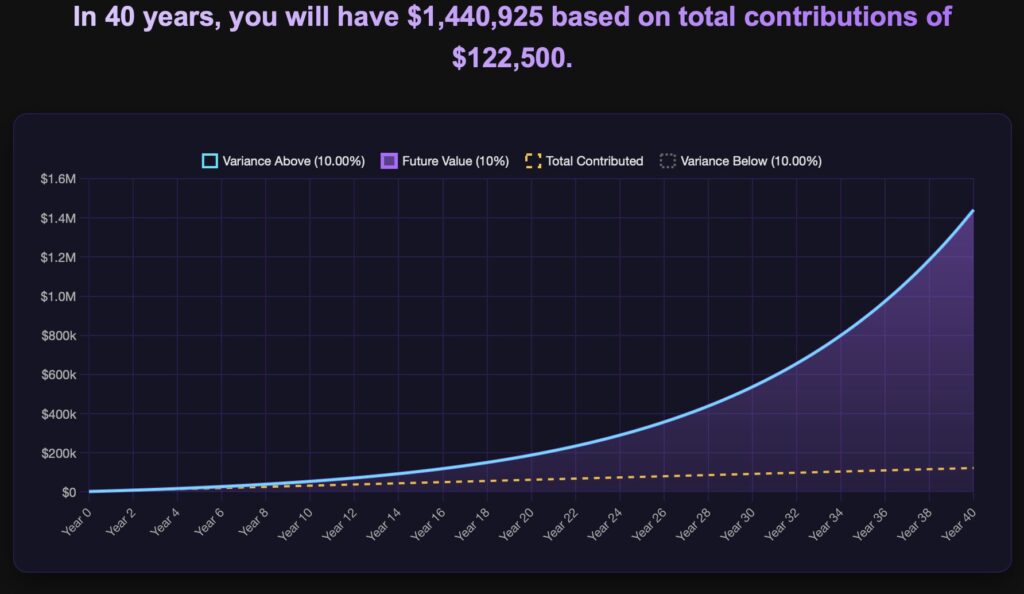
    After 40 years, Elissa has $1,440,925.

    Use the Think and Talk Money Compound Interest Calculator to motivate you to invest and take on the risk even in uncertain times.

    Elissa likewise contributed $122,500. After 40 years, at a 10% interest rate, Elissa’s retirement account will have a total of $1,440,925.

    Wow, Elissa!

    Elissa’s retirement account is worth 10 times more than what she personally contributed. Mike failed to even double his money.

    Recall in this hypothetical, Elissa did the exact same things as Mike, with one key difference. Elissa educated herself in basic personal finance concepts and was more comfortable taking on reasonable risk.

    Because Elissa was comfortable taking on some risk, her retirement savings were worth more than six times as much as Mike’s savings. Put another way, she has more than a million dollars more than what Mike has!

    person jumping from cliff to cliff illustrating the concept of reasonable investment risk for young people as shown by the Think and Talk Money Compound Interest Calculator.
    Photo by Micah & Sammie Chaffin on Unsplash

    Look at compound interest in action.

    One last thing: take a look at the pictures of Mike and Elissa’s investments over time. Notice the gaps between each of lines on the graphs. The blue lines represent the total account value, and the dotted lines represent only the contributions.

    While they each benefited from compound interest, Elissa benefited exponentially more. 

    Look at how Mike’s blue line stayed much closer to the dotted line. Because he wasn’t earning as much overall interest, he didn’t have as much money to multiply from compound interest.

    On the other hand, Elissa’s blue line mirrored her dotted line closely for the first 12-15 years. Then, the gap widened before the blue line skyrocketed over the final decade or so. 

    That’s the power of compound interest kicking in.

    So, what can we learn from Mike and Elissa?

    The point of this hypothetical is to reinforce the concept of risk when it comes to investing.

    We’ve all heard the saying, “You don’t get something for nothing.”

    That motto applies to investing as much as anything else. There is always risk involved in investing.

    The question is how do you react to that risk.

    Some people are so fearful of that risk that they don’t invest at all, like our friend, Mike. 

    Other people are so desperate to get rich quickly that they take wild risks.

    The people that tend to reach and sustain financial independence are the ones who educate themselves and become comfortable with taking on reasonable risk. This is what Elissa did.

    Think of risk as the cost to invest.

    If you want to reach true financial independence or any other financial goal, it’s going to cost you something. 

    Think of risk as the cost to invest.

    Sure, there are lawyers out there who may reach financial independence on a massive salary, even with poor financial habits. 

    For the vast majority of us, we’re going to have to get comfortable with investing and taking on reasonable risk.

    If you’re on the fence about taking on reasonable risk, now’s a good time to think about your ultimate life goals. Embrace the reasons for why you’re investing. Think about what would motivate you to open yourself up to reasonable risk. For me, it’s having ultimate optionality in life.

    It never hurts to remind yourself what you are hoping to achieve in the future. When you know what that thing is, it’s much easier to pay the cost of risk.

    When you understand reasonable risk, you know that market fluctuations are a good thing.

    Warren Buffett once said, “Look at market fluctuations as your friend rather than your enemy; profit from folly rather than participate in it.”

    This wisdom is important to remember today as multiple wars are being fought around the world and nobody truly knows where the economy is headed.

    Recently, I’ve talked to people still early in their careers who are selling stocks and moving into “safer” positions, like precious metals and cash. Setting aside whether these asset classes are in fact safer, I think it’s a mistake for young lawyers to get out of the stock market right now when they have decades of investment horizon ahead.

    Right now the market is fluctuating. That is completely normal. As Buffett says, this might be a great time to lean into the stock market. When the market goes down, if you consistently invest in broad-based index funds, you can purchase stocks on sale. That’s what Buffett means by profiting from other people’s folly instead of participating in it.

    This is why it’s important to think of reasonable risk in terms of decades, not weeks or months.

    When you look at Elissa and Mike’s future outlook, who would you rather be? 

    It’s not really a hard question, right?

    It’s not only that Elissa has a bigger bank account. What matters even more is that she has created options for herself. 

    Elissa should be in position to do whatever she wants at that point in her life, within reason.

    Mike won’t be.

    The takeaway is that when you have decades ahead of you, let risk work in your favor. Let other people panic and sell their assets when the market is dropping. Ignore the noise. You can’t time the market. Stay invested for the long-term by embracing the risk.

    Readers: are you naturally more inclined to act like Mike or Elissa when it comes to investing?

    If you’re more like Mike, have you thought about what outcome in life would make it worth taking on some reasonable risk?

    Does it feel more difficult to stay invested when the market is dropping?

    Have you tried flipping the script by telling yourself that stocks are on sale when the market drops?

    Let us know in the comments below.