

One of my favorite TV shows is Alone.
If you haven’t seen it, the show depicts a competition between 10 survival experts who are dropped off in the middle of nowhere, completely isolated from all human contact. Each person may bring ten survival items, some clothes, and a safety kit. They all bring cameras to film their journeys. Whoever survives the longest wins $500,000.
It is astonishing what these people are capable of. They build their own shelters and catch all their own food. On a daily basis, they’re forced to solve problems. They have no one to help them, or to blame, but themselves.
My wife and I first discovered Alone during the pandemic. It was the perfect show during that time of immense mental and physical hardship. There was something about the way each survivalist focused on that day’s tasks, and blocked everything else out, that resonated with us.
Watching the latest season of Alone these past few weeks, it occurred to me that the show is full of analogies for the personal finance topics we discuss in the blog.
I’ve found analogies to be great teaching tools, so here we go.
1. Not all calories are created equal.
The major challenge in Alone is getting enough calories to survive. Food is not exactly plentiful in the remote locations where the competitors are dropped off.
To survive, competitors dedicate endless hours strategizing and looking for food. Common strategies include fishing, trapping, hunting, and foraging.
One of the first things you learn is that not all calories are created equal. Calories from fat and protein are at a real premium. Even with an unlimited supply of berries and greens, the competitors make clear that you cannot survive for long periods without fat and protein.
Besides the importance of the type of calories, the way the calories are procured is just as critical.
This makes perfect sense in a survival scenario. If you expend 2,000 calories of energy to catch a fish, and that fish only provides you 1,000 calories of food, that is a losing proposition. If you continue on that trajectory long enough, you’ll starve to death.
This is why contestants on the show always think about ways to passively procure food, such as setting traps or using gill nets. If they can obtain food passively, they can then use that time to rest (save calories) or on other necessary tasks.
In the show, most competitors eventually tap out, on the brink of starvation, having failed to obtain enough food. It’s never for a lack of effort. It’s just really hard.
So what do calories have to do with personal finance?
Just as not all calories procured are created equal, not all dollars earned are created equal. If you think about what you do to earn money, are you the contestant trading 2,000 calories of energy for 1,000 calories of food?
In other words, are you always working?
Let’s look at two hypothetical lawyers.
The first lawyer works 80 hours per week and earns an annual salary of $200,000.
The second lawyer works 40 hours per week and earns an annual salary of $120,000.
Which one would you rather be?
Would your answer change if we convert the annual salary to an hourly rate?
On an hourly rate, the first lawyer ends up earning $48 per hour.
The second lawyer earns $58 per hour.
If you’re still leaning towards the first lawyer who earns more overall but less per hour, did you think about how valuable that extra 40 hours per week could be? You could spend that time on your true passions. You could enjoy more time with friends and family. Or, you could develop a skill or earn income through a side hustle you enjoy.
Looking at it another way, what if you could earn the same $200,000 without having to work 80 hours per week? This is where passive income streams come in.
Like the gill net that catches fish without the active involvement of the fisherman, have you explored ways to make money while freeing up your time for other worthwhile pursuits? This is a key step on your way to financial freedom.
For what it’s worth, I’m confident that the survival experts would all choose to be the person who makes more money per hour while also having more time available for other pursuits.
2. It’s not good enough to just acquire food, you also need to protect it.
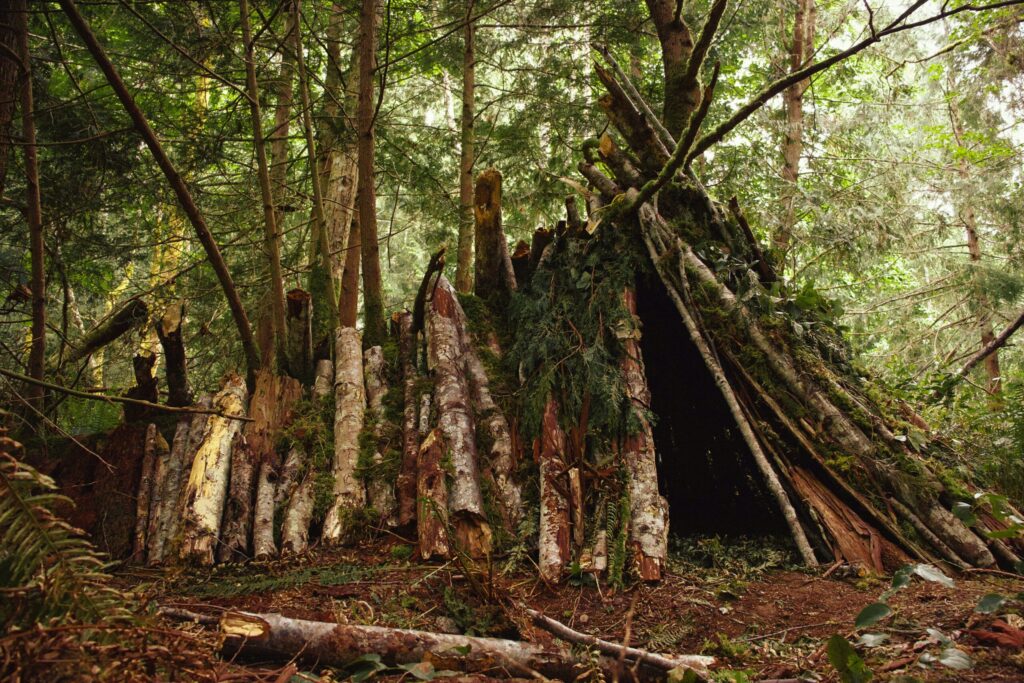
Procuring enough food to eat is only part of the challenge. On the most recent season of Alone we watched, it wasn’t even the biggest challenge. No, the biggest challenge was protecting that priceless food from predators and scavengers.
Whether it was birds, wolverines, bears, mice, or pine martens, the competitors’ food was constantly under attack. There was no moment more heartbreaking (for both competitors and viewers) than when a freshly caught fish was scavenged in the middle of the night. You could feel the competitors’ agony blasting through the TV screen.
In order to survive on Alone, competitors needed to devise a system to safely store the food they acquired. They knew that there was no point in expending significant effort to get food if it was all going to disappear. The best competitors understood that the key to survival was to build an impenetrable food cache.
In other words, they needed a fortress around their food. It wasn’t enough to just get the food. They had to protect it so it was there when they needed it.
So, what does a food cache have to do with personal finance?
Like the contestants on Alone, we all need to keep cash on hand so we can build an impenetrable financial fortress.
Building a fortress with sufficient cash on hand serves two main purposes:
1. You can protect yourself from disaster. This type of cash is known in personal finance as Emergency Savings.
2. You can take advantage of opportunities. That may mean investment opportunities or life opportunities, like switching careers. I refer to this type of cash as Parachute Money.
When you have both Emergency Savings and Parachute Money, you’ve built a financial fortress.
At that point, you are in complete control of your finances and your life. No matter what the world throws your way, you will be ready. Everything that you worked so hard for is safe. Potential catastrophe becomes only a minor setback.
Like the contestants on Alone desperately trying to protect their food, if you want to have ultimate security and optionality in life, you need to build a financial fortress.
You can read more here about why it’s so important to build a financial fortress.
3. Attitude is everything.
Watching Alone, you see a wide range of personalities. While each contestant has the resume of a survival expert, one attribute always separates the winners from the losers: attitude.
The contestants are forced into what would be impossible survival scenarios for the average person. It’s completely understandable to have tense, frustrating, and stressful moments.
This isn’t me judging the contestants who have poor attitudes. I wouldn’t last an hour in the woods by myself. I’ve never even been camping. My wife caught more fish when she was six than I’ve caught in my whole life.
This is just my observation that most of the time, contestants have similar survival skills. What separates the winners is their attitude and ability to recognize that things will go wrong. When things go wrong, they don’t blame anyone else or play the victim. Instead of getting frustrated and quitting, they think of solutions to the problem at hand.
Why is your attitude so important when it comes to personal finance?
Yes, we all need a bit of luck in life to thrive. But, we need to put ourselves in position to benefit from luck when it comes our way. That takes intentional thought and effort.
As attorneys, we have the opportunity to make outsized incomes. But, that doesn’t mean we are immune from the challenges of life. We need to consciously use that money in a way that matches our values and propels us towards financial independence.
I’m guessing we all know very smart and talented lawyers that have bad attitudes. When things don’t go their way, they immediately blame other people. Nothing is ever their fault. They feel entitled to success without doing the work.
That type of person usually doesn’t lead a very happy or fulfilling life.
For sure, that person would not last a week on Alone.
4. Along with starvation, missing family is the hardest part.
If it’s not starvation, odds are contestants will tap out because they miss their families. The physical challenges of being forced to survive on limited food in rugged conditions is hard enough.
To do it alone and isolated from your family makes it nearly impossible.
One of the most enlightening parts of the show is when the contestants reveal their mental struggles to the camera. Since they’re alone, and typically starving, we get to see raw emotion in real time. You learn a lot about the human condition in these moments.
One unavoidable truth is that us humans are social creatures.
We need our people. We need love and support and connection. Going through life alone goes against our DNA.
Even the chance at winning more money than the contestants ever dreamed of is not nearly enough to keep them away from their families any longer.
What does missing family have to do with money?
This is why I want to encourage you to not isolate yourself with your money decisions. Money touches all aspects of our lives. Don’t try to go it alone. Include your people in your money life. Talk to them. You will only be better for it.
When each new season of Alone begins and the new contestants are introduced, my wife and I know right away who isn’t going to make it: the people with young kids.
These people have all the skills necessary to survive. But, those skills don’t matter when they start missing their kids. The emotion is too strong. The longing to be with their kids overcomes all else. They simply do not want to miss another day of their kids’ lives.
I think about this lesson in the context of our daily lives. Like the lawyer in our example above working 80 hours per week, at what sacrifice do all those hours come? How many hours away from home is that? How much time away from our kids?
When I think about those questions, I again think about what I would do with my time if I was financially free.
I think about my Tiara Goals.
Have you watched Alone?
Do you agree with my observations?
Let us know in the comments below!
Leave a Reply