Author: Matthew Adair

  • Money on My Mind: Global Happiness

    Money on My Mind: Global Happiness

    This week, we discuss recent reports on global happiness and starting families.

    We also discuss lessons from successful businesses that we can apply to our personal lives.

    The World Happiness Report 2025

    Since 2012, an organization known as The World Happiness Report (WHR) has studied global wellbeing and how to improve it.

    Each year, they analyze data from 140 countries and publish their findings in an effort to give everyone the knowledge to create more happiness for themselves and others.

    That sounds like a great mission to me.

    They also publish a global happiness ranking of all the countries studied. The rankings are based on answers to a single question:

    Please imagine a ladder with steps numbered from 0 at the bottom to 10 at the top. The top of the ladder represents the best possible life for you and the bottom of the ladder represents the worst possible life for you. On which step of the ladder would you say you personally feel you stand at this time?

    WHR explains that this “life evaluation” question empowers people to make their own judgments about what matters most.

    As part of its analysis, WHR uses economic modeling to explain countries’ average life evaluation scores. They look at six variables, and one of them jump out at me:

    “Freedom to make life choices.”

    What countries would you guess scored the highest on the 2025 rankings?

    The top five countries in the happiness rankings are:

    1. Finland
    2. Denmark
    3. Iceland
    4. Sweden
    5. Netherlands

    Each of these nations has ranked near the top for a long time.

    Where is the United States on the happiness chart?

    The United States fell to number 24, its lowest happiness ranking ever.

    The United States’ highest ranking was 11th place way back in 2011.

    I’m not totally surprised that the United States’ ranking is as low as it’s ever been.

    We’ve discussed some theories that may help explain this drop:

    I wasn’t surprised to see the United States rank 24th in the global happiness rankings, but I was shocked by the sub-ranking for this specific question:

    Are you satisfied or dissatisfied with your freedom to choose what you do with your life?

    The United States ranked 115th out of 147 countries in response to the freedom question!

    That ranking truly shocked me.

    It also helps explain one of the primary goals of Think and Talk Money: to help each of us reach financial freedom.

    When we are financially free, we can choose to live life on our own terms. To me, that sounds a lot like what the WHR freedom question is trying to answer.

    When you have financial freedom, you can make important decisions based on what truly matters. When you don’t have financial freedom, you risk making unsatisfactory decisions for money reasons.

    We can choose to spend more time with the people who are meaningful to us.

    We can choose to use our skills for work that is meaningful to us.

    Group of happy friends posing for a selfie on a spring day as they party together outdoors because they understand happiness is tied to financial freedom.

    Most of us grow up thinking that life only revolves around getting an education and then getting a job. We don’t allow ourselves to believe that financial freedom is possible for us.

    This was exactly how I felt before I wrote down my Tiara Goals one day on the beach in 2017.

    My goal with Think and Talk Money is to help us all realize that financial independence is within our reach. If we can think and talk about our money choices even a little bit every week, we can make sure our money life remains in balance with the rest of our life.

    By practicing strong personal finance habits, each of us can feel more satisfied with our freedom to choose what to do with our lives.

    How would you rank yourself on the freedom question?

    Are you satisfied with your freedom to choose what you do with your life?

    What are your core values?

    Have you ever written down your core values?

    Do you know what you’re striving for?

    Successful businesses look at these questions regularly. I find it helpful to learn how successful businesses operate so I can apply similar principles to my own life.

    For example, there’s a great business book called Traction by Gino Wickman. In the book, Wickman encourages businesses to focus on vision, mission, and values.

    It seems like a pretty good idea for all of us to think about vision, mission, and values as they apply to our own lives.

    For example, if you’re one of the nearly half of Americans not taking your PTO, are you making that choice based on your core values?

    It’s possible that you are. Perhaps you’re being strategic and have formulated a plan to benefit from all those extra hours at the office.

    Or, it’s possible that you’ve never really stopped to think about why you’re working so much. You’ve never paused to articulate to yourself what you want out of life.

    In Traction, Wickman makes a compelling argument why businesses should not skip this crucial step.

    We all should take the same step in our personal lives. In 2017, I wrote down my core values, what I call my Tiara Goals.

    Looking at the big picture, my Tiara Goals have helped me visualize what I truly want out of life.

    In the short term, my Tiara Goals help guide me through difficult decisions. As long as I’m clear with myself about what I want in the long run, I can make daily decisions to get my closer to those goals.

    Millennials want more kids but can’t afford them.

    According to a recent report from Business Insider, Millennials want more kids but can’t afford them.

    This makes me sad.

    The study points to rising costs, as well as the reality that Millennials are saddled with large amounts of student loan debt.

    Combined, it makes sense that Millennials are worried about money.

    If you want to start a family, or grow your family, what better motivation could there be to spend a little bit of time each week thinking and talking about money.

    If this is your reality, or you know someone in this position, establishing strong personal finance habits is crucial.

    Each week at Think and Talk Money, we focus on developing these strong personal finance habits.

    Please share Think and Talk Money with your friends and loved ones.

    I hope that in spreading the word about Think and Talk Money, we can all help each other make big life decisions without worrying about money.

    This is important whether you are hoping to start a family or have other life goals in mind.

    We can all benefit from making intentional and informed decisions with our money.

  • How to Use HELOC to Buy Investment Property

    How to Use HELOC to Buy Investment Property

    Have you ever wondered how successful real estate investors seem to acquire properties so quickly? The answer is usually related to “OPM”, or Other People’s Money. In today’s post, we’ll discuss how I’ve used a common form of OPM, a Home Equity Line of Credit or HELOC to buy investment property.

    The best part is that you can use and repeat this strategy to acquire multiple properties. On three separate occasions, my wife and I successfully used a HELOC to buy investment property.

    Besides acquiring properties, as a real estate investor, you can also use a HELOC to update a property. My wife and I have done both. We’ve used HELOCs to help with the initial downpayment to acquire properties. We’ve also used HELOCs to improve properties after we’ve purchased them to increase its value.

    Read on to learn what a HELOC is and how to use a HELOC to buy investment property.

    What is a HELOC?

    A Home Equity Line of Credit (HELOC) allows you to borrow money, in the form of a loan, against the equity in your home. Equity is the value of your home less what you owe on a mortgage.

    Think of a HELOC as a second mortgage on your property that works like a credit card. That means you will be charged interest when you use your HELOC funds.

    Just like with a primary mortgage, when you open a HELOC, the bank is protected by the equity in your home.

    Just like a credit card, you can choose when and how to use a HELOC. And, you can use your HELOC over and over again, as long as you pay down the balance. Use it, pay it off, use it again. This is what my wife and I have done.

    Of course, this is one of the best parts about HELOCs. Whether you want to use a HELOC to buy an investment property, or for any other purpose, you can tap the funds repeatedly and don’t get charged any interest until you use them.

    This point is worth repeating. You can open a HELOC and not use it right away. You won’t be charged interest while you wait for an opportunity to present itself.

    That opportunity might be using your HELOC to buy investment property.

    Or, it might mean using your HELOC to renovate your home or buy a car. This is what my wife and I did recently. When we bought a new car last year, we decided to use our HELOC funds instead of taking out a new auto loan.

    Extract equity or obtain funds from your property using a home equity loan or a HELOC to buy investment property.

    Keep in mind that when you decide to use your HELOC, you will be charged interest until you pay it back, just like a credit card. This is a major consideration to keep in mind if you’re thinking about using a HELOC to buy an investment property.

    To recap, a HELOC is really just a form of credit card, available to you for a set period of time, secured by the equity in your home.

    You can use those HELOC funds for any purpose. You can choose to use your HELOC to buy investment property, renovate your home, buy a car, or for pretty much any other purpose.

    What to know about paying off a HELOC.

    If this all sounds too good to be true, don’t forget that you do have to pay off your HELOC, with interest. Just like any other debt, whether it’s Good Debt or Bad Debt, a HELOC needs to be paid off.

    HELOCs are generally broken out into two phases, the “draw period” and the “repayment period.”

    The first phase is known as the borrowing period, or draw period. You can continue to use your HELOC funds for the duration of the draw period. Most HELOCs have a draw period of 10 years.

    During the draw period, your loan balance will accrue interest. Generally, you are required to make minimum payments during the draw period.

    These payments are usually referred to as “interest only” payments. This means you must pay the interest accrued during the previous month, but you don’t have to pay down the principle owed.

    At the close of the draw period, the repayment period begins. During the repayment period, you can no longer borrow from your HELOC.

    The repayment period typically lasts 10 or 20 years. Your lender will set a schedule for monthly payments to pay off the balance in full, similar to a mortgage.

    Four advantages to using a HELOC to buy investment property.

    Here are the four main reasons why I’ve used a HELOC to buy investment property. These same advantages apply to any other major purchase.

    1. You can use a HELOC as you would use cash, including for a downpayment.

    Once your HELOC is open, you can use the funds as you would cash. All you need to do is link your HELOC account to your primary checking account. You can make transfers into your checking account, as needed, up to your full HELOC credit limit.

    With a HELOC, once the transfer hits your checking account, you can spend that money just as you would any other money.

    This is a huge advantage if you want to use a HELOC to buy investment property.

    That’s because lenders heavily scrutinize where you are getting the funds you plan to use to close on a property. HELOC funds are almost always allowed to be used for a downpayment.

    On the other hand, cash advances from credit cards are typically not allowed for a downpayment on a conventional loans.

    2. HELOCs charge lower interest rates.

    The interest rate charged on HELOCs will typically be lower than the interest rate charged by credit cards and other personal loans.

    Interest rates on HELOCs are similar to prevailing mortgage rates, but typically charge about 1-2% more. This is to compensate the HELOC lender for the added risk of being the second mortgage on a property.

    According to Bankrate, here are the current average interest rates:

    As you can see, if you need to borrow money for any reason, using a HELOC usually gives you the best rate. This is a major reason why people generally use HELOCs.

    It’s also the primary reason why I have used a HELOC to buy investment property.

    Keep in mind that HELOCs generally charge a variable interest rate that may change monthly depending on market conditions outside your control. This is again to protect the HELOC lender, and is a factor to consider before you use your HELOC funds.

    In fact, this is one of the key risks with using HELOCs. You may apply for a HELOC when interest rates are low, but that can change. You may be faced with a significantly higher rate when you pay off the balance.

    From a real estate investor’s perspective, a higher interest rate may end up eating into all of your cashflow. Before using a HELOC to buy investment property, make sure the cashflow on the property can cover the higher loan payments.

    3. You only pay interest on HELOCs during the draw period.

    As discussed above, you typically only have to pay the interest on a HELOC during the draw period. That means your monthly payment is lower. As long as you make the minimum payment, the overall balance will not grow month to month.

    Then, during the repayment period, you have 10 to 20 years to pay off the balance. This lengthy period helps spread out the balance over time, which keeps the required payment lower each month. This long payoff period is extremely beneficial when paying off larger purchases, such as a home renovation.

    This is also another key reason why a real estate investor would use a HELOC to buy investment property.

    Spreading out the payments over the long term, and only paying interest during the draw period, means more monthly cashflow. Some real estate investors think differently, but to me, cashflow is king.

    4. You may have access to a larger sum with a HELOC.

    Because a HELOC is secured by the equity in your home, it’s likely you will be eligible for a larger sum than a typical credit card or other personal loan.

    While credit cards also allow cash advances, they are typically capped at a relatively low amount and come with higher interest rates.

    A larger available balance comes in handy when you want to use a HELOC to buy investment property.

    For conventional loans, you’ll typically need 20-25% of the purchase price as a downpayment. That is a lot of money to come up with on your own, even if you are great at fueling your savings.

    The same is true for funding any other major purchase. For example, just the other day, I spoke to a friend who opened up 12 different credit cards to launch his software business.

    If he had access to a HELOC, he would not have needed 12 separate credit accounts. The HELOC would have provided him enough funding.

    How I’ve used HELOCs to scale my real estate portfolio.

    Using HELOCs can be an effective way to scale your real estate portfolio.

    As mentioned above, you can use your HELOC for a downpayment on another investment property.

    This is one of the ways my wife and I scaled our real estate portfolio. We primarily invest in an area of Chicago where properties can get expensive. The same can be said about our vacation rental in Colorado.

    Coming up with a full downpayment in these markets on our own would take years of savings. We’ve made the choice to take on additional debt and added risk to scale more quickly.

    We purchased our first investment property in 2018. After making some improvements and paying down the mortgage, we applied for a HELOC in 2020. We then used those HELOC funds to help with the downpayment for our Colorado ski rental in 2021.

    After a couple years of unexpected appreciation on our ski rental, we took out a HELOC on that property in 2022.

    We then used that HELOC to help purchase a third rental property in Chicago in 2022 and our primary home in 2024.

    As you can see, we’ve used our equity gains in our earlier properties to take out HELOCs to help acquire additional properties.

    Along the way, we have worked on paying down the balances of each of those HELOCs. This way, we reduced our debt and increased our net worth. We can also now repeat the process and again use a HELOC to buy investment property.

    Besides a downpayment, real estate investors can use HELOC funds to make improvements to their properties.

    Real estate investors also use HELOC funds for improvements to their properties. These improvements can lead to equity gains through appreciation and also more monthly cashflow.

    We’ve used HELOCs in this way on multiple occasions. For example, we used our HELOC to install washers and dryers into three of our apartments.

    We then paid off the HELOC balance with the increased rental income generated by those three improved apartments.

    Don’t ignore the biggest risk of using a HELOC to buy investment property.

    With all the advantages of HELOCs, there is one major risk that cannot be ignored. This single risk is so important that is should outweigh all of the advantages for most people.

    HELOC equals debt.

    Like with all debt, if you abuse the privilege, you are going to get yourself in trouble.

    This is why Dave Ramsay is adamant that debt should not be used as a tool to build wealth.

    In his bestselling bookThe Total Money Makeover, Ramsey walks you through how to build wealth without relying on debt.

    If you decide to tap your HELOC funds, remember that the loan is tied to the equity in your home. If you fail to comply with the loan terms, your home is at stake.

    That’s a huge risk.

    Before you consider using a HELOC, be sure to have a plan in place for paying back the loan. This is where your Budget After Thinking can really help.

    I would not use a HELOC as a beginner investor.

    While there are upsides to using HELOCs, it is a potentially risky strategy that I would not feel comfortable with as a beginner investor.

    I say that for good reason.

    When you hear HELOC, you should immediately think about debt. For many of us, debt is problematic and leads to negative emotions.

    I’ve experienced these negative emotions associated with debt. I only got comfortable with taking on debt as I learned to trust myself again with the responsibility.

    While I’ve used HELOCs to scale my real estate portfolio, my primary money goal this year is to pay down these HELOCs. I’m tired of having those debt balances hanging over my head.

    If you have proven to yourself that you can responsibly handle debt, using a HELOC may be a worthwhile strategy.

    By responsible with debt, I mean:

    If you have satisfied all of the above, you can then make an informed decision about using debt to scale your real estate portfolio.

    How do you apply for a HELOC?

    Applying for a HELOC is just like applying for a mortgage. The bank will review your finances and determine if it will lend you money against the equity in your home.

    HELOC – Home with a Dollar Sign and Line Graph Symbolizing Borrowing Against Home Equity, which illustrates that using a HELOC to buy investment property can be a useful strategy to scale your real estate portfolio.

    If you’ve ever applied for a mortgage, you know this is not a fun process.

    The key to qualifying for a HELOC is that your home equity needs to have grown in value, either by paying down your primary mortgage or through appreciation.

    Let’s look at an example of using a HELOC to buy investment property.

    Note, you’ll never have to do this math yourself. This is for illustration purposes in case you want to estimate the amount you may be eligible for before you start the application process.

    For easy math, we’ll make some assumptions in this example. Always confer with your mortgage broker or lender for precise calculations.

    In this example, let’s say you bought a home five years ago for $500,000.

    • You put 20% down ($100,000) when you bought the home, so your original mortgage was for $400,000. This means your equity in the home when you bought it was $100,000.
    • For the past five years, you’ve paid down the principle on your mortgage every month. For easy math, let’s assume your remaining mortgage is now $350,000. Because you paid down $50,000 of the mortgage, your equity has increased by $50,000.
    • Not only have you been paying down the mortgage for five years, your home has also appreciated in value and is now worth $600,000. That’s another $100,000 in equity you now have in your home.

    Add it all up and you started with $100,000 in equity (your original downpayment) and now have $250,000 in equity.

    This is because you have paid the mortgage down every month and your home has appreciated in value.

    In this scenario, you may be eligible for a HELOC to buy an investment property.

    How do lenders calculate the amount of your HELOC?

    Each bank may have different standards for qualification and how much they will lend you. Generally, banks will use a metric called Loan-to-value ratio to calculate the amount of your HELOC.

    What is Loan-to-value ratio?

    Loan-to-value ratio is a complicated name for an easy math formula:

    LTVratio = Mortgage amount / Property value.

    In our scenario, your current mortgage amount is $350,000. Your property value is $600,000.

    So, your LTVratio is .5833 ($350,000 / $600,000). In terms of percentage, that’s approximately 58%.

    A typical HELOC lender will allow you to borrow up to a combined LTVratio of 70%.

    That means your existing mortgage plus the HELOC can only add up to 70% of the value of your home.

    The bank does this to protect itself by requiring you to maintain 30% equity in your home.

    To carry out our example, using a combined LTVratio of 70%, you may be eligible for a HELOC of $70,000:

    • Value of home = $600,000.
    • First mortgage = $350,000 (approx. 58%)
    • HELOC = $70,000 (approx. 12% of value of home)
    • Combined mortgage + HELOC= $420,000 (70% of home’s value).
    • Remaining equity in home = $180,000 (30% of home’s value).

    Again, you don’t need to do this math yourself, but it’s helpful if you want to understand what size HELOC you may be eligible for before starting the process with lenders.

    Have you used a HELOC to buy investment property?

    Using a HELOC to buy investment property can be an effective strategy. My wife and I have effectively used this strategy multiple times.

    Before you decide to use a HELOC, be sure to understand the risks associated with taking on additional debt.

    • Have you used a HELOC to buy investment property before?
    • What about using a HELOC for any other purpose?

    Tell us about your experience in the comments below.

  • No Need to Obsess Over Credit Score

    No Need to Obsess Over Credit Score

    Your credit score is very important.

    And, you need to stop obsessing over it.

    Here’s why both those statements are true.

    Your credit history will touch almost every important financial transaction you enter into today. I don’t just mean credit cards and loans.

    If you apply for a job, need insurance, or want to rent an apartment, those companies are going to review your credit report and credit score.

    So, even if you don’t intend to take out loans, your credit history and credit score are still important.

    But, obsessing over your credit score is counter productive.

    Has obsessing over any number ever served you well, anyways?

    GPA…

    Weight…

    Social Media Followers…

    Yes, these things may be important to you. But, obsessing over the number itself is not how they improve. The habits behind the number are more important.

    If you want to improve your GPA, you need to study more.

    To lose weight, you need to practice healthy living.

    For more social media followers, you need to create better content.

    The same logic applies to credit scores.

    If you want a good credit score, the best thing to do is to practice strong personal finance habits that we routinely discuss in the blog.

    Obsessing over your credit score number is a waste of mental energy.

    With this backdrop in mind, we can discuss credit scores.

    What is a credit score?

    As we learned in our post on using credit the right way, credit refers to an agreement to borrow money with the obligation to repay that money later, usually with interest. 

    Credit also refers to a person’s trustworthiness or history of repayment.

    We then learned that a credit report is a document that tracks that history of repayment, as well as the current status of any loans you’ve taken out.

    Your credit report will typically include:

    • Personal information (name, social security number, current and former addresses)
    • Credit accounts (current and historical accounts, including credit cards and any other loans)
    • Collection items (missed payments, loans sent to collections)
    • Public records (liens, foreclosures, bankruptcies)
    • Inquiries (when you apply for a new loan)

    Now, we’ll talk about credit scores.

    A credit score is a three-digit number calculated based on your credit history that represents your present day creditworthiness. 

    Your credit score captures a moment in time. That means it will change over time, sometimes quickly and dramatically.

    We each have multiple credit scores depending on the scoring service. While there are many others, the two main scoring services are FICO and VantageScore.

    Keep in mind that your score may vary depending on the type of loan you are applying for. For example, an auto lender looks at different factors than a mortgage lender.

    For that reason, FICO alone has more than 50 different versions of your score that it may send to lenders.

    What is a good credit score?

    FICO and VantageScore each assign a score ranging between 300-850.

    For both services, if you’re around 800, you’re doing very well. If you drop below 650, you’ve got some work to do.

    Businessman trying to improve credit score with the lessons learned on Think and Talk Money.

    Before we look at the factors that go into your credit score, I can’t emphasize this next point enough:

    Don’t obsess over your credit score.

    You certainly want to pay attention to dramatic changes in your score so you can understand where you need to make adjustments. That said, you should not be concerned with slight movement in either direction.

    For example, FICO considers a score between 800 and 850 as “Exceptional.” Once you’re in that range, it makes no difference whether your score is 804 or 837. You may notice slight variation from month to month. That’s normal and perfectly fine.

    Instead of worrying about fluctuations in your score, spend your time and energy on more important financial wellness strategies, like writing down your Tiara Goals.

    What factors go into your credit score?

    Regardless of the scoring service, your credit score generally consists of these factors:

    • Payment history
    • Current unpaid debt
    • The types of loan accounts
    • Length of credit history
    • New credit inquiries
    • Amount of available credit being used
    • Collections, foreclosures or bankruptcies

    Of course, not each factor counts equally. For example, FICO weighs each factor like this:

    • Payment history: 35%
    • Amounts owed (credit utilization rate): 30%
    • Length of credit history: 15%
    • Credit mix: 10%
    • New credit: 10%

    VantageScore does not assign percentages to each factor, but does define the importance of each factor like this:

    • Payment history: Extremely influential
    • Total credit usage: Highly influential
    • Credit mix and experience: Highly influential
    • New accounts opened: Moderately influential
    • Balance and available credit: Less influential

    In comparing the two main scoring methods, we can see that both methods generally look at the same factors. They both also place the highest emphasis on payment history and place less emphasis on new accounts opened.

    Here’s all you need to know about each factor.

    There’s no reason to overcomplicate what each factor means.

    Here’s all you need to know:

    Payment history reflects whether you consistently make on-time payments.

    Amounts owed, credit utilization rate, and total credit usage refer to how much of your available revolving credit you are currently using.

    Revolving credit mostly refers to credit cards, but could also include loans like a line of credit.

    For example, if you have a credit card with a monthly limit of $1,000, and you are currently charging $300 per month on that card, your credit utilization rate is 30%.

    To maximize your credit score, aim for using 30% or less of your available credit. This ratio applies to each individual account and to your total account balances.

    Length of credit history refers to how long various accounts have been open.

    The longer the accounts have been open, the better your score will be.

    Credit mix looks at what types of loans you have open.

    Generally, lenders prefer to see a variety of loans, like credit cards, auto loans, and mortgages.

    New credit refers to how many loans you’ve applied for recently.

    Applying for too many loans in a short period can negatively impact your score since you may seem desperate for loans to fund your lifestyle.

    What factors are not considered in your credit score?

    Credit scores do not take into account personal information like race, gender, age, or marital status.

    Credit scores also do not consider income or employment history.

    Keep in mind that while personal information or employment history is not a factor in your credit score, it certainly will be considered as part of your application by lenders.

    For example, mortgage lenders and landlords will want to confirm your history of steady employment and income before entering into a financial relationship with you.

    Don’t get caught up in precisely how your score is calculated.

    FICO and VantageScore provide the above information as general guidance. However, each of our credit scores is determined on a unique set of circumstances that changes over time.

    While these factors are generally considered for everyone, specifically how each factor is weighed varies for each of us.

    As FICO explains:

    Your credit report and FICO Scores evolve frequently. Because of this, it’s not possible to measure the exact impact of a single factor in how your FICO Score is calculated without looking at your entire report. Even the levels of importance shown in the FICO Scores chart above are for the general population and may be different for different credit profiles.

    Like we mentioned before, it’s important to not get hung up on the different methodologies that each scoring service uses. For the most part, your score won’t vary significantly from one service to another.

    The key point is to pay attention to the general factors that impact your score but understand that your score is always changing. Don’t waste your energy trying to decipher how much weight is given to each factor.

    How to check your credit score.

    These days, it’s easier than ever to monitor your credit score.

    Most major banks offer free credit scores to their customers.

    You can also sign up for credit monitoring, including credit scores, with the major credit bureaus, Equifax, Experian, and TransUnion. Note that only some services are provided free of charge.

    Of course, there are also no shortage of apps and websites providing similar services, sometimes free and sometimes for a price.

    If you’d like additional guidance on how to obtain your credit score, please reach out on the socials or by replying to our weekly newsletter.

    What should I do instead of obsessing over my credit score?

    Instead of obsessing over your credit score, focus on the strong financial habits we discuss regularly in the blog.

    You should not have to worry about your credit score if you:

    When you can make these habits part of your regular life, your credit score will automatically rise along the way.

    Look at credit scores from a potential lender’s point of view.

    I hope this goes without saying, but lenders are in the business of making money. They make money by gauging risk. The lower an applicant’s credit score, the more the lender’s risk increases.

    When the lender’s risk increases, it may decide to not lend you money. Or, it may choose to lend you money and charge you a higher interest rate to compensate for that higher risk.

    The same logic applies when other entities besides lenders are reviewing your credit score.

    For example, an employer may check your credit score to determine your level of trustworthiness before offering you a job.

    A landlord may check your credit score before agreeing to rent you an apartment to confirm whether you are likely to make the required payment each month.

    Always remember why credit scores are used in the first place.

    If nothing else, remember why credit scores are used in the first place:

    Credit scores are used to measure how risky it would be for someone else to enter into a financial relationship with you.

    In other words, can you be trusted with money.

    If you have a history of not making on-time payments, or not paying loans back, that indicates you are not responsible with money.

    When you are using up most of your current credit and carrying high balances, that demonstrates that you have a hard time limiting your spending.

    If you are constantly applying for new credit, it shows that you may be dependent on credit to fund your life.

    In any of these scenarios, the risk of entering into a financial relationship with you increases.

    Credit scores are especially important before big purchases.

    If you have a big purchase coming up, like buying a home or a car, it’s important to have your credit score in a good spot before applying. This is because your credit score will impact the interest rate you are offered.

    For a big purchase, even slight variations in the interest rate can make a huge difference.

    Because it’s normal for your credit score to change frequently, it is worth waiting to apply for that loan until after you’ve improved your score.

    The best ways to improve your score in the short term are to pay off debt and avoid applying for new credit.

    By paying off debt, you’ll improve your payment history and your credit utilization rate, two of the most important factors in your score regardless of scoring method.

    The best thing you can do to avoid the costly consequences of a poor credit score is to implement the personal finance fundamentals we routinely discuss in the blog.

    Have you ever needlessly obsessed over your credit score?

    Let us know what that felt like in the comments below.

  • Great Talk: Money and Fences

    Great Talk: Money and Fences

    Know anything about fences?

    We need to replace a 20 year-old wood fence at our home that’s one strong storm away from falling over. In these past few weeks, I’ve learned more about fences that I care to admit.

    On the bright side, shopping for a fence has led me to think about and practice many of the personal finance habits we talk about in the blog.

    Let me walk you through my thought process to help you whenever you have a big expenditure in front of you.

    In the world of privacy fences, there seem to be three primary choices available: wood, vinyl, and composite. I won’t bore you with all the details. The key points to consider for our conversation are:

    • Wood is the cheapest, but requires the most upkeep and will eventually need to be replaced.
    • Vinyl (plastic) comes with a lifetime warranty, requires little-to-no upkeep, but is 30-40% more expensive than wood.
    • Composite is the most durable, looks incredible, requires no upkeep whatsoever, has soundproofing ability, is made from recycled materials, comes with a 25-year warranty, but is nearly 3x more expensive than wood.

    We’ve ruled out wood after doing our research and determining that we’ve got too much going on to worry about annual fence upkeep.

    So, that leaves vinyl and composite. From our research, both would be good options. However, there’s really no doubt that composite is the best overall option, if you can stomach the cost.

    Talk to your people about expensive purchases.

    This is a big financial decision, so of course, I’ve been talking to my people for weeks about what they would do.

    I’ve gotten three common responses that go something like this:

    • “You’re planning to live in this home for the long run, make the investment in the best fence possible and never worry about it again.”
    • “How much do you really care about a fence? I’ve never even noticed my fence. Think of what other projects you could spend that money on.”
    • “Dude, leave me alone. I don’t want to talk about your fence.”

    As you can see, talking to your people does not mean that you’re off the hook for making the decision yourself. You will likely get a wide spectrum of advice.

    However, you’ll gain invaluable perspective to consider so you can make the best decision for your personal situation.

    Expensive purchases test your personal finance habits.

    Whenever you have a big purchase ahead of you, many of the strong personal finance habits you’ve been working to establish will be tested. You’ll be asking yourself questions like:

    My wife and I have considered all these questions as we’ve talked through the options.

    Rear view friends sitting on chairs talking at the bar but hiding from each other that they are in credit card debt.

    As of this moment, we’re leaning towards the composite fence so we never have to think about fencing again.

    To help defray the cost, we’re considering a financing option that offers 0% interest for 18 months.

    Important side note: if you ever choose to go with an attractive financing option, always read the fine print first.

    The lender is hoping you fail to pay off the purchase within the 0% interest period so you’re forced to pay insanely high interest on the remaining balance. The financing option we’re looking at jumps from 0% interest to 26% interest if we fail to pay off the loan in 18 months. That’s a serious penalty.

    Financing aside, we’ve also concluded that other projects will have to wait for a while so we don’t crush our money goals for the year.

    We’ll make our final decision this weekend.

    What would you do?

    Leave a comment below to help my wife and I decide.

    Sharing Think and Talk Money with Others.

    Over the past couple days, I’ve heard from several readers who have shared Think and Talk Money with people they care about.

    One reader told me that he shared the blog with his 25 year-old son. The reader was very appreciative because he’s experienced how important personal finance is.

    He knows his son will only benefit in the long run if he implements strong money habits at the beginning of his career.

    Another reader shared the blog with a friend who is now tracking her spending for three months. This is the first time she has ever tracked her spending to learn where her money is going each month.

    She is using her phone and a simple spreadsheet to track her expenses. She reports that even though it’s only been a month, she’s learning things about her money choices she never knew before.

    I love reader stories like this because they reflect one of our core philosophies at Think and Talk Money:

    It’s not taboo to to talk about money.

    When you start the conversation, you’re not just helping yourself, you’re helping people you care about.

    It doesn’t matter if you’re talking about paying for a fence or starting a budget. We all could use help when it comes to making good, consistent money decisions.

    Your friends are likely going through the same money challenges.

    Since writing about my challenges with credit card debt at the beginning of my career, I’ve had some great talks with friends I knew back then.

    Multiple friends have shared with me that they were dealing with the same credit card debt issues at the same time that I was.

    None of us ever knew it at the time. We were hanging out with each other every weekend, spending money we didn’t have. The joke of it all is that we were likely encouraging each other’s poor habits.

    Learning that I was in the same position as my friends all these years later does make me feel at least a little bit better about the mistakes I made back then. But, that’s not the important takeaway.

    The big takeaway for me is that if my friends and I were dealing with the same money challenges back then, we’re probably dealing with similar money challenges today.

    It might not be credit card debt from our social lives, but it might be something like saving for college or paying for a home. Maybe it’s what we should do when the stock market slumps.

    Just like we mentioned above, my friends and I will only benefit from having these kinds of money talks.

    Instead of just talking about mistakes we made in the past, we can talk about how to get it right as we move forward.

  • Why Credit Reports are So Important

    Why Credit Reports are So Important

    I first learned about credit when I was in law school. My teacher wasn’t a professor, though.

    My teacher was a surprisingly pleasant debt collector.

    I spoke to this debt collector after breaking my wrist snowboarding.

    For the second time in a year.

    Let me explain.

    About six months earlier, my friends and I took a road trip to go snowboarding in Wisconsin. I had never been to this location before and wanted to explore the entire ski area. After a few loops on the main run, I found my way to the terrain park.

    My plan was to scout out the terrain park and report back to my friends. I must have forgotten the plan as I approached a jump that I had no business approaching. That turned out to be a mistake.

    Heading towards the jump, I had too much speed and, for lack of a better word, panicked. My friend reported afterwards that as soon as I jumped, my body and snowboard turned parallel to the ground like I was lying in bed.

    After all these years, It almost seems peaceful to picture myself lazily flying through the air on a beautiful, blue sky, sunny day.

    Almost.

    To state the obvious, this was not a good position to be in since I needed my feet and snowboard to hit the ground first and land safely.

    I ended up landing on my backside with my hand and wrist hitting the ground first. The unpleasant result was a trip to the emergency room and a broken wrist.

    My reputation for having fragile wrists was secured.

    OK, back to the debt collector.

    A few weeks after returning to Chicago, I received a bill in the mail from the emergency room for approximately $200.

    I didn’t understand why I was receiving a bill since I had insurance and provided that information to the emergency room. I figured it must have been a mistake to send me a bill, and that my insurance company would pay for it.

    So, I crumbled up the bill and threw it in the trash.

    Healthcare and medicine. Medical and technology. Doctor working on digital tablet on hospital background illustrating how I first learned about the importance of credit history.

    Before you shake your head, remember that I was still in school and on my parents’ insurance. This was my first interaction with a medical provider where the bills came to me instead of them.

    I didn’t know at the time that even with insurance, I could potentially be responsible for some portion of the bill.

    For the next few months, I continued to receive bills from the emergency room. And, I continued to throw these bills straight in the trash.

    At some point, I received a new type of letter in the mail. This one caught my attention. It was from a collections agency.

    The letter said something to the effect of, “Call us immediately to dispute or pay this medical bill before we are forced to take action against you.”

    The scare tactic worked.

    I picked up the phone and had a surprisingly nice conversation with the debt collector. The debt collector explained how the collections process works and the potential impact failing to pay would have on my credit report.

    Credit report?

    Never heard of that before. Don’t think I have one.

    After hanging up the phone, I did some research and realized the debt collector wasn’t scamming me.

    I certainly did have a credit history, as reflected in my credit report, that I needed to be mindful of.

    I wrote a check to pay the bill the next day.

    This is how a broken wrist and a debt collector first taught me about credit reports.

    What is a credit report?

    As we learned in our post on using credit the right way, credit refers to an agreement to borrow money with the obligation to repay that money later, usually with interest.

    Credit also refers to a person’s trustworthiness or history of repayment.

    A credit report is a document that tracks that history of repayment, as well as the current status of any loans you’ve taken out.

    Your credit report will typically include:

    • Personal information (name, social security number, current and former addresses)
    • Credit accounts (current and historical accounts, including credit cards and any other loans)
    • Collection items (missed payments, loans sent to collections)
    • Public records (liens, foreclosures, bankruptcies)
    • Inquiries (when you apply for a new loan)

    Every time you open a loan, like a credit card, auto loan, or mortgage, it will appear on your credit report. Likewise, whenever you make a payment or miss a payment, that information will be reflected on your credit report.

    When someone has “good credit,” it means they have a reliable history of repayment. When someone has “bad credit,” it means they have not previously demonstrated a reliable history of repayment.

    Remember this key point: your credit report represents a complete picture of your interactions with credit over an extended period of time. Your credit report will include information about you going back years and years.

    This means that the information reflected on the report will follow you for the long term. Any negative information on your credit report will typically stay on your credit report for 7-10 years, depending on the credit reporting agency.

    What is a credit reporting agency?

    In the United States, there are three credit reporting agencies:

    • Equifax
    • Experian
    • TransUnion

    By law, you are entitled to receive a free copy of your credit report from each credit reporting agency every year.

    To do so, simply visit annualcreditreport.com.

    If you haven’t obtained your credit report recently, I highly encourage you to do so.

    Regularly checking your credit report is the best way to make sure that nobody has fraudulently opened any accounts using your social security number. It’s also the best way to monitor all the loans you are currently responsible for.

    Believe it or not, it’s not uncommon for people to forget about loans they have previously opened.

    Did you ever go to a Cubs game in college and sign up for a credit card just to receive a free XXL white t-shirt with a blue W on it?

    No?

    Uhh… me neither.

    How about signing up for a new credit card while making a purchase at your favorite store to save a whopping 10% that day?

    You may never end up using these credit cards and completely forget that you opened them. They’ll still appear on your credit report, and you are still responsible for those credit cards.

    Is a credit report different from a credit score?

    Yes, credit reports and credit scores are different.

    We’ll soon discuss credit scores in detail. For now, understand that a credit score is a number calculated based on your credit history that represents your present day creditworthiness.

    Your credit score captures a moment in time. That means it will change over time, sometimes quickly and dramatically.

    Unlike a credit score, your credit report does not change quickly. Like we mentioned earlier, any negative information on your credit report will typically stay on your credit report for 7-10 years.

    Why does my credit report matter?

    We typically rely on our ability to borrow money to make our biggest purchases in life. When you take out a mortgage or finance a car purchase, you are relying on your ability to borrow money to make that purchase.

    In these scenarios, lenders will “pull your credit” or do a “credit check” before agreeing to give you a loan.

    If you have a history of responsibly borrowing money and paying it back on time, a lender is more likely to lend you money.

    On the other hand, if you have a history of falling behind on payments, a lender may choose to not lend you money.

    Or, a lender may agree to give you a loan and charge you a higher interest rate to compensate for the increased risk. This could end up costing you lots of money.

    Poor credit history can lead to lost opportunities.

    Besides just financial consequences, a poor credit history can also lead to lost opportunities.

    As an example, it’s common practice for landlords to check an applicant’s credit history before renting them an apartment. Most major rental property search websites, like Zillow and Apartments.com, offer credit checks as part of the standard application process. My wife and I require a minimum credit score for all potential tenants.

    It makes sense why a landlord would pull an applicant’s credit. When you rent an apartment, you are signing a contract (a lease) to pay a predetermined about in exchange for a place to live.

    Landlords rely on those rent payments to pay for the property’s mortgage and upkeep. These rent payments can also directly impact the landlord’s livelihood.

    It should be no surprise that landlords are hesitant to rent apartments to people who have a poor track record of paying for things.

    Just as a landlord is sizing up your ability to pay the rent each month, other lenders, like a car dealership or mortgage lender, are sizing up the likelihood you can repay its loan.

    Don’t ignore your credit history.

    Have you checked your credit report this year?

    My wife and I check our reports at least once per year to make sure there are no red flags.

    Fortunately, I realized my mistake with the debt collector before that red flag ended up on my credit report.

    If I hadn’t, I would have seen that negative mark on my credit report for 7-10 years. This would have severely impacted my ability to qualify for mortgages and grow my real estate portfolio.

    I’m glad I learned that lesson about credit reports.

    I’m also glad that I haven’t been back to a terrain park since law school.

  • Good Credit with Unicorn Cake

    Good Credit with Unicorn Cake

    Something can be good and bad at the same time.

    I’ll give you an example. This weekend, we hosted a birthday party for my five-year-old daughter. She wanted a rainbow unicorn theme.

    When asked what she wanted for a present, she would unhelpfully respond, “No clue.”

    OK, great.

    Fortunately, the local toy store was stocked with rainbow unicorn items: puzzles, books, stuffed animals, craft kits, etc. The kids at school must be on the same page with their interest in rainbow unicorns this year.

    The rainbow unicorn party went well. We started with pizza, decorated cupcakes, and had a unicorn egg hunt.

    The highlight of the party?

    The birthday cake.

    We ordered a rainbow unicorn cake from one of the most popular bakeries in Chicago, Sweet Mandy B’s. The next time you’re in Chicago, do yourself a favor and pop in for a cupcake or cookie.

    After singing “Happy Birthday,” I started cutting pieces of cake for the kids. A few jumbo pieces of cake later, one of our guests came to my rescue and showed me how to cut smaller, kid-appropriate pieces.

    It’s a good thing she did because with the way I was cutting the cake, we were going to run out before all the adults got a piece. And that would have been a bad thing.

    See, this cake was incredible. I’m not always a cake guy (unless it’s ice cream cake), but this one was special.

    Vanilla confetti cake with buttercream frosting. It had the perfect balance of cake and filling. Sweet, but not too sweet. Soft and also firm.

    It wasn’t just me. I never saw a cake disappear so fast. Usually, we end up with so much cake leftover that I’m sneaking bites every time I open the fridge for the next week. Not this time. Sadly.

    By the end of the party, we had barely a single piece left (which was devoured within 24 hours).

    Half eaten cake on a plate symbolizing too much of a good thing like using too much credit can lead to debt which would be a bad thing

    There is a bright side to finishing the cake, though.

    If I had an unlimited supply of this cake, I’m not sure I could stop myself from eating it. The temptation would be too strong to sneak back to the fridge all day long, fork in hand. One little bite at a time.

    It’ll be fine.

    What does birthday cake have to do with personal finance?

    You know where this is going.

    Eating a wonderful cake at a birthday party is a good thing.

    Eating cake every day for the next week, no matter how good it is, would be a bad thing.

    You see? Something can be good and bad at the same time.

    And that leads us to our next major topic in the blog: the responsible use of credit.

    What is credit?

    Credit refers to an agreement to borrow money with the obligation to repay that money later, usually with interest. In this context, think of “credit” as another way of saying “debt.” When you use credit, you’re taking on debt.

    Credit also refers to a person’s trustworthiness or history of repayment. When someone has “good credit,” it means they have a reliable history of repayment.

    It’s important to always remember that credit and debt go hand-in-hand. That’s why before we discuss how credit can help us, we learned scary stats about debt. We discussed three big reasons why we’re in debt. And, in a preview to our conversation on credit, we learned the difference between Good Debt and Bad Debt.

    We typically rely on credit for big purchases.

    We typically rely on our ability to borrow money, or our credit, to make our biggest purchases in life. When you take out a mortgage or finance a car purchase, you are relying on your ability to borrow money to make that purchase. That ability to borrow money is known as credit.

    If you have a history of responsibly borrowing money and paying it back on time, a lender is more likely to lend you money.

    On the other hand, if you have a history of falling behind on payments, a lender may choose to not lend you money. Or, a lender may charge you higher interest rates to compensate for their increased risk.

    This could end up costing you lots of money.

    Poor credit will cost you more than just money.

    Besides just financial consequences, a poor credit history can also lead to lost opportunities.

    As an example, it’s common practice for landlords to check an applicant’s credit history before renting them an apartment. It should be no surprise that landlords are hesitant to rent apartments to people who have a poor track record of paying for things.

    These reasons, and other reasons we’ll soon discuss, illustrate why it’s so important to responsibly use credit.

    In our initial series on credit, we’ll discuss:

    • The basics of credit reports and credit scores and why they each matter.
    • How the responsible use of credit cards can fit into our personal finances.
    • What you need to know to maximize the benefits of credit card reward programs.
    • How to use other forms of credit, like a Home Equity Line of Credit (HELOC), to accelerate your progress towards financial freedom.

    By understanding what credit is and how your credit history is tracked, you’ll gain the confidence to use credit responsibly as part of a healthy financial life.

    I am in favor of the responsible use of credit.

    As I previewed in our discussion on Good Debt, I’m in favor of people responsibly using credit as part of a healthy financial life.

    That applies to our every day choices, like using credit cards to track our spending. It also applies to other forms of credit, like Home Equity Lines of Credit (HELOCs), to acquire assets. We’ll discuss these and other benefits of responsibly using credit in our upcoming posts.

    The important caveat, however, is that like the Sweet Mandy B’s birthday cake, we have to know when a good thing can become a bad thing.

    If we abuse the privilege of credit, the consequences can be severe. I abused the privilege of credit cards at the beginning of my career, and it took years to dig out of the hole.

    By understanding how credit works and how your credit is tracked, I hope you can avoid falling into a similar mess.

    I want you to happily enjoy the cake without the potential negative consequences.

  • Powerful Money Lessons from Alone

    Powerful Money Lessons from Alone

    One of my favorite shows is Alone.

    I’ve been talking about it a lot lately with anyone willing, or in the case of my students, with anyone without a choice but to listen.

    If you haven’t seen it, the show is a competition between 10 survival experts who are dropped off in the middle of nowhere, completely isolated from all human contact. Each person is allowed to bring ten survival items, some clothes, and a safety kit. They all have cameras to film their journeys. Whoever survives the longest wins $500,000.

    It is astonishing what these people are capable of. They build their own shelters and catch all their own food. On a daily basis, they’re forced to solve problems. They have no one to help them, or to blame, but themselves.

    My favorite competitor is an Australian guy named Outback Mike. I was blown away by the ideas he came up with and the things he built. There was no mental or physical challenge that he backed down from.

    My wife and I first discovered Alone during the pandemic. It was the perfect show during that time of immense mental and physical hardship. There was something about the way each survivalist focused on that day’s tasks, and blocked everything else out, that resonated with us.

    Watching the latest season of Alone these past few weeks, it occurred to me that the show is full of analogies for the personal finance topics we discuss in the blog.

    I’ve found analogies to be great teaching tools, so here we go.

    1. Not all calories are created equal.

    The major challenge in Alone is getting enough calories to survive. Food is not exactly plentiful in the remote locations where the competitors are dropped off.

    To survive, competitors dedicate endless hours strategizing and looking for food. Common strategies include fishing, trapping, hunting, and foraging.

    One of the first things you learn is that not all calories are created equal. Calories from fat and protein are at a real premium. Even with an unlimited supply of berries and greens, the competitors make clear that you cannot survive for long periods without fat and protein.

    Besides the importance of the type of calories, the way the calories are procured is just as critical.

    This makes perfect sense in a survival scenario. If you expend 2,000 calories of energy to catch a fish, and that fish only provides you 1,000 calories of food, that is a losing proposition. If you continue on that trajectory long enough, you’ll starve to death.

    This is why contestants on the show always think about ways to passively procure food, such as setting traps or using gill nets. If they can obtain food passively, they can then use that time to rest (save calories) or on other necessary tasks.

    In the show, most competitors eventually tap out, on the brink of starvation, having failed to obtain enough food. It’s never for a lack of effort. It’s just really hard.

    So what do calories have to do with personal finance?

    Just as not all calories procured are created equal, not all dollars earned are created equal.

    This begs the question:

    If you think about what you do to earn money, are you the contestant trading 2,000 calories of energy for 1,000 calories of food?

    In other words, are you always working?

    landscape photo of man fishing on river near mountain alps symbolizing that not all dollars are created equal as discussed on Think and Talk Money.

    Let’s look at two hypothetical professionals.

    The first professional works 80 hours per week and earns an annual salary of $200,000.

    The second professional works 40 hours per week and earns an annual salary of $120,000.

    Which one would you rather be?

    Would your answer change if we convert the annual salary to an hourly rate?

    On an hourly rate, the first professional ends up earning $48 per hour.

    The second professional earns $58 per hour.

    If you’re still leaning towards the first professional who earns more overall but less per hour, did you think about how valuable that extra 40 hours per week could be?

    That’s time that could be spent on your true passions. It’s time that could be spent with friends and family. That’s time that could also be spent developing a skill or earning income through a side hustle.

    Looking at it another way, what if you could earn the same $200,000 without having to work 80 hours per week? This is where passive income streams come in.

    Like the gill net that catches fish without the active involvement of the fisherman, have you explored ways to make money while freeing up your time for other worthwhile pursuits? This is an unavoidable step on your way to financial freedom.

    For what it’s worth, I’m confident that the survival experts would all choose to be the person who makes more money per hour while also having more time available for other pursuits.

    2. Attitude is everything.

    Watching Alone, you see a wide range of personalities. While each contestant has the resume of a survival expert, one attribute always separates the winners from the losers: attitude.

    The contestants are forced into what would be impossible survival scenarios for the average person. It’s completely understandable to have tense, frustrating, and stressful moments.

    This isn’t me judging the contestants who have poor attitudes. I wouldn’t last an hour in the woods by myself. I’ve never even been camping. My wife caught more fish when she was six than I’ve caught in my whole life.

    This is just my observation that most of the time, contestants have similar survival skills. What separates the winners is their attitude and ability to recognize that things will go wrong.

    When things go wrong, they don’t blame anyone else or play the victim.

    Instead of getting frustrated and quitting, they think of solutions to the problem at hand. This is what so impressed me with Outback Mike.

    Yes, we all need a bit of luck in life to thrive. But, we need to put ourselves in position to benefit from luck when it comes our way. That takes intentional thought and effort.

    I’m guessing we all know very smart and talented people that have bad attitudes. When things don’t go their way, they immediately blame other people. Nothing is ever their fault. They feel entitled to success without doing the work.

    That type of person usually doesn’t lead a very happy or fulfilling life.

    For sure, that person would not last a week on Alone.

    3. Along with starvation, missing family is the hardest part.

    If it’s not starvation, odds are contestants will tap out because they miss their families. The physical challenges of being forced to survive on limited food in rugged conditions is hard enough.

    To do it alone and isolated from your family makes it nearly impossible.

    One of the most enlightening parts of the show is when the contestants reveal their mental struggles to the camera. Since they’re alone, and typically starving, we get to see raw emotion in real time. You learn a lot about the human condition in these moments.

    One unavoidable truth is that us humans are social creatures.

    We need our people. We need love and support and connection. Going through life alone goes against our DNA.

    Even the chance at winning more money than the contestants ever dreamed of is not nearly enough to keep them away from their families any longer.

    This is why I want to encourage you to not isolate yourself with your money decisions. Money touches all aspects of our lives. Don’t try to go it alone. Include your people in your money life. Talk to them. You will only be better for it.

    There’s one other lesson Alone teaches us about the importance of family. A lesson that is extremely relevant to me right now.

    When each season begins and the new contestants are introduced, my wife and I know right away who isn’t going to make it: the people with young kids.

    These people have all the skills necessary to survive. But, those skills don’t matter when they start missing their kids. The emotion is too strong. The longing to be with their kids overcomes all else. They simply do not want to miss another day of their kids’ lives.

    I think about this lesson in the context of our daily lives. Like the professional in our example above working 80 hours per week, at what sacrifice do all those hours come? How many hours away from home is that? How much time away from our kids?

    When I think about those questions, I again think about what I would do with my time if I was financially free.

    I think about my Tiara Goals.

    Have you watched Alone?

    Do you agree with my observations?

    Let us know in the comments below!

  • Is Debt Snowball or Debt Avalanche Better?

    Is Debt Snowball or Debt Avalanche Better?

    Let’s take a deeper dive into the two most common strategies for paying back debt when you have multiple loans: Debt Snowball v. Debt Avalanche.

    In our post on how to confidently tackle debt, we discussed that it’s a smart idea to apply one of these strategies. Here, we’ll see why.

    You’ll notice we have lots of charts and numbers in this post. Don’t worry, you don’t need to do any math. I’ll show you how to use a simple online calculator to help you decide with strategy is best for you.

    Before we look at the strategies, always keep in mind the number one rule:

    Always pay the minimum required amount on every loan no matter what.

    Whatever strategy you end up using, always pay the minimum payment on every loan. If you fail to do so, you will be charged penalties and your credit history and score will be negatively impacted. You will also accrue interest on those penalties, compounding your mistake.

    Don’t worry if this sounds confusing right now. We’ll discuss credit cards and the responsible use of credit in detail in upcoming posts.

    The below strategies apply to any excess funds you have left after paying at least the minimum on every loan balance. No matter what, you need to make the minimum payment on each loan every single month.

    What is the Debt Snowball method?

    The first strategy is known as “Debt Snowball.” When you apply the Debt Snowball strategy, the idea is to focus on the loan with the smallest balance first, regardless of interest rate.

    Remember, these strategies are for helping you pay back multiple loan balances.

    Once you have paid off the first loan in full, you move to the loan with the next smallest balance, again regardless of interest rate. The money you had been paying to the first loan can now be rolled into the second loan.

    What is the Debt Avalanche method?

    The second strategy is referred to as Debt Avalanche. With this method, you will prioritize the loan with the highest interest rate, regardless of the balance.

    Once you’ve paid off the loan with the highest interest rate, you move to the loan with the next highest interest rate. Just as before, the money you had been paying to the first loan can now be applied to the second loan.

    You can apply either of these strategies in the same way no matter how many loans you have.

    The first step in choosing a debt payoff strategy is to gather some basic information on each loan that you have.

    For each loan, you’ll need to find the outstanding balance, the interest rate, and the minimum required monthly payment. You can pull this information from your most recent monthly statement.

    Once you have this information, you can plug the numbers into a simple online calculator. By doing so, you’ll get an idea of how much it will cost you (in terms of time and money) to pay off these debts.

    I like using calculator.net.

    They have calculators for all sorts of different purposes, including a Debt Payoff Calculator. Using the Debt Payoff Calculator, you can decide the best payoff strategy for your personal situation.

    You may prefer the quicker emotional wins that come with the Debt Snowball method. Or, you may prefer the savings that come from the Debt Avalanche method.

    There’s no wrong answer. The choice is yours.

    Let’s see how Debt Snowball and Debt Avalanche work in practice.

    Note, for simple illustration purposes, the minimum payments in these examples remain the same throughout the life of each loan.

    Example 1: Two Different Credit Card Balances

    Imagine you have two credit cards with balances owed.

    Credit Card 1: $5,000 balance with a 15% interest rate and a minimum required payment of $150 per month.

    Credit Card 2: $10,000 balance with a 20% interest rate and a minimum required balance of $200 per month.

     BalanceRateMin. Pay.
    Credit Card 1$5,00015%$150
    Credit Card 2$10,00020%$200

    After creating a Budget After Thinking, you’ve determined that you have $1,000 per month to put towards these two loans. Because you have to pay a minimum of $150 to Credit Card 1 and $200 to Credit Card 2, you have $650 left to deploy.

    How should you do it?

    Debt Snowball

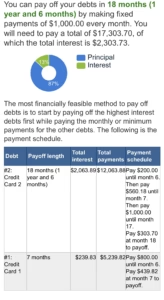
    If you apply the Debt Snowball approach, you prioritize paying off the loan with the smallest balance. That means paying $800 to Credit Card 1 ($150 minimum payment plus $650 remaining funds) until that loan is paid off completely. The remaining $200 needs to be applied to cover the minimum payment on Credit Card 2.

    Once Credit Card 1 is paid off completely, you will add that $800 payment to Credit Card 2 for a total payment of $1,000.

     BalanceRate.Min. Pay.Snowball
    Credit Card 1$5,00015%$150$800
    Credit Card 2$10,00020%$200$200

    Using calculator.net, you’ll see that it will take you 18 months to eliminate both loans with the Debt Snowball approach. It will cost you a total of $17,303.70, of which the total interest is $2,303.73.

    Importantly, Credit Card 1 will be completed paid off in 7 months.

    Debt Avalanche

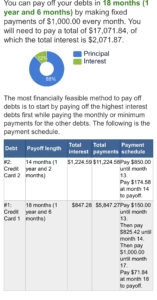
    Now, let’s see what happens when we apply the Debt Avalanche approach. Under this approach, you would prioritize Credit Card 2 because it has the higher interest rate. That means you would pay $850 to Credit Card 2 and only the $150 minimum payment to Credit Card 1. Once Credit Card 2 is paid off, you would pay the full $1,000 to Credit Card 1.

     BalanceRateMin. Pay.Avalanche
    Credit Card 1$5,00015%$150$150
    Credit Card 2$10,00020%$200$850

    Using calculator.net, you’ll see that it will take you 18 months to eliminate both loans with the Debt Avalanche approach. You’ll end up paying a total of $17,071.84, of which the total interest is $2,071.87.

    It will take you 14 months to eliminate the first loan, Credit Card 2.

    Now, we can compare the results of using Debt Snowball or Debt Avalanche.

    Under the Debt Snowball approach, you’ll pay $231.86 more in interest. It will take you 18 months to eliminate both debts under each approach.

    However, under the Debt Snowball approach, it will only take you 7 months to completely erase one loan. Under Debt Avalanche, you will not erase the first loan until 14 months have gone by.

    Now that you have this data, you can decide whether you prefer Debt Snowball or Debt Avalanche. Some people may prefer the emotional win of eliminating one loan completely after 7 months using the Debt Snowball method.

    Other people will prefer the Debt Avalanche approach, which results in more savings. The tradeoff is that they won’t eliminate any loans completely until month 27.

    As we said before, there is no right or wrong answer. It is entirely a matter of personal preference.

    Why not just pay the same amount to each credit card?

    If you pay $500 to each credit card from the beginning, let’s see what happens:

     BalanceRateMin. Pay.Equal
    Credit Card 1$5,00015%$150$500
    Credit Card 2$10,00020%$200$500

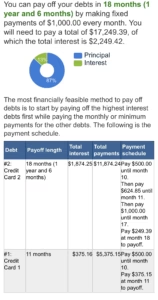
    You will end up paying off both loans in 18 months and paying a total of $17,249.39, of which the total interest is $2,249.42. You won’t eliminate any loans completely for 11 months when Credit Card 1 is paid off.

    Compared to the Debt Snowball approach, splitting the payments evenly means four more months to pay off the first loan completely. That means you’re waiting longer for your first emotional win.

    Compared to the Debt Avalanche approach, you’ll end up paying $177.55 more in total interest. If you’re looking to maximize your savings, splitting payments is not the way to go.

    As you can see, whatever your preference is, it makes sense to pick either Debt Snowball (fastest emotional win) or Debt Avalanche (most money saved).

    Personally, I prefer the Debt Snowball approach.

    I prefer the Debt Snowball approach because of the emotional win that comes with eliminating a debt in less time, sometimes even twice as fast.

    That victory is more important to me than saving $231.86 spread out over 18 months (the length of time it takes to eliminate both debts).

    If you prefer paying the least amount in interest, I won’t argue with you. There’s nothing wrong with saving money. It’s a personal choice.

    That said, there is one instance where I prefer Debt Avalanche to Debt Snowball.

    If you have Bad Debt, like credit card, always pay that debt first.

    Bad Debt typically has significantly higher interest rates than other forms of debt, like student loans, auto loans, or mortgages.

    Compare these current (February 2025) average interest rates for various types of loans:

    It’s not hard to see that credit card debt comes with a significantly higher interest rate than any other form of common debt.

    This is why I recommend you always pay your credit card debt first.

    Let’s look at a second example to illustrate this point.

    Example 2: Auto Loan and Credit Card Balance

    Auto Loan: $8,000 balance with an interest rate of 5% and a minimum required payment of $50 per month.

    Credit Card: $20,000 balance with an interest rate of 20% and a minimum required payment of $400 per month.

     BalanceRateMin. Pay.
    Auto Loan$8,0005%$50
    Credit Card$20,00020%$400

    Just as before, you’ve determined that you have $1,000 per month to put towards these two loans. Because you have to pay a minimum of $400 to your credit card and $50 to your auto loan, you have $550 left to deploy.

    How should you do it?

    Debt Snowball

    If you apply the Debt Snowball approach, you would prioritize paying off the loan with the smallest balance. That means paying $600 to your Auto Loan until that loan is paid off completely. The remaining $400 needs to be applied to cover the minimum payment on your credit card debt.

    Once the auto loan is paid off completely, you will add that $600 to the credit card debt for a total of $1,000.

     BalanceRateMin. Pay.Snowball
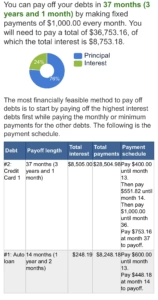
    Auto Loan$8,0005%$50$600
    Credit Card$20,00020%$400$400

    Using calculator.net, you’ll see that it will take you 37 months to eliminate both loans with the Debt Snowball approach. It will cost you a total of $36,753.16, of which the total interest is $8,753.18.

    Importantly, the auto loan will be completed paid off in 14 months.

    Debt Avalanche

    Now, let’s see what happens when we apply the Debt Avalanche approach.

    Under this approach, you would prioritize the credit card loan because it has the higher interest rate. That means you would pay $950 to the credit card and only the $50 minimum payment to the auto loan. Once the credit card is paid off, you would pay the full $1,000 to your auto loan.

     BalanceRateMin. Pay.Avalanche
    Auto Loan$8,0005%$50$50
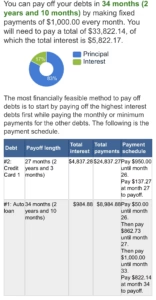
    Credit Card$20,00020%$400$950

    Using calculator.net, you’ll see that it will take you 34 months to eliminate both loans with the Debt Avalanche approach. You’ll end up paying a total of $33,822.14, of which the total interest is $5,822.17.

    It will take you 27 months to eliminate the credit card debt.

    We can again compare the results of using Debt Snowball and Debt Avalanche.

    Under the Debt Snowball approach, you’ll pay $2,931.01 more in interest. It will also take you three months longer to eliminate both debts.

    On the plus side, your auto loan will be completely paid off in 14 months, which is nearly twice as fast as with Debt Avalanche.

    Some people may still prefer the emotional win of eliminating one loan completely after 14 months using the Debt Snowball method.

    For me, the price of that emotional win has gotten too expensive. I would prefer to save the $2,931.01 and have both loans paid off in less time, even if that means waiting longer to pay off a single loan.

    If you do this exercise with any normal credit card compared to another form of loan, you’re likely going to find that the credit card interest rates are so high that you should target those loans first.

    Do you prefer Debt Snowball or Debt Avalanche?

    As we said before, there’s no right or wrong answer. Money decisions are emotional. Paying off debt is the perfect example.

    Using a simple online calculator can help you make the best decision for your situation. All you need to do is find the balance, interest rate, and minimum payment for each of your loans and the calculator will do the rest.

    Whichever method you choose, stick with it. Save yourself the stress of doing mental gymnastics each month.

    The most important thing is that you are making your payments every month.

    Have you used Debt Snowball or Debt Avalanche?

    Which method do you prefer?

    Let us know in the comments below.  

  • How to Realistically Pay Off Debt on a Budget

    How to Realistically Pay Off Debt on a Budget

    In this post, we’ll learn how to pay off debt on a budget. In our initial series on debt, we first looked at some scary stats about how common debt is in society.

    We learned that 8 out of 10 people have some form of debt. We also learned that nearly half of credit card users carry a balance. Finally, we saw that consumer debt is a worldwide problem.

    By recognizing that debt is something that impacts nearly all of us, I hope that you stop feeling alone if your’e in debt. There’s no reason to be ashamed. You are not a bad person.

    If people were more willing to talk about money, you may not have had those feelings in the first place. You may have already learned how to pay off debt on a budget.

    Understanding how you got into debt is the first step in working your way out. That’s why we next looked at three big reasons why people are in debt.

    Of course, there are other explanations, but in my opinion, these three explanations sum it up:

    1. We can be careless with our money.
    2. We don’t plan ahead for emergencies.
    3. And, we try to keep up with the Kardashians.

    With these common causes in mind, we can now start focusing on how to pay off debt on a budget.

    These strategies can work whether you are trying to eliminate Good Debt or Bad Debt.

    In my experience, both Good Debt and Bad Debt can feel heavy. While Good Debt can help you achieve financial freedom, the debt will still hang over your head until it’s paid off.

    Before we get to my top 10 strategies to eliminate debt, let’s get one thing straightened out:

    If you’re looking for a magic wand to immediately erase all your debt, you’re in the wrong place.

    Paying off debt takes time. It requires patience and discipline. You may not notice much progress in the beginning, but you need to stick with it.

    It most likely took you years to get into debt, so be reasonable with your expectations of how long it will take to pay it off.

    My top 10 strategies for how to pay off debt on a budget.

    1. Write down your Tiara Goals.
    2. Create a Budget After Thinking so the debt stops growing.
    3. Prioritize Later Money funds for debt.
    4. Apply our Top 10 strategies for staying on budget.
    5. Talk to your people about paying down debt.
    6. Track your net worth and saving rate for small wins.
    7. Pick a strategy and stick with it: Debt Snowball v. Debt Avalanche.
    8. Think about loan consolidation.
    9. Get a side hustle.
    10. Don’t let yourself fall backwards.

    1. Write down your Tiara Goals.

    Have you ever asked yourself what you would do with financial freedom?

    I asked myself that powerful question on a beach years ago and came up with my Tiara Goals.

    Debt is a major obstacle on the way to financial freedom. To help you stay motivated to eliminate debt, write down your version of Tiara Goals. By reminding yourself what you’re actually striving for, you’re more likely to stay on track.

    Whenever we talk about good money habits, it always starts with establishing strong motivations. This is especially true when it comes to debt. There are too many temptations that can push us off track.

    When you’re faced with these inevitable temptations, take a look at your Tiara Goals. I keep my Tiara Goals in my notes section on my phone. I also have a picture on my phone of the original sheet of notebook paper I scribbled on.

    All it takes is a quick glance at my most important life values to overcome whatever temptation is in front of me.

    Getting out of debt is not easy. Make it easier by regularly reminding yourself what you would do with financial freedom.

    2. Create a Budget After Thinking so the debt stops growing.

    If you’re currently in debt, it’s crucial that you stop that debt from getting larger. Think about it. If you’re paying off $1,000 of credit card debt each month, but you’re still spending $1,200 more than you earn, your efforts will be for nothing.

    Your debt is growing faster than you’re paying it off. You’re not getting any closer to being debt-free.

    That’s why to eliminate debt, you need to first create a Budget After Thinking.

    Once you’ve stopped the disappearing dollars and learned where your money is going each month, you can make thoughtful decisions to pay off debt on a budget.

    Then, you can be confident that any money you allocate to debt will actually lower your debt balance.

    3. Prioritize Later Money funds to pay off debt.

    As we’ve discussed, the art of budgeting is to generate fuel for your Later Money goals. The more fuel you can generate each month, the faster you will achieve your personal finance goals.

    There are lots of options on what to do with your Later Money. For example, you can invest in real estate or the stock market.

    When you’re in debt, I recommend you prioritize using your Later Money to eliminate that debt. This is especially true if you have Bad Debt, like credit card debt. Your number one money focus needs to be to eliminate that debt.

    This is the key to learning how to pay off debt on a budget.

    There’s a good reason to focus on paying off your Bad Debt.

    The interest rate on Bad Debt is generally very high. The amount you pay in interest each month will be significantly greater than what you may reasonably expect to earn through investments.

    If you only have Good Debt, like student loan debt, you have some more flexibility in whether to focus on that debt or your other investment goals. This is because Good Debt generally carries lower interest rates, so your investment returns may match or even exceed what you’re paying in interest.

    In this scenario, I suggest that you consider splitting your Later Money between debt pay down, savings, and investments. This is what my wife and I are currently doing in 2025.

    Seeing your savings and investments grow while focusing on how to pay off debt on a budget can provide an emotional lift. Establishing good savings and investment habits now will also have longterm benefits that should survive your debt phase.

    4. Apply our Top 10 Strategies for staying on budget.

    Our Top 10 Strategies for staying on budget will help you generate more money to allocate to debt. These tips are crucial if you’re trying to learn how to pay off debt on a budget.

    For example, when you see something that you might want to buy, make a note in your phone instead of buying it right away. After a couple weeks, you probably won’t even want that thing anymore. Take that money you didn’t spend and put it towards your debt.

    As another example, how about playing The $500 Challenge Game? When you come in under budget that month, use the excess funds to pay down debt.

    When you have debt, applying our Top 10 strategies to staying on budget can teach you something powerful. You’ll see for yourself that the emotional high of paying down debt is better than the feeling you’d get from spending that money on things you don’t care about. It’s important not to ignore these emotional wins when learning how to pay off debt on a budget.

    5. Talk to your people about how to pay off debt on a budget.

    Stop me if you’ve heard this before:

    Why do we insist on struggling with our money choices alone instead of talking to the people we trust and love?

    Talking money is not taboo. That includes talking about our current money goals and money challenges. Of course, it includes talking about how to pay off debt on a budget.

    I’m currently focused on paying down HELOC debt, building up my emergency savings, and funding my kids’ 529 college savings plans.

    What are your current money priorities? If you don’t want to share with us, are you sharing with your friends or family?

    I struggled with debt when I began my career as a lawyer. For years, I kept that to myself. I wish I had been more open. I’ve recently learned that many of my friends were struggling in the same way.

    The problem was that none of us talked about it. I think about how much stress we could have saved each other if we were just willing to talk about money like we talked about everything else. Instead, we hid our truths from each other. Even worse, we likely enabled each other’s poor spending habits.

    I now know that it didn’t have to be that way. I would have been better off if I was open about it.This part still bothers me today: I also might have helped my friends facing the same challenges just by starting the conversation.

    6. Track your net worth and savings rate for small wins.

    Remember that your net worth grows when you reduce your liabilities, meaning debt. When we think of net worth, it’s common to focus on growing our assets. Don’t forget that reducing your debts has the same impact on your balance sheet.

    For example, when tracking your net worth, eliminating $1,000 in debt is the same as an investment that grows by $1,000.

    Even when you’re focused on how to pay off debt on a budget, tracking your net worth can be very motivating. Every payment you make to reduce that debt improves your net worth.

    This is especially helpful if you are focused on paying off student loans or paying down a mortgage. You may not have many appreciating assets, but you can still make a positive impact on your net worth by reducing your debt.

    The same logic applies to tracking your savings rate. Measure and feel good about each additional amount you dedicate to eliminating debt. The goal is to stay motivated while you pay off debt on a budget.

    7. Pick a strategy and stick with it: Debt Snowball v. Debt Avalanche.

    There are two common strategies to consider when you hope to pay off debt on a budget. These strategies are referred to as “Debt Snowball” and “Debt Avalanche.”

    Debt Snowball means paying down your smallest debt balance first, regardless of interest rate. When you’ve paid off that loan completely, you then move to the next smallest balance, again regardless of interest rate.

    Debt Snowball is ideal for people that are motivated by the emotional wins that come with eliminating a loan completely, even if it costs more money in interest in the long run.

    Debt Avalanche means you pay down the debt that has the highest interest rate first, regardless of the balance. Once that debt is gone, you move to the loan with the next highest interest rate.

    Debt Avalanche is for people who would prefer to pay less overall interest, even if it will take longer to pay off a single loan and receive the emotional win.

    A snowball has grown large due to the force with which it rolls, tumbling down a forested mountain during the snowy season, lifting small amounts of snow along its path, illustrating the preferred method for how to pay off debt on a budget.

    I discussed the pros and cons of each strategy here. Some people will prefer the emotional wins of the Debt Snowball method, while others will prefer the mathematical advantage of the Debt Avalanche method.

    Personally, I use the Debt Snowball method.

    I value the emotional wins of eliminating a debt entirely, even if it ends up costing me more in the long run. I am currently applying the Debt Snowball method to pay off HELOC debt.

    I’ve experienced firsthand that our money choices have more to do with emotions than they do math. If you prefer to play it strictly by the numbers, I completely understand.

    The key is that whichever strategy you pick, stick with it. You’ll save yourself a lot of unnecessary mental gymnastics by choosing one approach and then moving on.

    One word of caution: whichever method you choose, be sure to always pay the minimum on all of your loans. Otherwise, you’ll be in violation of your loan terms and face devastating penalties.

    The idea with either of these methods is to allocate whatever funds remain to the single loan you have prioritized after paying the minimum on all loans first.

    8. Think about loan consolidation or balance transfers.

    Whether you have credit card debt, student loan debt, or even mortgage debt, you may have the option to consolidate each type of loan into a single loan. If you do your homework, you should end up with a lower overall interest rate and have only one loan payment to make each month.

    If you choose to go this route, make sure you fully understand the fine print involved.

    For example, if you’re thinking about consolidating your student loans, you’ll end up sacrificing certain loan forgiveness provisions that accompany federal loans.

    The same caveat applies when considering a credit card balance transfer. A balance transfer is when you move the balance from one credit card to a different credit card with a lower interest rate. Most major credit cards accept balance transfers from other banks’ credit cards.

    The main reason to consider a balance transfer is if the card you are transferring into carries a significantly lower interest rate than your current card. In some instances, you may even qualify for a promotional rate with no interest charged for a limited period of time.

    I used balance transfers when I was focused on eliminating credit card debt at the beginning of my career. I did my homework and found a card that was advertising 0% interest for 12 months with no balance transfer fees. That meant that for an entire year, I paid no interest. Every payment I made went directly to lowering my overall debt.

    If you’re considering a balance transfer, be mindful that there are usually upfront fees involved, usually around 3%. That fee may end up cancelling out any benefit from doing the transfer in the first place.

    9. Get a side hustle to help pay off debt on a budget.

    You’re not too busy or too important for a side hustle.

    At the end of the day, there are really only two ways to more quickly pay off debt on a budget: spend less money and/or make more money.

    We already talked about creating a Budget After Thinking to help on the spending side.

    If you really want to get rid of your debt faster, earning more money and the same time you’re spending less money is a dominate combination.

    If you take on a side hustle, you can use every dollar you earn to pay off debt. Since this is new money you’re earning, you shouldn’t need it to fund your Now Money or Life Money.

    Avoid the temptation of using that money on things you don’t really want anyways. Think about how much faster that debt will disappear if you’re able to throw additional money at it each month.

    If you’re not ready for a side hustle, the same logic applies anytime you earn a bonus or commission at your primary job. Put that money to good use by paying down your debt.

    10. Don’t let yourself fall backwards while you pay off debt on a budget.

    When you do succeed in eliminating a debt, don’t let yourself fall back into bad habits. It’s hard to pay off a debt. It takes time. It takes patience and discipline.

    Don’t let it all be for nothing.

    When you pay off a loan, celebrate that accomplishment!

    Be proud of yourself and let that good feeling motivate you to continue on your journey towards financial freedom.

    Before you know it, debt will be part of your past life. You can shift all your attention to the opportunities that comes next for you and your family.

    Let us know in the comments below:

    Have you used any of these strategies to pay off debt on a budget?

    What about any other strategies to pay off debt on a budget that have worked for you?

  • My Path to Financial Freedom with Tiara Goals

    My Path to Financial Freedom with Tiara Goals

    A few months before we got married, my wife and I took a trip down to Florida. One afternoon, I headed out to the beach with a book, a notebook, and a few ice cold beverages.

    The weather was perfect. It was sunny but not too hot. Blue skies and just a slight breeze. The beach was quiet that afternoon. I set up my chair to face the ocean and started reading. This little break was exactly what I needed in the middle of “wedding planning.”

    I don’t recall the book I was reading that day. I’ve been meaning to look back at my journals to see if I can figure it out. Anyways, I’ll never forget what I learned about myself that afternoon.

    The author wrote about the power of financial freedom. We’ve discussed financial freedom in previous posts. The basic idea is that when you are financially free, you can choose how to live your life on your own terms. You can make important decisions based on what truly matters to you, as opposed to being forced down a certain path for money reasons.

    On the beach that day, the concept of financial freedom was not new to me. I had read about it for years. The concept really hit home that afternoon when the author asked a simple but powerful question:

    What would you do with financial freedom?

    Maybe the question really resonated with me because I was about to get married. It’s only natural to daydream about what life would be like after the wedding, even though my wife and I had been a couple for six years by that point.

    Over the years, we had talked a lot about what we wanted our lives together to look like. We knew long before the wedding how we each felt about major topics like starting a family and where we wanted to live.

    We were also on the same page when it came to money decisions. My wife and I met early on during my personal finance journey, not long after I had determined to get my money life sorted out. My wife still jokes that she was my first personal finance student.

    By the time we got married, I had been on my personal finance journey for about seven years. I was out of debt and was starting to think about the options that were now available to me. It was around this time that I learned one of the most powerful words in personal finance:

    DINK

    Back then, my wife and I were both working as lawyers in Chicago. We didn’t have any kids. I didn’t realize it until later on, but we were DINKs.

    DINK means “Dual Income No Kids.”

    When you’re in a relationship where you have two incomes coming in and are sharing financial responsibilities, you have the opportunity to supercharge your Later Money goals.

    If you are currently a DINK, or will soon be a DINK, please pay extra attention here.

    Don’t waste this powerful opportunity to supercharge your Later Money goals.

    This is what my wife and I were able to do, even if we didn’t know what a DINK was. We each had good incomes coming in and our monthly expenses were low. The two of us could comfortably share an apartment, instead of each paying for an apartment separately. That’s major savings each month.

    We didn’t have to worry about childcare. We were young so the odds of unexpected medical care were lower. All things considered, it was pretty easy to keep our Now Money to a minimum with plenty to spare for Life Money.

    This allowed us to fuel our Later Money goals, like having a nice wedding and saving up for a home or rental property. We had money in the bank and seemingly endless choices.

    And, I didn’t want to screw it up.

    Which brings us back to me sitting on the beach, thinking about what I would do with financial freedom, with maybe 1 or 2 less beverages in the cooler.

    What did I really want out of life?

    I put my book down and looked off into the ocean, thinking about what I wanted out of life. I started thinking about what my ideal life would look like. By this point, I was engaged in the type of deep thought where you don’t even realize what’s happening around you.

    It quickly occurred to me that I had never truly thought about what I wanted in life. Sure, I had thought about things like having a family and being able to take vacations.

    But, I never carved out time to purposefully think hard about what I actually wanted. I had never asked myself what truly motivates me.

    Without a doubt, I had never written down the answer to that powerful question: what would I do with financial freedom?

    I hadn’t ever allowed myself to dream about financial freedom.

    The truth is, I don’t think I had ever visualized a life that wasn’t dominated by a full-time job. Up to that point, my whole life had revolved around getting an education and then getting a job. I never pictured a world where I might not need a full-time job to provide for myself and eventually my family.

    I had read about the concept of being financially free, but it always seemed like a possibility for other people, not me. Writing this years later, I feel sad for that version of myself for having such limiting beliefs.

    That said, I completely understand why I felt that financial freedom was unattainable for someone like me. This was in the phase of my life where I had been preoccupied with eliminating debt. Because of that debt, I didn’t allow myself to dream about what life could look like if money wasn’t holding me back.

    This was also before my wife and I had rental properties. It was before we recognized the impact of side hustles and multiple streams of income. I had read about and understood these concepts in theory, but I hadn’t put what I learned into practice.

    That day on the beach, it was like a light went on in my head.

    After years of patience and discipline, I had climbed out of debt. I was now a DINK with Later Money in the bank waiting to be deployed. That meant I had created opportunities.

    I wasn’t financially free, but for the first time in my life, I allowed myself to accept that financial freedom was possible for me.

    This was one of the most powerful moments in my life.

    With that realization in my mind, I walked into the ocean to cool off and think some more.

    What would I do with financial freedom?

    There in the ocean, I wasn’t thinking about dollars or career goals. This was more important than that. I was thinking about what I wanted my life to look like if money was not an issue. I was thinking about what I would do with my time if I was in complete control.

    Floating there in the water, it was like I had an epiphany. Everything suddenly became clear to me. I ran out of the ocean to get back to my chair before I forgot what just popped into my head.

    I whipped out my top bound spiral notebook and started writing with a blue pen. Minutes later, I had written down seven answers to the question: what would I do with financial freedom?

    My “Tiara Goals” were born.

    Nearly eight years later, I still have that sheet of notebook paper. I keep it safe in a leather binder protected by a laminated page holder. It has those familiar tear marks on the top of the page where the paper connected to the spiral binding.

    Even though I have these seven goals memorized by now, I still look at this sheet of paper every month. Looking at this sheet is an incredible reminder of that day on the beach when everything became clear to me.

    A quick aside, I call my goals “Tiara Goals” because it’s a silly, but meaningful, description to me. Have some fun with what you name your goals. If you do it right, you’ll be thinking and talking about these goals a lot.

    What are my Tiara Goals?

    So, here are my original Tiara Goals from 2017, as scribbled on that sheet of paper and edited for clarity:

    1. Be with my wife and kids as much as I want. Dad never missed a game. Mom never missed a game. Nana never missed a game.
    2. Not be forced to commute to work on Friday or Tuesday or whatever day, if I need that day for myself.
    3. Choose how to spend my working hours (representing clients, teaching, volunteering, building a business, etc.).
    4. Continue to study and learn constantly.
    5. Take at least one big trip every year.
    6. Never turn down an exciting or smart opportunity because I can’t afford it.
    7. Work alongside people that value my contributions.

    Keep in mind that I wrote these goals before I had kids and before I was even married. This was also years before the pandemic when working from home was a foreign concept to most of us.

    I think it says a lot that I was thinking about these things way back then.

    Travelers couple look at the mountain lake. Adventure and travel in the mountains region in the Austria after thinking about what to do with financial freedom.

    In a future post, we’ll unpack each of these goals.

    While I haven’t reached financial freedom yet, I think I’m doing a pretty good job already living by these fundamental values.

    How do my Tiara Goals help me today?

    My Tiara Goals motivate me to continue striving for financial freedom. We’ve talked extensively about the importance of having strong money motivation in our lives. When we have these powerful motivations, we can stay on budget, get out of debt, and fuel our Later Money goals.

    We can obtain Parachute Money. We can choose to do meaningful work and choose to spend more time with people who are meaningful to us.

    No, it’s not easy to achieve financial freedom. But, it is a whole lot easier when you know what you are striving for in the first place.

    That’s why at the beginning of my financial wellness class, I ask my students to write down their own versions of Tiara Goals. I want to help them avoid the limiting beliefs that I had before that day on the beach.

    My favorite part of class is when my students share their Tiara Goals.

    Without a doubt, this is always my favorite part of class. When I say I’m on a mission to convince you that talking money is not taboo, I think of my students sharing their goals. I get so energized by hearing their goals. My students report the same sentiment after learning what drives their friends and peers.

    Over the years, my students have shared countless impactful stories. As unique as these goals can be, it’s remarkable how most of us want the same things in life. Year after year, I hear the same motivating forces:

    • Spend more time with my family.
    • Travel and enjoy experiences around the world.
    • Stay healthy and fit.
    • Provide for my children and my aging parents.
    • Work for a cause I believe in.
    • Have time to volunteer.

    I also regularly hear one thing that my students, and the rest of us, don’t want:

    • I don’t want to be stressed about money.

    Isn’t it telling that year after year, most of us want the same things in life? I’ve yet to hear anyone say that they dream about working endless hours and not taking their PTO.

    Be specific, but not too specific, when you think about financial freedom.

    When we talk about what we do with financial freedom in class, I encourage my students to get specific without being so precise that the goal becomes restrictive. When we’re thinking about goals related to financial freedom, the idea is to focus more on big-picture, core values.

    There will be a time and a place to strategize how to get there. The point here is to help define what you’re even trying to get in the first place.

    For example, instead of “spending more time with family,” I would suggest something like, “never miss my child’s soccer game or dance recital because of work.”

    Instead of “travel around the world,” I would suggest “at least one overseas trip of at least 2 weeks per year.”

    Adding that little bit of specificity will help you visualize what you’re striving for with your money decisions.

    Don’t get discouraged if you think you are not close to financial freedom.

    Even when you feel like financial freedom is only a distant dream for you, it’s important to actively think about what you want out of life. I’d even suggest that the further away you feel from financial freedom, the more important it is to think about what it would mean for you.

    When you’re at your lowest point, visualizing what you would do with financial freedom is a helpful escape.

    If you haven’t ever actively thought about what you would do with financial freedom, hopefully this post will encourage you to do so.

    Don’t forget to write down whatever you come up with.

    I suggest you share your version of Tiara Goals with your friends and loved ones. It’s OK to keep some of your goals private. By sharing, you will get the benefit of them cheering you on. You’ll also hopefully encourage them to share their goals with you, which can be very inspiring.

    Have you thought about what you would do with financial freedom?

    Have you ever written it down or shared your answers with others?

    What are your Tiara Goals?

    Let us know in the comments below!

  • Money on My Mind: Always Working?

    Money on My Mind: Always Working?

    Simple question. Don’t lie to yourself.

    Do you work too much?

    I’m not asking if you work too hard.

    I mean too much, as in too many hours of your life dedicated to a job.

    I started thinking about this question after recently coming across a few surveys.

    Let’s talk it out. Let me know what you think in the comments below.

    I am shocked by these survey results.

    I’m not often surprised by survey results. This is one of the rare exceptions.

    According to a recent report from MyPerfectResume, 81% of workers worry they may lose their jobs in 2025.

    8 out of 10 people! Is it just me, or is that mind-boggling?

    On the flip side, only 4% of workers report no concerns about losing their jobs.

    These numbers are shocking to me, but maybe I shouldn’t be that surprised. As Yahoo Finance explains,

    Many large corporations have already announced or kicked off a round of layoffs, including Chevron, CNN, Estee Lauder, Meta, and Southwest Airlines. And that, of course, doesn’t count the thousands of workers terminated under Elon Musk’s campaign to reduce the federal workforce.

    My mind immediately jumps to a follow-up question:

    How many of those people worried about losing their jobs have an emergency savings account?

    Sadly, the answer is probably very few people have meaningful savings.

    Surveys like this one motivate me to continue bringing attention to core personal finance issues, like having adequate emergency savings. This is why I so strongly believe that talking about money is not taboo.

    Life is too short and too precious to be in a constant state of worry. Is there any sense worrying about something, like getting laid off, when you have practically no control over whether it happens or not?

    Instead of worrying about what we can’t control, I think it’s better to use our energy on what we can control, like saving up for emergencies.

    Hopefully, you’re not one of these people worried about losing your job. If you are, there’s no better time than right now to prioritize your savings.

    If the first survey shocked me, this one just makes me angry.

    According to this Pew Research Center study, 46% of US workers take less paid time-off than they’re offered.

    I need to say that again.

    Nearly half of US workers choose to work more days than they are required to!

    And, it gets worse if you’re a high earner or highly educated.

    According to the same study, the more money you earn, the less likely you are to take your full paid time-off.

    The more educated you are, the less likely you are to take your full paid time-off.

    The more senior you are, like being a manager vs. non-manager, the less likely you are to take your full paid time-off.

    If the first survey mentioned above surprised me, this one just makes me angry.

    Do you recognize a difference between working hard and always working?

    Don’t misunderstand why these results make me angry. It’s not about working hard vs. slacking off. It’s not about being a good employee vs. a bad employee. I am 100% in favor of people working hard and working with integrity to get the job done.

    My frustration is that somewhere along the way, “working hard” turned into “always working.”

    By the way, before you accuse me of being a slacker, I am no stranger to working hard.

    I work full-time as a lawyer, manage 11 rental properties, teach law school courses on Wednesdays and Sundays, and publish three blog posts per week. Still, none of these things are more important to me than spending quality time with my family.

    Years ago, I first read Tim Ferris’ game-changing book, The 4-Hour Workweek. Ferris described how his small business took off as soon as he started doing less, not more. He empowered his staff and stopped himself from getting in the way. Not only did his company thrive, he had more time available to pursue what really mattered in his life.

    Since writing The 4-Hour Workweek, Ferris has become one of the most influential thought leaders around. To learn more from Ferris, visit his website here.

    Why do you work so much?

    If you’re one of these people choosing to work more hours instead of taking your earned vacation time, have you ever asked yourself why?

    Keep in mind, these are days off that your company has already agreed to give you. You earned them. Why are you not taking them?

    Are you worried about getting fired? Passed up for a promotion? Is your self-worth tied to how many hours per week you work?

    Years from now, when your grandkids are huddled up for story time, do you plan on telling them how much you worked and how many life experiences you skipped out on?

    These are hard questions to truthfully answer. If you’re being honest with yourself, you may start thinking about another set of questions:

    Is this job the right job for me? Do I want to spend my life stressed from working too much? What would be a better use of my working hours so I can spend more time doing the things that I love with the people that I love?

    I’ve spent a lot of time thinking about these questions. I’ve realized that I’ll never understand what the point is of working so much at the cost of spending time with the things and people you love.

    Maybe I’m the weird one. But, I don’t think I am. Unfortunately, the data backs me up and confirms that working too much can have series consequences.

    Fortunately, we can learn from strategies geared towards retirees. Let me explain.

    Apply lessons for retirees to your life today.

    Writing for BBC Science Focus Magazine, Hayley Bennett shares 5 expert tips for a healthy post-work life.

    The tips include finding a purpose, strengthening your body, and rebuilding your brain.

    Woman on beach in summer thinking about spending more time during her working years living with purpose and focused on health as learned on Think and Talk Money.

    When I came across this story, I immediately thought that we shouldn’t wait for retirement to do these things. This is solid advice for all of us, at any stage in our lives.

    Do you know what sounds pretty great to me?

    A life filled with purpose sounds pretty great. The same goes for being fit and smart.

    The challenge is that work often gets in the way.

    When we let this happen, the consequences can be catastrophic.

    As just one example, lawyers as a profession have long struggled with mental health issues. I first learned about these challenges during law school orientation. Today, I see it in practice. Being a lawyer is a hard way to make a living. When you work as a lawyer, the hours are intense and stress levels are consistently high.

    In 2023, the Washington Post analyzed data from the U.S. Bureau of Labor to determine what the most stressful jobs are. The study confirmed that lawyers are the most stressed.

    Of course, lawyers are not alone in struggling in this regard due to long, stressful hours. The same study showed that people working in the finance and insurance industries were right up there with lawyers as being highly stressed.

    Anecdotally, I’ve personally talked to people recently in a wide variety of other fields, like consultants and small business owners, who are frustrated for the same reasons.

    The point is, regardless of industry, many of us struggle with work stress.

    What can we do about it?

    That’s a complicated question with many possible answers. For starters, I firmly believe that by building strong personal finance habits, we can create more opportunities to find purpose and practice good health.

    I recommend you think back to our conversations about Parachute Money and why you should want to be good with money. When you’ve made thoughtful money choices, you can choose to live a life right now on your terms rather than waiting until retirement.

    I agree with what you’re probably thinking. These are not easy or fun topics to think about. However, in my opinion, it’s much worse to let life go by while failing to take responsibility.

    Am I wrong about people working too much?

    Maybe I’m wrong about people working too much?

    I don’t think I am.

    The data paints a very sad picture for lawyers, and I have to believe anyone else working long and hard hours. If you have similar data about your profession, please share it with us. I hope I’m wrong about what that data will show, but I fear I’m right.

    As always, let us know what you think in the comments below.

    And, thank you for continuing to share stories you’ve come across that would be good to discuss here.

  • How to Responsibly Use Good Debt

    How to Responsibly Use Good Debt

    There may not be a more polarizing debate in personal finance than the concept of Good Debt vs. Bad Debt.

    “Good Debt” generally means loans used to acquire income generating assets, like rental properties or businesses.

    “Bad Debt” generally refers to consumer debt, which is personal debt owed because of buying things for personal or household use. For most people, this simply means credit card debt.

    Two absolute giants in the field, Robert Kiyosaki (of Rich Dad Poor Dad fame) and Dave Ramsey (maybe the most well known personal finance expert in the world), take opposite viewpoints.

    If you’d like to learn more about Kiyosaki, check out his website here. For more on Ramsey, click here.

    Before addressing their different opinions, it’s important to highlight that both Kiyosaki and Ramsey agree on a critical point:

    All consumer debt is bad.

    You’d be hard-pressed to find any personal finance expert who says that credit card debt is OK. I’d be concerned if you found anyone at all, expert or not, who seriously took the position that credit card debt is OK.

    We’ve talked about how this type of debt is scary and can drag down your finances. We also explored the three big reasons why people end up with credit card debt. The bottom line is you’ll never be truly financially free if you’re burdened by debt.

    A quick side note: There is some difference in opinion as to what else besides credit card debt qualifies as consumer debt. For example, is your primary home mortgage considered consumer debt? What about your student loan debt? I’ll give you my take below.

    Now, let’s take a look at how each Kiyosaki and Ramsey differ on Good Debt v. Bad Debt.

    Kiyosaki believes in the power of Good Debt.

    Kiyosaki argues that Good Debt is a powerful tool to generate consistent cash flow from investments. Kiyosaki defines Good Debt as debt that is used to buy assets like real estate or businesses that generate income.

    As long as the debt leads to positive income, it’s considered Good Debt. For example, Good Debt would include taking out a mortgage to buy a cash flowing rental property.

    Kiyosaki suggests that Good Debt can be responsibly used to quickly acquire more assets, even if the debt is considered a liability.

    To better understand the difference between assets and liabilities, check out our post on net worth.

    In Rich Dad Poor Dad, Kiyosaki discusses in detail how investors grow their wealth through the responsible use of Good Debt.

    Ramsey believes all debt is Bad Debt.

    Ramsey could not disagree more with Kiyosaki.

    If it were up to Ramsey, there would be no distinction between “Good Debt” and “Bad Debt.” All debt is bad and carries risks that will weigh on your emotions and drag down your net worth.

    Ramsey is adamant that debt should not be used as a tool to build wealth. He contends that a person’s income is the best way to consistently build wealth.

    In his bestselling book, The Total Money Makeover, Ramsey walks you through how to build wealth without relying on debt.

    So, where do I come out on the Good Debt v. Bad Debt debate?

    Kiyosaki and Ramsey are personal finance legends. There’s no right or wrong in this debate. I appreciate each of their viewpoints.

    Ultimately, what side of the debate am I on?

    I’m on Team Kiyosaki.

    When you responsibly use Good Debt, you can more quickly create income streams to accelerate your journey towards Parachute Money. However, if you’re struggling with consumer debt, taking on any additional debt, even Good Debt, is a bad idea.

    Like other real estate investors, my wife and I have experienced firsthand the power of Good Debt. In seven years, we have acquired four cash flowing rental properties (three in Chicago, one in Colorado) that add extra income to our personal balance sheet each month. Without that income coming in, our financial picture would look completely different.

    On top of that, we have benefited from appreciation with each of our properties, further increasing our net worth. Of course, appreciation is largely out of anyone’s control. Market conditions have been very favorable for us.

    Some people may condescendingly say that we’re just lucky. As bestselling author and thought leader Mel Robbins would say, “Let them think that!”

    Of course we’ve been lucky!

    That doesn’t change the fact that we acted on opportunities when others only talked. We lived in small apartments for six years with a growing family. We responded to tenants whether we were on vacation or it was the middle of the night. Above all else, we stayed disciplined, focused on our goals, and paid the bills even when money was tight.

    For these and so many other reasons, I believe in the responsible use of Good Debt to acquire cash flowing assets.

    Just because we’ve taken on debt doesn’t mean we don’t worry about it.

    All that said, Ramsey’s voice still rings in my ears when it comes to debt. Up to this point in our lives, my wife and I are comfortable with the Good Debt we’ve taken on to build our portfolio. Even so, we frequently think about Ramsey’s point of view and the valid debt risks he highlights.

    Even with the extra rental income coming in, we still feel the heavy burden of mortgage debt. That’s why our goal for 2025 is to prioritize eliminating as much mortgage debt as possible. While we are comfortable with a certain level of debt, we don’t ever want to be reckless.

    If you’re thinking about using debt to acquire assets, don’t ever ignore the heavy emotional toll that debt will have on you. Just as importantly, if you’ve struggled with debt in the past, be careful about going down that road again.

    It’s easy to get blinded by the potential cashflow of an investment while ignoring the accompanying debt. Long before you ever sign the loan documents, make sure you’ve done your homework and thought hard about what it’ll take to pay that loan off.

    What about primary residence mortgage debt and student loans?

    I mentioned that I would share my perspective on whether debt to buy a primary residence or student loan debt is Good Debt.

    I think both should absolutely be considered Good Debt.

    This is one area where Kiyosaki and I don’t agree.

    Why I consider a primary home mortgage Good Debt.

    Kiyosaki favors using Good Debt to buy assets, meaning investments that put money in your pocket. A primary home does not put money in your pocket, so Kiyosaki would not recommend using debt for this purchase.

    He’s not alone in this viewpoint. Many smart people think it’s financially foolish to buy a primary residence instead of renting. For an in-depth analysis on the question of buying vs. renting, check out this video from Khan Academy.

    I don’t agree with this viewpoint. For most of us, our primary residence is the best way to build generational wealth for our families. This is not my personal strategy for building wealth. That said, I understand that this strategy is how most of us do build wealth.

    Besides just wealth building, I appreciate more than ever how owning a home can be emotionally beneficial. Since we moved to our longterm home, I’ve already experienced the psychological benefits of establishing roots and feeling connected to a community. After bouncing around apartments in Chicago for nearly 20 years, I can tell you that it feels good having a permanent home.

    So, I consider a primary home mortgage Good Debt. For similar reasons, unlike Kiyosaki, I recommend including your primary residence in your net worth.

    Why I consider student loans Good Debt.

    I also disagree with Kiyosaki on whether student loans count as Good Debt.

    I don’t want to put words in Kiyosaki’s mouth, but his perspective seems mostly shaped by how he feels about the modern educational system in this country.

    How exactly does he feel about our education system?

    He… hates it.

    All things considered, it makes perfect sense that he thinks student debt is Bad Debt.

    I don’t agree. I’m grateful for my education through law school. I learned how to think and solve problems. I learned how to challenge myself and do hard things. I think this is true for anyone that goes to school and takes it somewhat seriously.

    I’m not discounting Kiyosaki’s point that maybe the system needs fixing. Regardless, I believe that education opens doors, whether that’s through connections made along the way or licenses earned (like the license to practice law).

    From my perspective, debt incurred to pay for that experience and training is well worth it.

    If that wasn’t enough, the data shows highly educated people earn more money. In fact, men with graduate degrees earn $1.5 million more over a lifetime than those with only high school degrees. That’s another reason why I consider an investment in yourself through student loans Good Debt.

    Are you Team Kiyosaki or Team Ramsey?

    Maybe you feel there is such a thing as Good Debt. Maybe not. Either perspective is completely valid.

    In the end, can we at least all agree that credit card debt is always bad debt?

    Are you Team Kiyosaki or Team Ramsey?

    Let us know in the comments below.

  • Buy a Home Now or Wait for Mortgage Rates to Drop?

    Buy a Home Now or Wait for Mortgage Rates to Drop?

    In today’s Q&A, we’ll address two great questions from readers about shopping for a home in today’s environment. We’ll also talk through how to know if you have enough Parachute Money.

    As always, please continue to reach out with your questions on our socials or by replying directly to our weekly newsletter emails. I personally read and reply to every email.

    Subscribe Here to Join our Newsletter!
    Name

    Should I wait for mortgage rates to drop before buying a home?

    This question has been on people’s minds for a few years now. Ever since rates started climbing from the all-time lows during the pandemic, people have been hoping they might significantly drop again.

    In my humble opinion, that ain’t happening. At least not anytime soon.

    Google “Are interest rates going to drop” and you’ll find that nearly every major news outlet and mortgage lender has a prediction. Most predictions right now are about the same. US News summed it up just about perfectly:

    Analysts expect the 30-year fixed mortgage rate to stay elevated between 6% and 7% for the next two years. Just two months ago, economists thought it would fall into the 5% range by the second half of 2025. With such wild fluctuations in the forecast, you’d be just as likely to get a satisfactory mortgage rate outlook from a Magic 8 Ball: Cannot predict now. Ask again later.

    Nobody knows what’s going to happen with rates. Just two months ago, US News thought rates would drop. Now, they’re expected to stay elevated. What are you supposed to do with that information?

    I recommend you ignore it.

    My advice is to buy a home when you’ve decided it’s the right moment in your life to do so. Make that decision regardless of what current interest rates are.

    Why do I recommend you ignore mortgage rates?

    There are really only three things that can happen to mortgage rates over time:

    1. Stay the same.
    2. Go up.
    3. Go down.

    In any of those three scenarios, there’s no point in basing your decision to buy a home only on the current rates. Let me explain.

    Let’s say you have a crystal ball and can look three years into the future. Looking into your crystal ball, let’s play out each of the three scenarios mentioned above.

    1. Your crystal ball shows you that mortgage rates stayed relatively consistent.

    Since rates stayed the same, there would be no point in waiting to buy a home because of rates. The rates three years from now are the same as they are today.

    By waiting, you’re likely going to experience that homes have gotten more expensive. The longer you wait, the more expensive they are going to be.

    The data shows that homes have become more expensive historically and in the recent past. In 2024, U.S. homebuyers paid nearly double what they paid for homes in 1965, accounting for inflation. More recently, in Chicago for one example, home prices are up more than 9% since just last year.

    So, even if rates stay the same, prices are likely to go up and you shouldn’t sit around waiting for them to drop.

    2. Your crystal ball shows you that mortgage rates went up.

    If rates go up, it’s easy to conclude that it’s a mistake to delay your home buying decision. Higher rates, combined with higher prices, is… not good.

    3. Your crystal ball shows you that mortgage rates went down.

    This is the scenario that many people are waiting for. When rates go down, you can afford a more expensive home. That’s a good thing, right?

    Not so fast.

    Do you think you’re the only person sitting around waiting for rates to drop? For the same reasons that you’re waiting, many other people are also waiting.

    So, what happens when lots of people are waiting to buy the same thing? Demand goes up. When demand goes up, you have more competition to buy that same house. That means prices go up. You’ll end up paying more money for the house, even with a lower interest rate.

    Take it from me, bidding wars are not fun. I would much prefer to get the house I want without the added competition.

    If mortgage rates end up dropping later on, I’ll refinance my loan into the lower rate. I may pay more on a monthly basis in the short term, but long term, I have the house I want at the best available current rate.

    So, there you have it. No matter what happens to rates, in my opinion, you’re best off shopping for a home when the time is right in your life.

    Forget about the rates. If rates do end up going down in the future, you can still benefit by refinancing.

    My wife and I are considering buying a home that would be the most expensive home ever sold in the neighborhood. Is that a bad idea?

    This is another great question. Opinions will certainly vary, so I encourage you to talk to your inner circle to get a variety of perspectives.

    Personally, I have no problem buying the most expensive property in a neighborhood, under one condition: I plan on holding that property for at least 10 years.

    Like the data above shows, home prices tend to go up historically. Since 1990, home prices nationally have appreciated on average at a rate of 4.4%.

    If you’ve done your homework and are shopping for real estate in good neighborhoods, it’s only a matter of time before another home sells for a higher price.

    The longer you hold the real estate, the more home appreciation works in your favor.

    Appreciation is one of the best reasons to invest in real estate, after all.

    When we bought our first rental property in Chicago in 2018, we paid the highest price for any 4-flat in our neighborhood. At the time, we were a bit concerned that we were overpaying. Those worries were short lived. With seven years of appreciation working in our favor, numerous properties have sold since then for significantly more money.

    Family walking into new home just purchased illustrating it's not always a bad idea to buy the most expensive home in neighborhood as learned on Think and Talk Money.

    Yes, there are always going to be dips in the market. Do not expect your home to steadily appreciate every year. This is why my one condition is to hold the property for at least 10 years. When you hold property (or any investment) for the long run, time is on your side. You can wait out any dips in the market.

    As long as you’ve done your homework and are willing to hold a property for the long run, I would have no hesitations in buying the most expensive property in a neighborhood.

    I’m fascinated by the concept of Parachute Money. My question is: how will I know if I have enough Parachute Money?

    The idea of Parachute Money is one of my favorite concepts in personal finance. Check out our post here to learn more about how empowering Parachute Money can be.

    To know how much Parachute Money you need, look back at your Budget After Thinking. All you need to do is add up your monthly Now Money and Life Money to figure out how much Parachute Money you’ll need to maintain your current life.

    For example, let’s say your budgeting process taught you that you need $6,000 of Now Money and $4,000 of Life Money each month. Your Parachute Money target is $10,000.

    If your goal is to walk away from your primary job, you’ll need to create $10,000 of income streams not counting that primary job. That could be from any combination of investments and side hustles. Once you hit $10,000 in parachute strings, you should be able to safely walk away from that job.

    Note that for calculating your Parachute Money, you can ignore your Later Money goals. The reason why relates back to the purpose of Parachute Money.

    The purpose of Parachute Money is to be able to choose to walk away on your own terms while continuing to support yourself.

    Presumably, choosing to walk away from a bad situation accomplishes one of your primary goals for saving and investing money in the first place.

    At this phase of your life, it’s OK to temporarily set aside your Later Money goals. If and when you choose to seek new sources of income, you can start fueling your Later Money goals again.

    The exception to this rule is if you have debt obligations that are not accounted for in your Now Money. If that’s the case, be sure to include your debt obligations in your Parachute Money target.

    One last thing about Parachute Money: achieving true Parachute Money is hard. Just remember, the payoff could be extremely valuable to you: not having to work your primary job if you choose not to. That’s the definition of financial independence.

    Thanks again for all the great questions!

    If we didn’t get to your question this week, we’ll do our best to get to it in an upcoming post.

  • Three Big Reasons Why You’re in Debt

    Three Big Reasons Why You’re in Debt

    “Live below your means.”

    “Money doesn’t grow on trees.”

    “Don’t break the bank.”

    We’ve all heard these common money phrases. If you were to ask someone older than you for one piece of personal finance advice, I’m betting you’ll hear one of these lessons. Let me know if I’m right about that in the comments below.

    There’s a reason these phrases are so common. They’re simple and easily reflect some of our core personal finance principles. In fact, we’ve covered these concepts in detail in earlier posts:

    Like many personal finance concepts, it’s not too challenging to understand the meaning of these phrases.

    Most of us understand that it makes sense to spend less money that we earn, right?

    How many of us remember rolling our eyes as kids after our parents wouldn’t buy something we wanted because “money doesn’t grow on trees”?

    Does anyone truly disagree with these lessons? If so, I’d be very appreciative to hear your perspective in the comments below.

    Assuming we’re in relative agreement on these philosophies… what am I getting at?

    I’ll answer that with a question of my own:

    Why is it that we can all agree with these core personal finance lessons and at the same time choose to ignore them?

    For example, we intuitively know that we should live below our means, but nearly half of us carry a credit card balance.

    On top of that, hardly any of us are completely satisfied with our savings.

    It’s not that we want to have high debt and low savings. So why is this the reality for so many of us?

    I have 3 main theories why we fall into debt.

    There are countless theories on why people end up in debt. I have three primary theories. Looking at each of these explanations can help us understand and avoid common pitfalls that lead us into debt.

    1. We fall into debt because we are simply careless.

    When I struggled with debt at the beginning of my career, it was basic carelessness.

    I didn’t have any idea how to budget or make intentional choices with my money. I had never thought about why or how to be good with money.

    Like many people, I failed to create a budget and assumed that my W-2 income was plenty. I ignored emergency savings and never even thought about creating Parachute Money.

    The saddest part is that I didn’t even realize that I was slipping backwards. I had no idea because I didn’t track my net worth or savings rate. I worked hard all year long and just hoped things would work out.

    By the way, if this sounds familiar, you should know by now I’m not judging anyone. I’ve been very open about my money mistakes. We all deserve a chance to learn about and talk about strong personal finance habits.

    That’s why I’m on a mission to flip the script: talking money is not taboo.

    2. We don’t plan ahead for emergencies.

    So, being careless with money is one common reason people fall into debt. Another common reason is that bad things happen in life.

    This might include medical emergencies, home repairs or car troubles. It’s not our fault that these things happen. But, it is our fault if we’re not prepared in advance. 

    While these events are unfortunate, and maybe even tragic, they are not unexpected. We all need to expect that bad things will happen.

    Preparing for the unexpected is part of every solid organization’s planning. In government, planning ahead means having a “rainy day fund.”

    When managing properties, planning ahead for big repairs means having a “Capital Expenditures” or “Cap Ex” fund. For our personal finances, planning ahead means having an emergency fund.

    Whether it’s government, business, or personal finance, the goal is to have options other than taking on debt to get through challenging circumstances.

    3. Blame the Kardashians.

    Besides carelessness and emergencies, there’s another powerful force that contributes to rising debt levels across the world. This force is nearly impossible to ignore. It’s become a part of our daily lives, whether we want to admit it or not. 

    What is this powerful force that contributes to our rising debt levels?

    The Kardashians.

    OK, not just the Kardashians, but they’re kind of the mascots.

    The era of social media and on-demand entertainment has made it harder than ever to avoid temptation. It’s everywhere we look.

    Blaming the Kardashians realtes to another timeless, common money phrase: “Keeping up with the Joneses.”

    The Kardashians are the modern day Joneses.

    Once upon a time, “the Joneses” represented your neighbors, people you could observe from a distance on a regular basis. The idea behind the phrase is that you can see what your neighbors are spending money on and are either consciously or subconsciously tempted to do the same.

    If your neighbors buy a new car, you buy a new car to keep pace. If your neighbors vacation in Australia, you research diving tours at The Great Barrier Reef. When you notice your neighbors hosting a backyard BBQ party with lots of happy looking people, you decide to host a party the next weekend.

    As humans, it can be difficult to ignore the temptation to keep up with our neighbors. Whether we like it or not, we are concerned with our social status. Part of our self-worth gets tied to comparing ourselves to others.

    Who better to measure up against than the people in our neighborhood who we probably have a lot in common with?

    This same idea is oftentimes compounded in the professional setting. It is not uncommon to compare ourselves in the same way to our colleagues at the office.

    Some professions heighten the pressure to keep up. Have you ever noticed that real estate agents seem to always drive nice cars? Or, big city lawyers wear fancy suits? It’s easy to get caught up in expensive tastes when you’re expected to fit in.

    One of my favorite personal finance books, The Millionaire Next Door, discusses this concept in detail. I highly recommend you read this book if you are struggling with comparing yourself to others.

    What does this all have to do with the Kardashians?

    In today’s world dominated by social media and the internet, we’re no longer influenced just by our neighbors or colleagues. We’re now influenced by people throughout the world. That could mean friends or complete strangers.

    Instead of just learning your neighbors went on vacation, now you know when anyone in your circle is on a trip. At any moment, you may be on the train in 12 degree weather heading to work. One look at your phone and you’ll see plenty of wonderful pictures of people doing cool things. It’s hard to not want that for yourself.

    The byproduct of social media and the internet is the never ending temptation to spend money. Even if that means spending money we don’t have. That’s a powerful force pushing us deeper into debt.

    I am fighting this temptation in my life right now. Having moved to a new home not long ago, there are so many things we want to buy and projects we want to do. I need to constantly remind myself to slow down so I don’t again fall victim to consumer debt.

    So, what’s the solution? 

    Deactivate social media? Cancel the internet?

    Nah. If you did that, you’d miss out on epic Instagram reels like this one where I share my top five favorite personal finance books.

    Instead, the first part of the solution is to recognize when you’re making careless money decisions based on what you think other people are doing.

    Making money decisions based off of your neighbors, let alone the Kardashians, is the fast road to debt. You have no idea why or how another person is spending money. For all you know, it’s all for show and that person is barely getting by.

    Do you really want to blindly follow this person’s choices? Wouldn’t it be better to confer with people you trust to help you think through money decisions? 

    The second part of the solution is to recognize that everywhere you look, companies are clamoring for your dollars.

    Not an exaggeration: nearly $2 Trillion (with a ‘T’) of marketing dollars are spent worldwide each year with one goal in mind: to separate you from your money.

    Digital Marketing Technology Solution for Online Business Concept - Graphic interface showing analytic diagram of online market promotion strategy on digital advertising platform via social media, leading to us spending more money and sinking into debt as learned on Think and Talk Money.

    If you let that reality sink in, you’ll hopefully pause the next time you’re about to spend money on something you don’t actually care about.

    This is where we circle back to money mindset.

    To counteract social media and mass marketing, you need to have a competing force in your life that’s strong enough to overcome all the noise.

    I’m referring to your ultimate goals in life. I mean the reasons you wake up every morning to go to a job or stay up late to finish a project.

    Why are you working so hard?

    When you can answer that question, you’ll know what your ultimate goals are in life. With those goals in the forefront of your mind, it’s much easier to make consistent, intentional money decisions. 

    Most importantly, you’ll stay on budget and avoid sinking into debt.

    You’ll also be much happier when you stop worrying about what random strangers are spending money on.

  • Scary Stats to Know About Debt to Help You Get Out of It

    Scary Stats to Know About Debt to Help You Get Out of It

    My four-year-old daughter created a game recently that I’ll call “The Raise Your Hand Game!”

    At random times, she’ll say something like, “Raise your hand if you have an ‘M’ in your name!”

    I raise my hand. Refusing to play along is not an option.

    With my hand in the air, she’ll nod in approval that I participated and didn’t lie.

    That’s the whole game.

    Let’s play. I’ll be the host.

    “Raise your hand if you currently have debt!”

    Come on, play along. Get those hands up.

    Nearly 80% of you should have your hand in the air.

    Yup, 8 out of 10 of us have some form of debt. Put another way, just about everyone reading this post has debt. That’s why learning to effectively deal with debt is a core personal finance concept.

    For the next couple of weeks in the blog, we’re going to focus on debt so we can continue our progress towards financial independence.

    Those of us who can successfully eliminate debt will move closer and closer to financial independence.

    Those of us who don’t want to learn will remain debt’s financial prisoner.

    As we begin our discussion on debt, let’s start with some scary statistics.

    According to the Federal Reserve Bank of New York, total household debt in the United States grew to $18.04 trillion by the end of 2024. That’s such a big number, it’s hard to know what to do with that information.

    Let’s break it down by the type of debt:

    • Credit card balances increased by $45 billion from the previous quarter and reached $1.21 trillion at the end of December 2024.
    • Auto loan balances increased by $11 billion to $1.66 trillion.
    • Mortgage balances also increased by $11 billion and reached $12.61 trillion.
    • HELOC balances increased by $9 billion to $396 billion.
    • Other balances, reflecting retail cards and other consumer loans, increased by $8 billion.
    • Student loan balances increased by $9 billion to reach $1.62 trillion.

    While these numbers are still too big to comprehend, one powerful conclusion is hard to miss:

    In every category, the amount of debt increased from the previous quarter.

    This pattern of increasing consumer debt has been consistent for some time now. HELOC balances have increased for eleven consecutive quarters. Credit card balances have increased or remained the same for 10 of the last 11 quarters.

    Now, let’s look at the statistics on a per household basis.

    Per household, we see the same picture of increasing consumer debt in the United States.

    According to an Experian report that compared consumer debt per household from 2023 to 2024, we see that:

    • Credit card balances increased 3.5% to $6,730.
    • Auto loan balances increased 2.1% to $24,297.
    • Mortgage balances increased 3.3% to $252,505.
    • HELOC balances increased by 7.2% to $45,157.
    • Student loan balances actually decreased by 9.2% in 2024 to $35,208. This one’s an outlier due to federal loan forgiveness programs.

    Let’s look closer at credit card debt for a moment.

    According to a recent survey looking at credit card debt in 2024 by Bankrate.com:

    • 48% of credit card holders carry a debt balance, an increase of 9% since 2021.
    • 53% of the people have been in credit card debt for more than a year.
    • The main causes of credit card debt are unexpected medical bills (15%), car repairs (9%) and home repairs (7%).

    According to another Bankrate.com survey, 33% of Americans report they have more credit card debt than emergency savings.

    These last couple stats helps us begin to understand why so many people fall into debt in the first place. It goes back to our previous conversation about the importance of emergency savings. When we don’t have savings, the first place we turn is to our credit cards.

    Consumer debt is a worldwide problem.

    While the above statistics are specific to the United States, you’re not off the hook if you live elsewhere. In fact, the data in your nation may be worse.

    Any readers in Denmark, Norway or Switzerland?

    According to a recent study by Compare the Market, these three nations lead the way with the highest household debt. The same study ranked the United States at number 18.

    What can we learn from these scary debt statistics?

    Whether we look at the national figures or per household numbers, the picture is clear.

    Worldwide, we have a consumer debt problem. And, it’s getting worse.

    For most of our conversation on debt, we’ll focus on credit card debt. Most everyone agrees this is the worst kind of debt to have. It’s also the type of debt that’s the most relatable to many of us, regardless of where we are in our careers.

    Before we go any further, it’s important to understand the two main reasons why I share studies like these about debt.

    1. If you are currently in debt, please know that you are not alone.

    These scary stats make it abundantly clear that many of us are struggling with debt. You probably don’t know if your friends and family are in debt because we’ve been brainwashed not to talk about money.

    As you know, I’m on a mission to change that.

    Nearly half of us in America are burdened with credit card debt. And yes, it is a heavy burden. There’s no sense in trying to convince yourself that you’re not worried about it.

    The good news is there are proven strategies for getting out of debt that we will learn in upcoming posts.

    These strategies are not hard to implement, but they are challenging to stick with. Temptation to overspend is everywhere. To succeed in eliminating your debt, you need to have strong motivations.

    Personal finance always come back to your money mindset. Just like with budgeting, I can give you proven techniques and strategies.

    If your money mindset is not in the right place, it won’t matter. You’ll stay in debt, or worse, your debt will continue to increase.

    2. If you think you are immune from falling into debt, think again.

    When we are presented with statistics like this, it’s not uncommon for us to be in denial. We might say to ourselves:

    “No, I understand that other people are in debt. But, that won’t happen to me.”

    Or, “No, I make good money. I can pay off my credit card debt if I really wanted to.”

    If it were really that easy, then why do half of Americans carry credit card debt? Why is our credit card debt growing instead of shrinking?

    You may not currently be in credit card debt, and that’s a very good thing. But, what if one of those emergencies mentioned above surfaces in your life?

    • If you were hit with a large, unexpected medical bill, could you cover it without credit cards?
    • What if your roof needs to be replaced? Or, your furnace breaks during the middle of winter? Do you have tens of thousands of dollars saved to cover these necessary expenses?
    • Do you own a car? How awful is that annoying “Check Engine” light? A simple trip to the mechanic could be another few thousand dollars out of your pocket.

    These types of financial emergencies do not discriminate.

    Each one of these situations could happen to any of us at any time. Let’s not forget that 90% of us are not completely satisfied with our savings. That means almost all of us would have to turn to credit cards to cover these emergencies.

    Credit cards, close up, illustrating on Think and Talk Money that too many people worldwide have some form of debt.

    Ending up in debt might come as an unpleasant shock to you. Knowing these statistics will hopefully put your mind at ease that you’re not alone.

    So, even if you’re comfortable in your job and make good money, you may still end up in debt. If you do end up in debt, the lessons we’ll soon learn will ensure that your stay in the financial penalty box is as short as possible.

    In our series on debt, we’ll soon learn:

    Whether you currently have debt or smartly want to be prepared just in case, our series on debt is crucial for anyone seeking financial independence. There is no faster way to undue all your hard work than to fall into debt.

    You don’t need me to tell you that debt is a major barrier to reaching financial freedom. In fact, debt is oftentimes the exact opposite of financial freedom.

    When you have debt, your choices are limited. It’s like you’re in financial prison. When you are free of debt, you are in control.

    Learning about handling debt does not have to be depressing or scary. When we talk it out together, I think you’ll find that you’re not alone. Like with all hard things, there’s no point in struggling by yourself.

    Hands in the air. We got this.

  • Big Decisions are Easier with Parachute Money

    Big Decisions are Easier with Parachute Money

    Pretend your life is like flying on an airplane.

    Maybe you feel like your airplane is a fighter jet, moving too fast to enjoy the ride. Maybe your airplane is a small regional carrier, boringly flying back and forth between the same two airports.

    For whatever reason, you decide you need to get off this airplane. You decide to take control and make a change. You’re ready to jump.

    All you need is a parachute.

    You have a choice between the only two parachutes on the plane.

    The first parachute has only one string (or line) connecting the canopy to the harness . You think to yourself, “This doesn’t seem very safe. What if that one string breaks? That would end very badly for me.”

    Then, you look at the second parachute. This parachute has 10 strings. You say to yourself, “OK, this one looks much safer. If one string breaks, the parachute still has nine other strings to keep me safe. Even if something goes wrong with one or two strings, I would glide safely to the ground.”

    It’s obvious which one of these parachutes to choose.

    This situation illustrates what I believe is one of the most empowering concepts in personal finance.

    It’s what I call “Parachute Money.”

    Before we move on to our next core personal finance topic, credit and debt, let’s take a few minutes to discuss this powerful money concept.

    What is Parachute Money?

    The central idea of Parachute Money is to create multiple sources of income so you are not beholden to any one source.

    Parachute Money includes your primary job, any side hustles, any income generating assets, and your emergency savings account. It also includes the income of your significant other, if you share finances.

    With Parachute Money, if one of your sources of income dries up, you are more than covered with your other sources.

    Picture each source of income as a string on your parachute. The more strings on the parachute, the stronger it is. Likewise, the more sources of income you have, the stronger your personal finances are.

    Note that multiple sources of income does not have to mean multiple jobs. Even with one job, you can still pursue additional, or stronger, parachute strings.

    Let’s say you earn a salary and also could earn commissions or bonuses. Each one of those income streams could be another string in your parachute.

    Or, you could prioritize boosting your emergency savings even more than you normally would. You might even consider a separate savings bucket called “Parachute Money.” Besides boosting your savings, you could also focus on passive income streams, like investing in dividend stocks.

    The central idea remains the same. Protect yourself with as many income sources as you can.

    Think of Parachute Money as a way to visualize financial independence.

    Think of Parachute Money as a way to visualize what financial independence really means.

    Parachute Money empowers you to confidently make big life changes. When you have Parachute Money, you are financially free to control your life, not the other way around.

    Parachute Money is all about your intentional decisions. It’s for when you’ve decided, on your terms, that you’re ready to make that big change in your life. You’re excited to take matters into your own hands, but you don’t want to disrupt your entire life in the process.

    To return to our airplane analogy, you could stay on the plane if you wanted. Nobody is forcing you to jump. But, you’re ready for something different. And when you do jump, you want a parachute that will help you land as safely as possible.

    That’s what Parachute Money can do for your life. It allows you to make that leap while landing gracefully.

    You could say it out loud like this, “I have Parachute Money. I am financially independent because I am not beholden to any single source of income. If one source of income goes away, because I’ve decided it’s time for a change, my other sources of income will protect me.”

    Parachute Money is more than just emergency savings.

    Parachute Money is more than just a bank account. We’ve talked about how an emergency savings account is the first savings account that everyone needs.

    An emergency savings account is part of your Parachute Money, but there’s more to it.

    Recall that an emergency savings account is what you turn to when life dictates your choices. If you unexpectedly lose your job or have a large bill to pay, emergency savings will keep you afloat. You didn’t choose for these things to happen, but you still need to be prepared.

    So, emergency savings are for protecting yourself and your family from the unexpected. Like we talked about above, Parachute Money is about you dictating the course of events, not the other away around.

    What are my current parachute strings?

    My wife and I have worked hard to create multiple sources of income. We currently have the following strings in our parachute, in no particular order:

    • My primary job as a mesothelioma attorney
    • My wife’s primary job as an attorney
    • Rental Property 1
    • Rental Property 2
    • Rental Property 3
    • Rental Property 4
    • Law School Professor
    • Emergency Savings

    Combined, these sources of money provide a solid parachute for us.

    If you wanted to, you can break out some of these sources of income into further parachute strings.

    For example, Rental Property 1 consists of 4 apartments. Each apartment could be a separate string. I teach multiple law school courses; each course could be another string. Like we talked about above, your job may include a salary, commissions, and bonuses. Each could be a separate parachute string.

    What are some situations where Parachute Money can make big decisions easier?

    Let’s look at three possible situations where Parachute Money can empower you to make the best choices for you and your family.

    1. It’s time for a new job.

    After working for the same company for 10 years, life around the office looks different.

    Your direct supervisor left for a new job. You were passed up to take her place. New policies are rolling out, including a requirement to be in the office five days per week.

    You feel stuck in place. You still like your job and most of the people you work with. And, you could hang around for the steady paycheck.

    Or, you can take control and make a change. If you have Parachute Money, you can take your time looking for a new job that matches your priorities. Maybe you decide not to go back to full-time work at all.

    2. It’s time to move.

    You live with a roommate and have another 10 months on your lease. Things have gotten uncomfortable.

    He doesn’t clean up after himself. He stays up late watching movies so loud you can’t sleep. He eats your favorite leftover Thai food you had saved for lunch the next day.

    You could “tough it out.” He’s still a good friend of yours.

    Or, you can take control and make a change. If you have Parachute Money, you can handle the costs of breaking the lease and finding a new apartment.

    3. It’s time to stop depending on your parents.

    You’re a full-grown adult and are still financially dependent on your parents.

    Sure, the money is nice to have.

    The problem is your parents have let it be known, in so many words, that they are to be consulted on how you spend their money.

    You may think you are choosing where to live or where to send your kids to school. Deep down? You know your parents will have the final word.

    Elderly father lends money to his adult son. He helps his child deal with financial problems. His son is hoping to not be dependent on his father anymore thanks to Parachute Money learned on Think and Talk Money.

    You can continue letting your parents dictate your life.

    Or, you can take control and make a change. If you have Parachute Money, you can tell your parents, “Thanks, but no thanks.”

    Parachute Money gives you control.

    These are just a few examples of how Parachute Money allows you to regain control of your life.

    Notice that in each situation, you’re not dealing with a sudden emergency. Instead, you’ve reached a tipping point and decided it was time for a change. Without Parachute Money, your options would be limited.

    In our example above about wanting a new job, Parachute Money allows you to make that leap. You may temporarily be without your primary source of income- that string on the parachute broke.

    But, you’ll be more than fine because you have other parachute strings to land you safely, like an emergency savings account, a side hustle as a ghost writer for a blog, and a rental property.

    Parachute Money is one of my favorite personal finance concepts.

    Parachute Money is one of my favorite concepts in personal finance. I first learned about the general idea from J L Collins in his renowned book on investing, The Simple Path to Wealth: Your road map to financial independence and a rich, free life.

    The Simple Path to Wealth is a must read for anyone wanting to learn the power of investing on your own through index funds.

    We’ll have plenty more to say about how Collins has influenced my own decisions in our investing series. I credit him for teaching me that investing does not have to be hard. It’s actually pretty simple if you follow his tips.

    To learn more from J L Collins, check out his website here.

    In his book and blog, Collins describes what he calls “F-You Money.” He tells the story of getting in a shouting match with his boss one day at work, shortly before walking away from that company. As Collins explains, nobody deserved an “F-You” more than that guy.

    In Collins’ example, he had enough money saved up where he could say those choice words to his boss. His “F-You Money” empowered him to live on his own terms.

    On your way to financial independence, don’t ignore Parachute Money.

    The reason I love the idea of Parachute Money is because it encapsulates so many of the money wellness habits and goals we’re striving for with Think and Talk Money.

    Parachute Money gives you flexibility and control. When you have multiple sources of money, you are not beholden to any one source.

    Think back to the image of the parachute with only one string. What happens if that one string breaks?

    Likewise, what happens if your only source of money no longer fits into your best life?

    As you think about these questions, picture yourself jumping out of the airplane.

    What parachute are you reaching for?

    Disclosure: This page contains affiliate links, meaning I receive a commission if you decide to purchase using my links, but at no additional cost to you. Please read my Disclosure for more information.

    © 2025 Matthew Adair

    Subscribe Here to Join our Newsletter!
    Name
  • Great Talk: Money, Friends and Cheeseburgers

    Great Talk: Money, Friends and Cheeseburgers

    Talking money is not taboo.

    The only thing that’s taboo is avoiding your personal finances.

    To help flip the script and convince you that talking money is not taboo, I plan to regularly post about the current money conversations that I’m having. Through my examples, I hope to encourage you to have similar conversations.

    In our first “Great Talk” post, we’ll discuss what my wife and I decided to do with our Later Money throughout 2025. We’ll also talk about how really smart people I know have started budgeting. We’ll conclude with an empowering conversation I had with a friend about what you can do with your time if money wasn’t an obstacle.

    What I’m doing with my Later Money in 2025.

    Later Money is what you are saving, investing, or using to pay off debt. This bucket includes long term goals and investments, like retirement and college savings. It also includes emergency savings, paying off debt, or any other shorter term goals, like saving for a wedding or a downpayment for a house.

    Later Money is the key category that fuels your ultimate life goals, like financial independence.

    The more you fuel this category, the faster you can reach your goals.

    So, what are my wife and I doing with our Later Money in 2025?

    We recently had a great talk about our options and came up with a plan that will guide us throughout the year. Before we talk about our 2025 goals, it’s important to keep in mind that your Later Money goals will change over time. That’s perfectly fine.

    Our goals in 2025 are not the same as they were between 2016 and 2024. Prior to 2025, my wife and I were focused on expanding our real estate portfolio.

    We purchased our first rental property in 2018, a four-flat in an up-and-coming Chicago neighborhood. Less than a year later, we bought a three-flat in the same neighborhood.

    In 2021, we invested in a Colorado rental ski condo. In 2022, we purchased our fourth rental property, a three-flat, in the same (now booming) neighborhood in Chicago.

    After living in our rental properties since 2018, we purchased a single-family home just outside Chicago in 2024.

    During this timeframe, any spare dollar we earned went towards acquiring more real estate. We contributed towards other financial goals, like retirement and college, but our priority was investing in real estate.

    Knowing when enough is enough.

    Our goals have changed in 2025. We started talking about revamping our goals towards the end of 2024. I owe a lot of credit for our new goals to Chad “Coach” Carson and his excellent book, Small and Mighty Real Estate Investor: How to Reach Financial Freedom with Fewer Rental Properties.

    In his book, Coach Carson makes a compelling argument to think about when enough is enough. His message was about acquiring more and more real estate, to no end, but also applies to any pursuit in life. You can learn more about Coach Carson and his incredible journey on his website.

    Reading Small and Mighty Real Estate Investor helped my wife and I conclude that at this point in our lives, we have enough. If anything, we’re closer to having too much on our plate. We self-manage our 10 units in Chicago and work closely with a property manager in Colorado. With our full-time jobs and kids at home, we’ve bitten off as much as we can chew.

    Our portfolio generates enough income to help fuel our current goals. If we were to continue expanding, the headaches could end up outweighing the financial benefits.

    We want to build a life full of experiences and memories. That means we need more time, not more money. Acquiring and managing more properties right now would take up a lot of time. That tradeoff is not currently worth it to us.

    So, if we’re not pursuing additional properties in 2025, what are our goals?

    After talking it through together and weighing all our options, my wife and I came up with these three goals for 2025:

    1. Our first goal is to continuing paying down our mortgage debt. We used HELOCs (Home Equity Line of Credit) to help us acquire some of our properties. Now that we’ve determined that “enough is enough,” we’re focused on paying back these loans.
    2. Our second goal is to build up our emergency savings. We mostly ignored our emergency savings between 2017 and 2024. It was risky and led to some touch-and-go moments that we’d like to avoid moving forward.
    3. Our third goal is to boost our contributions to our kids’ college savings accounts. We use what’s called a “529 college savings plan.” 529 plans are state-sponsored, tax-advantaged investment accounts. We use Illinois’ 529 plan because we receive a tax break as Illinois residents. Just about every state offers a 529 plan. They are a great way to save for college.

    With our plan in place ahead of time, we now know where every dollar is going before we earn it. This takes the anxiety out of trying to figure it out after the money has already hit our bank account.

    At the end of each month, all we need to do is make our Later Money transfers to each account. We can rest easy knowing that we’re making progress towards our personal finance goals.

    How Budgeting is Helping Very Smart People.

    One of my favorite moments since launching Think and Talk Money occurred just last week. Walking down the hall in my office, one of my colleagues called me over.

    She was very excited to share that she started tracking her spending so she can create a Budget After Thinking.

    We chatted for ten minutes. She’s been reading the blog on her commute to work every Monday, Wednesday, and Friday. She used Think and Talk Money vocabulary, like “Now Money” and “Life Money.”

    She showed me the app she’s been using to track her spending, one I wasn’t familiar with and am now looking into. The best part was that she’s been telling her friends about Think and Talk Money because she’s already learned so much.

    This is exactly why talking about money is not taboo. She taught me something new and helped me think about my own budgeting process. She gave me new ideas to think about.

    How could this type of conversation be bad?

    We didn’t need to talk numbers. We talked strategy and habits. That’s what talking money is all about.

    What would you do with your time if money was not an obstacle?

    I had lunch with an old friend last week at a downtown Chicago lunch spot that’s been serving up epic burgers since the 1970’s. My friend and I are both balancing careers as lawyers in Chicago with young families at home.

    In between bites of a massive BBQ-bacon-cheeseburger, I asked him a question I like asking smart people:

    “What would you do with your time if money wasn’t an obstacle?”

    Without hesitation, he answered that he would work with his hands. He likes working on projects around the house. He gets immediate satisfaction from completing a repair or making an improvement.

    Two men eating out in cafe or restaurant talking about financial independence as learned on Think and Talk Money.

    His answer was great and very relatable. My years as a landlord has taught me the same feeling of satisfaction in completing a project.

    What stood out to me the most was how quickly he answered the question. He knew exactly what he would do if money was not an obstacle.

    This simple question helps illustrate what I mean when we talk about financial independence. It’s not an easy goal to accomplish, but I can’t think of a better goal to strive for.

    You are financially independent when money is not an obstacle.

    When you are financially independent, you can spend more time doing what is meaningful to you.

    You can spend more time with people who are meaningful to you.

    Whether you want to work with your hands or represent clients or teach kids, the choice is yours when you’re financial independent.

    That seems like a goal worth striving for.

    What could ever be better than that?

    So, let me ask you:

    What would you do with your time if money was no obstacle?

    Please share below!

    And always remember, talking money is not taboo.

  • Money Truth: It’s Not Taboo to Talk About Money

    Money Truth: It’s Not Taboo to Talk About Money

    Why do so many smart people feel like they’re barely getting by?

    Even with salaries of more than $100,000, too many people across the United States are living paycheck to paycheck.

    Whether you are a high earner or not, we all need to exert mental energy on our personal finances.

    Don’t make the mistake that just because you make a lot of money, you are immune.

    @thinkandtalkmoney

    Talking about money is not taboo. The only thing that is taboo is avoiding your personal finances. #thinkandtalkmoney #moneyisnottaboo #taboo #financialfreedom #financialliteracy #personalfinance

    ♬ original sound – Thinkandtalkmoney
    Subscribe Here to Join our Newsletter!

    Name

    One of the biggest misconceptions in personal finance is that people that make a lot of money don’t have money worries.

    I’m not saying that we should feel sorry for people that are high earners. I’m pointing out that personal finance education is important for all of us.

    It’s not your fault if you’ve made poor money choices, up to a point.

    I don’t blame anyone, high earners included, for making poor money choices (up to a point). Most people never learn basic personal finance skills.

    Think about an emergency room physician. He was likely one of the top students in his class his entire life. He’s proven that he can learn complex matters. He can do the hardest things imaginable, like saving someone’s life.

    The problem is he was never taught to use his brain to manage his own personal finances.

    If that ER doctor is living paycheck to paycheck, he likely won’t receive much sympathy. He’s probably blamed for not making better money choices.

    People will say he makes plenty of money. It’s his own fault. He must be irresponsible or selfish or craves expensive things.

    I don’t think that’s fair.

    I think that ER doctor should get a pass from undeserved judgment. I’m not saying you have to feel bad for him or offer him your sympathies. What I am saying is he should be given a chance to learn about personal finance just like the rest of us.

    Does that mean he is forever excused from taking responsibility for his money choices?

    Of course not.

    We all need to take responsibility to educate ourselves. That’s the reason a website dedicated to thinking and talking about money exists in the first place.

    Fortunately, more than half of the United States now requires some form of personal finance education for high school students.

    That’s a great start, but it’s not enough.

    Personal finance education is for all stages of our lives.

    Personal finance education needs to continue throughout adulthood. So many of the concepts we talk about won’t resonate with high school kids who are still provided for by their parents.

    Personally, I needed to feel the pain of being out on my own before the core lessons sunk in. I had no perspective prior to that.

    One of my priorities with Think and Talk Money is to help you learn these core principles before you feel too much pain.

    If you’re in the early stages of your career, there is no better time than now to develop strong money habits. It can be very difficult to correct bad habits as time goes on. A better plan is to work on developing good money habits now.

    If you’re already established in your career, maybe all you need is a reminder or a sounding board to more consistently make good choices.

    If you’ve struggled up to this point and want to work on your money habits, there’s good news. You have a major advantage.

    You’ve felt the pain.

    Elementary Classroom of Diverse Bright Children Listening Attentively to their Teacher Giving Lesson. Brilliant Young Kids in School Learning to Be Great Scientists, Doctors, Programmers, Astronauts, but not learning about personal finance, which is why they need Think and Talk Money.

    You know what it’s like to live paycheck to paycheck.

    Use that perspective to motivate yourself to make adjustments.

    Don’t blame yourself or feel ashamed. Like the ER doctor, personal finance education wasn’t something you knew you needed. Now you know better. Time is still on your side, if you get started today.

    Talking about money is not taboo.

    One of my other priorities with Think and Talk Money is to confront the negative money stereotypes that dominate society. To start with, I’m on a mission against the common refrain that it’s taboo to talk about money with our family and friends.

    Are we supposed to accept that it’s better to struggle alone?

    That we should isolate ourselves in a constant state of worry?

    That we are forbidden from seeking out help by talking to the people we trust the most?

    I refuse to accept any of that.

    Who even said talking about money is taboo in the first place?

    What does “taboo” even mean? Let’s look it up.

    Taboo: “Banned on grounds of morality or taste.”

    Morality or taste? What does that mean? Let’s look up “moral.”

    Moral: “of or relating to principles of right and wrong in behavior.”

    Ah, I see.

    With these definitions as context, let me try to define taboo in terms that actually make sense:

    Taboo means we shouldn’t do things that we know are wrong.

    OK, that I get.

    I’m flipping the script on what taboo means when it comes to money.

    And with that understanding in mind, I’m flipping the script on what taboo means when it comes to money.

    I can keep going all day. I think you get the point. Talking money is not taboo.

    Keep an eye out for posts about the current money conversations I’m having.

    In the spirit of convincing you that talking money is not taboo, we are introducing a new post series this week. So in this continuing series, I will highlight the current money conversations that I’m having with my friends and family.

    In our first of these posts later this week, I’ll share how my wife and I recently talked through our decision to split our Later Money between emergency savings, college savings and mortgage debt.

    I’ll also share some of the empowering conversations I’ve had recently with Think and Talk Money readers. I learn so much from these conversations, whether they’re with my mesothelioma clients, my students, or my friends.

    Let’s flip the narrative together.

    Talking money is not taboo. The only thing that’s taboo is avoiding your personal finances.

    Have you had any beneficial money talks lately? How did it feel afterwards?

    Please continue to reach out in the comments or on socials with your responses and thoughts.

  • How to Get Better Results with a Higher Saving Rate

    How to Get Better Results with a Higher Saving Rate

    Do you remember when I asked, “What would you do with $20,000 right now?”

    Did you have a plan then?

    Do you have a plan now?

    Let’s turn this simple question into a hypothetical scenario.

    It’s time to learn one final (for now) important personal finance tracking metric, known as “saving rate.”

    Congratulations on your raise!

    Let’s say you’ve been at your job for a few years. Your current salary is $100,000.

    It’s salary review time, and you set up a meeting with your boss. You want to make sure she remembers all your major contributions from the past year.

    Prior to the meeting, you send her a letter setting forth your top accomplishments. It’s a hard letter to write. It doesn’t feel like a normal thing to have to brag about yourself.

    You remember seeing a quote somewhere, “If you don’t advocate for yourself, nobody else will.” You push on and send your boss the letter.

    On the day of your meeting, you’re nervous walking into your boss’ office. Why did I ask for this? She’s going to be so annoyed.

    Before you even sit down, she puts your mind at ease. Your boss has a welcoming smile on her face.

    She immediately thanks you for your thoughtful letter. She appreciates the reminder of all your accomplishments throughout the year.

    Your boss tells you that you’ve always been a valuable member of the team. She thanks you again for reminding here of some of the specific projects you worked on that year.

    It’s not a long conversation. Before you go, she asks what else the company can do to enhance your work experience. You walk out of her office feeling like a valuable member of the team.

    You’re happy that you initiated the meeting, even though you didn’t enjoy the process.

    A couple of weeks later, you receive an email that your salary is increasing by $20,000.

    You couldn’t be happier. You earned it.

    Subscribe Here to Join our Newsletter!
    Name

    Wait, a raise?

    Work continues as normal the rest of the week. By the time your next paycheck hits your bank account, you sort of forgot that you’re now making more money.

    After taxes and retirement contributions, your biweekly (every 2 weeks) paycheck is now for roughly $538 more. That comes out to $1,166 more money per month, which of course, is a very good thing.

    But, you need to figure out what you’re going to do with that money.

    Ideally, you’ll have a plan in place before you receive the money. Whether it’s a raise, a bonus, or you switch jobs and earn a higher salary, the thought process remains the same.

    Thinking about what to do with this new money is what I’m getting at when I ask, “What would you do right now with $20,000?”

    No, it’s not coming in one lump sump payment.

    Fine, you have to pay taxes on the $20,000 so it’s more like $14,000 in new money.

    The point of the question doesn’t change. What are you going to do with this money?

    3 options for what to do when you earn more money.

    You now have more income coming in each month. Let’s talk through some of the options on what you can choose to do with that excess money.

    Spoiler alert!

    I recommend you think long and hard about Option 3.

    Make more money, spend about the same.

    The odds are that you will make more money as your career progresses. Statistics show that the average salary for Americans tends to increase as we get older, up until about our mid-50s.

    Your career trajectory may be different, and you certainly may continue to make more money well-beyond your 50s.

    The takeaway is that you are most likely going to make more money. It’s up to you to make sure you put that money to good use.

    The best way to supercharge progress towards your ultimate life goals:

    Make more money, spend about the same.

    It’s easier said than done. But, this is the key to getting ahead in life with your personal finances.

    How can you measure whether you are saving more as you earn more?

    By tracking your saving rate.

    What is my saving rate?

    Your saving rate is simply the amount of money you save each month divided by the amount of money you make.

    Just like staying on budget with two simple numbers, you can monitor your saving progress with this simple formula.

    I find it helpful to measure your saving rate based on your monthly income and savings. This way it matches up with your Budget After Thinking.

    I also find it most useful to express your saving rate as a percentage. To see your saving rate percentage, all you need to do is multiply your saving rate by 100.

    Moving forward, when I refer to saving rate, I will be talking about your saving rate percentage. It’s more informative to see what percentage of your money you are saving, rather than an amount with no context.

    What I mean is this: if someone asked me if saving $10,000 per year was a good target, I wouldn’t be able to comment with more context.

    If that person was making $75,000 per year, I would say that seems pretty good. That’s a saving rate of more than 13%.

    If someone told me they were making $750,000 per year, and only saving $10,000, I would recommend that person revisit their Budget After Thinking. That’s a saving rate of only 1.3%.

    Follow these tips for calculating your saving rate.

    Just like we talked about when creating your budget, don’t overcomplicate this process. Here are some suggestions to help you easily calculate your saving rate:

    When you calculate your saving rate, be sure to use your take-home pay for “Money Earned.” This means the amount of money that hits your bank account after taxes and retirement contributions.

    Like we discussed before, you’ve already made a terrific choice by investing it for retirement. Feel good about that. For calculating your saving rate, ignore it. We are only concerned with tracking how much we are saving each month from our take-home pay.

    This next part gets a little bit tricky to explain, but it’s important.

    If you get paid biweekly (every other week), that means you will receive 26 paychecks every year (52 weeks / 2 = 26). If you are paid twice per month, like on the 1st and 15th of every month, you only receive 24 paychecks.

    OK, so what?

    To determine your monthly take-home pay so you can calculate your saving rate, you need to know the amount you earn for the whole year.

    To figure out how much you earn in a full year, multiply the amount you receive in one paycheck by 26 (or 24). That’s your annual take home pay.

    Then, to calculate how much you earn per month, divide your annual take home pay by 12. This is the amount you’re going to use for “Money Earned.”

    Enjoying serene moment. Successful satisfied millennial woman resting on comfy sofa at home looking aside with dreamy smile imagining pleasant things creating new plans visualizing future vacation because she tracks her savings rate with Think and Talk Money.

    For “Money Saved,” include all of the money you are putting towards your Later Money goals each month (except your retirement contributions through work).

    I know it’s called “saving rate,” but for this purpose, include all your Later Money in the saving rate equation.

    Of course, we know that “saving” is different from “investing.” Saving is also different than paying down debt or any other personal financial goal you’ve set.

    It doesn’t matter. When calculating your saving rate, your goal is to see what percentage of your take-home pay is fueling our Later Money goals.

    What can I learn from tracking my saving rate?

    Tracking your saving rate will help you understand if you are making progress over time. It’s not about comparing yourself to someone else.

    Whatever your current saving rate is, the goal is to seek personal improvement. Just like with tracking your net worth, the purpose is to see if you are making personal progress over time.

    When it comes down to it, there are really only two ways to improve your saving rate.

    1. You can spend less, and save more, of the money you’re currently making.
    2. You can make more money and save most of that money, all while keeping your expenses the same.

    Combining those two ideas is even better. Like we just said, make more money, spend about the same.

    Use the excess money you make to fuel your Later Money goals.

    If you can do that, your saving rate and your net worth will steadily climb. You’ll experience that your Later Money goals are closer to becoming reality than you think.

    Let’s do the saving rate math together.

    Now that we know what our saving rate is and why it’s such a useful metric, let’s revisit our $20,000 raise to do some math together.

    Going back to our hypothetical, you were making $100,000 before your raise. Let’s assume that your take home pay was $70,000 per year after taxes and retirement plan contributions.

    Let’s also assume you were putting $1,000 per month towards your Later Money goals.

    Using our saving rate percentage formulas above, we see that:

    • Money Earned = $5,833 per month ($70,000 / 12)
    • Money Saved = $1,000 per month
    • Saving Rate = $1,000 / $5,833 = .17
    • Saving Rate Percentage = 17%

    17% of your take home pay to fuel your Later Money goals is great!

    Now, let’s see what happens if you add your entire raise to fuel your Later Money goals.

    Earlier, we assumed that after taxes and retirement contributions, your take home pay increased by roughly $1,166 per month. With your raise, your annual take home pay has now climbed to $84,000, or $7,000 per month.

    Look what happens to your saving rate percentage when you add the full $1,166 to Money Saved (instead of spending it)

    • Money Earned = $7,000 per month ($84,000 / 12)
    • Money Saved = $2,166 per month
    • Saving Rate = .31
    • Saving Rate Percentage = 31%

    You more than doubled your monthly savings contributions and improved your saving rate to 31%!

    Think about how much more quickly you can reach your goals by planning out this one decision.

    I know what you’re thinking.

    This guy’s no fun!

    I earn a raise and he wants me to save it all.

    This is just an example. I’m not suggesting you have to, or even should, save your entire raise. I want you to spend your money on things and experiences that are meaningful to you.

    My point here is show you how dramatically one decision can accelerate your progress towards your goals.

    If you don’t want to save the full $1,166, can you save $600 each month while enjoying the rest? That’s still an incredible improvement.

    It’s your money and the choices are yours.

    Before you spend the whole raise though, think and talk it out with your people.

    Maybe you just need to ask yourself:

    “Is spending more money right now on things I don’t really care about going to make me happier?”

    “Do I even want to go out to more restaurants? Or fancier restaurants?”

    “Do I despise my home/my car/my wardrobe so much that I must replace it immediately?”

    Only you can answer these questions.

    Maybe you’ll realize that your life is pretty good right now as it is.

    You might just decide that you don’t need the extra money at this moment.

    You’d rather use the money as fuel for what you really want in life.

  • Q&A: Look for a Valuable Side Hustle

    Q&A: Look for a Valuable Side Hustle

    In this week’s Q&A, we talk about how the timing was right to launch Think and Talk Money, why you should consider a side hustle, and what comes next for the website.

    As always, please email your questions or leave a comment below or on socials.

    I had been thinking about writing a book or starting a website for a couple years. Over the holidays, my dad gave me the final push I needed.

    We were casually chatting while the kids played in the other room. Out of nowhere, he said, “Matt, you should do it.”

    Do what?

    “You should write a book.”

    Oh, no biggie.

    I didn’t expect him to say that. He went on to explain how you get to a certain age and you look back on life and wonder where it all went. You think about all the things that you wanted to do but never got around to doing.

    No regrets, blogging then book.

    He knew I had been thinking about writing a book for a while and didn’t want me to regret not doing it.

    I thought about it and realized he was right. I would never forgive myself if I didn’t take this chance.

    Now that I’ve thrown this out there, I have to do it, right?

    There’s never a perfect time in life. If I didn’t start Think and Talk Money now, I might never have gotten around to it. Something always comes up. It’s too easy to make excuses.

    It’s true we have a lot going on. Fortunately, I had a system already in place that gives me time to write thanks to Hal Elrod’s The Morning Miracle.

    I hesitate to say a certain book “changed my life.” This might be one of them.

    For almost 10 years now, I’ve been waking up at 5:30 a.m. to read, journal, and relax. It’s so beneficial to have that time for myself, especially now with kids, before the day gets away from me.

    To learn more about the benefits of a daily morning ritual, check out Elrod’s miracle morning website.

    Since launching Think and Talk Money, I use my mornings to blog instead of reading. I like teaching and writing about personal finance, so my mornings are still enjoyable.

    That being said, I may need to adjust the schedule to read the latest book in the Empryean series, Onyx Storm.

    Short answer: I love side hustles.

    We’ll spend some time in a future post talking about all the advantages of having a side hustle.

    The obvious advantage is you can make more money. The important thing is what you do with that money to make the side hustle worth it. A side hustle is another time commitment, after all. If you’re going to take on the responsibility, make sure it counts.

    Before you consider a side hustle, have a plan in place for why you want additional money. Are you looking to pay down debt faster? Save for a wedding? Invest in your first rental property?

    One of my favorite experiences teaching personal finance to law students involved a side hustle. A couple of years ago, a student approached me during a break and told me about his credit card debt. It had been weighing heavily on him.

    After our discussion about side hustles, he committed himself to driving for DoorDash and using the income to pay off his credit card balance.

    Six months later he sought me out to share that the plan worked. His side hustle allowed him to pay off his credit card in less than six months. All while working a full-time job and attending law school par-time. I couldn’t have been happier.

    To help you think through why you might want a side hustle, check out these three posts:

    BTW, you’re not too busy or important for a side hustle.

    Some people reading this will automatically think, “I’m way too busy to even think about another job.”

    In my personal finance class for law students, we spend a lot of time challenging that notion. Very few people- and I mean very few- are too important or too busy to take on a side hustle.

    You may think you’re one of those “too important” people. I would challenge you to assess whether you’re confusing “too important” with “too stressed.”

    Setting that conundrum aside, the ideal side hustle is something you enjoy doing that can earn you extra money at the same time. Some examples my students have come up with in class include:

    • Bartending. Entice your friends to come to your bar by offering cheap drinks. You get to hang out with them and get paid at the same time.
    • Fitness instructor. Instead of paying $48 for the spin class you love, become the instructor and get paid to lead the class.
    • Dog Walker. If you love dogs and don’t currently have one of your own, what better way to fill that void in your life while making money. The same applies to babysitting.
    • Home Baker. Make homemade treats with your kids and sell them to parents who don’t have the time.

    There is always a way to make more money.

    The point is there are always ways to make more money by doing things you like to do anyways. Even if you’re busy. You just have to exert some mental energy to figure out how.

    I’m reminded of another conversation my dad and I had when I was in high school.

    Growing up, my siblings and I were busy kids. Sports, clubs, performances, classes, you name it. I made a remark to my dad about it at one point.

    He responded that being busy wasn’t a bad thing because you don’t have time to fool around. When you have no choice other than to stay focused, you actually perform better in all facets of life.

    You’re not thrown off by distractions because you’re locked in on accomplishing your goals.

    Smiling female bartender talking with customers as her side hustle to make extra money learned on Think and Talk Money

    After launching Think and Talk Money, I feel a heightened sense of focus. It’s benefitting me in all of my pursuits. I take care of business as best I can, while prioritizing my family and my health.

    I can see your eye rolls through your screen.

    This guys is nuts. He’s a workaholic. He has no life.

    The people who know me best would beg to differ.

    They might just tell you that I’m striving to build a life where I spend my working hours doing what is meaningful to me.

    I spend my personal time with the people that are meaningful to me.

    Yes, I’ve used HELOCs, which stands for Home Equity Lines of Credit, to scale my real estate portfolio.

    This question leads to so many concepts we need to discuss, from debt and credit to investing. We’ll come back to HELOCs more fully in a separate post.

    The bottom line is using HELOCs to scale your investment portfolio is a more advanced strategy that I would not recommend for everyone. I probably wouldn’t recommend it for most people, even experienced real estate investors.

    I say that for good reason. When you hear HELOC, think debt. For many of us, debt is problematic and leads to negative emotions.

    I experienced these negative emotions associated with debt. I only got comfortable with taking on debt as I learned to trust myself again with the responsibility.

    HELOCs are like credit cards, just in another form of debt.

    My advice: if you have proven to yourself that you can responsibly handle debt, using a HELOC may be a worthwhile strategy for you.

    By responsible with debt, I mean:

    If you satisfy all of the above, a HELOC may be useful to scale your real estate portfolio. If you’re thinking about using a HELOC in the near future and want to talk it out, please feel free to reach out.

    It’s only been five weeks, but I’m happy I took the chance to launch Think and Talk Money.

    It’s been fun.

    And, it’s been hard.

    First, the fun stuff. I’ve enjoyed writing and talking about personal finance concepts that are important to me. I’ve especially enjoyed all the interactions with our readers.

    One unexpected element I’ve appreciated is the sense of accomplishment that comes with publishing every post. This is very different from my experience as a lawyer where we typically work on a case for years before its conclusion.

    I’ve also had fun writing in a new style. I haven’t ever blogged before. I haven’t done any writing other than legal writing since college. If you’ve ever had the pleasure of reading a legal brief or court opinion, first off, I’m sorry. Second, you understand how different legal writing is from blog writing.

    Even though the writing styles are different, there is certainly some overlap in the fundamentals. My aim in both styles of writing is to be clear, concise, and informative. I hope to be somewhat interesting, as well.

    As a blogger, I’m still finding my voice, as they say.

    It can be challenging to make core personal finance concepts- like budgeting and saving money- educational, simple, and entertaining. If I’m doing my job, then my personal finance content should also be relatable and understandable.

    Please let me know you have any feedback on what’s working (or not working for you)!

    Now, for the hard stuff.

    My wife and I launched Think and Talk Money with zero knowledge, skills, or experience in starting a website.

    Can you tell? Be nice.

    We have no tech background whatsoever. Two months ago, I had no idea what SEO, caching, or plugins were.

    We also have no design or marketing background. I didn’t even have social media (other than LinkedIn) until we launched. The fact that we have 129 Instagram followers (don’t laugh) seems like a small miracle to me.

    My first post on LinkedIn had more than 12,000 impressions in the first few days. I still have no idea what that means, but it’s exciting!

    If you’ve ever started a website, you know exactly what I mean. Creating the content is only the first step. So much more goes into it behind the scenes. We’re still only scratching the surface.

    To sum it up, the tech stuff has been challenging and time consuming. We’ve learned so much already but have so much more to learn.

    Thank you to everyone who has reached out with tips and suggestions!

    I completely understand why this is an important question to think about. The truth is we’re just getting started and haven’t thought about Think and Talk Money in terms of an end game.

    I’ve always liked to teach and write, and this lets me do more of both. For now, our mission is to introduce the most important concepts of personal finance through the blog.

    We post three times per week on Mondays, Wednesdays, and Fridays.

    Some of the posts cover core personal finance topics in depth. Other posts are more targeted and address specific strategies or lessons.

    A writer engrossed in their work at a desk overlooking a tranquil lake, finding inspiration in the natural surroundings to write about personal finance at Think and Talk Money.

    There’s an intentional order to the way we’ve been introducing concepts. The order is important and mirrors the curriculum in my personal finance class for new lawyers.

    We started with money mindset, then moved to budgeting, then moved to savings.

    These are core personal finance concepts that we will always revisit in the blog. If your mind is not in the right place, it doesn’t matter if you know the particulars of how to budget or save.

    We’ll soon move on to topics like debt and credit, investing, and real estate.

    So, what comes next for Think and Talk Money?

    My wife and I are thinking about all the options: podcast, online courses, personal coaching, speaking events, and a book.

    Of all these options, the book might be the surest thing. I’ve wanted to write a book for a long time.

    Whatever happens, we’ll do our best to continue creating valuable content and listen to what our audience wants.

    Let us know if you have any thoughts or ideas on what should come next!

  • Why You Need to Track Your Net Worth Every Month

    Why You Need to Track Your Net Worth Every Month

    On the first of every month, I wake up at 5:15 a.m., brush my teeth, and put on my robe.

    I walk downstairs, pour a cup of coffee, and head to my favorite chair in the living room.

    I then power on my laptop and open my personal copy of the TATM Net Worth Tracker™️.

    Using this template, my wife and I have been tracking and discussing our net worth for years.

    It takes me about 20 minutes to update my TATM Net Worth Tracker™️ each month. The hardest part is remembering all the passwords for our accounts.

    When I finish entering the new account values, I study the TATM Net Worth Tracker™️ for about two minutes.

    I hope to see that our money efforts that month resulted in our assets increasing in value and our debts decreasing.

    When I’m finished with the updates, my wife grabs her coffee and sits with me. She will likewise study the TATM Net Worth Tracker™️ for about two minutes.

    We’ll then spend about three minutes talking about the changes from the previous month.

    And, that’s it.

    It takes us less than 30 minutes each month to track and discuss what I consider the most important metric in personal finance.

    That’s all the time it takes to know if we are progressing towards our most important goals.

    By tracking our net worth, we can quickly see if we are making good money decisions or need to make adjustments.

    I recommend everybody, no matter where you are in your financial journey, track your net worth.

    Just like budgeting with two simple numbers, tracking your net worth is the best, and easiest, way to measure your money progress.

    There’s no better way to learn how much money you’re keeping after a month of making money.

    Think of tracking your net worth in terms of keeping score during a basketball game.

    If you don’t know the score of the game, you don’t know if your strategy is working. You don’t know if you need to make adjustments before time runs out.

    The same applies to tracking your next worth. The point is to educate yourself on your current financial situation so you can make adjustments while there is still time.

    In this post, we’ll talk about what “net worth” means, how to track it, and why it’s so important.

    Let’s start with a little story about when I first learned what net worth means.

    Going into hiding straight from a London pub.

    One night when I was studying abroad in London, my good friend, Kais, and I were talking in a pub.

    I don’t remember what we were talking about when, out of nowhere, he said something like:

    “If I was in trouble and needed to go into hiding, I could sell everything that I own, pay all my debts, put the leftover money in the bank, and be fine for a couple of years.”

    Uhh, OK…

    At the time, I had no idea what he was talking about.

    Still, I had to admit that it seemed pretty cool that he had that kind of financial flexibility.

    I knew I couldn’t survive for a couple of weeks, let alone a couple of years.

    People in an english pub talking about their net worth as learned on Think and Talk Money.
    Photo by Luca Bravo on Unsplash

    Looking back years later, I now realize that he was talking about his net worth.

    Kais, if you’re reading this, drop me a line to let me know you’re not hiding.

    So, what is net worth?

    Your net worth is simply all of your assets less all of your liabilities.

    Yup, you only need those two numbers to calculate your net worth, the most important number in personal finance.

    There’s no complicated math involved. Just addition and subtraction, which couldn’t be easier in a basic spreadsheet.

    Actually, it could be easier. Just use the TATM Net Worth Tracker™️.

    To get started, you’ll need to understand what counts as an asset and what count as a liability.

    Let’s take a look.

    What are assets?

    An asset is anything that has economic value and can be owned or controlled.

    In even simpler terms, an asset is just about anything you can think of that could be exchanged for money.

    My family’s current assets include:

    Other common examples of assets include:

    • Collectibles (artwork, coins, designer bags)
    • Furniture
    • Household goods (TVs, appliances, rugs, etc.)
    • Clothes
    • Tools
    • Recreational gear (bicycles, golf clubs, boats)
    • Toys

    It’s up to you to decide what assets to include in your balance sheet. There is no strict science to it.

    That said, there’s no point in overstating (or understating) your assets. You (and your family) are the only ones who will be reviewing your balance sheet.

    I personally don’t include all of our household items, but you are certainly welcome to. For me, it’s not worth the time and effort to determine how much I could earn by selling my TV or snowboard.

    a closet that is organized and neatly arranged with clothes, shoes, and accessories, illustrating items that could count as assets learned on Think and Talk Money.

    It’s perfectly acceptable if you want to tally up the value of your items. I think it makes sense to do so if you have a lot of nice things. If you choose to do so, aim for estimates, rather than precise values, to make your life easier.

    Why it is so important to acquire assets.

    Assets can, but don’t always, appreciate (increase in value) over time.

    For example, a property may appreciate over the long term, but a typical car will do the opposite and depreciate (lose value over time).

    Assets can also generate income, but don’t always. A good rental property should generate monthly cashflow. A stock portfolio can generate dividends (payments from companies to investors).

    On the other hand, a designer bag won’t generate income, unless you charge people to borrow it. Even so, a designer bag is still considered an asset because you could exchange it for money.

    To state the obvious, owning assets is a very good idea. Especially assets that appreciate and assets that generate income.

    When you own these types of assets, your net worth will increase over time without much extra effort on your part.

    You don’t have to specifically trade your time for money with these types of assets.

    Think of it like this: the best way to achieve financial independence is to own assets that increase in value over time and generate income.

    By tracking your net worth each month, you’ll know how your assets are doing.

    Does my home count as an asset?

    Some people, like personal finance legend Robert Kiyosaki, don’t think you should count your home as an asset. The argument goes something like, “You can’t really sell your home because then you wouldn’t have anywhere to live. So, you shouldn’t count it as an asset.”

    I couldn’t possibly disagree more.

    For many of us, our homes are our most important purchase in our lives. Over the long run, most of our homes will appreciate in value, even if not as much as we hoped.

    We spend years working to make money so we can pay down the mortgage. Each payment we make reduces our debt and increases our equity in the home, thereby improving our net worth.

    Don’t overcomplicate it. Include your home as part of your net worth. Just don’t forget to include the mortgage as a liability (we’ll discuss below).

    How do you determine the value of your home for purposes of tracking your net worth?

    Make it easy on yourself. The goal is to obtain a reasonable estimate. If you’ve worked with a real estate broker, ask her for the current value of your home.

    She will use recent “comps”, meaning similar comparable properties in the area, to come up with a fair value.

    You can also make a decent estimate of the value of your home by studying comps yourself. Platforms like Redfin or Zillow make it easy to see what homes have sold in your neighborhood.

    Look for homes as similar to yours as you can find. Focus on size, the number of bedrooms and bathrooms, and the quality of the finishes.

    Remember, this is not an exact science. We’re aiming for an estimate of your home value only for the purpose of measuring your net worth.

    On our family balance sheet, I only update the estimated value of our properties once per year. That’s good enough for me, and all you really need to do.

    Now that we know what assets are, we need to figure out what liabilities are to calculate our net worth.

    What are liabilities?

    A liability is any debt or obligation that you owe to someone else. Liabilities are most commonly found in the form of loans.

    Unlike assets, liabilities diminish your overall net worth.

    To speed up your path to financial independence, focus on reducing or eliminating liabilities.

    Closeup image of a woman holding and choosing credit card to use, which she knows counts as liabilities from Think and Talk Money.

    My family’s current liabilities include:

    • Lines of credit
    • Mortgages

    Other common examples of liabilities include:

    • Credit card debt
    • Student loan debt
    • Auto loans
    • Personal Loans
    • Consumer loans

    When you are beginning your career, it’s common for your liabilities to be greater than your assets. This is usually because of student loan balances.

    Remember our real life, really lost boy? He had a negative net worth for years.

    Don’t let that discourage you from tracking your net worth. Even if you’re in negative territory, each month is a chance to shrink that negative number, which means your net worth is increasing.

    Whether you are paying down debt, or adding to your savings or investments, the result is the same: your net worth increases.

    The reason for tracking your net worth also remains the same: individual progress, over time.

    Now that we know what assets and liabilities are, we can use the TATM Net Worth Tracker™️ to determine our net worth.

    Figuring out your net worth is easy with the TATM Net Worth Tracker™️.

    On the top of the TATM Net Worth Tracker™️, each row represents an asset, or something you own.

    On the bottom, the rows represent the liabilities or debts you owe.

    Each of the 12 columns (one column for each month) in the spreadsheet indicates the value of each asset at the end of the month.

    The reason there’s a new column for each month, instead of just updating the values in a single column, is so you can easily see how your net worth has changed over time.

    Once all 12 months for the year are filled in, start a new sheet and repeat the process. This helps you track how your net worth has changed over the long run.

    Since your TATM Net Worth Tracker™️ is for your eyes only (or your family’s eyes), you can edit the asset and liability rows to match your personal situation.

    You’ll notice there are different categories depending on what kind of asset you own.

    I like separating it this way because it helps me quickly visualize if my net worth is concentrated in a particular category.

    Here’s a preview of what the TATM Net Worth Tracker™️ looks like.

    To give you an idea, here’s what the TATM Net Worth Tracker™️ looks like:

    The TATM Net Worth Tracker makes it easy to quickly calculate and visualize your net worth without needing to share your private information with any third party apps.

    Once you input the amounts for each cell in the appropriate column, a graph automatically populates so you can visualize your progress.

    The TATM Net Worth Tracker makes it easy to quickly calculate and visualize your net worth without needing to share your private information with any third party apps.

    You’ll also be able to quickly see exactly how your net worth has changed since the beginning of the year:

    The TATM Net Worth Tracker makes it easy to quickly calculate and visualize your net worth without needing to share your private information with any third party apps.

    That’s all there is to it.

    Now, you know your net worth.

    Tracking your net worth is the best way to measure your personal financial progress.

    By now, you should be thinking that it’s not too difficult to track your net worth.

    It takes my wife and I less than 30 minutes each month to track and talk about the most important number in personal finance.

    How can we spend so little time on the most important number in personal finance?

    Because we’re only looking for progress compared to what our net worth was previously.

    We’re not interested in anyone else’s numbers. We only care about making personal improvements for our family.

    If our net worth is increasing over time, it means we are heading in the right direction.

    It means that we are continuing to fuel our Later Money goals.

    We’re paying down debt.

    We’re letting our investments do their thing.

    If our net worth is decreasing, it means we need to consider making adjustments.

    Sometimes our net worth decreases because the markets are heading down. If that’s the case, we don’t do anything. At this stage in our lives, we can afford to wait for the markets to tick back up.

    If the issue is that our debt is increasing, or we haven’t fueled our investments that month, we make adjustments.

    By studying our net worth each month, we can catch these setbacks before they become a continuous problem.

    Start tracking your net worth today with the TATM Net Worth Tracker™️.

    Start tracking your net worth today. It’s the only way to know if all of your hard work each month is actually paying off.

    No matter your starting point, knowing your net worth will help you level up.

    Maybe you need to make some adjustments.

    Maybe you’re doing exactly what you should be doing.

    Track your net worth so you know for sure.

    All it takes is the TATM Net Worth Tracker™️.

    And a cup of coffee.

  • Money on My Mind: Capital One Edition

    Money on My Mind: Capital One Edition

    From time to time, I’ll post about current events and news I come across that adds to our recent discussions.

    In today’s post, we’ll talk about Capital One’s alleged deceptive practices, rising credit card balances, and how much we should save for retirement.

    Like with our Q&A posts, please leave a comment below, email me, or reach out on the socials if there are any stories you’d like to discuss here.

    Contact Me
    Name

    Let’s start with recent news that impacted me personally.

    A reminder to consistently evaluate your banking relationships.

    For a long time, I used Capital One for all my savings accounts. When I started law school in 2006, there was a Capital One cafe right next to my school. You could get a cup of coffee for $.75 and talk to a banker at the same time. It was a cool concept and convinced me to bank with Capital One.

    I told everyone about how great Capital One was. I had Capital One savings accounts and a Capital One credit card. You could say I was a huge Capital One fan.

    Key word: was.

    In November 2023, I had been a loyal Capital one customer for 17 years. This was during the time period when interest rates on savings accounts were rising dramatically. Many banks were advertising rates as high as 4% or 5%, which were higher than most of us had ever seen.

    One day that November, for whatever reason, I logged into my Capital One account to see what rate I was earning. I was sure it would be in the 4% range, and probably closer to 5%, since Capital One was a leader in online banking.

    When my statement loaded, I was shocked.

    0.30%!

    Shocked probably isn’t the right word. I was disgusted.

    0.30% in 2023 might as well have been 0.0%… from a bank that had been a leader in online savings accounts that I had banked with for 17 years.

    What the heck happened?

    Capital One, unbeknownst to me, switched my savings from its high interest platform into an account with the much lower interest rate. At the same time, Capital One was still advertising and offering top rates to new customers.

    It wasn’t just me. I am one of the many people that Capital One switched out of high interest rate savings accounts into inferior products. These deceptive practices are now the subject of a federal lawsuit brought by the Consumer Federal Protection Bureau.

    Dishonest word or phrase in a dictionary symbolizing how Capital One treated its customers by switching us to lower interest accounts.

    When I discovered the sneaky switch, I immediately closed all of my accounts and transferred my money to a new bank. I no longer have a Capital One credit card, either.

    Capital One, of course, denies the allegations. Maybe they did nothing legally wrong. For me, I saw the deceit in my own statement and the damage was already done.

    Why do stories like Capital One’s alleged deceptive practices matter?

    It wasn’t the amount of interest I lost out on that bothered me.

    This all happened during that time we talked about when my wife and I were aggressively acquiring properties, so we never had a lot of money sitting in savings for an extended period.

    For me, it was about the principle. I don’t want to have any relationship with a bank that would do that to its customers, especially long-term customers like me.

    That said, I have to admit that writing this post is reopening old wounds.

    I did a quick search in my inbox and found a Capital One statement from December 2022 showing a 0.30% interest rate. That means Capital One had deceived me for at least a year before I caught on.

    Now I’m getting hot all over again.

    “Take a deep breath,” as my son says to his sister when she’s crying.

    On the bright side, this experience was a good reminder of how important it is to look at our accounts regularly.

    You could also say it’s a good reminder to regularly think and talk about money so something like this doesn’t happen to you.

    No matter how much you trust your bank, keep an eye on your accounts.

    Americans are spending more on credit cards and carrying bigger balances.

    The Wall Street Journal reported this week that Americans are spending more on credit cards and carrying higher balances month to month.

    As The WSJ notes, “Bigger credit-card balances mean people are paying more in interest charges, with rates hovering around their highest levels on records. The average credit-card rate was around 21% late last year, according to data from the Federal Reserve.”

    These findings are consistent with a recently published study by The Federal Reserve reporting that consumers are using credit cards more often when compared to cash transactions.

    Higher credit card balances combined with more frequent credit card use is a problematic combination.

    I am no stranger to carrying a credit-card balance. These reports don’t come as a shock to me. Especially in an era where the cost of living is rising so sharply everywhere.

    It’s because I’ve personally felt the negative emotions tied to credit card debt that I never like seeing stories like these.

    Indoor shot of unhappy young lady using mobile phone in front of laptop and analyzing home finances and credit card bills.

    I understand that some people don’t have options besides using credit cards because of life circumstances. I’m hopeful that through money wellness education, more and more people will realize that they do have options.

    I’m not saying it’s easy. But, there is a path forward. You can create a money plan that is consistent with your life goals and does not include high-interest debt.

    How much money should you have saved for retirement by age 50?

    Investopedia recently summarized reports from three major 401(k) providers on the average balances people have in their 401(k) plans. These articles can be helpful to measure your progress. Just be careful on what you take away from them.

    We all have different goals in retirement. That could mean when we hope to retire. Or, how we plan to spend our money in retirement.

    Plus, some of us have different investments, such as real estate holdings, that would not be reflected in studies like this.

    For many of the same reasons that I’m not a fan of a rigid 50-30-20 budget framework, I don’t find these types of comparisons too helpful. I prefer we strive for personal improvement, like fitness instructors have been teaching us for years.

    Let’s look at one of the potential issues with articles like these. Empower reports that the average balance for someone in their 50’s is $592,285, and the median balance is $252,850.

    That’s a big difference. Let’s refer back to high school math (ok fine, Google) for a refresher on what “average” and “median” are.

    The average balance is calculated by adding up everyone’s account balance and dividing by the total number of people. The median reflects the middle account balance if we list everyone’s balance from smallest to largest.

    Using Empower’s data, the average balance seems skewed on the high side. This is likely because of a subset of high net worth individuals driving the average up. The median value is probably a more informative number for the average American.

    Let’s put this all another way. Whether my colleague has $50,000 saved or $500,000 saved should not impact my retirement planning. The amount he has saved doesn’t matter to me.

    Instead of talking about his numbers, I can still benefit from talking to him about his goals. I should be talking to him about his money mindset, like what motivates him to save in the first place.

    Am I saving too little or too much for retirement?

    Since 2011, I’ve represented individuals with mesothelioma, a terminal cancer caused by exposure to asbestos. Most of my clients are in their 70’s and don’t get the chance to enjoy their retirements because of their mesothelioma.

    My perspective on work, family, and life has undoubtedly been shaped by visiting with my clients in their homes and talking about their life experiences. I am forever grateful for what I have learned in these moments.

    When I see stories like this one from The WSJ about the financial regrets of people over age 80, I pay attention. I read these stories about people who are living longer than they expected and can’t help but think of my clients with mesothelioma who won’t have that same experience.

    I also think about Bill Perkins and his excellent book, Die with Zero. You can read more about Perkins and his philosophy that many of us are saving too much for retirement on the Die with Zero website.

    For my own money decisions, I’m still sorting out these three competing realities:

    1. Some people, like my mesothelioma clients, don’t get to enjoy a full retirement;
    2. Others outlive their money in retirement; and
    3. Still other people saved more than they’ll ever spend in retirement.

    My main takeaway is that I want to make choices today that allow me to spend more time with the people I love and more time doing the work that I love. However those three realities play out in my own life, I’m confident I won’t regret living this way.

    This mindset is what led me to start Think and Talk Money. I enjoy helping people think through these types of choices.

    Please help me spread the word about Think and Talk Money so more of us can consider these important concepts.

  • Protect Yourself With an Emergency Savings Account

    Protect Yourself With an Emergency Savings Account

    In our last post, we talked about the importance of fueling your savings and how savings differ from investments.

    Here, we’ll discuss how to best optimize your savings so you are protected in times of emergency and can achieve your short-term goals.

    We’ll also talk about whether you should automating your savings, and if it makes sense to start saving while you’re paying off debt.

    Let’s begin with the most important savings account we all need: an emergency savings account.

    The first savings account you need is an emergency savings account.

    The first savings account you need is commonly referred to as an emergency savings account. This is your ultimate security blanket for whatever life throws at you.

    For example, if you lose your source of income, your emergency savings will keep you afloat until you find a new source of income. The idea is to use your savings so you don’t have to pull from your long-term investments.

    Your emergency savings is not just for when you lose your job. Your emergency savings will also protect you in times of emergency (brilliant, huh?), like unexpected medical bills or expensive home repairs.

    The idea remains the same: instead of pulling from your investments, you will have cash available in your savings account to cover your needs.

    Aim for 3-6 months of Now Money saved for emergencies.

    Aim for building up 3-6 months of your Now Money saved in a dedicated emergency savings account.

    Why aim for saving enough Now Money instead of saving enough to cover your total Budget After Thinking?

    Because Now Money represents the consistent, reoccurring expenses that you need to pay every month to take care of yourself and your family. Since you will only be using this money in times of emergency, you can, and should, forego some of life’s luxuries until you get back on track.

    Man protected from the crisis because he has 3 to 6 months of emergency savings thanks to think and talk money.

    The same is true for fueling your Later Money goals. Take a pause until you sort out whatever it was that caused you to spend your emergency savings in the first place.

    Come on Matt, should I save 3 or 6 months of Now Money?

    It depends! Personal finance is personal.

    If you have no dependents, 3 months worth of savings is a good benchmark. In most circumstances, that should give you enough time to get back on your feet.

    If you have dependents, that means you are responsible for additional humans, sometimes tiny humans. These humans are counting on you for support. Targeting 6 months of savings is a good idea so you can continue to provide for them.

    You should also consider your source and consistency of income when deciding how much you’ll need saved for emergencies. If you are not paid regularly throughout the year, you should target a larger amount in your emergency savings to cover those longer gaps between pay.

    When you are part of a dual-income household, you may be able to get away with less emergency savings since two people are contributing to the monthly bills. If one of you suffers a sudden job loss, the other person’s income can still be used to keep the household afloat.

    One last thing: Building up to 3-6 months of emergency savings will take time. Don’t pressure yourself to accomplish this goal overnight. Each month, you can add to this account until you reach your target. Any and all progress is good progress.

    Do not rely on credit cards for emergencies.

    Unfortunately, many of us rely on credit cards to pay our bills. When we do this, our debt grows and cancels out any gains we’re making through our savings and investments.

    Just as you shouldn’t pull from your investments in times of emergency, you should not rely on credit cards to protect you.

    Savings is also for more fun, short-term goals.

    We just talked about the first savings account you need, an emergency savings account. I agree with you that thinking about emergency savings is not exactly fun. Job loss… medical treatment… car repairs. Yup, not fun.

    Let’s talk about more fun stuff. Savings is also for short-term goals, whatever those goals are for you. This is your Later Money in action fueling your life goals.

    Remember, we said emergency savings was your first account. Not your only account.

    Once you’ve identified your specific Later Money goals, it’s a good idea to create separate savings accounts, or buckets, for each goal. This will help you visualize the progress you’re making towards each goal. It will also help you not use your savings that was intended for one goal on something else.

    Happy wedding photography of bride and groom at wedding ceremony paid for with savings learned on Think and Talk Money

    What kind of savings buckets might you have? Before I got married, I had separate savings accounts for:

    • Engagement ring
    • Wedding
    • Down payment on a home
    • Travel
    • Cubs Season Tickets
    • Emergency Savings
    • Budget Busters

    I had a specific amount in mind for each category and would make transfers each month into those buckets. Not each account received an equal amount.

    For example, I knew how much I needed for Cubs tickets, usually payable at the end of the year, and divided that amount by 12 months.

    The amount needed to purchase something like an engagement ring was more… fluid.

    My students in recent years have suggested other savings buckets, as well. We’ve talked in class about saving for a car, saving for holiday presents, and saving for kids’ schooling.

    Whatever your savings goals are, using separate buckets will help you stay on track.

    Setting up separate savings accounts online is easy.

    It’s easy to set up separate savings accounts online with most major banks. Once you create your initial account, you can create sub-accounts that will appear on the same landing page as your primary account. Each account will have an individual account number, and you can label them however you like.

    When you do set up your savings accounts, it’s a good idea to have a different bank for your primary checking account and your savings accounts. This will help you resist the temptation to spend your savings. Out of sight, out of mind, and all that.

    I’ll soon have a post on my favorite online savings accounts. There are a number of them out there that offer good interest rates and a solid user experience.

    Automating your savings is a good idea, but I don’t personally automate.

    I automate a lot of my money tasks, like setting up automatic bill payment for every bill that comes to mind. This includes my mortgages. I also have automatic deductions taken from my paycheck for my 401k plan.

    Automating your money is a very good idea. In The Automatic Millionaire, David Bach explains how the single step of automating your finances can help you live rich and retire richer. You can learn more about Bach’s philosophy on his website.

    I don’t disagree with Bach and implement many of his strategies in my own life. The Automatic Millionaire is definitely worth a read.

    Still, I don’t automate my savings transfers.

    I automated my savings transfers in the past and learned that I prefer the emotional high of manually making savings transfers.

    Money is emotional. This is just one example.

    Happy young couple making savings transfer online in computer app and feeling an emotional high thanks to Think and Talk Money

    I like how it makes me feel to go into my checking account and transfer that month’s Later Money to my savings. It makes me feel good to see the pop up on my computer: “Your transfer is complete!”

    I like that feeling so much that I’m not worried about skipping a savings transfer. That moment gives me a lot of joy.

    Whether you choose to automate or manually transfer into your savings account, please make sure the dollars are not disappearing and are actually going towards your most important goals.

    If you have debt, should you still build up your emergency savings?

    During my money wellness class, I usually get a question like this:

    “Should I build up my savings while I’m paying off student loans or other debt?”

    My recommendation is different depending on the type of debt. That’s because interest rates are generally much lower for student loans or mortgages than for credit card debt.

    In a future post, we’ll talk about what is commonly referred to as “good debt” and “bad debt.” Student loans and mortgages, in my opinion, represent good debt. Credit card debt is almost universally considered bad debt.

    Typically, good debt has much lower interest rates than bad debt. You might be paying 20% or more on your credit cards and closer to 8% on your student loans (and probably even lower on your mortgage).

    If you have high interest credit card debt, pay that off first before you prioritize savings. It doesn’t make any sense to pay 20% interest to a credit card company just so you can earn 4% interest in a savings account.

    On the other hand, if you have student loan debt or mortgage debt, I recommend you start building your emergency savings account while you’re simultaneously paying down that debt.

    Yes, paying 8% interest is mathematically worse than earning 4% in savings account. If you are driven strictly by the math, you should pay off that 8% debt before you start saving in a 4% interest account.

    Never forget that money is emotional.

    But, money is emotional. I think it’s worth paying the interest on your good debt so you can experience your savings growing.

    Plus, if you do have an emergency that requires you to tap into your savings, you won’t have to rely on credit cards and pay the much higher penalty.

    Keep in mind that if you go this route, you still need to make your required debt payments. We are only talking about extra money that you have available that could go towards additional debt payments or to savings.

    The temptation to ignore your savings is real, especially when you have debt.

    The temptation will be there to pay off whatever debt you have as quickly as possible and forego saving altogether.

    I still feel this temptation every month. Should I contribute my next dollar to building up savings or paying down mortgages?

    For most of the past year, I was laser focused on paying down mortgage debt. More recently, I’ve reassessed and have been working to build up my savings.

    Having talked it over with my wife, we want to make sure we’re protected should something unexpected happen, even if that means temporarily slowing down our progress on our mortgages.

    This way, we won’t end up in a cycle of using credit cards to cover us in times of need.

    If you’re faced with a similar decision, know that you’re already ahead of the game by even thinking about how to use your Later Money to fuel your goals.

    Whether you are paying down debt or increasing your savings, you are heading in the right direction.

    Please drop a comment below if you have any additional tips to share!

    Do you prefer automatic savings or manual transfers?

    What are some of your favorite savings buckets you’ve used?

  • Why You Need to Fuel Your Savings

    Why You Need to Fuel Your Savings

    Would it surprise anyone to learn that most Americans are not satisfied with the amount they have saved?

    Let’s take look at some of the key findings in the recently published Yahoo Finance/Marist Poll 2025 National Survey on the State of Savings:

    • Only 10% of households are completely satisfied with the amount of money they have saved.
    • Only 20% reported saving more in 2024 than in 2023.

    These numbers are scary. You can read more here. The scariest part for me is that these results aren’t surprising at all. They closely mirror the stats I first showed my students back in 2021 when discussing savings.

    Why are these numbers so scary?

    In the abstract, I can understand why these stats may not seem too scary to you.

    Let’s look at another stat that illustrates what happens when we don’t have adequate savings:

    • About 33% of households would not be able to pay their bills or expenses for one month, if faced with a sudden loss of income.
    • This number rises to 38% of Gen Z and 41% of Millennials who report they could not pay their bills for even a month.

    What do these numbers mean?

    1 in 3 people currently reading this post, in the comfort of their homes they have worked so hard for, would not be able to afford those homes for even one month if they suddenly lost their jobs. It’s worse for Gen Z and Millennials.

    Maybe you’re on the train commuting to work while reading this. How many people are in the train car with you? 30 or so? Pick out 10 passengers, really look at their faces.

    Seats of a passenger car in a European train with 1 of 3 people sitting on it not able to pay their bills for one month if they lost their jobs.

    They’re just like you, typically good people, working a job to provide for themselves and their families. If these 10 people suddenly lost their jobs, they wouldn’t be able to pay their bills next month.

    Count me in the group of people not completely satisfied with their savings.

    If you read these stats and are honestly not worried about your savings, you are in the minority and are doing a tremendous job managing your personal finances.

    Keep up the good work and please let us know in the comments below what strategies are working for you.

    On the other hand, if you’re being honest with yourself, you’re most likely in the 90% of people that are not completely satisfied with their savings.

    Count me in this group.

    From 2017 to 2024, my wife and I prioritized using all of our available money to acquire real estate. The downside was limited funds available for savings.

    We now have work to do to build our savings back up. Instead of presently shopping for investment properties, we are now focused on paying down mortgage debt and increasing our savings.

    Most people attribute their low savings to rising cost of living.

    What is the most common explanation given by people that have so little saved? Rising cost of living across the nation:

    • Nearly 66% of Americans believe that the cost of living for the average family is not affordable in their area.

    Millennials and Gen X are the most worried about the cost of living, with more than 70% of each group feeling unprepared. 64% of Gen Z and 59% of Baby Boomers likewise feel unprepared.

    Cost of living includes necessary expenses like housing, food, transportation, and healthcare. In other words, Now Money.

    There are any number of reasons we can point to that are combining to drive up the cost of living, like limited housing inventory, higher interest rates, and more expensive groceries.

    Father and daughter buying apples in grocery store as part of rising cost of living nationally

    Whatever the reason for why costs are going up, I’m more interested in adapting and thriving in the current environment rather than making excuses.

    So, what exactly can we do to improve our savings?

    We can first eat Italian beef while working on our money mindset.

    Then, we can create a Budget After Thinking that fuels our goals.

    The next part, figuring out what to do with that money you generated for savings, is much easier. Before we talk about specific savings tips, let’s make sure we’re on the same page as to what we are trying to accomplish through saving.

    Savings are for short term protection and short term goals.

    When we talk about savings, what exactly are we talking about anyways?

    According to Merriam-Webster, saving means “the preservation from danger or destruction: deliverance.”

    Uhh, that’s intense.

    Scrolls down…

    Savings (pleural) means “the excess of income over consumption expenditures.” Much better.

    That’s about as simple as it gets. Savings is the money you have left over that you didn’t otherwise spend. In Think and Talk Money vocabulary, it’s your Later Money.

    In The Richest Man in Babylon, George Clason described savings with one of my favorite quotes in all of personal finance:

    “A part of all you earn is yours to keep.”

    Translation: you worked hard to earn that money. You should think about keeping some of it.

    Close up of baby girl wrapped in a security blanket symbolizing an emergency savings account learned on Think and Talk Money.

    Actively saving money to fuel your Later Money goals is a non-negotiable step towards financial independence.

    You can use your savings to protect yourself and your family in times of need. You can also use your savings for short-term goals, like paying for a wedding or a downpayment on a house.

    Think of it this way, your savings make it so all those hours you spend on the job- the time away from your family or your passions- was not for nothing.

    What is the difference between saving and investing?

    Keep in mind that savings is different from investments, although both count towards your Later Money.

    Savings is for (1) short term protection and (2) short term fuel for your life goals. Your savings is your security blanket for the here and now so you don’t have to take away from your wealth-generating investments at the wrong time.

    Keep this money in a dedicated savings account (or accounts) so the money is readily available when you need it.

    There is very little, if any risk, involved with saving money. That’s because reputable banks in most countries carry deposit insurance to protect your money. In the United States, deposits are protected up to $250,000 by The FDIC.

    So, how are savings different from investments?

    Investments are assets that you purchase with the goal of making a profit over time. That might be through the stock market, real estate, or any number of other options. Think of investing as the best way to supercharge your wealth over the long term.

    Investing is a major component of overall money wellness, but investing comes with risk. As the saying goes, “you don’t get something for nothing.”

    Because you can lose your money in any investment, it’s not a good idea to expect that money will immediately be there when you need it. That’s one reason why you should have savings distinct from your investments.

    One way to counteract investment risk is to invest for the long-term, so you don’t want to interrupt those investments for short-term goals. This is another reason why we need savings in the short term.

    One final point about saving vs. investing. There is a point when you will have enough saved in the bank that you can solely focus on growing your investments. This is a very comfortable place to be and where I am currently focused on returning.

    Saving is an essential part of overall money wellness.

    To recap, saving money to fuel our Later Money goals is crucial to overall money wellness. Sometimes, we’ll use our savings for protection, like in times of emergency. Other times, we’ll save with a clear goal in mind, like paying for a wedding or a house.

    Saving is not the same as investing, although both are important. The reason we save money, rather than invest it, is so that money is readily available when we need it.

    In our next post, we’ll discuss what to do with the money we are saving for maximum results. We’ll cover some key strategies for what to do with the money you have generated so your savings align with your overall money goals.

    Let me know in the comments below if you’re not completely satisfied with your savings, like me.

    Have you taken any steps to join the 10% of Americans who are completely satisfied?