
Author: Matthew Adair

  • What is Your Magic Retirement Number?

    What is Your Magic Retirement Number?

    Have you thought about your number recently?

    According to a recent study by Northwestern Mutual, Americans expect they will need $1.26 million to retire comfortably.

    When you first hear that retirement number of $1.26M, does that sound impossibly high? Does it sound way too low?

    Or, maybe your reaction was like what my five-year-old says when questioned about who made the mess:

    “No clue.”

    I think it’s safe to say that, at some point, most professionals accept that they need to save for retirement. Hopefully, you are in that group and have been investing early and often.

    However, I suspect most people have never thought about how much they’ll actually need to retire comfortably. That’s understandable since retirement can seem like such a far-off goal.

    Still, it’s a good idea to start thinking about how much you’ll need to retire comfortably. We’ll refer to that amount as your magic retirement number.

    That way, you can start taking the necessary steps today to reach that magic retirement number.

    Today, we’ll learn how to calculate your magic retirement number.

    So, how do I figure out my magic retirement number?

    To answer that question, let’s turn to the “4% Rule.”

    The 4% Rule is one of the most popular ways in the personal finance community to ballpark how much money you’ll need in retirement.

    Of course, your personal answer depends on a variety of factors, like when you want to retire and how much you expect to spend in retirement.

    You can imagine how someone hoping to achieve FIPE (Financial Independence Pivot Early) may require a different amount than some retiring in his 70s.

    Your answer may also change after reading a book like Die with Zero, where author Bill Perkins brilliantly argues that most of us are actually saving too much for retirement.

    In any event, the 4% Rule can give you a good idea of where you currently are. Then, you can decide what changes you may want to make to ensure you hit your magic number.

    Let’s dive in.

    What is the 4% Rule?

    The 4% Rule suggests that you can safely withdraw 4% of your investments each year, adjusted for inflation, and expect your money to last for 30 years.

    Without getting too technical, the 4% Rule is based off of research looking at historical investment gains, inflation, and other variables.

    For simplicity, let’s say you have $1 million in your portfolio. According to the 4% Rule, you can safely withdraw $40,000 per year (4% of your portfolio) and not run out of money for 30 years.

    Using the magic retirement number of $1.26 million, you could safely withdraw $50,400 and not run out of money for 30 years.

    These simple examples show how you can take your current retirement savings and project how much you can safely spend so your money lasts 30 years.

    The 4% Rule also works in reverse.

    By that, I mean you can use the 4% Rule to ballpark how much money you’ll need in retirement to maintain your current lifestyle. We’ll look at exactly how to do that below.

    In either case, the 4% Rule is an effective and easy way to start thinking about a magic retirement number.

    Use the 4% Rule as an easy projection tool, not an actual withdrawal rate.

    I view the 4% Rule as a tool to ballpark your magic number, as opposed to a strict withdrawal rate once you actually retire.

    I point that out because there’s some debate in the personal finance community as to whether 4% is still a safe withdrawal rate in today’s economic environment.

    For our purposes, I’m not too concerned about that debate.

    Once you get to retirement, your actual withdrawal rate may be higher or lower than 4% depending on a variety of factors.

    Regardless, the 4% Rule is a great way to start thinking about how much you’ll need in retirement.

    So, let’s practice using the 4% Rule.

    Our goal is to help you project a magic retirement number based on your current spending habits.

    How to use the 4% Rule based on your current savings.

    We mentioned above that the 4% Rule works two ways.

    First, you can take your current retirement savings and calculate how much you can safely spend so your money lasts 30 years.

    If you have $1 million invested, the 4% Rule says you can safely spend $40,000 annually and expect your money to last 30 years.

    $1,000,000 x .04 =$40,000.00

    That’s a useful calculation, especially if you’re nearing retirement age and just want to know how much you can spend each year.

    The 4% Rule works two ways, meaning you can calculate how much you can spend in retirement based off of your current savings or you can reverse it and calculate how much you need to maintain your current spending levels.
    Photo by Hugo Delauney on Unsplash

    But, what if you don’t exactly know when you want to retire?

    Your main priority may not be to retire by a certain age. Instead, your aim may be to retire with enough money to maintain your current lifestyle. You’re determined to continue working for as long as it takes.

    To calculate that magic retirement number, you can once again use the 4% Rule.

    How to use the 4% Rule based on your current spending habits.

    The second way to use the 4% Rule is to start with your current spending habits to project how much money you’ll need to maintain that level of spending in retirement.

    This may seem obvious, but to do so, you’ll first need to know your current spending habits.

    If you don’t know how much you’re currently spending on a monthly basis, take a look at our budgeting series here.

    The good news is that once you’ve created a Budget After Thinking, this next part is easy.

    To calculate your magic retirement number based on current spending, simply follow these steps:

    1. Add up the amount your’re spending each month in Now Money and Life Money.
    2. Take that number and multiply it by 12 to see how much your lifestyle costs per year.
    3. Divide that yearly spending by .04

    That’s your magic retirement number.

    One note related to your Budget After Thinking: for this exercise, ignore your Later Money (with one caveat). Only use your Now Money and Life Money totals.

    The reason is that since you’re retiring, you likely won’t be focused on saving for future goals anymore. Presumably, you’ve already reached your goals. If you include your Later Money in your monthly spending, you’re magic retirement number will be artificially inflated.

    The caveat is for those people pursuing FIPE. In that case, you should include your Later Money in your calculations. That way, you have a buffer in place to cover you over a longer retirement period.

    Now, let’s use some real numbers to help illustrate how to use the 4% Rule to project your magic retirement number.

    Here’s how to use the 4% Rule to forecast your magic retirement number.

    Let’s look at an example using the 4% Rule to forecast your magic retirement number.

    Let’s say that you reviewed your Budget After Thinking and learned that you spend $6,000 per month in Now Money and $4,000 per month in Life Money.

    Combined, that means your lifestyle costs you $10,000 per month, or $120,000 per year.

    To figure out how much you would need in investments to cover your current lifestyle for 30 years, divide $120,000 by .04.

    $120,000 / .04 =$3,000,000.00.

    That means to maintain your current lifestyle of spending $120,000 per year for 30 years, you would need $3 million in investments.

    In other words, your magic retirement number is $3 million.

    If that number seems impossibly high to you, you now know to make some adjustments to your current spending.

    Let’s look at how your magic number changes with some tweaks to your spending habits.

    Assume you’re open to cutting some expenses in retirement to reduce your magic number. That might mean spending less money on transportation, meals out, your wardrobe, and whatever else.

    Let’s assume that by making those cuts, you shaved $1,000 off your Now Money expenses.

    As a result, you only need $9,000 to cover your retirement lifestyle each month. That’s $108,000 per year.

    Using the 4% Rule, your magic retirement number has now shrunk to $2.7 million.

    $108,000 / .04 =$2,700,000.00.

    That means that by reducing your spending by $1,000 per month, you have reduced your magic retirement number by $300,000.

    It also means you have just sped up your timeline to retirement by reducing your lifestyle expenses.

    A surprising note about people’s magic retirement number in 2025.

    At the beginning of this post, we learned that according to a recent study by Northwestern Mutual, Americans expect they will need $1.26 million to retire comfortably.

    What’s most interesting to me is that this year’s magic retirement number dropped from $1.46 million reported in the same study just last year.

    Think about that for a minute.

    Because of inflation (and now tariffs), things are only getting more expensive year over year. If anything, you would think that people would say they need more money to retire comfortably in today’s enviornment.

    Except, the study found the opposite happened. Instead of wanting more money to pay for all these more expensive things, people think they can retire comfortably on nearly 14% less money.

    How does that make any sense?

    For starters, I doubt many of these respondents used the 4% Rule to project their magic retirement number based on their current spending habits.

    If they had, they would have seen that their spending has likely gone up this year, unless they’ve made big cutbacks. Then, they would have seen that their magic retirement number also went up to account for those higher expenses.

    Besides ignoring the 4% Rule, my other takeaway relates to one of our major themes at Think and Talk Money:

    Money is emotional.

    If our money thoughts were strictly rational, there would be no way that someone could say he needs less money to survive when everything is more expensive.

    The reality is that our decisions don’t always make rational sense.

    And, that’s OK.

    Recognizing that our money decisions are not always rational, what can we do about it?

    We can think and talk about money.

    Talking to our people about our money decisions, like we would anything else, is the best way to find a balance between our emotional side and our rational side.

    So, what is your magic retirement number?

    Now you know how to use the 4% Rule to calculate your magic retirement number.

    Be sure to use the 4% Rule as a tool to help you think about making adjustments to your current spending or savings habits.

    Knowing how to use the 4% Rule, does a magic number of $1.26 million seem too high, too low, or maybe just right?

    Let us know in the comments.

  • 2 Easy Steps to Start Investing for Long-Term Wealth

    2 Easy Steps to Start Investing for Long-Term Wealth

    By now, I hope I’ve begun to convince you that investing is actually the easy part. The more challenging part is consistently coming up with money for your investments.

    If you’ve been worried about the risks associated with investing, we covered that, too. At the end of the day, reasonable risk is the cost to invest.

    Because of inflation, the reality is that it’s more risky to not invest than it is to invest. Take a look at what happened to our pretend friend Terry who chose to play it safe.

    At a bare minimum, investing is a way to play offense and defense. Investing to do fun things later on is playing offense. Investing to counteract inflation is playing defense.

    We’ve also previously covered three great ways to minimize investment risk:

    1. Invest early and often. Take advantage of the power of compound interest by starting early and being consistent. Over time, compound interest will lead to wealth.
    2. Minimize fees. One of the few things we can control when we invest is what we choose to pay in fees. Keep fees to a minimum to maximize your long term gains. Even a fee of only 1% can do significant damage to your future prosperity.
    3. Learn the language. Investing can seem intimidating when you hear phrases like “asset allocation” and “diversification.” Once you learn the language, you’ll realize that practicing asset allocation and diversification is actually not that hard.

    With this backdrop in mind, there should be no more excuses for why you can’t start investing.

    So today, we’re going to talk about the two main steps to get started investing.

    How to start investing in 2 steps.

    If you’ve never invested before, are you nervous about how complicated the process is going to be?

    Don’t be.

    To start investing, there are really only two main steps involved.

    • Step 1: Open an account.
    • Step 2: Pick the investments for inside that account.

    There really isn’t much more to it.

    But, don’t forget to complete both steps.

    Step 1: Open an account.

    The first step to investing is simply to open an account.

    There are endless investment companies available where you can easily open an account online. Some of the more popular companies are Vanguard, Fidelity, and Charles Schwab.

    I personally use Vanguard.

    Once you’ve chosen an investment company, you’ll next select the type of investment account to open.

    There are two main types of investment accounts and some other popular accounts I’ll highlight below.

    Before you do anything else, you’ll need to decide what type of account matches your investment goals. Once you know the type of account that best suits you, you will need to open that account before moving on to step 2.

    It really is that easy to start investing.

    BIG EASY, reflective of how easy it is to actually start investing.
    Photo by Jay Clark on Unsplash

    You don’t need a financial advisor or a broker to open an account. Like most things these days, as I mentioned above, you can easily open an account on-line by yourself.

    In fact, most of us begin investing in employer-sponsored retirement accounts, like 401(k) plans. When you start a new job, your HR department will provide you detailed instructions on how to enroll.

    So, what are the main types of investment accounts to choose from?

    Tax-advantaged retirement accounts.

    The most common tax-advantaged retirement accounts include 401(k) plans, Roth IRAs, and traditional IRAs. “IRA” stands for Individual Retirement Account.

    We’ll soon take a deep dive into the advantages and disadvantages of each type of account.

    As a whole, the primary difference between tax-advantaged retirement accounts and traditional brokerage accounts relates to taxes.

    The government wants us to save for retirement. To encourage us to do so, retirement accounts come with major tax advantages. That’s why most investors begin investing in these types of retirement accounts.

    Traditional brokerage accounts do not have the same tax advantages.

    In addition, tax-advantaged retirement accounts, like a 401(k) plan, are commonly offered by employers. That makes it easy for employees to invest.

    You may be wondering: with these great tax advantages, why would someone open a traditional brokerage account?

    Let’s take a look.

    Traditional brokerage (non-retirement) accounts.

    There are two main reasons to open a traditional brokerage account.

    First, tax-advantaged retirement accounts have caps in place for how much someone can invest per year.

    While the government is happy to encourage investing for retirement, its generosity only goes so far. Uncle Sam still depends on tax revenue and can’t afford to give us an unlimited free pass.

    Once you reach those caps, and still have money that you want to invest, you’ll need to open a traditional brokerage account.

    Most investors try to max out their retirement accounts to receive the full tax advantages before moving on to investing in traditional brokerage accounts.

    The second reason is that tax-advantaged retirement accounts are intended for long-term retirement planning.

    If you withdraw from your account before reaching a certain age, typically 59 1/2, you’ll be subject to penalties and taxes.

    Of course, Think and Talk Money readers know that there are other reasons to save and invest besides retirement.

    You may be investing to buy a home in 10 years. Maybe you have reached financial independence and rely on your investment income to fund your life.

    Whatever the case, traditional brokerage accounts provide flexibility for people to withdraw their money when they want to.

    Other types of investment accounts.

    Besides tax-advantaged retirement accounts and traditional brokerage accounts, there are two other popular investment accounts to highlight.

    529 Savings Plans for College: 529 college savings plans are state-sponsored, tax-advantaged investment accounts. While there are certainly other ways to save for college, 529 plans are hard to beat because they typically offer triple tax benefits.

    To read more, check out my in-depth post on 529 Plans for Sky High College Costs.

    Health Savings Accounts (HSA): An HSA is a tax-advantaged account that you can use to pay for eligible medical expenses.

    These accounts are typically linked to employer-sponsored health insurance plans. You can choose to invest your HSA contributions, similar to how you might invest in a 401(k) plan.

    Like with 529 plans, the reason to invest in an HSA is to receive triple tax benefits that are hard to beat. Your contributions, earnings, and withdrawals are all tax-free if you follow some basic rules.

    We’ll explore this further in a future post.

    You are not limited to just one type of account.

    To recap, the first step to investing is simply to open an account.

    There are two main types of investment accounts to consider: tax-advantaged retirement accounts and traditional brokerage accounts.

    There are also other investment accounts intended to help with specific goals, like saving for college or medical expenses.

    For almost all investors, it makes sense to first open a tax-advantaged retirement account before considering the other types of accounts. For many of us, that means participating in our employer-sponsored 401(k) plan.

    Keep in mind, you are not limited to just one investment account. Many investors have various accounts for different goals. My wife and I have multiple retirement accounts, 529 plans for each of our kids, an HSA, and others.

    Once you’ve opened an account, you’re ready to move onto step 2. The next step is choose what investments you want inside that account.

    Step 2: Pick the investments for inside that account.

    Now that you have an account opened up, the next step is to pick what investments you want inside that account. By that, I mean selecting what mutual funds, index funds, individual stocks, or bonds you want to buy.

    Each major investment company offers a variety of investments to choose from, including target retirement date funds that are as easy as it gets.

    Picture the account you just opened as a bucket. Now, you need to fill that bucket with something.

    What you fill that bucket with are your investments.

    This second step is crucial. It’s also easily overlooked.

    More often than you might think, when people new to investing complete step 1 by opening an account, they mistakenly believe that their job is done. That’s not the case.

    When you first open an account (other than employer-sponsored plans), you will need to fund that account with a minimum required deposit.

    The key to remember is that once you make that transfer, your money will sit in your new investment account, not earning much or any interest, until you choose how to invest it.

    Until you complete this second step, your money sits in your account and you don’t reap the benefits of investing.

    As a side note, you’ll likely need to complete this second step every time you make a transfer into your investment account. You can link your checking account to your new investment account to make transfers easier.

    One other side note, I mentioned that employer-sponsored plans, like 401(k) plans, operate a little differently. That’s because when you first enroll in your 401(k) plan, you will make your investment selections right then and there.

    Because your contributions are automatically deducted from your paycheck, they will automatically be invested in your preselected investment choices.

    Don’t laugh about people forgetting to choose their investments.

    When I first taught my financial wellness course to law students, I thoughtlessly made a joke about people who forget to complete this second step. At the time, it seemed obvious to me that once an account was opened, the next step was to select the investments.

    Boy, was I wrong.

    In that first class, a student raised her hand and said she had made that mistake before. Her money sat in her investment account, without earning any interest, for more than a year before she realized her mistake.

    She was not laughing at my joke.

    Nor was she the only person in my class who had made that mistake. It turned out nobody was really laughing.

    Since that first class, I’ve realized that it’s actually a common mistake.

    That’s why I now emphasize there are two steps to start investing. The first step is to open an account. The second step is to pick investments for that account.

    listen up yall illustrating professor Adair teaching personal finance to law students.
    Photo by Kenny Eliason on Unsplash

    And, guess what?

    I recently made the exact same mistake.

    My HSA had been with one provider for years before that provider changed. My money was automatically transferred over to the new provider.

    However, somehow I missed the announcement that my money would not be invested until I chose the investments for that new account.

    It took me about six months of earning no interest to realize what was going on.

    That’s what I get for making a joke about step 2!

    How do I pick the right investments to fill my account?

    We recently discussed the importance of learning the language of investing. In that post, we talked about stocks, bonds, mutual funds, and index funds. When you’re selecting investments, you’re choosing between these types of options.

    We also talked about the importance of asset allocation and diversification. These terms make investing seem more complicated than it really is.

    Ultimately, you’ll need to do your homework or pay an advisor to do it for you. Before you make your decision, be sure to check out my previous posts on investing so you have a good understanding of your options.

    Personally, I invest in index funds to keep my costs down and to ensure a certain level of diversification. If I don’t have the option to invest in a total stock market index fund, I invest in an S&P 500 index fund.

    I also invest in target date retirement funds since these funds automatically rebalance for me as time goes on. It doesn’t get any easier than this.

    Now you know how easy it is to start investing.

    If you were ever hesitant to start investing in the past, now you should be feeling more confident in how to get the process started.

    There are really only two steps:

    1. Open an account.
    2. Pick investments for that account.

    It doesn’t have to be any more complicated than that.

    As always, leave a comment below if I can answer any questions as you get started.

  • Learn the Complicated Language to Make Investing Easy

    Learn the Complicated Language to Make Investing Easy

    Investing has always seemed more complicated than it really is.

    This is partially because of the complicated language used to describe relatively straightforward concepts.

    Exhibit A: “asset allocation.”

    Exhibit B: “diversification.”

    Asset allocation and diversification are not terms that come up in regular day-to-day conversation. That’s a good thing, btw.

    Because of that, these terms don’t make immediate sense to somebody new to investing. That’s why I want to spend some time learning some basic investment language.

    Then, you’ll appreciate how asset allocation and diversification are some of the best ways to minimize risk when investing.

    We’ve already talked about a couple of the other main ways to minimize risk. One is to buy and hold for the long term, which I think of as investing early and often.

    We’ve also looked at the importance of minimizing fees.

    When you combine all three strategies, you’ll be setting yourself up for a very prosperous future.

    So today, let’s talk about the importance of asset allocation and diversification.

    To make better sense of what we mean by asset allocation and diversification, let’s first define some key terms.

    What is a security?

    The term security broadly includes any investment instrument, such as a stocks or bonds.

    When you invest money in a company, you have a protected or “secured” claim on profits from that company.

    What are stocks?

    Stocks are a type of security that gives stockholders a share of ownership in a company. If you buy stock in a company, you own a small piece of that company.

    Why would a company sell you an ownership piece?

    Companies issue stock to get money for a variety of reasons, like developing new products or paying off debt. The basic idea is that by offering stocks, companies can thrive and make more money.

    Stocks also are called “equities.”

    Stocks have typically offered investors strong potential for growth over the long term. However, there’s no guarantee that you will earn a strong return. You can lose money when you invest in stocks.

    What are bonds?

    Bonds are like IOUs where you are lending money to an entity, like a company, government, or municipality.

    These entities issue bonds to raise money from investors. In exchange, the issuer agrees to pay the investor interest during the life of the bond. The issuer also agrees to repay the principal (the original investment) after a set period of time.

    Bonds are generally considered safer than stocks. Because bonds are a safer investment, you can expect a lower return on your investment.

    What are mutual funds?

    A mutual fund is a company that pools money from many investors and invests in securities, like stocks and bonds.

    As an investor, you can buy shares in mutual funds. Each share represents your part ownership in the fund and the profits it generates.

    Meet me on Wall St sign which makes it seem like investing is more complicated than it is.
    Photo by Patrick Weissenberger on Unsplash

    Mutual funds typically invest in a variety of companies and industries. This helps minimize your risk as an investor. A mutual fund may have a combination of stocks and bonds, which also acts to minimize risk.

    Mutual funds are usually professionally managed. That means managers do the work for you. But, that service comes with a price or “fee.”

    The fee can be a significant drain on your investment earnings. We looked at the impact of even a 1% fee on your long term earnings here.

    Mutual funds were very popular in the latter half of the 20th century, especially the 1980s and 1990s.

    Nowadays, a subtype of mutual funds, known as “index funds,” has become a popular and advantageous option for most regular investors.

    What are index funds?

    An index fund is a type of mutual fund that seeks to track the returns of a market index, like the S&P 500 Index.

    As explained by Vanguard:

    An index mutual fund or ETF (exchange-traded fund) tracks the performance of a specific market benchmark—or “index,” like the popular S&P 500 Index—as closely as possible. That’s why you may hear people refer to indexing as a “passive” investment strategy.

    Instead of hand-selecting which stocks or bonds the fund will hold, the fund’s manager buys all (or a representative sample) of the stocks or bonds in the index it tracks.

    When we talk about investing in the S&P 500 Index, we mean investing in an index fund that tracks the returns of the S&P 500.

    Index funds are typically passively managed, rather than actively managed. Index funds are focused on long term returns. Unlike an actively managed fund, index funds do not buy and sell securities frequently.

    smiling woman standing while holding orange folder who learned basic investment terminology so she understands what asset allocation is.
    Photo by Icons8 Team on Unsplash

    Because index fund are passively managed, their fees are significantly lower than actively managed mutual funds.

    With these terms in mind, we can now talk about asset allocation and diversification.

    What is asset allocation?

    Asset allocation refers to dividing your investments among different options like stocks, bonds, and cash.

    The optimal asset allocation varies from investor to investor.

    Your optimal asset allocation will vary depending on where you are in your investment timeline. That’s because one of the biggest factors in asset allocation is an investor’s time horizon.

    The longer the time horizon an investor has, the more risk that investor can afford to take on. That typically means investing more money in stocks.

    Stocks usually offer a higher potential rate of return, but come with greater risk.

    As an investor’s time horizon shrinks, it’s wise to invest less money in stocks and more in bonds. This safer approach acts to protect years of investment earnings from drastic losses later in life.

    For these reasons, it’s important for investors to rebalance their portfolio as time goes on.

    What do we mean by “rebalance”?

    Let’s look at an example. Let’s say an investor’s optimal asset allocation is 50% stocks and 50% bonds. After a year of impressive stock market growth, this investor’s portfolio now consists of 60% stocks and 40% bonds.

    As a result, he’s now weighted more heavily in stocks than his optimal asset allocation. To rebalance his portfolio, he could take a variety of steps. He could sell some stocks or purchase more bonds to get back to where he wants to be.

    What is diversification?

    Diversification refers to the act of spreading money around in different investments to decrease risk.

    Think of diversification in two parts:

    • First, it’s important to diversify among asset classes, like owning a combination of stocks and bonds.
    • Next, it’s important to diversify within each asset class, like owning a variety of stocks instead of just one type of stock.

    As for diversifying among asset classes, stocks and bonds generally have an inverse relationship. When one asset class does well, the other performs poorly.

    By holding a combination of stocks and bonds in your portfolio, you can minimize the consequences of big drops in the market.

    As for diversifying within asset classes, it’s generally recommended that investors own a variety of each type of asset.

    For example, it is typically wise to own stocks of various companies and across different industries. That way, your investment returns are not determined by one small subset of the overall economy.

    The S&P 500 and the Dow are the two most common stock indices.

    When people talk about “the markets”, they’re typically talking about the S&P 500 or the Dow.

    The S&P 500 is a broad stock market index that tracks the performance of about 500 large publicly traded companies in the United States.

    Because it tracks companies from a wide variety of sectors, the S&P 500 is typically a good barometer for the entire U.S. (and world) economy.

    This is all to say that if you choose to invest in an S&P 500 index fund, you essentially own a piece of 500 large companies.

    That’s pretty good diversification.

    The other most common index you’ll hear about is the Dow Jones Industrial Average (“Dow”). The Dow tracks 30 U.S. blue chip companies. You can invest in an index fund that tracks the Dow and essentially own 30 of America’s biggest and best companies.

    In addition to these two major indices, investors have a variety of options to invest in index funds that track certain sectors of the economy.

    You can also invest in an index fund that tracks the entire U.S. stock market. For example, Vanguard offers a popular fund called the Vanguard Total Stock Market Index Fund.

    This fund provides exposure to nearly the entire U.S. stock market, which consists of 3,598 companies.

    Now, that’s really good diversification.

    Read The Simple Path to Wealth by J.L. Collins

    One of my favorite authors on investing, J.L. Collins, wrote about the advantages of investing in a total stock market index fund in his seminal book, The Simple Path to Wealth.

    In fact, Collins makes a compelling argument that the Vanguard Total Stock Market Index Fund may be the only stock fund that you’ll ever need.

    I highly encourage you read The Simple Path to Wealth.

    You can read my full review of The Simple Path to Wealth in my post here.

    If all this sounds complicated, don’t worry.

    I’ve told you before that investing is actually the easy part.

    Now, I can explain why.

    Index funds have become the go-to investment choice for most everyday investors. That’s because index funds are naturally diversified, meaning when you invest in an index fund, you own stock in every company that makes up that index.

    Index funds are also passively managed, which means they have very low fees.

    When you combine a diversified selection of stocks with low fees, you’re setting yourself up for success.

    But hey, don’t take it from me.

    Take it from the single greatest investor of our lifetimes, if not ever: Warren Buffett.

    In 2013, Buffett famously instructed that after he dies, his wife’s money should be split 10% in short-term government bonds and “90% in a very low-cost S&P 500 index fund.”

    Good enough for Buffett, good enough for me.

    Don’t ignore target date retirement funds.

    If this still seems too complicated, that’s OK.

    There’s an even easier option available to all of us, at a very low cost, called target date retirement funds.

    The idea behind a target date retirement fund is that your portfolio automatically rebalances as you move closer to retirement.

    Over time, your portfolio will gradually reduce its exposure to stocks and increase its exposure to safer assets, like bonds.

    You do not have to do a thing.

    It simply cannot get any easier than this.

    Most employer-sponsored retirement plans offer target date retirement funds as a low cost, low stress option. Target date retirement funds are a great option for just about all of us.

    Do you agree with me that investing is actually not that hard?

    Even though investing may seem complicated, understanding these terms should take some of that complexity away.

    When you have a basic understanding of the key language, you’ll feel more confident in choosing an investment strategy that works for you.

    That holds true no matter what direction you take. You’ll be prepared if you choose to talk to an advisor.

    You’ll also have a head start if you choose to invest on your own.

    So, what do you think?

    Is investing really that hard?

    Or, is investing actually the easy part?

  • Money on My Mind: Read Millionaire Milestones

    Money on My Mind: Read Millionaire Milestones

    On my journey to financial independence, I’ve read close to 100 personal finance books.

    This week, Sam Dogen of Financial Samurai fame, released Millionaire Milestones: Simple Steps to Seven Figures.

    I pre-ordered my copy of Millionaire Milestones and read it cover-to-cover in three days. You may have noticed my posts this week have been slightly delayed. Now, you know why.

    You can find a breakdown of my favorite money mindset books here. I recently added Millionaire Milestones to my list. It was that good.

    If you’re serious about becoming financially independent, I highly recommend you read Millionaire Milestones.

    Who is Sam Dogen aka The Financial Samurai?

    Dogen has been a leader in the personal finance space since he launched Financial Samurai in 2009. Since then, he’s shared his experience and knowledge for free with three posts per week. I do my best to read every post.

    Millionaire Milestones is his third book. Dogen’s also written the Wall Street Journal Bestseller Buy This, Not That and the bestselling e-book How to Engineer Your Layoff.

    What separates Millionaire Milestones from other books?

    As many of you know, I’ve been on my journey to financial independence since 2010 when I was drowning in credit card debt. Since then, I’ve read every personal finance book I can get my hands on.

    Allow me to over-generalize and separate the books I’ve read into two broad categories.

    The first category of books are written by authors who are at a very early stage in their personal finance journeys. These authors tend to be in their 20s and early 30s. They are intelligent people, good writers, and have a lot of valuable advice to share. I certainly gained a lot of insight from these books.

    The second category of books are written by authors who had not only achieved, but also sustained, financial independence. Contrary to the first category, these authors are typically in their 60s and 70s. They have decades and decades of experiences and knowledge to draw upon. They are absolute legends in the financial wellness space.

    person holding book sitting on brown surface illustrating the need to read Millionaire Milestones by Sam Dogen
    Photo by Blaz Photo on Unsplash

    With those overly broad categories in mind, do you see where I’m going with this?

    Category 1: Too young.

    Category 2: Too old.

    Enter Dogen AKA The Financial Samurai.

    AKA… Goldilocks?

    Millionaire Milestones is the Goldilocks of Personal Finance books.

    Yup, Dogen is part samurai and part golden-haired girl.

    Let me explain.

    Dogen is in his mid-40s. He’s not too young. He’s not too old. His book hits just right.

    In Millionaire Milestones, Dogen covers his journey from finance bro in New York in his 20s to present day life as a writer, investor, and husband and father.

    What separates Millionaire Milestones from other personal finance books is that Dogen’s still on his journey. Don’t get me wrong, he’s been financially independent for more than a decade. He certainly has accumulated decades of knowledge since his time working on Wall Street.

    But, Dogen’s still in the thick of things. He’s not preaching from the rocking chair on his patio overlooking his immaculate yard.

    Dogen’s presently raising kids. He’s focused on his website and his investments. Like you and me, he can relate to the present day challenges of personal finance because he’s still on his journey.

    To recap, Dogen’s not wet behind the ears. You don’t have to question his credentials.

    At the same time, he’s not so far removed from his peak earning years that his advice is outdated.

    That’s why I think Millionaire Milestones is the Goldilocks of personal finance books.

    In Millionaire Milestones, Dogen doesn’t pull any punches.

    Now, Dogen might be part Goldilocks.

    But, make no mistake. He’s still all samurai.

    If you read Millionaire Milestones, Dogen will tell it to you straight. He’s not going to sugarcoat anything for you. The journey to financial independence is hard. Most people don’t have it in them to make the sacrifices that Dogen recommends.

    The fact that Dogen doesn’t run away from that reality is what separates his book from others I’ve read.

    If you want the truth about what it takes to become a millionaire, Dogen will give it to you.

    Throughout his multiple decades studying and teaching personal finance, Dogen has seen many ups and downs. He’s not shy about sharing his mistakes in hopes that we can learn from those mistakes.

    He opens up about his relationship with his wife and his young kids. This is key because it helps understand why money even matters to him in the first place.

    Dogen has felt the pain.

    Importantly, Dogen has felt the pain. I’ve previously expressed my opinion that personal finance education is best suited for people that have already begun their careers or are just about to start.

    This is why I teach personal finance to law students and launched Think and Talk Money for lawyers and professionals.

    I know that personal finance education didn’t matter to me until I felt the pain. By feeling the pain, I’m talking about that struggle that comes with balancing rent, debt, and a social life for the first time with your own money.

    I don’t know Dogen, and I wouldn’t presume to put words in his mouth. But, my impression after reading Millionaire Milestones is that he would agree that personal finance education is best suited for people that have felt the pain.

    Dogen is not shy about sharing how he’s felt the pain at various stages of his life.

    In fact, he will tell you that if you want to be truly independent, you’re going to have to feel the pain, too. And, it won’t come easy.

    But, he’ll also convince you that it’s well worth it.

    Read Millionaire Milestones to the very end to see why it’s all worth it.

    Reaching financial independence is hard. If you make excuses, Dogen will be the first to tell you that you aren’t going to get there.

    But, if you take responsibility for educating yourself about money, Dogen will also be the first to tell you that it’s all worth it.

    Read Millionaire Milestones to the very end. If you think you might not be cut out for the journey, seeing what it looks like at the finish line may persuade you otherwise.

    Dogen does an excellent job of not only showing you how to amass wealth, but also what you can do with that wealth you’ve worked so hard for.

    That was my favorite part of the book.

    At this point in my personal finance journey, I know the steps I need to take to become financially independent.

    What I’m still sorting out is what to do with myself once I’m there.

    Reading Dogen’s perspective on what is possible once you’ve amassed enough wealth was fascinating.

    I found his conversation about how much to spend each year once you’ve left full-time employment especially valuable. As he puts it, there’s a sweet spot between spending too much and spending too little. He gives you the tools to find that sweet spot.

    Dogen also talks about spending money in ways that boost your happiness. That could mean something as small as leaving a generous tip or as large as a once-in-a-lifetime trip for your friends.

    Most of all, his conversation about helping others through the knowledge he’s acquired really resonated with me.

    I started teaching personal finance and launched Think and Talk Money because of all the knowledge I have acquired from people like Dogen. My life has been greatly enhanced through this education.

    I’ll be nothing short of thrilled if I can carry the torch and share my personal finance journey in order to help others like Dogen has helped me.

    I highly recommend you read Millionaire Milestones.

    Wherever you are on your journey to financial independence, I highly recommend you read Millionaire Milestones.

    Dogen has not only done it all, he’s still doing it.

    Dogen won’t pull any punches. The journey to financial independence is not an easy one.

    But, as he makes clear, it’s well worth the sacrifice in the end.

  • Great Talk: Money, Baby Blue, and Friends

    Great Talk: Money, Baby Blue, and Friends

    What’s the best money you’ve spent recently?

    I thought of this question the other day as I sat in the yard. It’s such a simple but important question.

    You should be able to easily feel money well spent. If nothing comes to mind, that might be an indication that the money you are spending has not been well spent.

    The best money I’ve spent recently was on a beautiful Colorado Baby Blue Spruce for my backyard.

    Man, saying that out loud makes me feel old.

    This one purchase gave me an extended, triple happiness boost.

    Buying this tree for my backyard gave me a triple happiness boost.

    First, I enjoyed the process of learning about and choosing the right tree.

    I liked talking trees with the experts at the nursery and my family members. My kids and I would walk around the neighborhood and take pictures of any trees that we liked. It was infectious how excited they were to hunt for beautiful trees.

    Even though my daughter’s first choice was this Easter egg tree, she eventually relented and agreed the Baby Blue was the way to go .

    My daughter's favorite easter egg tree she wanted for the backyard.

    My second happiness boost came from buying and then planting the tree.

    The day I bought the tree, I walked around the nursery in the rain with my father-in-law and picked the actual tree we wanted. I’ve never picked out a tree before, but it was fun. I learned from the experts and enjoyed pretending I knew what I was doing.

    The next day, the landscaping crew came over to plant the tree. It was fun to strategize exactly where to put it and then watch the experts execute the plan.

    My third happiness boost came the next day with the tree in the ground and my kids running around the back yard.

    My son played with his toys at the base of the tree. He and his sister played hide-and-seek and took advantage of the new hiding spot.

    The whole time I watched them, I sat with a smile on my face. I expect that feeling will continue every time I look at Baby Blue in my yard.

    So, yeah, Baby Blue was money well spent.

    And yeah, I know. I’m old.

    Baby Blue brought me joy before, during, and after the purchase.

    Baby Blue is an example of the trifecta of happiness. It brought me joy before, during and after.

    The same happiness effect has been well-documented when it comes to traveling. People get a happiness boost in planning the trip, then taking the trip, and finally remembering all the fun things they did on the trip.

    That’s why so many people “love to travel.” It brings them happiness before, during, and after.

    Baby Blue taught me that I can spend money to get that same triple happiness boost even when not traveling.

    I recently met up with an old friend for a great talk about money.

    I experienced the same trifecta recently when I met up with an old friend for a great talk about money.

    Funny enough, we reconnected after he learned from a mutual friend that I had launched Think and Talk Money. I had no idea that he’s as fascinated about personal finance as I am.

    I had been looking forward to our “date” since we planned it a couple weeks ago.

    The conversation was great. We talked about money, careers, kids, and shared friends. We hadn’t seen each other for years, but you would never know it. That’s the sign of a good friendship.

    When the check came, I was delighted to spend my money. That conversation brought me a lot of happiness.

    Since we met up, I’ve been revisiting in my mind so many of the topics we covered. I’m already looking forward to the next time we get together.

    That’s money well spent.

    Personal finance is not just about the numbers.

    In the personal finance world, we spend a lot of time talking about numbers. That’s not a bad thing. Numbers help us turn our ultimate life goals into quantifiable action steps.

    However, saying you want to “buy a house” is nice, but it’s not that helpful for planning purposes.

    Saying you want to “save $100,000 for a down payment on a house in the next 3 years” is an improvement.

    Running the numbers and committing to saving $2,800/month to achieve that goal is even better.

    So, while numbers are certainly important in personal finance, it’s equally important to continuously recognize the emotions behind those numbers.

    Those emotions turn into our motivation to stay on track and hit our numbers.

    Personal finance is tied to our emotions.

    I spent money on Baby Blue. In exchange, I received a triple happiness boost. The same is true about catching up with an old friend. These experiences reminded me of why I care about money.

    Money is nothing but a tool. I care about money because I want to wield that tool to bring me and my family happiness.

    Happiness is hard to define. Spending money in exchange for happiness can be hard to accomplish. What has helped me in that regard is thinking about how I can use money to get what I want.

    Sunshine bath illustrating the triple happiness boost spending money the right way can give you.
    Photo by Zac Durant on Unsplash

    Sometimes, that means taking a deep look at my Money Why. Or, it could mean sitting on a beach with a notepad (and maybe a beer or two) and writing down my Tiara Goals for Financial Freedom.

    But, thinking about money is not just about long term goals.

    It also means how we spend our money in the present.

    Humans are emotional creatures. We can rationally look at examples and charts and won’t dispute the long term magic of compound interest.

    At the same time, we have emotions and feelings that need to be tended to now.

    It’s not realistic to expect people to put off all happiness until some unknown time in the future.

    It is realistic to make reasonable sacrifices now to ensure a better future.

    That’s the essence of investing. We invest money that we could spend today and hope it turns into more money later on.

    What might be a reasonable sacrifice for one person may be totally unreasonable for someone else. That’s perfectly fine. Still, it’s one thing to make sacrifices. It’s another thing to deprive ourselves entirely.

    I don’t think it’s reasonable to expect people to entirely deprive themselves of the things that make them happy. The key is understanding what those things are, and then spending our money in the pursuit of those things.

    This is one of the things my friend and I talked about the other day. It’s not that hard to understand the numbers on the spreadsheet. It’s much more difficult to stay motivated to keep making good money choices.

    This intersection of money and life is what makes personal finance so fascinating.

    Personal finance is fascinating, not because of the numbers, but because of the emotional impact of money.

    It’s why I encourage people to talk about money with their loved ones. Talking money is not about talking numbers and spreadsheets. It’s about motivating each other to intentionally use money in a way that aligns with our values. And, to do so both in the present and in the future.

    When we create a Budget After Thinking, this is exactly what we’re doing. Not only are we generating fuel for our Later Money bucket, we are giving ourselves permission to spend our Life Money on things we truly care about.

    So, what’s the best money you’ve spent recently?

    I bought a tree.

    I had a beer with a friend.

    Sure, I could have saved that money and invested it. But, I’m glad I didn’t.

    Both experiences continue to bring me joy.

    That’s money well spent.

  • How Much Money a 1% Advisor Fee Really Costs

    How Much Money a 1% Advisor Fee Really Costs

    I recently attended a “financial empowerment” workshop hosted by a financial advisor.

    The financial adviser was smart and very passionate about helping people plan for retirement. She shared a lot of valuable information, such as investing early and often.

    She also shared good examples on how compound interest works and how inflation eats away at our purchasing power.

    I liked just about everything she was sharing with the audience. It was solid advice, and her presentation included many informative charts and examples.

    I was not even bothered that she was frequently pitching her services in hopes that audience members would hire her to manage their money. It was her presentation and she earned the right to promote herself.

    The thing is, and I was not surprised by this in the least, the topic of fees hardly came up at all.

    In fact, the first mention of fees did not come up until the very last slide. In total, fees were addressed for maybe 30 seconds in an hour-long presentation.

    I don’t necessarily blame the advisor for not discussing fees until the very end. She’s trying to make a living and doesn’t want to scare people off before hearing what she had to say.

    I think most people in her situation would have structured the presentation the same way.

    That said, in my opinion, fees should be one of the first things discussed when it comes to investing. It should not be a throw-in at the end of a presentation.

    The amount we pay in fees is one of the main things we as in investors can control.

    There is not much we can control as stock investors. Markets are unpredictable. One of the only things we can control is the amount we pay in fees.

    There are two primary types of fees: transaction fees and ongoing fees.

    • Transaction fees are charged each time you make a transaction, like buying a stock.
    • Ongoing fees are charged regularly, like account maintenance fees.

    Whenever you are choosing how to invest your money, pay close attention to the fees associated with that investment option.

    You cannot avoid fees completely, but you can minimize the amount you pay depending on the investments you choose.

    Below, we will take a look at how even a seemingly small fee of 1% can have a huge negative impact on your account balance over time.

    As a general rule, passively managed investments like index funds, charge lower fees. Actively managed investments charge higher fees.

    If you choose to work with an investment advisor, be sure to understand all of the fees charged for those services. Pay particular attention to the ongoing fees, which can have a big impact on your investment portfolio.

    I am not on a crusade against financial advisors.

    Before all the financial advisors out there bite my head off, let it be known that I am not on a crusade against you.

    Believe it or not, I’m not here to tell anybody whether he should work with a financial advisor or not. That’s not for me to decide.

    I believe that advisors can offer significant benefits to a lot of people, including benefits that are difficult to quantify. For example, an advisor may help someone stay calm during market dips so that person stays invested for the long term.

    I view my role in the personal finance food chain as that of an educator. I am not a financial advisor, and I won’t be giving personal investment advice.

    My purpose in writing this post is to help you decide whether the cost of hiring an advisor is worth it to you.

    Dapper Professional wearing a blue plaid suit, a custom shirt and a silk knit red tie, illustrating a financial advisor ready to charge you "only 1%" in fees.
    Photo by Benjamin R. on Unsplash

    I do the same thing when I teach personal finance to law students. I try my best to present options and information so they can make the best decisions.

    When it comes to investment fees, it’s hard to know exactly what we’re paying. What does a 1% fee even mean?

    By looking at the examples below, you should get a better idea of what a 1% fee looks like over the long term. Then, you can be better equipped to make a thoughtful decision on whether to work with an advisor.

    In the end, I’ve done my job if I’ve helped you acquire enough personal finance knowledge to make educated choices with your money.

    So today, we’re going to talk about fees.

    Remember, none of us can control the market, and that includes financial advisors. The best any of us can do is project what may happen in the future based on what has happened in the past.

    Since we can’t control the market, let’s focus on what we can control, like fees.

    To help us understand how fees can be a drain on our investment returns, let’s revisit our friend Sally.

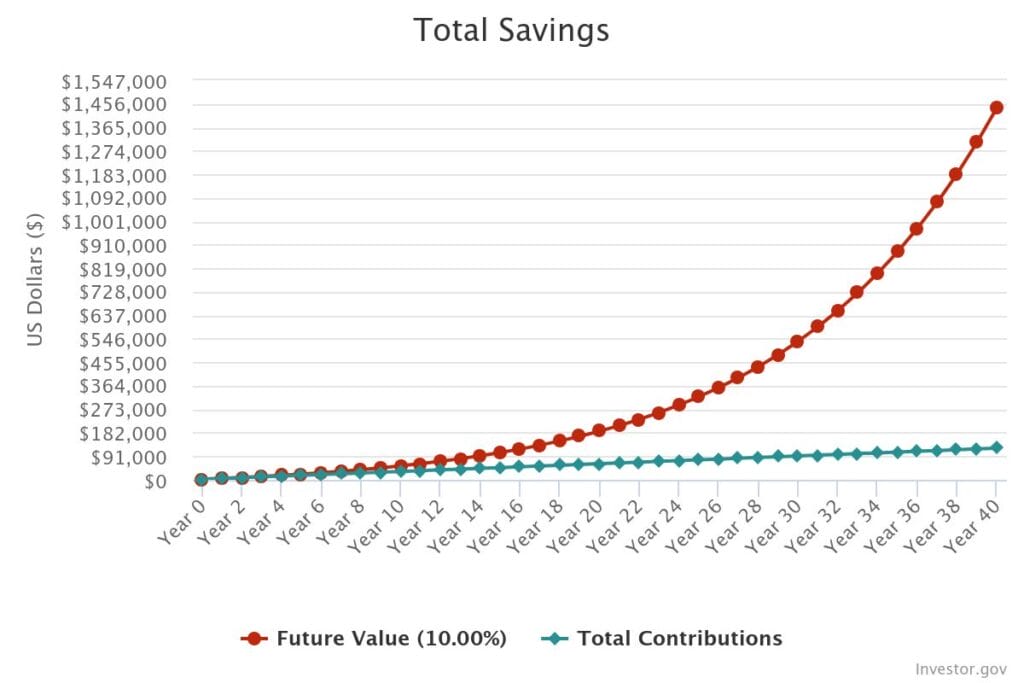
    Sally earns 10% a year and pays no advisor fees.

    Remember our friend, Sally?

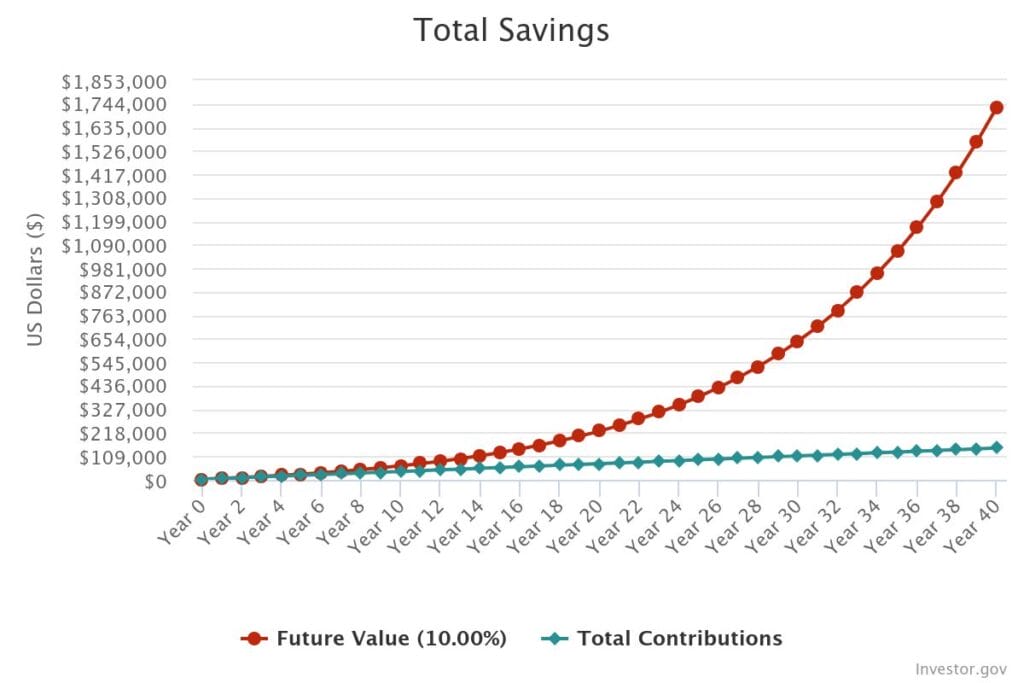
    While in her 20s, Sally funded her retirement account with an initial contribution of $2,500. She then made contributions of $250 every month for 40 years.

    She was comfortable with reasonable risk and invested in the S&P 500, which has historically earned an average annual rate of return of 10%.

    After 40 years, Sally had contributed a total of $122,500.00. Her retirement account grew to  $1,440,925.81.

    After 40 years, a $2,500 initial contribution and $250 subsequent monthly contributions earning 10% average annual interest will be worth $1,440,925.81

    Sally set herself up to have a lot of choices come retirement.

    Now, let’s make one slight adjustment to our hypothetical to account for a fee of “only 1%.”

    Sally earns 10% a year and pays a 1% advisor fee.

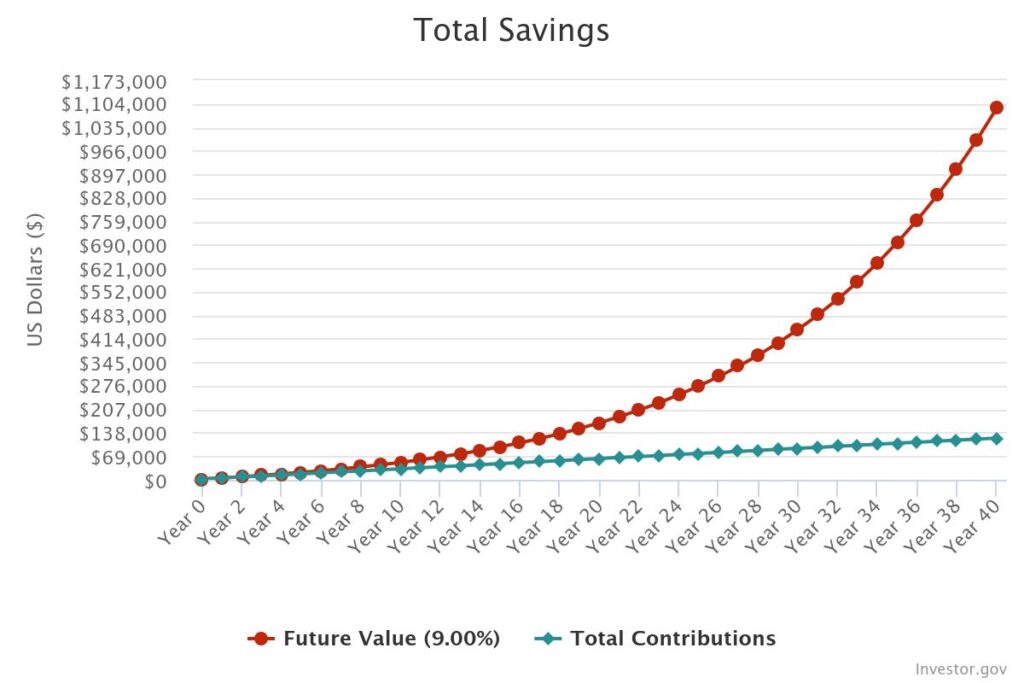
    Let’s assume that Sally decided to work with a financial advisor that charges a 1% fee. That means every year, Sally pays her advisor 1% of her account balance.

    We’ll assume that her advisor also averaged a 10% annual rate of return for Sally. However, because Sally pays her advisor a 1% fee, Sally’s actual earnings rate drops from 10% to 9%.

    Let’s see how that 1% fee changes Sally’s performance over 40 years.

    After 40 years of earning 9% after paying a 1% fee to her advisor, Sally will have $1,092,170.89.

    The 1% fee resulted in Sally’s account dropping by $348,754.92.

    That’s 24% less money than she had in our example when she earned 10%.

    The impact of even a 1% fee is monumental.

    Through this example, you should be able to see that even a seemingly small fee can have major consequences on your long term gains.

    When people start investing, the 1% fee does not seem like a bad deal. In my experience, whenever a financial advisor has explained fees to me, he uses words like “just 1%” or “only 1%”.

    I think that language is misleading and deceiving. Sally would probably agree that words like “only 1%” do not accurately express a cost of $350,000.

    If you look at the very beginning of Sally’s investment profile, it’s true that the 1% fee seems to have little impact.

    In Sally’s case, the difference in her account in the two scenarios after 1 year is only $25.

    • Sally’s account after 1 year at 10% interest: $5,750.
    • Sally’s account after 1 year at 9% interest:$5,725.

    That’s a pretty marginal difference. However, it takes time for the impact of fees to materialize.

    The reason is because it takes time for the magic of compound interest to set in. That’s why we need to invest early and often.

    Let’s look at the difference in Sally’s account over time:

    Looking at these numbers, it becomes clear how much a 1% fee can impact your overall investments.

    One other consideration: the fee also typically gets taken straight out of your account. That can make it feel like the fee is relatively small or doesn’t exist at all.

    It would feel much different if each month you had to go through the process of writing a check to your advisor. Maybe feeling that pain would impact your decision to pay the fee.

    Decide for yourself if the real cost of an advisor is worth it to you.

    You can play with these numbers to match your personal situation. Maybe you have an advisor charing less. Maybe yours charges more.

    If you want to tweak the annual rate of return you expect to earn by working with an advisor, please do.

    Or, maybe you just want to ask your advisor or potential advisor about fees and how they may impact your portfolio over the long term.

    Hopefully, looking at these numbers gives you something to think and talk about.

    I personally do not work with a financial advisor.

    Let’s circle back to the financial empowerment workshop I attended the other day.

    At its conclusion, the advisor’s husband came by to collect the sign-up sheet. I happened to be the last person to receive the clipboard.

    Seeing that I had not signed up for a free consultation, he looked at me and said, “Oh, you forgot to sign up!”

    I chuckled.

    Uhh, no I didn’t “forget”.

    I respectfully declined to be added to the list. I’ve chosen not to work with an advisor.

    I shared my story about how I set $93,000 on fire when my former advisor pulled me out of the markets in 2008.

    In that post, I also shared that it wasn’t her fault. It was my fault for not being educated.

    Since then, I’ve been convinced by endless reports, such as this from Yahoo! Finance, that I’m better off without an advisor when considering the cost:

    Making matters worse is that the professionals, who the average investor might turn to for guidance, have poor track records. In the past decade, an alarming 85% of U.S.-based active fund managers underperformed the broader S&P 500. Those who invest in these funds are essentially paying for unsatisfactory results.

    How much does 1% matter to you?

    I recently calculated how much I would have paid an advisor by this point in my life. I determined that If I had been working with an advisor, I would have paid more than $100,000 in fees so far.

    When I think about all the things I could do with more than $100,000, I’m very happy that I chose to educate myself and keep that money instead of paying it to an advisor.

    Maybe I would have earned more if I worked with an advisor. Maybe that $100,000 would have been a worthwhile price to pay. Then again, maybe not.

    If you choose to work with an advisor, I won’t blame you. Hopefully your advisor consistently beats the returns of the S&P 500 or provides value to you in other ways.

    Whatever the case may be, you now should have a better understanding of what you’re paying when you hear the phrase “only 1%.”

    • Do you work with an advisor?
    • What fee does your advisor charge?
    • What are the top benefits you receive in exchange for the cost?

    Let us know in the comments below.

  • Why Successful Investing is Playing Offense and Defense

    Why Successful Investing is Playing Offense and Defense

    When you hear the word “inflation,” what’s the first thing that jumps to mind?

    Is it the price of eggs?

    Eggs really have it bad right now. If it’s not being the poster child for inflation, it’s the bird flu causing eggs problems.

    Eggs are even getting blamed for ruining Easter! Just look at this headline from AP News:

    “US egg prices increase to record high, dashing hopes of cheap eggs by Easter”

    Yeesh. I feel bad for eggs.

    I’ve certainly noticed the elevated price of eggs at the grocery store.

    But, eggs are not the first thing that comes to mind when I think of inflation.

    When I think of rising prices, my mind immediately goes to lunch downtown during the work day.

    Now, please indulge me for a minute. I know I’m about to sound like the old man who yells at clouds.

    I try to bring my lunch most days. It’s partly trying to eat healthier. The other part is that I have a hard time justifying the cost and have decided that lunch is really not something I care about.

    Ever since I was a really lost boy in my 20s and started budgeting to create fuel for my investments, lunch was an easy thing to cut.

    Even so, there are days when I run out of time in the morning to get a lunch packed before I’m out the door. On those days, I’m usually looking for something relatively quick and healthy.

    I’ve noticed that no matter where I go near my office, it seems like the cost of a fast-casual lunch is between $15-$20. That’s true whether it’s a sandwich or a salad or a burrito.

    $20 for a lunch that is not even the least bit exciting! That’s hard for me to swallow (sorry, couldn’t help myself…)

    Am I yelling at the clouds alone here?

    Why does it matter that everything is getting more expensive?

    There’s no single explanation for why things are getting more expensive. For example, restaurants are facing higher costs for ingredients, labor, and even online reservation sites.

    Setting aside isolated explanations, the reality is that all things tend to get more expensive over time.

    The word for that reality is “inflation.”

    Specifically, inflation is defined as “ongoing increases in the overall level of prices.”

    If you were accustomed to paying $10 for lunch, and now that same lunch costs $20, that’s what inflation looks like.

    Evening clouds over the sea representing things we can't control, like inflation.
    Photo by Nick Scheerbart on Unsplash

    Why do we care about inflation?

    We care about inflation because inflation reduces the buying power of our hard-earned money. We can’t control or stop inflation. It’s going to happen.

    Ask your parents how much they paid for their first car.

    Or, you can ask my high school basketball coach. When we would complain, he would respond “That and $1.25 will get you a ride on the bus!”

    Don’t worry, none of us knew what it meant either. Although, I wonder if he’s updated his quip to “That and $5.50…”

    The point is, In order to counteract the drain of inflation, we need to invest our money.

    Investing to do fun things later on is playing offense.

    We’ve spent a lot of time in the blog talking about all the amazing things you can do with your money if you develop strong personal finance habits.

    Strong personal finance habits include budgeting, paying off debt, and saving. We do these things so we have fuel to invest.

    When you invest, your money grows without much effort on your part. You can then do those amazing things in the future.

    That’s playing offense.

    Look back at our friends Terry and Sally.

    Terry took no risk and kept his money in a savings account. Terry did not play offense.

    Sally took on reasonable risk and invested in the S&P 500. Sally played offense.

    What happened after 40 years in our hypothetical scenario?

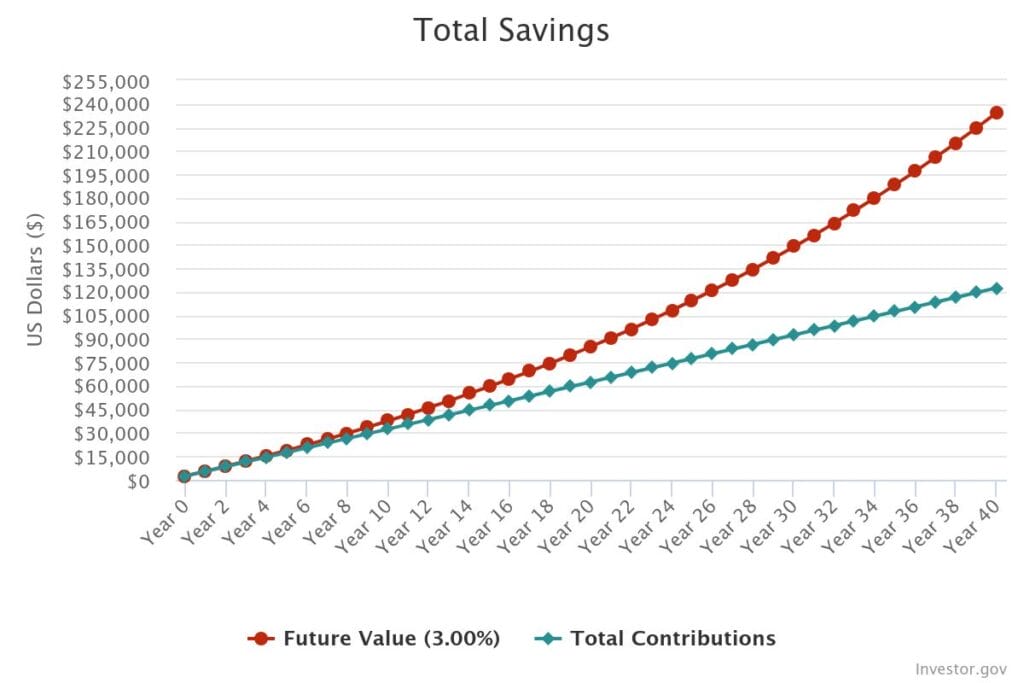
    Terry, at a 3% interest rate from his savings account, had a total of $234,358.87.

    Sally, at 10% annual returns from the S&P 500, had a total of $1,440,925.81.

    As a result, Sally will have $1,200,000 more than Terry to do fun things with in retirement.

    Sally clearly played offense. Terry clearly did not.

    Investing to counteract inflation is playing defense.

    You may be thinking that at least Terry’s “safe” approach meant that he played good defense.

    Nope.

    Terry’s approach was bad defense just like it was bad offense.

    All because of inflation.

    Investing to counteract inflation is playing defense. It’s protecting your hard-earned purchasing power.

    Over the long term, it’s critical to invest your money and earn a return that exceeds the rate of inflation.

    Otherwise, you risk not being able to afford the same items you’re accustomed to buying today because those items will be more expensive.

    In our earlier examples of eggs and workday lunches, we’ve seen how things feel like they’re getting more expensive over time.

    It’s not just eggs and lunches that get more expensive. Everything does.

    Let’s plug some numbers into US Inflation Calculator to illustrate how things really are getting more expensive.

    Let’s say you bought something in 2000 for $100. Based on the actual inflation rates between 2000 and 2025, that same $100 item would could $185.71 today.

    That’s an increase of 85.7%!

    Inflation calculator showing how buying power decreases over time.

    So, by keeping his money in a savings account earning 3% interest, Terry may have thought he was doing the right thing because his balance was getting bigger.

    The problem is that while his bank balance was increasing, so was the cost of everything he might want to buy. So, he had more money, but he could buy less things with that money.

    That’s what inflation does.

    The only way to get ahead of inflation is by investing and earning a higher rate of return.

    So to return to our question: was Terry really playing good defense by keeping his money in savings?

    No, because his actual purchasing power diminished even though his balance grew.

    Investing is about playing offense and playing defense.

    By now, you should hopefully be motivated to invest as a way to play offense and play defense.

    It’s fun to think about what you can do with your money when it grows with very little effort on your part.

    It’s just as important to think about investing as a way to protect your ability to buy the very same things in the future that you buy today.

    Instead of being the man who yells at the clouds, you can be the one buying as many eggs and lunches as you want.

  • Money on My Mind: Financial Literacy Month

    Money on My Mind: Financial Literacy Month

    April is known as National Financial Literacy Month.

    That’s cool. It’s never a bad idea to pay a little extra attention to your finances.

    Of course, Think and Talk Money readers don’t wait until April to be reminded of all the things we should be doing with our money.

    With more than 50 posts already at our disposal, Think and Talk Money readers pay attention to our money year round.

    We know how important money is to reaching our ultimate goals in life. That’s why we like to think and talk money just a little bit every week.

    Think and Talk Money readers know that personal finance starts with getting our money mindset in the right place. That’s why we create our personal version of Tiara Goals for Financial Freedom.

    With the right mindset, we can stay on budget and consistently generate fuel for our investments.

    When other people get worked up over the stock market, we talk to our people and stay calm.

    We know that time is on our side.

    Plus, investing is actually the easy part.

    We control what we a control. That’s why we invest early and often to get the maximum benefit of compound interest.

    So, Think and Talk Money readers don’t need a national personal finance month.

    And, we’re happy that personal finance gets a little extra attention each year in April.

    aerial photography of flowers at daytime in April, personal finance month, which Think and Talk Money readers don't need.
    Photo by Joel Holland on Unsplash

    These credit card fees are getting out of hand.

    Is it just me, or are you also noticing more and more businesses charging fees to use credit cards?

    I wrote about my disdain for credit card fees recently. 

    In just the past couple of weeks, I’ve chosen to pay with cash instead of credit card on multiple occasions:

    • At the butcher shop, which charges a 3% fee, and is kind of smug about it.
    • At the local ice cream shop, which charges a 4% fee and misleadingly labels it a 4% discount for customers paying in cash.
    • For the garage door repair guy, who creatively indicates the fee in terms of cash instead of a percentage. In this instance, $11 instead of 3% of the total bill.
    • At the tree nursery, which also charges a 3% fee for credit cards. This one hurt the most. Trees are expensive! I really would have liked those points.

    By paying cash, I avoided hundreds of dollars in fees. Don’t get me wrong, I love credit cards points as much as anyone. But, I just can’t stomach paying these fees to earn the points.

    I even ran the numbers recently and determined that the points don’t make up for the added penalty of using a card.

    I know many business owners disagree, but in my opinion, these fees are bad for business.

    Fees act as a deterrent for me to spend money. I imagine they are a deterrent for others, as well. If I do shop at one of these establishments, I end up being more selective and spending less money than I otherwise would have.

    • At the butcher shop, I didn’t buy the side items to go with my skirt steaks. 
    • At the ice cream shop, I bought ice cream for my kids but not for myself. Luckily (or unluckily?), my son gave me his leftover, melty Superman ice cream with rainbow sprinkles.
    • I had no choice with the garage door guy- the garage was broken and needed fixing. You win, garage door guy!
    • At the tree nursery, I bought half as many trees and plants as I intended. 

    The way I see it, both the customer and the business lose out because of these fees. 

    For example, at the nursery, I didn’t get all the plants I wanted. That made me kind of sad.

    At the same time, the nursery lost out on more than $1,000 in plant sales. I don’t know how that made the business feel. Obviously, it’s not that sad since it continues to charge the fee.

    Taking a broader viewpoint, maybe these credit card fees are actually good for us consumers.

    In our consumer-driven society, we all spend too much money when we go out to eat or go shopping. Studies have consistently proven that we spend less money when forced to use cash.

    In that sense, a deterrent to spending, which is exactly what these fees are, is probably a good thing for us consumers. 

    I can’t imagine it’s good for business, though.

    What do you think?

    It’s OK that tracking your net worth is less fun during a market dip.

    I track my net worth once per month using a simple spreadsheet. Today was the first day I updated the spreadsheet since “Liberation Day” and markets dipped.

    Like so many others, my net worth took a hit this past month.

    That’s not fun.

    But, I’m not losing my mind over it.

    I’m not saying it feels good. I would much rather see my net worth steadily improving.

    A Yellow Warbler sits in a flowering tree on a sunny spring morning during financial literacy month, which Think and Talk Money readers don't need.
    Photo by Mark Olsen on Unsplash

    I’m just saying I’m not freaking out about it. Time is on my side. 

    I expect dips like this will occur multiple times throughout my investing timeline.

    One thing I’ve found is that it helps to talk about money when things aren’t going well. You realize that you’re not alone. Your friends and family are probably having the same feelings that you’re having.

    You don’t have to share how much money you have or how much you lost. You can still benefit emotionally by acknowledging to your loved ones that you’re thinking about the markets a little bit more these days.

    People are going bananas for The Bananas.

    A reader sent in a great story about a couple who went $1.8 million into debt to start The Savannah Bananas.

    If you haven’t heard of The Bananas, they might just be the best story in sports right now.

    Despite countless opportunities to cash in by taking on investors, the owners still own 100% of the team. They continue to do things their way, even if that means foregoing massive profits.

    I love stories like this. These owners bet on themselves and found success. Instead of cashing in at the first chance, they’re staying true to themselves.

    At the end of the day, they’re making money and seem to enjoy what they’re doing. 

    Is there anything better than that?

  • Risk is the Cost to Invest

    Risk is the Cost to Invest

    Two young coworkers, Terry and Sally, start the same job at the same time making the same amount of money.

    While still many years away, Terry and Sally both know that they should invest early and often for retirement.

    They each decide to fund a retirement account with an initial contribution of $2,500. They are also dedicated to making contributions of $250 every month until they retire.

    Both plan to retire in 40 years while they’re in their 60s.

    There’s one major difference between Terry and Sally.

    They view risk differently.

    silhouette of man and woman under yellow sky illustrating the different investment paths of Terry and Sally.
    Photo by Eric Ward on Unsplash

    Terry doesn’t like risk.

    Terry doesn’t like risk. He wants to be able to sleep at night knowing that his hard-earned money is safe and sound in the bank. He can’t stand the idea of potentially losing money from one month to the next.

    When Terry wakes up in the morning, he likes to check his bank accounts while he drinks his coffee. He gets a jolt out of opening up his mobile banking app and seeing exactly how much money he has.

    In fact, at any given moment, Terry can tell you within a few hundred dollars what his net worth is.

    Because Terry doesn’t want to take any chances, he decides to stash all of his retirement savings in a savings account that earns an average annual return of 3%.

    Terry is lucky because this is a pretty generous return for a savings account based on historical savings account interest rates.

    Sally is more comfortable with reasonable risk.

    Sally is more comfortable with reasonable risk. Upon starting her career, Sally was aware that she had never learned basic personal finance skills. She was determined to put in a little bit of effort early on to set herself up for a prosperous future.

    She was a frequent reader of popular personal finance websites like Financial Samurai and Think and Talk Money.

    Sally even read JL Collins’ book on investing, The Simple Path to Wealth.

    Through the process of educating herself about personal finance, Sally started thinking about what she really wanted out of life. Since she was young and had just started her career, it wasn’t easy to come up with a good answer.

    Still, Sally knew that whatever she wanted to do in life, investing was an important part of her financial journey. If she wanted to create more time for herself down the road, she would need passive income from investments to sustain her.

    So, after doing her homework, Sally decided to invest her money in a low cost S&P 500 index fund.

    While she appreciated that there are no guarantees when it comes to investing, Sally knew that the S&P 500 has historically earned an average annual return of 10%.

    Unlike Terry, Sally only checked her accounts once per month when she tracked her net worth and savings rate. Sally slept fine at night because she knew time was on her side.

    Let’s see how Terry and Sally turned out 40 years later.

    Using a simple online calculator like the one at investor.gov, let’s see how much money Terry and Sally will have in their retirement accounts after 40 years.

    time steps on illustrating that the cost to invest is risk.
    Photo by Immo Wegmann on Unsplash

    Terry’s retirement savings total $234,358.87.

    After 40 years, Terry will have contributed a total of $122,500.00 to his retirement savings account.

    At a 3% interest rate, Terry will have a total of $234,358.87 after 40 years.

    In other words, Terry has just about doubled the value of his total contributions in his account.

    Not bad, Terry.

    Now, let’s check out Sally’s account.

    Sally’s retirement savings total $1,440,925.81.

    Sally likewise contributed $122,500.00. After 40 years, at a 10% interest rate, Sally’s retirement account will have a total of $1,440,925.81.

    Wow, Sally!

    Sally’s retirement account is worth 10 times more than what she personally contributed. Terry failed to even double his account.

    Recall in our little hypothetical, Sally did the exact same things as Terry, with one key difference. Sally was more comfortable taking on reasonable risk.

    Because Sally was comfortable taking on some risk, her retirement savings were worth more than six times as much as Terry’s savings. She has over a million dollars more than what Terry has!

    Look at compound interest in action.

    One last thing: take a look at the pictures of Terry and Sally’s investments over time. Notice the gaps between each of their red and blue lines.

    While they each benefited from compound interest, Sally benefited exponentially more.

    Look at how Terry’s red line stayed much closer to his blue line. Because he wasn’t earning as much overall interest, he didn’t have as much money to multiply from compound interest.

    Sally’s red line mirrored her blue line closely for the first 12-15 years. Then, the gap widened before the red line skyrocketed over the final decade or so.

    That’s the power of compound interest kicking in.

    So, what can we learn from Terry and Sally?

    The point of this hypothetical is to introduce the concept of risk when it comes to investing.

    We’ve all heard the saying, “You don’t get something for nothing.”

    That motto applies to investing as much as anything else. There is always risk involved in investing.

    The question is how do you react to that risk.

    Some people are so fearful of that risk that they don’t invest at all, like our friend, Terry.

    Other people are so desperate to get rich quickly that they take wild risks.

    The people that tend to reach and sustain financial independence are the ones who educate themselves and become comfortable with taking on reasonable risk. This is what Sally did.

    In future posts, we’ll dive into the various ways you can reduce investment risk.

    At this point, knowing why you’re investing and taking on risk is a powerful first step. I was recently reminded of my Money Why when my baby girl was born.

    Think of risk as the cost to invest.

    If you want to reach true financial independence or any other financial goal, it’s going to cost you something.

    Think of risk as the cost to invest.

    Sure, there may be some people out there who are able to reach financial independence on a massive salary.

    For the rest of us, we’re going to have to get comfortable with investing.

    There’s a reason we spend so much time talking about our ultimate life goals. It’s important to embrace the reasons why you’re investing and why you’re opening yourself up to risk.

    It never hurts to remind yourself what you are hoping to achieve in the future.

    When you know what that thing is, it’s much easier to pay the cost of risk.

    When you look at Sally and Terry’s future outlook, who would you rather be?

    It’s not really a hard question, right?

    It’s not that Sally has a bigger bank account. What matters is that she has created options for herself.

    Sally should be in position to do whatever she wants.

    Terry probably can’t.

    • Are you naturally more inclined to act like Terry or Sally?
    • If you’re more like Terry, have you thought about what outcome in life would be worth taking on some reasonable risk?

    Let us know in the comments below.

  • Invest Early and Often for the Magic of Compound Interest

    Invest Early and Often for the Magic of Compound Interest

    There’s an infamous slogan in Chicago politics, “Vote early and often.” My professional advice: don’t do that. Instead, I prefer: “Invest early and often.”

    We’ll call it the new Chicago way.

    When you invest early and often, you can take advantage of the power of compound interest.

    There’s very little we can control when it comes to investing. One of the main things we can control is how early we prioritize investing.

    In today’s post, we’ll learn what compound interest is and why it’s so powerful in generating long-term wealth.

    Invest early and often to benefit from the magic of compound interest.

    Compound interest is the interest you earn on interest.

    How’s that for a confusing definition?

    Fortunately, the idea of compound interest makes a lot more sense with a simple example.

    Let’s say you make an initial investment contribution of $1,000. Let’s assume that you earn 10% interest each year on that investment. We will also assume that you re-invest your investment gains.

    After the first year, your initial contribution of $1,000 earns $100 in interest (10% of $1,000). That means after one year, you have $1,100 in your investment account.

    Because we are re-investing our gains, that means that at the start of year two, yo have $1,100 to invest: $1,000 from your initial contribution plus the $100 earned in interest.

    If you earn the same 10% interest on that $1,100 investment, you will have $1,210 at the end of year two.

    Notice that in year two, you earned $110 in interest, whereas in year one you earned $100 in interest. That’s because in year 2, you earned interest on the interest your previously earned.

    This is the key point about compound interest: you earned more money in year two, even though the interest rate remained the same and you did not contribute any additional money.

    That’s how compound interest works. Compound interest is earning interest on interest you’ve previously earned.

    So, why is compound interest so powerful?

    Earning an additional $10 in interest year two may not seem like a lot.

    Over the long run, those additional earnings add up.

    Let’s look at an illustration from investor.gov of what happens to that initial $1,000 contribution over a 30-year period:

    A chart showing the power of compound interest and why you should invest early and often.

    In 30 years, you will have a total of $17,449.40. That’s a pretty good result from total contributions of only $1,000.

    However, for this example, that total is not the important part. The important part is to visualize how compound interest worked its magic to get that result.

    Look closely as the two lines on the graph. The blue line that doesn’t change represents your initial $1,000 contribution.

    The red line represents the amount of money you have over time.

    Notice how in the first 10 years or so, the red line and blue line mirror each other pretty closely. Around year 12, you start to see some separation between the two lines.

    While the blue line stays flat, the red line begins to arc upwards. That’s because all that interest you earned during the previous decade has been earning interest. Your investment begins to accelerate upwards without any additional contributions from you.

    By the end of year 30, look at how steep the red line is jetting upwards.

    We can look at the specific amount of money you’d earn each year in this hypothetical to really drive this point home.

    As we mentioned earlier, you earned $100 in interest during year 1. Then, you earned $110 in interest during year 2. That’s a good, but modest, increase.

    During year 12, you earned $285.31 in interest. That’s significantly more than you earned in the early years, all without any additional contributions on your part.

    During year 30, you earned $1,586.31 in interest!

    The more time that you stay invested, the more money you’ll earn as compound interest works its magic.

    That’s the power of compound interest.

    Invest early and often to be a millionaire with very little effort on your part.

    Compound interest is so powerful that it can make you a millionaire with very little effort on your part. All it takes is time and consistency.

    In other words, invest early and often.

    Let’s look at another example to see how you can easily become a millionaire if you invest early and often.

    Let’s say you begin your career after going to law school or grad school at age 25. During your first year working, you saved up $3,000 and decided to invest in a low cost index fund.

    You also make a plan to contribute an additional $300 per month to your investment account for the next 40 years, setting yourself up to retire at age 65.

    We’ll also assume you earn the same 10% interest from our prior example, and you don’t make any withdrawals from your account.

    By the time you reach retirement age, you’ll have $1,729,110.97 in your retirement account!

    That’s after contributing only $3,000 initially and $300 per month after that.

    Put another way, your total contributions of only $147,000 turns into $1,729.110.97 by the end of your career.

    Let’s look at the graph corresponding with these figures to once again visualize compound interest at work.

    A picture showing how to invest early and often with $3,000 and then monthly contributions of $300 that turns into $1.7 million by retirement age.

    You’ll notice this graph looks almost identical to our prior example, even with the additional contributions that you make over time.

    You can once again see that the blue and red lines mirror each other closely for the first 10-15 years.

    Then, the blue line stays relatively flat while the red line gradually arcs up before skyrocketing towards the end.

    Your personal investment picture should look similar in the long run.

    Now, there’s no way to predict exactly when you’ll start to notice the magic of compound interest. There are too many variables at play.

    The point is that given enough time, your personal investment trajectory should look similar because of compound interest.

    You can play with the numbers in an investment calculator like the one available at investor.gov to match your personal situation.

    If you’ve created a Budget After Thinking, you may be able to invest much more than $300 per month.

    No matter what initial contribution you make and what interest rate you assume, you should notice a similar investment picture over the long run.

    When I say investing is the easy part, this is what I mean.

    I just showed you how an early contribution of $3,000 and regular contributions of $300 can turn into more than $1.7 million.

    You don’t have to understand the math behind compound interest.

    You just have to trust that it works.

    Then, invest early and often.

    Given enough time, assuming normal, historical market conditions, your investments will gradually increase before shooting up in the later years.

    Read that sentence again. “Given enough time” is the key phrase.

    The magic behind compound interest is time.

    The earlier you can start investing, the better off you will be.

    Since we can’t control investment returns, I prefer to focus on what we can control when it comes to investing.

    We can control when we start investing and how long we invest for.

    By making regular contributions over a long period of time, compound interest ensures that your wealth will grow.

    Invest early and often.

    $3,000,000 today or a penny that doubles each day for the next 30 days?

    Let’s look at one more fun example to demonstrate the power of compound interest.

    At the start of each personal finance class I teach, I ask my students this question:

    “Would you rather have $3,000,000 today or one penny that doubles each day for the next 30 days?”

    A penny sitting on top of a table representing the power of compound interest when you invest early and often.
    Photo by Roman Manshin on Unsplash

    Maybe the fact that I’m asking the question in the first place gives away the answer. Still, some students refuse to believe that the penny could grow to more than $3,000,000 in 30 days.

    The real lesson in asking this question is not that the penny ends up being worth more. The lesson is that it’s not until the very end of the time period that the penny takes the lead.

    Check out this graphic from TraderLion:

    A chart showing a penny doubling each day for 30 days proving why you should invest early and often.

    If you chose the penny, for the first 20 days, you’d be feeling pretty foolish. Even after 29 days, the penny still hasn’t outpaced the guaranteed $3,000,000.

    Then, by day 30, you realize the full power of compound interest. The penny ends up being worth $5,368,709.12!

    Just like we saw with our prior examples, it takes time for the magic of compound interest to do its thing.

    When it comes to investing, time is the most important factor that we can control. The more time you spend in the markets, the better chance you have of significantly increasing your wealth.

    People smarter than you and me preach the power of compound interest.

    Warren Buffett, the world’s greatest investor, fully appreciates the power of compound interest. He’s famous for saying that his favorite holding period for an asset is “forever”.

    Buffet’s not literally saying that there’s never a time or reason to sell an asset, like a a stock. He’s simply making the point that compound interest benefits people who stay invested over the long term.

    My first try to take a pro picture of Albert Einstein indicating the power of compound interest and to invest early and often.
    Photo by Jorge Alejandro Rodríguez Aldana on Unsplash

    If the world’s greatest investor isn’t impressive enough for you, how about the world’s greatest thinker?

    Albert Einstein is often credited with this famous quote about compound interest:

    Compound interest is the eighth wonder of the world. He who understands it, earns it. He who doesn’t, pays it.

    You don’t have to be as smart as Buffet or Einstein to benefit from compound interest.

    You just have to invest early and often.

    The Chicago Way: Invest early and often.

    Let’s recap:

    • Voting early and often = bad idea.
    • Investing early and often = good idea.

    Whether you are new to investing or have been investing for some time, never underestimate the power of compound interest.

    It will take time before you see results. But, the only way you’re going to get those results is by staying patient and staying invested.

    When you’re tempted to pull out of the market, remind yourself that investing is a long-term game.

    Picture the graphs that show how your money can skyrocket with enough time. Remember the question about the penny doubling for 30 days. Don’t ignore the words of Buffett and Einstein.

    Let compound interest do its thing.

    Invest early and often. It’s the new Chicago way.

  • Investing is Actually the Easy Part

    Investing is Actually the Easy Part

    Investing is a major part of leading a healthy financial life.

    It also should be the easiest part.

    Despite all the attention, news, and marketing, investing doesn’t have to be complicated.

    Investing simply means committing money now to earn a financial return later. This is why I refer to money I invest as Later Money.

    To be honest, the most difficult part of investing is continuously generating money to invest in the first place.

    The actual investing part is pretty easy.

    That’s because when you invest the right way, your money should earn more money without much additional effort from you.

    This is the best part about investing. Your money can (and should) grow over time without your active participation. This is why investment gains are often referred to as “passive income.”

    If you are on a journey towards financial independence, you know how important passive income is. The best way to get your time back is to earn money passively through investments while you’re off doing something else.

    We’ll soon learn why investing does not have to be complicated. If you can drown out the noise, all you’ll really need to do is regularly fund your investment accounts and watch your net worth slowly grow.

    This is when personal finance starts to get really fun.

    Investing is when personal finance starts getting really fun.

    When you’ve invested the right way, your wealth will slowly multiply. You won’t notice it at first. Trust me, give it time.

    You’ll soon see that all the effort you put into educating yourself about money was more than worth it.

    No, you won’t be immune from market swings like the one we’re in right now.

    But, you’ll be educated enough to not panic. You’ll know that time is on your side.

    Have you noticed that we’re now 50 posts in and have hardly talked about investing?

    There’s a reason we’ve hardly talked about investing in the first 50 posts of Think and Talk Money.

    In order to get the benefits of investing, you need to have the right money mindset. That means knowing why you’re investing in the first place. Without the right motivation, you will struggle to consistently fund your accounts.

    After all, when you invest, you are sacrificing money you could spend right now for the opportunity to spend even more later on. Without the right motivation, too many people put off, or give up on, investing altogether.

    When they do that, they have a little more money to spend today. But, years from now, they will wonder why they’re still working so hard and don’t see an end it sight.

    A morning yoga session peering into the jungle in Ubud, Bali demonstrating how investing does not have to be complicated, it just takes consistency and dedication.
    Photo by Jared Rice on Unsplash

    What is your motivation to invest?

    Your motivation may be to reach financial independence so you can pivot directions in life. This is known as FIPE (Financial Independence, Pivot Early).

    Your goal may be to pay for your kids’ college. One way to do that is to take advantage of 529 college savings plans.

    You may not know exactly what you want down the road. That’s OK, too. Whatever it is, investing now will make it easier to pursue whatever that thing ends up being.

    Once your mindset is in the right place, you’ll be more determined to craft a budget that consistently creates money to invest.

    Think about it: would you rather be someone who invests $1,000 one time or someone who invests $1,000 every month?

    If you practice solid personal finance fundamentals, you can be the person consistently investing to accomplish your ultimate life goals.

    Too many people think personal finance is only about investing.

    Too many people skip over the part where we learn strong personal finance habits. These people think that personal finance is only about investing. 

    Let’s play a game. Walk down the hall at your office and ask the first person you see what they know about personal finance.

    I’m guessing you’re going to get a response like:

    “Personal finance? Oh, yes. I need to learn that. I don’t know anything about the stock market.”

    If I’m right, leave a comment below. This should be fun.

    By the way, people that assume personal finance is only about investing are not bad people. They just haven’t been properly educated. Just like me when I set $93,000 on fire.

    By now, you know that personal finance is about so much more than investing. You know that you need to develop strong habits so you constantly have money to invest in the first place.

    And, you’ll soon learn that investing is really the easy part.

    When you learn basic investing principles, like minimizing fees and playing the long game, your money can slowly grow over time.

    As that happens, you move closer and closer to financial independence without much effort at all.

    It’s actually pretty easy.

    We’ll cover these basic principles in upcoming posts.

    One thing we won’t discuss at Think and Talk Money is the latest hot stock tip.

    If you want to study P/E ratios and company balance sheets in a quest for the best individual stocks, I won’t stop you.

    I just won’t be joining you.

    That’s because it’s very hard to pick winning stocks. Even the “experts” have a very hard time doing it consistently.

    You don’t believe me, do you?

    What if I told you that the vast majority of investment pros underperform the S&P 500?

    Check this out from Yahoo! Finance:

    Making matters worse is that the professionals, who the average investor might turn to for guidance, have poor track records. In the past decade, an alarming 85% of U.S.-based active fund managers underperformed the broader S&P 500. Those who invest in these funds are essentially paying for unsatisfactory results.

    If the “pros” can’t beat typical market returns that are available on the cheap for all of us… why even play that game?

    Why overcomplicate things?

    Sure, maybe you’ll get lucky and your investment pro is one of the few who can beat the market. Odds are that if your pro beat the market one year, he probably won’t the next year.

    If that’s your game, I wish you nothing but good fortune.

    Personally, I’d rather do things the easy way. I’d rather focus on what I can control, like how much money I’m contributing to my investment accounts each month.

    And, that brings us to an interesting point.

    Even if you are working with a professional, you are not excused from participating in your investment journey. You still need to understand the basics.

    Plus, while you may not be watching your portfolio closely, your job is always to make sure there is consistent money to be invested.

    My guess (or is it hope?) is that your advisor has told you as much.

    Investing is a major component of financial independence.

    Whether you are striving for financial independence, or hoping to maintain it, investing is a major component.

    To be a successful investor, you first need to practice strong financial habits.

    Don’t worry. If your mind is in the right place, the investing part is actually pretty easy.

  • How to Set $93,000 on Fire

    How to Set $93,000 on Fire

    My first experience investing did not go well.

    You could say I set $93,000 on fire.

    Here’s what happened.

    Matthew Adair thinking about the valuable lesson he learned about investing in 2008 that was like setting $93,000 on fire.
    Matthew Adair, founder of Think and Talk Money

    Back in 2008, I was a third-year law student. My entire life savings at that point was about $10,000. A lot of this money came from savings bonds gifted to me by my grandma for my birthday since the year I was born.

    I mentioned the year was 2008, otherwise known as the beginning of The Great Recession. As detailed in Forbes Advisor:

    The Great Recession of 2008 to 2009 was the worst economic downturn in the U.S. since the Great Depression. Domestic product declined 4.3%, the unemployment rate doubled to more than 10%, home prices fell roughly 30% and at its worst point, the S&P 500 was down 57% from its highs.

    Suffice it to say, 2008 was not a great time to be graduating or looking for jobs.

    Those of my friends fortunate enough to have secured a job offer soon learned that their offers were being rescinded. Such were the times.

    But, I digress.

    Back to how I set $93,000 on fire.

    As I mentioned, my life savings at the time totaled about $10,000. I had previously decided to use a financial advisor to invest my money for me.

    I had been working with this financial advisor for a few years prior to The Great Recession.

    All these years later, I couldn’t tell you what she had me invested in prior to the markets imploding. I’m assuming that she took into account my age and risk tolerance and designed a suitable portfolio for me.

    What I can tell you is that my portfolio suffered the same fate as just about everyone else towards the end of 2008. My $10,000 balance was shrinking.

    At that point, my advisor took me out of the markets and stashed the remainder of my money in a savings account earning close to 0% interest.

    I didn’t notice this maneuver right away. In fact, it wasn’t until 2010 that I noticed that my money was sitting in a savings account.

    When I finally caught on that my account balance had not changed for a couple years, I called my advisor. She explained that she had pulled me out of my investments when things weren’t looking too good.

    She didn’t have a good explanation for why I was still in the savings account in 2010. To be honest, it seemed like maybe she forgot about me. 

    By that point, the markets were improving. I had already missed all of the upswing from 2009. Since I had felt neglected, I withdrew my money and closed my account.

    I wish I could tell you that I started investing on my own at that point.

    Nope, that’s not how you set $93,000 on fire.

    Instead of investing, I let the money sit in my checking account until it just kind of disappeared. I had no plan for the money. All these years later, I have no clue what I spent it on. I just know that it disappeared.

    First Job during the Great Recession was not easy to come by.
    Photo by frank mckenna on Unsplash

    But Matt, you said you only invested $10,000. How did you end up setting $93,000 on fire?

    I’m glad you asked.

    If I had known then what I know now, I would have invested that $10,000 in a low-cost S&P 500 index fund.

    I also would not have taken my money out of that S&P 500 index fund when the markets dropped.

    Time was on my side. The smart thing would have been to do nothing at all.

    Between the start of 2009 and the end of 2024, the S&P 500 earned an average annual return of 14.98%.

    That means my $10,000 invested in a low-cost S&P 500 index fund at the start of 2009 would have been worth $93,265.90 by the end of 2024.

    That, my friends, is how I set $93,000 on fire. 

    And, I have nobody to blame but myself. 

    Let me make one point perfectly clear:

    It’s nobody’s fault but my own that I missed out on those earnings.

    It was my fault for not taking a more interested, and educated, approach to my personal finances.

    In a way, I’m glad I learned that lesson with only $10,000 at stake instead of later in life when I had more to lose.

    It’s not my financial adviser’s fault. She did what she thought was best. For some people, her strategy was probably successful.

    My problem was I blindly trusted my adviser without educating myself first. I didn’t know the right questions to ask. I didn’t understand the plan.Worst of all, I didn’t pay attention when my account statements arrived in the mail each month.

    In my mind, once I transferred my money over to my advisor, I was excused from taking any responsibility for my future.

    That was a mistake I’ll never make it again. When things didn’t go well, I had no one to blame but myself. 

    We all need to understand the basics of investing.

    Whether you choose to work with an advisor or not, it’s up to each of us take accountability for our own future.

    We need to educate ourselves enough to be part of the planning process. We need to know why we’re taking certain steps and be savvy enough to ask the right questions.

    You may be more comfortable working with a financial advisor. That’s perfectly fine. You still need to understand the basics of investing.

    My problem in 2008 and 2009 was that I hadn’t educated myself. I like to share this little story to illustrate how important it is to pay attention to our finances.

    These days, I manage my own investments. I’ve determined that paying fees for someone else to manage my money is not worth it to me. 

    By the way, we’re going to spend a lot of time talking about fees so you can decide for yourself if you want to pay them.

    Whether you manage your own investments or you use an adviser, it’s critical to understand the basics about investing in the stock market. The good news is the basic principles of investing are relatively straightforward. 

    Always remember: there are some things we can control and a lot of things we can’t control.

    We’re going to focus on what we can control.

    That means focusing on how much fuel you’re generating each month to invest in the first place.

    Then, it means minimizing fees and maximizing your time in the market. 

    If you can successfully implement just those ideas, you will wake up years from now with major gains to your net worth due to the power of compound interest.

    There are other strategies we’ll cover, as well. You’ve likely heard fancy terms like “diversification” and “asset allocation.” We’ll talk about what those phrases mean with the goal of convincing you that investing does not have to be complicated. 

    That’s right. Investing does not have to be complicated.

    You don’t have to read the Wall Street Journal. You don’t have to study financial statements. Even people who do that for a living struggle to predict what’s going to happen next. 

    So, let’s not waste our time. We’ve got better things to do on our way to financial independence than studying corporate balance sheets. 

    With even just a little bit of knowledge, you can feel comfortable and confident investing in the stock market. Then, all you’ll need to stay on track is the occasional reminder to think and talk about money with your loved ones.

    You won’t even have to set $93,000 on fire first. 

  • Happy that I Delayed Financial Independence

    Happy that I Delayed Financial Independence

    I’m further away from financial independence today than I was five years ago.

    You know what’s funny?

    I couldn’t be happier about where I am today.

    Let me explain.

    In 2020, my wife and I had very minimal expenses.

    At the start of 2020, my wife and I were both working as lawyers in Chicago. We lived in an apartment in a 4-flat that we had purchased in 2018. We had no kids at the start of the year, but were about to welcome our first.

    This was a good apartment in a popular part of town. It had 3 bedrooms and 2.5 bathrooms. That was plenty of space for my wife and I, and eventually the two babies we brought home there.

    We purchased this 4-flat from a real estate investor who had done a decent job on the renovation. It had in-unit washer/dryer, modern finishes, and plenty of storage.

    We had a small outdoor patio with enough room for a grill and little table. We also had a garage parking space but ended up parking our 20-year-old car on the street most days.

    When we purchased the building, it was the most expensive 4-flat that had ever been sold in that part of town. It was a bit of a risk to set the high-water mark in the area.

    In the end, the risk was more than worth it.

    Even though the building was expensive for the area, this was not a fancy apartment. This part of town was still up-and-coming. Some people probably thought it was not a nice part of town.

    I doubt many people came over and thought, “Wow, look at this amazing apartment!”

    The more likely reaction was probably something like, “What the heck are they doing?”

    To be fair, I asked myself that question plenty of times.

    So, what were we doing?

    We were paying ourselves to live there.

    Say that again?

    My wife and I paid ourselves to live in that apartment.

    We lived for free. And made a profit at the same time.

    See, the rental income from the other three units covered the entire mortgage plus all expenses for the property.

    But, that’s not all. On top of covering all the expenses, the rental units generated a profit of $1,000 per month on average.

    So, not only did we spend zero dollars each month on housing, we profited $1,000 per month.

    Looking back, getting paid to live in a decent apartment was maybe the best decision we ever made.

    Landlord working outside the office checking his balance and earnings. Getting paid concept. Internet money income. Showing the power of house hacking even if it means delaying financial independence.

    What happens to your finances when you live for free?

    Let’s take a look at how living for free can be a major advantage on your way to financial freedom.

    The common wisdom is for people to spend no more than 30% of their gross income on housing. Regardless of how much you make, that usually means thousands of dollars.

    Because our tenants were paying our living expenses for us, we did not have that expense for the five years we lived in that apartment.

    In other words, we didn’t have to worry about budgeting for housing.

    We also drove a nearly 20-year-old car and could walk to the “L” (Chicago’s subway). We lived in a neighborhood with plenty of nearby restaurants and shops. That meant our transportation costs were next to nothing.

    Because we weren’t paying for housing and had very minimal transportation costs, we could supercharge our savings.

    How much were we able to save?

    Let’s take a look.

    Between 2018 and 2023, my wife and I acquired three buildings and ten apartments in that same neighborhood. We’re very familiar with market rents in the area.

    We rent our apartments for anywhere from $2,300 to $3,600 per month. Our usual tenants are professionals like engineers, lawyers, doctors, consultants, and pilots.

    The unit we were living in from 2018 to 2022 was one of our larger units. At the time, it would have rented for $3,500 per month on average. That equals $42,000 per year to rent that apartment.

    Keep in mind, if someone was paying rent to live there, that would be $42,000 of after-tax money.

    Since we owned the building, we lived there for free. We could save that $42,000 we would have otherwise paid in rent. Instead of spending that savings on things we didn’t need, we were able to save that money for our next real estate investment.

    Plus, we earned $1,000 on average per month while we lived there. That’s an additional $12,000 per year in profit.

    We lived in that unit for almost five years.

    Add it all up and we saved $270,000 by living in that apartment for five years.

    • $42,000 saved rent x 5 years =$210,000.
    • $12,000 profits x 5 years = $60,000.
    • Total savings = $270,000

    We used that $270,000 for a downpayment on a rental condo in Colorado ski country.

    It took five years of living in a decent, but not-awesome, apartment to have a ski condo that will hopefully be in our family for decades.

    Choosing to live in our 4-flat to save $270,000 over five years was one of the best financial decisions we’ve ever made.

    Snowboarders breath on a cold day illustrating the power of financial independence earned through house hacking.
    Photo by Alain Wong on Unsplash

    I highly recommend you consider house hacking if you’d like to start investing in real estate.

    Many of you are familiar with the strategy of living in a building (or home) you own while tenants (or roommates) pay for it. Brandon Turner, of BiggerPockets fame, popularized the concept he dubbed “House Hacking”.

    You can read all about house hacking on BiggerPockets here.

    For even more information on house hacking, Craig Curelop wrote a book for BiggerPockets called The House Hacking Strategy: How to Use Your Home to Achieve Financial Freedom.

    Without a doubt, there is no better strategy for entry level real estate investors than house hacking. I gave you a glimpse of the financial upside earlier in this post.

    Besides the financial upside, it’s like landlording with training wheels. Since you live on site, you can more easily learn how to manage a rental property, including responding to tenants and handling routine maintenance.

    The naysayers will say something like, “I don’t want to live with my tenants. They’re going to stress me out. I don’t want to be bothered at 2 a.m.”

    Ignore them.

    My wife and I lived with our tenants for five years at this property and two more years at a subsequent property. We did this while working full-time jobs as lawyers and raising two kids.

    Because we didn’t listen to the naysayers, we now have four income-generating properties and our “forever home” just outside Chicago.

    Even though we’re no longer living for free, the income from our rental properties is enough to cover the expenses of our home.

    So, why am I further away from financial independence today?

    I’m further away from financial independence today because my expenses have gone up since 2020. I’ve already alluded to those increased expenses throughout the post.

    In 2020, we had our first child. Now, we have three children.

    Also, after seven years of house hacking, we decided it was time to purchase a long-term home for our growing family just outside the city in a terrific area.

    We also finally traded in our 21-year-old car for our first new car ever.

    How’s this for easy math:

    Three Children + Nice House + New Car = Further Away from Financial Independence

    While that combination means I’m further away from reaching financial independence, I now have everything that I could possibly ever want.

    That’s why I couldn’t be happier with where I’m at today.

    My end game is finally in sight. Five years ago, I didn’t know where I’d be living or what car I’d be driving or what my family situation might be.

    Now, the picture is clear.

    I can calculate with reasonable certainty how much money I need to be truly financially independent. I can use that number as a target and make every financial decision with that target in mind.

    That’s why in 2025, I’m focused on paying down HELOC debt. Each time I make a debt payment, I move closer to financial independence.

    Besides, my goal is FIPE not FIRE.

    My goal is to reach FIPE not FIRE.

    FIPE means Financial Independence, Pivot Early.

    I have no intentions of retiring any time soon. Retiring early is not, and has never been, my goal.

    My goal is to become financially independent to create as many options as possible to protect myself and my family. I want to be financially independent so I can pivot no matter what life throws at me.

    If my goal was to retire early, I may have skipped the single family home in a great neighborhood. I could have continued house hacking, minimized my expenses, and lived off of the rest of the rental income.

    But, I want more for me and my family. I don’t want to just survive.

    Have you delayed financial independence to craft the life you really want?

    My life has certainly changed in the past five years, but all that change has been for the better.

    That meant house hacking at first to keep expenses as low as possible. Now it means enjoying the wealth I created by making those earlier sacrifices.

    In order to have the life I want, I needed to temporarily move further away from financial independence.

    Still, I’m confident that I’ve taken the right steps to not just reach financial independence, but to reach it while living the life I want.

    The tradeoff is that it will take me longer to be truly financially independent. I’m perfectly happy with that.

    Financial independence has never been more clearly in sight. It’s just delayed a little bit.

    • Is your goal to reach FIPE and pivot as quickly as possible?
    • Or, are you OK with delaying FIPE temporarily for the life you truly want?

    Let us know in the comments below.

  • FIPE not FIRE: Financial Independence, Pivot Early

    FIPE not FIRE: Financial Independence, Pivot Early

    We focus a lot on financial independence here at Think and Talk Money. That’s because achieving financial independence is the ultimate goal for most of us.

    To me, financial independence does not mean retiring.

    That’s why I don’t like the popular acronym, FIRE: Financial Independence, Retire Early.

    Instead, I I like to view my financial freedom journey as FIPE: Financial Independence, Pivot Early.

    Let me explain why I believe in FIPE not FIRE.

    FIPE = Financial Independence, Pivot Early

    Whatever it is that you truly want to do in life, financial independence makes it possible.

    When you have financial independence, you have options. You can make decisions based on your core values instead of making decisions based on money. You can pivot, if necessary.

    Financial independence is for people who want to be empowered to take more control of what they do with their working hours.

    It’s not about quitting work. It’s about the freedom to pivot to other work, if you want. I’m convinced that humans are meant to be productive. We are social creatures who at our core want to be contributing.

    That doesn’t mean we have to be or want to be employees. But, it does mean that we want to do something meaningful with our working hours every week.

    That’s why I believe in the power of pivoting, not retiring.

    Why I don’t like the name FIRE.

    Part of the misconception about financial independence may stem from the name of the popular personal finance concept known as FIRE: Financial Independence, Retire Early.

    It’s not uncommon for people to hear financial independence and immediately think that’s only for people who want to quit their jobs and retire. That’s how widespread FIRE has become in the personal finance space.

    I agree with so many of the principles of FIRE. I just don’t agree with the name.

    Financial independence is about much more than retiring early.

    FIRE emphasizes saving more and spending less until you reach the point where your passive investments generate enough income to allow you to quit your job.

    I love this part of FIRE: the idea of creating enough income streams so that you have the freedom to do what you want with your time. I share the primary goal of saving more money and spending less to achieve more life freedom.

    I call this Parachute Money. I like to view each income stream as a separate parachute string. The more parachute strings you have, the safer it is to make a big change in life.

    The problem for me is that the FIRE end game is suggested right there in the name: become financially independent so you can retire.

    I don’t like that part. I don’t like what the word “retire” implies.

    If you look it up, you’ll see that the word “retire“means to withdraw, to retreat, to recede.

    None of those things sound appealing to me at all.

    Each word implies moving backwards. I’m not working so hard to achieve financial freedom so I can move backwards in life.

    Fire burning on beach, depicting the FIRE movement: Financial Independence, Retire Early instead of FIPE: Financial Independence, Pivot Early.
    Photo by Benjamin DeYoung on Unsplash

    I prefer to think of financial independence in terms of creating options. I prefer to think of financial independence as a way to move forward in life.

    I think “pivot” better reflects that mission.

    Pivot means to adapt or improve through modifications and adjustments.

    That sounds so much more appealing to me.

    With FIPE, financial independence is still the primary goal. But, the endgame is not to withdraw or retreat. The endgame is to adapt and improve how you spend your working hours.

    FIPE = Financial Independence, Pivot Early.

    Granted, the name “FIPE” is not as catchy as FIRE.

    But, I think it actually better encapsulates the entire purpose of financial independence in the first place.

    To explain, let’s look back at the modern day origin of FIRE for a minute.

    Vicki Robin and Joe Dominguez are often credited for laying the groundwork for the modern day FIRE movement. Robin and Dominguez wrote an incredible book called Your Money or Your Life.

    It’s one of my favorite personal finance books. You should definitely read it if financial independence is important to you.

    In their book, Robin and Dominguez have a lot to say about the relationship between money, work, and time. 

    Guess what?

    Most of us are doing it all wrong.

    Most of us make the mistake of chasing money at the cost of our precious time. When you read Your Money or Your Life, you will start to value your time for what it’s really worth.

    By making good choices about how to earn money- and as importantly what to do with that money- you can get the most out of your money and your life.

    That’s what FIRE is really all about. It’s about choosing to use your working hours in a way that is more meaningful to you than clocking in-and-out as an employee each day.

    It’s not about retiring from meaningful work. It’s about pivoting to work that is more meaningful to you.

    FIRE proponents would likely agree that the goal is not to withdraw or retreat.

    I think proponents of FIRE would actually agree with me that the end game is really not about withdrawing or retreating. The mission is always about moving forward, not backwards.

    My belief is that people who are disciplined and skilled enough to reach financial independence in the first place are the type of people who don’t retreat or withdraw.

    They may opt for periods of temporary retirement, as they should. But, I don’t think financially independent people are truly wired for full-time retirement.

    That’s why you see so many people who have obtained financial independence continue to pursue income streams.

    That might mean managing real estate investments, teaching others, or even starting a financial freedom blog.

    So, technically speaking, most people who have obtained financial independence have not actually retired. They haven’t withdrawn or retreated. Instead, they have pivoted.

    They are now spending their working hours doing other things. They may not be working full-time for an employer, but they’re still working.

    They’ve achieved financial independence and have earned the right to pivot.

    Financial Independence, Pivot Early.

    Even FIRE leaders would likely agree that the end game is not to completely retire.

    FIRE is not about retiring or quitting. It’s about pivoting to more meaningful life pursuits.

    I don’t want to speak for Robin, but I think this is what she was getting at.

    I also think this is what modern day FIRE leaders like Mr. Money Mustache and the Financial Samurai believe in. Not long ago, Financial Samurai actually wrote an excellent post called “Why Early Retirement / FIRE is Becoming Obsolete.”

    I just think the name FIRE doesn’t accurately portray the mission. Pivoting early seems more appropriate to me than retiring early.

    We all have the same goals in mind: financial independence. And, I believe we have the same end game in mind: pivoting to more meaningful work.

    That’s why I like FIPE instead of FIRE.

    Are you looking to retire early or simply to pivot?

    What is it that you’re aiming for by getting your personal finances in order? If you want to retire early, there’s nothing at all wrong with that. You may be at the point in your career and life where that makes sense.

    Personally, I’m not looking to retire early. That’s why I like to view financial independence as a chance to pivot.

    Pivoting doesn’t mean you have to switch jobs or change things up just for the sake of change. It just means that you have that option if you want it or need it.

    By the way, I’m not alone in viewing financial independence as a chance to pivot instead of retire.

    Scott Trench, CEO and President of BiggerPockets has been beating this drum for a while. He’s also talked about it on the BiggerPockets Money podcast.

    I’m in complete alignment with Trench. I like almost everything about FIRE, just not what the name implies. 

    With FIPE, the goal is not to retire. The goal is to give yourself the freedom to choose what to do next.

    Whether you want to retire early or just pivot to a new chapter in your life, being good with money is key.

    Do you like the name FIRE or FIPE?

    At the end of the day, whether you like to view it as FIRE or FIPE, the mission is the same. We are all looking for the freedom to choose what to do next.

    When striving for financial independence, the goal is to create options. Those options likely include pivoting to more meaningful work, rather than withdrawing or retreating.

    Personally, I think the name FIPE better encapsulates that mission.

    • Do you agree?
    • What name resonates more with you on your financial freedom journey?
    • Are you interested in retiring early or pivoting early?

    Let us know in the comments below.

  • My Journey to Financial Freedom

    My Journey to Financial Freedom

    Financial freedom doesn’t happen overnight. I’ve been on my journey to financial freedom for more than a decade.

    I’m not there yet.

    Here’s a look at how my journey to financial freedom has progressed since I graduated law school in 2009.

    My journey to financial freedom began in my late-20s and was focused on eliminating debt.

    In my 20s, I needed to pay off credit card debt and student loan debt. All I knew about the journey to financial freedom back then was that it seemed very far away.

    I started budgeting, which meant reigning in my spending on things I didn’t really care about.

    I began to establish good money habits. It wasn’t easy, and I was far from perfect. That’s OK. The 80/20 rule reminds us that we don’t need to aim for perfection.

    By the way, my life didn’t all of a sudden become boring and miserable when I became more money conscious. Quite the opposite, actually.

    I became more confident in myself because I had a plan. I no longer felt like I was sliding backwards. With each paycheck, I moved one step closer to erasing my debt. That was a powerful feeling.

    In my early-30s, my journey to financial freedom was about fueling my savings.

    By the time I turned 30, I had paid off my credit card debt and my student loan debt. I’ll never forget the day I made my last student loan payment as my family and I were heading out to Colorado. A huge weight had been lifted from my shoulders.

    I felt free. My journey to financial freedom was still in the early stages, but I was on my way. Most importantly, I still had good habits and a plan.

    The byproduct of eliminating my debt was that I had more fuel to accomplish my other goals.

    Financial Freedom wooden sign with a beach on background, illustrating that my journey to financial freedom and the journey to financial freedom for lawyers and professionals does not happen over night.

    What other goals?

    The money I had been allocating to student loan and credit card debt could now be put towards more fun goals and experiences.

    Instead of aimlessly spending the thousands of dollars each month that had been going towards debt, I rolled that money directly into savings. Highest on my list was saving for an engagement ring.

    Within a year, I had enough saved to purchase the ring. I thought being free from debt was strong motivation. Turns out that motivation was nothing compared to the desire to buy a ring for the woman you love.

    As your career progresses and you earn more money, you will benefit from strong personal finance habits.

    As my career progressed, like many of you, I started earning more money. When I earned more, I did my best to use that additional income as fuel for my goals.

    I’m grateful I had previously learned strong personal finance habits on my journey to financial freedom when I earned relatively little.

    For most of us, our usual career progression is the exact opposite of the typical lottery winner. Who hasn’t heard the stories about the lottery winners that hit it big and then quickly go broke?

    These stories are unfortunately all too common. What starts out with so much elation usually ends in tragedy.

    The normal downfall involves unrestrained spending on things like houses, cars, and extravagant nights out. It also involves the pressure to give money away to family, friends, and charities.

    The same pattern has been well-documented for professional athletes who earn millions before quickly going broke.

    The challenge is the same for lottery winners and professional athletes. They come into a lot of money suddenly without any prior personal finance education. When this happens, that money disappears quickly.

    What can we learn from lottery winners and professional athletes?

    I think it’s safe to say that none of us are going to win the lottery or earn millions as a professional athlete. I hope I’m wrong about that!

    But, we can still fall victim to the same set of challenges on the journey to financial freedom. It may not be a sudden rise and then an equally sudden drop-off. Our financial growth presents itself more slowly.

    Over time, we may earn referrals/commissions, raises, and bonuses. These earnings certainly add up and can make a huge difference in our lives, if we have a plan. That’s a big “if” for most of us.

    I didn’t have the full plan figured out in my 20s. Our goals change as life changes. There’s nothing wrong with that.

    That said, because of the steps I took in my 20s to learn about personal finance, I was better prepared for the opportunities and challenges that arose in my 30s. I learned that when you create a solid foundation for yourself, you have options.

    To me, life is all about giving yourself options. Nobody likes feeling stuck, including me.

    In my mid-30s, my journey to financial freedom was about building wealth through real estate.

    Besides saving for an engagement ring and a wedding, I was able to save up for a downpayment on a home. At the time I started saving up for a home, I had no idea that I could use my savings to invest in real estate.

    It wasn’t until I went to a Cubs game with a good friend of mine, The Professor, that I learned about real estate investing.

    This is when my journey to financial freedom really accelerated.

    See, The Professor had a beautiful condo with an incredible rooftop deck near Wrigley Field. During the game, he told me he was selling the condo and moving into a 4-flat with his fiancee in an up-and-coming part of town.

    Huh?

    Why on earth would you give up your amazing condo? And move to a random neighborhood I’d maybe been to one time in my life?

    I thought The Professor had lost his mind. Back then, I had no idea what a 4-flat even was. I couldn’t even point to his new neighborhood on a map of Chicago.

    The Ivy at Wrigley Field illustrating when Matthew Adair accelerated his journey to financial freedom through real estate investing.

    The Professor set me straight.

    He walked me through the numbers. He explained that he was going from paying $3,000 per month for his condo to receiving $700 per month on top of living for free in the 4-flat. That’s a $3,700 difference per month!

    The Professor also introduced me to BiggerPockets. That was huge for me because I believe in the motto, “Trust but verify.”

    Over the next week, I read everything I could and listened to podcasts every day. It didn’t take long before I was convinced that I wanted a 4-flat of my own.

    Eight years later, I own three buildings and 10 apartments in that same Chicago neighborhood. I have a ski rental condo in Colorado.

    Without that great talk with The Professor, I don’t think I would be where I am today on my journey to financial freedom.

    Man I’m glad The Professor wasn’t afraid to talk money with me!

    He knew that taking about money is not taboo.

    We all need to position ourselves to benefit when luck comes our way.

    I was fortunate to have learned from The Professor’s experience. We all need some luck on the journey to financial freedom. I’m convinced that we’ll all catch a break here or there. The question is what we do with that luck when it comes our way.

    If I hadn’t taken the time to learn about personal finance in my 20s, I wouldn’t have been positioned to benefit from that conversation with The Professor.

    That’s why I say the journey to financial freedom doesn’t happen over night. It’s about one building block at a time.

    For any aspiring real estate investors out there, please take that message to heart. Before you can successfully invest in real estate, you have to invest in your own financial literacy.

    I’ve learned firsthand that the same principles that apply to personal finances apply to managing a real estate portfolio. Each pursuit takes a plan that only works with discipline and patience.

    In my late-30s, my journey to financial freedom was about paying off debt.

    In my late-30s, my journey to financial freedom pivoted from acquiring properties to optimizing my portfolio. My wife and I decided we were ready to transition from growing our real estate portfolio to paying off our debt.

    In a way, I’ve come full circle on my journey to financial freedom.

    We owe a lot of credit to Chad “Coach” Carson and his excellent book, Small and Mighty Real Estate Investor: How to Reach Financial Freedom with Fewer Rental Properties.

    Reading Small and Mighty Real Estate Investor helped us conclude that at this point in our lives, we have enough. Our portfolio generates enough income to help fuel our current goals. If we were to continue expanding, the headaches could end up outweighing the financial benefits.

    Progress is not linear, either. I’ve taken on debt in the form of mortgages and HELOCs to invest in more real estate.

    In the short term, that mortgage debt pulls me further away from financial freedom.

    If my plan works, that same debt will push me more rapidly to financial freedom.

    Financial freedom through real estate has existed for decades, if not centuries.

    By the way, I didn’t invent the plan of achieving financial freedom through real estate. That idea has existed for decades, if not centuries. I’d avoid anyone who tells you they pioneered this concept.

    Years ago, I remember sharing my newfound passion for real estate with mom. She had this smile on her face as I excitedly shared this “new” phenomenon of investing in real estate to achieve financial freedom.

    The next time I saw her, I realized her smile was actually more of a smirk.

    She handed me a book called How You Can Become Financially Independent by Investing in Real Estate.

    It was written by Albert J. Lowry, Ph. D.

    In 1977!

    Picture of a financial independence book showing that my journey to financial freedom through real estate is a concept that has existed for decades.

    Financial Freedom doesn’t happen over night.

    It’s natural to want to jump to the finish line. I’m guilty of that, too. I think about achieving financial freedom every day and need to remind myself to take it one step at a time.

    Even with all I’ve learned about personal finance, it can sometimes feel like I’m heading in the wrong direction.

    Wherever you currently are on your journey to financial freedom, remember that it doesn’t happen over night. I need to constantly remind myself to stay the course.

    Keep coming back to Think and Talk Money for daily reminders that financial freedom is within all of our grasps.

  • The Biggest Money Question: What is Your Money Why?

    The Biggest Money Question: What is Your Money Why?

    What is your Money Why?

    I had the happiest occasion to think about that question this past week.

    My wife and I welcomed our third child, a little baby girl.

    We were very fortunate and had a smooth delivery process.

    Even so, when you’re in the delivery room, your mind runs wild. You just want everything to go well. It’s completely out of your hands by that point.

    Things get really interesting when you’ve been at the hospital for a while and haven’t slept. There’s no telling where your mind will go.

    No matter how much you tell yourself not to do it, you can’t help but think of all that can go wrong.

    During these moments, I can assure you that one thing you’re not thinking about is money. If anything, you’re thinking that you would trade all the money you have for a healthy baby and a healthy mom.

    I guarantee you won’t be thinking about free falling markets. You’re not thinking about setting up a 529 college savings plan, either.

    When you finally hold your new baby, nothing else in the world matters. Everything around you goes quiet. The sense of relief is overwhelming and you cry.

    It’s a beautiful thing.

    In those first few moments, I told my baby girl that I love her. I promised that I will always protect her. Whatever she needs, I will be there.

    If I want to keep that promise, I need to be good with money.

    To be good with money, I need a powerful Money Why.

    Matthew Adair, founder of Think and Talk Money, holding his baby girl and remembering why he wants to be good with money.

    What is my Money Why?

    I’ve known my Money Why since I wrote down my Tiara Goals for Financial Freedom on a beach in 2017. My number one Tiara Goal for Financial Freedom is to be with my wife and kids as much as I want.

    I wrote down that goal before I was even married or had kids.

    Years later, my Money Why hasn’t changed. The only thing that’s changed is my Money Why has gotten stronger and stronger since then.

    • In 2017, my Money Why got stronger when I got married.
    • Then in 2020, my Money Why got stronger when my daughter was born.
    • Again in 2022, my Money Why got stronger when my son was born.
    • This week, my Money Why got stronger when my baby girl was born.

    My Money Why has never been more clear. It doesn’t even matter if my brain is functioning at half speed right now on limited sleep.

    My Money Why is my baby girl, my son, and my daughter. My Money Why is my wife.

    Of course, I want to provide for my family financially.

    But my Money Why is more than that.

    I don’t want to just provide money, I want to provide time. And, I want to be present and share experiences.

    Most of all, I want to be with them.

    My overall goal in life is to spend as much time as possible with the people who are meaningful to me. To accomplish that goal, I need to be good with money.

    If I’m good with my money, I can achieve financial freedom.

    With financial freedom, I can choose how to spend my time. That means I can choose who to spend my time with.

    My Money Why is not about being rich.

    Saying that I want to be good with money is not the same thing as saying that I want to be rich. Funny enough, people that are good with money oftentimes feel rich regardless of what their net worth is.

    As nicely put by Sam Dogen, founder of Financial Samurai, one of the preeminent personal finance blogs:

    But I’ve noticed on my path to financial freedom there were several times when I felt incredibly rich and money wasn’t the dominant reason.

    I couldn’t agree more with Dogen. There’s no richer feeling than having just come home from the hospital with a healthy baby girl. That feeling has nothing to do with money.

    Check out more from Dogen at his website financialsamurai.com. There’s a reason why he is one of the leading voices in the personal finance space.

    Simply making a lot of money will not make you feel rich.

    On the flip side, people that make a lot of money but are not good with money often feel like they’re struggling to get by. As CNBC explained after talking with financial psychologists:

    Whether you’re aiming to save more cash or boost your overall earnings, it’s important to ask yourself what you hope to achieve by obtaining more money, Chaffin says. Otherwise, if you don’t change your internal money beliefs, you may still feel anxious about money even if you hit millionaire status.

    The takeaway is that it is pointless to make money without stopping to think why you want that money and what you’re going to do with it.

    If you’ve never thought about money that way before, here are three three powerful reasons to get you started:

    1. Money can give you choices.
    2. Money can give you personal power.
    3. And, money can give you time.

    Money is nothing but a tool that you can manipulate to get what you truly want out of life. The thing is, you have to actually think about what you want if you are going to use that tool effectively.

    Don’t wait for a major life event to start thinking about money.

    You don’t have to wait until you have a baby to start thinking about what money can do for you. In fact, if you wait for a major life event like that, it’s going to be a lot harder than if you start thinking now.

    Ask yourself:

    “What is my Money Why?”

    Whatever comes to mind, write it down.

    Maybe you want to retire early. Maybe you’re just looking for a life pivot, as Scott Trench, CEO and President of BiggerPockets wrote about recently and has regularly discussed on the BiggerPockets Money podcast.

    I personally agree with Trench, and I like almost everything about FIRE, which stands for Financially Independent Retire Early. It’s just that I know that retiring early is not for me.

    I prefer to think of it as FIPE:

    Financially Independent Pivot Early

    With FIPE, the goal is not to retire. The goal is to give yourself the freedom to choose what to do next.

    Whether you want to retire early or just pivot to a new chapter in your life, being good with money is key.

    Besides, I’ve never seen the point in working endless hours to make money, while spending hardly any time seriously thinking about how to keep that money.

    What’s your Money Why?

    My Money Why gets clearer by the day. It has never been more clear than it is right now after bringing home a little baby girl.

    • What is your Money Why?
    • Has your Money Why changed over time?
    • How does your Money Why impact your relationship with money?

    Let us know in the comments below.

  • Top 10 Student Loan Tips for Lawyers and Professionals

    Top 10 Student Loan Tips for Lawyers and Professionals

    Student loans are…heavy.

    That’s it.

    They’re. Just. Heavy.

    They’re a weight that we carry around long before we even make the first repayment. Sometimes that weight feels so heavy, it’s hard to imagine it ever going away.

    And as much as we wish we could, we can’t ignore our student loans.

    One way or the other, we have to get rid of them.

    And when we do get rid of them for good, there might not be a better personal finance feeling in the world. Personally, I’ll never forget the day I made my last payment and shared the news with my future wife and family.

    To help you have that same feeling of accomplishment, here are my top 10 student loan tips for lawyers and professionals.

    Top 10 Student Loan Tips for Lawyers and Professionals

    1. Locate all your loans.
    2. Sign up for automatic payments.
    3. Do not miss a payment.
    4. Consider using Debt Snowball or Debt Avalanche.
    5. Make an extra monthly payment.
    6. Create a BAT that generates fuel for your student loans.
    7. Make more money and use that money for your loans.
    8. Take a tax deduction and use your tax refund for your loans.
    9. Consider a loan consolidation.
    10. Look for ongoing scholarship opportunities.

    1. Locate all your loans.

    As a first step, be sure that you are aware of all of your loans. Most people end up needing both federal loans and private loans, which are not tracked by the same loan servicers.

    Additionally, you may have taken out different types of loans at different stages of your education. It’s not uncommon to forget about some of those loans.

    Before you can implement a thoughtful strategy to pay back your loans, you need to ensure that all of your loans are accounted for.

    The best place to locate all of your loans is on your credit report. The next best option is to ask your school’s financial aid office.

    credit report is a document that tracks your history of repayment and the current status of any loans you’ve taken out.

    You are entitled to receive a free copy of your credit report from each of the three main credit reporting agencies every year. To do so, simply visit annualcreditreport.com.

    For federal loans, you can also check online at studentaid.gov. But, your private loans won’t be tracked by the federal government at studentaid.gov.

    Besides checking your credit report, you can access all your private loan information from your loan servicer.

    Once you’ve identified all your loans, you can implement a strategy to pay them off efficiently.

    2. Sign up for automatic payments.

    By signing up for auto pay, you can save .25% interest on your federal loans. Many private loan companies also offer a .25% discount for using auto pay.

    Over time, those savings will add up. And, there’s really no downside to you.

    In fact, you should be using automatic payments even if your loan servicer does not offer a discount.

    When it comes to paying back loans or achieving any other financial goal, automating your money is a very good idea. In The Automatic Millionaire, David Bach thoughtfully explains how the single step of automating your finances can help you achieve all of your financial goals.

    You can learn more about Bach’s philosophy on his website.

    I personally implement many of Bach’s strategies in my own life. I used to automate my student loans payments. Now, I automate my mortgage payments. 

    The Automatic Millionaire is definitely worth a read.

    3. Do not miss a loan payment.

    You know that expression, “Act now, apologize later”?

    That absolutely does NOT apply to loan payments.

    No matter how responsible or well-intentioned you are, sometimes life happens. Whether it’s technically your fault or not, a missed loan payment is a big problem.

    It may seem unfair, but even a single missed payment can severely impact your credit history and credit score.

    Pieces of wood with message fair and unfair on wooden background illustrating one of the 10 student loan tips for lawyers and professionals is to not miss a payment.

    Because the consequences of a missed payment are so severe, this is another reason why setting up auto payments is such a good idea.

    If you know ahead of time that you won’t be able to make a payment, it is imperative that you notify your loan servicer ahead of time. Your loan servicer may be able to work with you and figure out a solution before major consequences set in.

    4. Consider using Debt Snowball or Debt Avalanche to pay off your student loans.

    When you apply the Debt Snowball strategy, the idea is to focus on the loan with the smallest balance first, regardless of interest rate.

    Once you have paid off the first loan in full, you move to the loan with the next smallest balance, again regardless of interest rate. The money you had been paying to the first loan can now be rolled into the second loan.

    When you apply the Debt Avalanche strategy, the idea is to prioritize the loan with the highest interest rate, regardless of the balance.

    Once you’ve paid off the loan with the highest interest rate, you move to the loan with the next highest interest rate. Just as before, the money you had been paying to the first loan can now be applied to the second loan.

    Either approach works perfectly for paying off multiple student loan balances. Regardless of which method you choose, always pay the minimum required amount on all loans every month.

    For more on the pros and cons of each method, check out our deep dive on Debt Snowball v. Debt Avalanche.

    5. Make an extra monthly payment for massive savings.

    You may be surprised how big of an impact even a small additional payment each month can have on your loans.

    Let’s look at an example.

    Let’s say you owe $100,000 in student loans and currently pay back $1,250 per month with an 8% interest rate.

    Using calculator.net, you learn that at this pace, it will take you 9 years and 7 months to pay off your loans. You’ll pay back a total of $143,377.94.

    Student loan calculator illustration showing the power of one additional monthly payment as part of Think and Talk Money's 10 student loan tips for lawyers and professionals.

    Now, let’s imagine you are able to pay back an additional $100 per month.

    Look what happens:

    Student loan calculator showing the power of one additional $100 monthly payment as part of Think and Talk Money's 10 student loan tips for lawyers and professionals.

    You can eliminate your loans an entire year sooner and save $5,040.13 in interest payments. Just with an extra $100 per month!

    What about if you are able to pay back an extra $250 per month?

    This is when I start to get excited.

    Check this out:

    Student loan illustration showing the power of an additional $250 monthly payment as part of Think and Talk Money's 10 student loan tips for lawyers and professionals.

    For just $250 per month, you can knock off 2 years and 2 months of loan repayments and save $10,684.35 in interest!

    Think about how good it will feel to get 2 years and 2 months of your life back without loan payments.

    How are you supposed to come up with an extra $100, $250, or more per month?

    I’m glad you asked.

    6. Create a Budget After Thinking that generates fuel for your student loans.

    If you want to pay off your student loans faster, you really only have two options.

    The first option is to create a Budget After Thinking that prioritizes loan repayment. One of the key purposes of budgeting is to generate fuel for your future goals, including eliminating student loan debt.

    Instead of letting your hard-earned dollars disappear, put them to good use. Even $100 a month can make a big difference, as we just saw.

    If you’re having a hard time generating additional fuel for your student loans, check out my 10 Tips to Win the Budget Game.

    So, the first option to pay off your loans faster is to create a budget and spend less money elsewhere.

    What’s the second option?

    7. Make more money and put those extra earnings directly to your loans.

    If you’re not going to cut spending in favor of student loan repayment, then your only other option is to make more money.

    That might mean getting a valuable side hustle. Or, it might mean earning a raise or a bonus at your primary job.

    Whatever the case may be, as you make more money, focus on improving your savings rate.

    Financial bills and adhesive note with text - Side hustle showing one of the 10 student loan tips for lawyers and professionals is to get a side hustle.

    Your savings rate is simply the amount of money you save each month divided by the amount of money you make.

    Even though it’s called “savings rate,” there’s no reason why you can’t include debt repayment in your calculations. Whether you are adding money to a savings account or eliminating debt, your net worth improves.

    It all counts in my book.

    The point is that when you start to earn more money, put that money to good use.

    Instead of shopping at more expensive stores or eating at fancier restaurants, keep your spending habits the same. Put those higher earnings towards your important life goals, like eliminating student loan debt.

    8. Take a tax deduction and use your tax refund for your loans.

    The IRS permits borrowers, up to certain income limits, to take a federal tax deduction up to $2,500 per year for student loan interest payments. That means that you can reduce your taxable income by up to $2,500 per year based on the interest you paid that year.

    The actual amount of money you’ll save with this tax deduction depends on variables like your tax bracket. Check with your accountant or tax professional for specifics.

    Regardless, as we’ve seen above, even a small amount of extra money can go a long way if used for additional student loan debt payments.

    In the same vein, what if you made it a goal to apply your entire tax refund to your student loan debt?

    Let’s return briefly to our example above.

    This time, let’s assume that each year, you receive a tax refund of $1,700. Instead of wasting that $1,700 annually on things you don’t care about, you decide to put that money directly towards your student loans.

    Look what happens when you apply that $1,700 tax refund to your student loans each year, without making any additional payments whatsoever:

    Student loan illustration showing the power of an annual $1,700 payment as part of Think and Talk Money's 10 student loan tips for lawyers and professionals.

    With just that one decision to use your annual tax refund for student loan payments, you knock off 1 year and 4 months of payments and save $6,099.26!

    That seems like a great use of money that you’ll never miss anyways.

    9. Consider a loan consolidation.

    Consolidating your various loans into a single loan can help make your life easier and save you money.

    Your life should get easier when you only have to track and pay one loan back each month. There’s also a much smaller chance that you forget to make a payment or lose track of a loan altogether.

    Besides the convenience, when you consolidate, you should receive an overall lower interest rate. That means long-term savings.

    Before you consider a loan consolidation, be sure to do your homework. One major consideration is that you will lose whatever federal loan benefits you currently have if you consolidate, such as the possibility for loan forgiveness.

    10. If you’re still in school, look for ongoing scholarship opportunities.

    This is something that didn’t occur to me until my final year of law school. It took me that long to realize that schools regularly offer scholarships, stipends, and grants to current students, not just prospective students.

    During my third year of law school, I applied for a scholarship and was awarded $2,000. I didn’t think of it at the time, but looking back, I could have used that $2,000 to prepay my student loan interest.

    That would have accelerated my progress towards eliminating my loans while I was still in school.

    This is a good time to point out that personal finance requires consistent attention. You don’t have to think and talk about money every day. Not even I want to do that.

    But, you do have to intentionally make your personal finances a regular part of your life.

    Let’s revisit our example once more.

    Sorry, I can’t help myself.

    What if you combined some of the 10 tips we just talked about?

    Let’s say you decide to make an extra $250 monthly payment, contribute your $1,700 tax refund annually, and make a one-time payment of $2,000 for a scholarship you earned while finishing up school.

    Let’s take one more look at calculator.net:

    With just three relatively painless decisions, you can knock off 3 years and 1 month of student loan payments! And, you’ll save $15,481.76!

    Think about what you could do with an extra 3 years and 1 month of your life without student loan payments.

    You can now use that $1,500 per month you had been using for student loans on other goals. Not to mention what you could do with your annual tax refund.

    On top of that, think about what you could do with that $15,481.76 you saved in interest payments.

    Decisions like these are how financial freedom happens.

    That’s powerful stuff.

    What are your favorite student loan repayment strategies?

    To recap my top 10 student loan tips for lawyers and professions:

    1. Locate all your loans.
    2. Sign up for automatic payments.
    3. Do not miss a payment.
    4. Consider using Debt Snowball or Debt Avalanche.
    5. Make an extra monthly payment.
    6. Create a BAT that generates fuel for your student loans.
    7. Make more money and use that money for your loans.
    8. Take a tax deduction and use your tax refund for your loans.
    9. Consider a loan consolidation.
    10. Look for ongoing scholarship opportunities.
    • Have you applied any of these strategies?
    • What am I leaving out that has worked for you?

    Let us know in the comments below.

  • Money Questions: Markets in Free Fall

    Money Questions: Markets in Free Fall

    A reader reached out late last week and asked, “What do you do when the markets are in free fall?”

    It’s a question that really captures the intersection between money and emotions.

    I’m not an investment advisor, but I’m happy to share what I’m currently doing as the markets drop. Your personal situation may be different than mine so be sure to check with your investment advisor.

    Before we jump in, here’s a recap from Yahoo! Finance about how significant the drop was last week:

    US stocks cratered on Friday with the Dow Jones Industrial Average (^DJI) plunging more than 2,200 points after China stoked trade-war fears and Fed Chair Jerome Powell warned of higher inflation and slower growth stemming from tariffs.

    The Dow pulled back 5.5% to enter into correction territory. Meanwhile, the S&P 500 (^GSPC) sank nearly 6%, as the broad-based benchmark capped its worst week since 2020. The tech-heavy Nasdaq Composite (^IXIC) dropped 5.8% to close in bear market territory.

    The major averages added to Thursday’s $2.5 trillion wipeout after China said it will impose additional tariffs of 34% on all US products from April 10 — matching the extra 34% duties imposed by Trump on Wednesday.

    My hyper-technical analysis: that’s not good.

    Read on to see how I’m handling the market drop, how The Simple Path to Wealth helped shape my personal investing strategy, and how Die with Zero changed my perspective on how much to save for retirement.

    Let’s dive in.

    So, what am I doing with my portfolio right now while markets are falling?

    Despite how bad it seems, this is not a difficult question for me to answer.

    I’m not doing anything.

    I invest in the stock market to help achieve my long-term goals. My two main long-term goals are to save for college and to save for retirement.

    Each objective is so far away that time is on my side.

    man puts fingers down in lake kayaking against backdrop of golden sunset, unity harmony nature illustrating staying calm when markets are in free fall.

    My oldest child is five-years-old. I have 13-14 years until she even begins college. We make regular contributions to a 529 college savings plan to pay for her education. We fully anticipate that the market is going to go up and down over these next 13-14 years.

    As for retirement, I’ve still got decades in front of me. Same as what we just talked about with saving for college, I fully expect the market is going to go up and down many times before I retire.

    I don’t enjoy seeing my portfolio drop so suddenly.

    It’s not fun to read the headlines right now. My brain seems to jump to the worst case scenario. Maybe you do the same thing. It’s nice to have someone to talk to about it. Misery loves company, right?

    This is one of the reasons why I only look at my portfolio once per month when I track my net worth.

    To remind myself to hold steady during the down times, I think of a study that examined what would happen if an investor missed the 10 best days for the market in each decade since 1930.

    As summed up by CNBC:

    Looking at data going back to 1930, the firm found that if an investor missed the S&P 500′s 10 best days each decade, the total return would stand at 28%. If, on the other hand, the investor held steady through the ups and downs, the return would have been 17,715%.

    These results illustrate how risky it would be for me to try to time the market. The last thing I want to do is miss the upswing. I have no idea when it’s coming.

    But, time is on my side.

    I’m going to do my best to be in the market when that upswing eventually comes.

    And, I am confident that upswing will come. It may not be until years from now. That works for me and my investment horizon.

    One other mental hack that’s helping me right now:

    I’m telling myself that the market is on sale right now. How so? I can buy the exact same stocks today for less money than they would have cost even a few days ago. I do love a good sale.

    In the end, no matter how bad things seem right now, I plan to continue making regular contributions to each of my investment accounts.

    Since I’m investing for the long run, I’ll let the market do its thing while I’m off doing my own things.

    Disclaimer: Your situation may be different. I am not an investment advisor. Do your homework and make the best decisions for your personal situation.

    What is my personal investing strategy?

    My personal investing strategy is largely based off of J.L. Collins’ exceptional book The Simple Path to Wealth. If you want a complete and easy to understand guide on all things investing, check out The Simple Path to Wealth.

    You can read my full review of The Simple Path to Wealth in my post here.

    If nothing else, it’s crucial to educate yourself so you can make informed decisions, especially in times of economic uncertainty like we’re in right now.

    The Simple Path to Wealth is a great place to start when it comes to investing in the markets.

    As Collins explains, benign neglect of your finances is never the solution. ReadThe Simple Path to Wealth and check out Collins’ website for a gold mine of information when it comes to personal finances and investments.

    So, what is my personal investing strategy?

    When it comes to investing in the markets, I’m about as boring as can be.

    My wife and I invest primarily in index funds.

    What is an index fund?

    As explained by Vanguard:

    An index mutual fund or ETF (exchange-traded fund) tracks the performance of a specific market benchmark—or “index,” like the popular S&P 500 Index—as closely as possible. That’s why you may hear people refer to indexing as a “passive” investment strategy.

    Instead of hand-selecting which stocks or bonds the fund will hold, the fund’s manager buys all (or a representative sample) of the stocks or bonds in the index it tracks.

    Why index funds?

    The simplest way to answer that one is to direct you to the single greatest investor of our lifetimes, if not ever: Warren Buffett.

    In 2013, Buffett famously instructed that after he dies, his wife’s cash should be split 10% in short-term government bonds and “90% in a very low-cost S&P 500 index fund.”

    Good enough for Buffett, good enough for me.

    For more on index fund investing, check out our full series on investing or read The Simple Path to Wealth.

    To sum it all up, my wife and I are not active traders. We don’t seek out the newest, hottest stocks.

    We’re pretty boring, actually.

    We simply make regular contributions to our various investment accounts and let the markets take care of the rest.

    As an example, for my daughter’s 529 plan, we chose a passive investment option that’s a mix of stock index funds and bond index funds.

    Our portfolio automatically rebalances over time based on my daughter’s projected first year of college. Essentially, the closer we get to her first year in school, the more conservative our portfolio becomes.

    We chose a similar option for our son’s 529 plan.

    One other note for context: Keep in mind that my wife and I are real estate investors. We own five properties and 11 total rental units. Our real estate investments comprise a major part of our overall net worth.

    How much money do I put towards each of your financial goals?

    Between saving for emergencies, saving for college, and saving for retirement, there are a lot of options. In addition, you may have other short term goals, like paying for a wedding or a house. Or, you may want to invest in real estate.

    So, how do you determine how much to allocate to each goal?

    There’s no perfect answer here.

    The first thing you can do is to spend some quality time formulating your version of Tiara Goals for financial freedom.

    Then, let those goals inspire conversations with your people to help you make the best decisions. This is exactly how my wife and I came up with our financial goals for this year.

    It also helps to attach specific targets to your financial goals, like we did when we estimated how much you should be saving to pay for college.

    I went through a similar exercise with my retirement savings after reading Die with Zero by Bill Perkins.

    Woman thoughtful about work at home office desk laptop wondering whether she is saving too much for retirement.

    As crazy as it sounds, are you saving too much for retirement?

    In Die with Zero, Perkins suggests that many of us are saving too much for retirement at the expense of using that money to live our best lives now.

    It’s one of the most compelling personal finance books I’ve read in a long time, and I highly recommend it. You can also learn more about Perkins and his journey on his socials.

    Perkins is not suggesting that saving for retirement isn’t important. He’s saying that the hard data shows that most of us are over-saving.

    When I read Die with Zero, I used an online calculator to estimate my projected retirement savings. As Perkins would have expected, at our then savings rate, my wife and I risked over-saving for retirement.

    With that realization, I made some adjustments and am now paying down HELOC debt at a faster rate.

    How much should you save for retirement?

    There’s no way to fairly answer this question. Spend enough time on the internet, and you’ll get many different answers. There are just too many variables in play, like what kind of retirement you want and when you want to retire.

    Perkins points out in Die with Zero that most of the advice out there encourages people to save too much money. You might agree or you might not.

    I encourage you to read Die with Zero and make that determination for yourself.

    At the end of the day, whether it’s saving for retirement or other major life goals, the most important thing is that you are consistently generating money fuel for your life.

    Don’t stress yourself out by worrying about the perfect amount to save towards each goal.

    Are you talking about your money mindset these days?

    It’s never been more important to talk to your friends and family about your money mindset. You don’t have to talk numbers to help each other during uncertain times.

    • Are you talking to your people about your money mindset?
    • What types of conversations are you having to help get through these times of uncertainty?
    • Would you recommend any books or articles that have helped you in the past?

    Let us know in the comments below.

  • 529 Plans for Sky High College Costs

    529 Plans for Sky High College Costs

    My five-year-old has already decided that she’s not going to college.

    She doesn’t want to sleep there, she says. Instead, her plan is to move in with her aunt.

    At least that’s one kid I don’t have to worry about when it comes to paying for college.

    In case your five-year-old hasn’t already decided her future, read on to learn about 529 educational savings plans, one of the best ways to pay for college.

    My students are already worried about paying for college for their unborn children.

    Whenever I teach personal finance to law students, we take some time to at the beginning of class to discuss what each of us would do with financial freedom.

    This is always my favorite part of class.

    Over the years, I’ve had students who want to travel the world, start businesses, pursue hobbies, and take care of aging parents.

    I’ll never forget the student who wants to coach high school football after working as a lawyer. Or, the student who simply wants the time to exercise every day. As she put it, “look good, feel good.”

    Of all the goals I’ve heard, there is one that comes up more than any other: paying for their children’s education.

    A lot of times, I hear this goal from students who don’t even have kids yet. I think that shows how important education is for many people. It also shows how worrisome it is to think about paying for college.

    What’s troubling is that my students typically have their own student loans to pay back. And, before they’ve even started their careers, they’re thinking about paying for the education of their unborn children.

    That’s intense. But, understandable.

    Some students share that they want to pay for their children’s college because they benefitted from their parents paying for college. These students were grateful for the opportunities their parents gave them.

    For other students, they want to pay for their children’s college because their parents did not pay for their college. They want to help their children avoid student loan debt as they begin their careers.

    For most people, saving for college is a top priority.

    According to a recent study by Fidelity, 74% of parents say they are currently saving for college.

    77% of parents think that the value of a college education is worth the cost.

    At a time when there is a lot of uncertainty surrounding student loans, it’s never been more important to have a plan to pay for your kid’s education.

    One of the best ways to do that is with a 529 college savings plan.

    In today’s post, we’ll discuss the major advantages of 529 plans. We’ll also learn how you can estimate the cost of college for your child so you can figure out how much you should be saving today.

    Be warned, the numbers are scary.

    What is a 529 college savings plan?

    529 college savings plans are state-sponsored, tax-advantaged investment accounts. The name stems from Section 529 of the Internal Revenue Code.

    While there are certainly other ways to save for college, 529 plans are hard to beat.

    The reason 529 plans are such a great way to save for college is because you receive triple tax benefits:

    1. Most states offer tax breaks on contributions to its residents for participating in the in-state plan. For example, as Illinois residents, my wife and I can deduct up to $20,000 in contributions to the Illinois-sponsored 529 plan from our state income each year.
    2. Your investment earnings grow tax-deferred, meaning your investments will benefit from tax-free compound interest. That means your savings will grow faster without being hindered by taxes.
    3. Investment earnings are 100% free from both federal and state taxes when used for eligible education expenses. Eligible education expenses include things like tuition, room and board, books, computers and other standard costs associated with college.

    An investment opportunity with triple tax benefits like this is almost unheard of.

    How do 529 plans work?

    In basic terms, 529 plans are investment vehicles designed to grow your contributions and make paying for college easier. When you invest in a 529 plan, you are generally investing in some combination of stocks and bonds.

    That means there is risk involved, just like with any other investment.

    Once you open your 529 account, you will choose how to invest your contributions. In this sense, 529 plans are similar to a 401(k) plan offered by your employer.

    Like with your 401(k) at work, a 529 plan will typically provide you different investment choices within the plan. You can choose how aggressive or conservative you want to be with your investments.

    The investment options will vary depending on which state’s 529 plan you choose.

    Every state offers a 529 plan.

    Every state offers a 529 plan. You don’t have to be a resident of that state to use its plan. You also don’t have to use your 529 savings for a school located within that state.

    Regardless of what plan you choose, the federal tax incentive remains the same. Money invested in 529 plans grows tax free. That means no federal taxes on your 529 earnings as long as the money is used for qualified educational expenses.

    While you also won’t have to pay state tax on earnings (same as federal), there are some additional state tax implications to be aware of.

    These state tax benefits are a bit more complicated because they vary state-to-state.

    Blue USA map with borders of the states and names on grunge background illustrating that each state offers a different 529 college savings plan.

    Remember, there is no federal tax benefit when you make your original contributions. But, most states do offer its residents a tax break on their original contributions for investing in-state.

    Morningstar has a detailed breakdown of which states offer additional tax benefits to its own residents.

    If your state offers tax benefits to invest in-state, that’s usually a good reason to choose your in-state plan.

    My wife and I use Illinois’ 529 plan, called Bright Start 529, for the added tax benefits we receive as Illinois residents.

    Besides the state tax benefits, keep in mind that not all 529 plans are created equal. 529 plans may offer different investment options or charge different fees. States may also provide different level of oversight, which may be important to protect your investments.

    You should always do your homework before choosing a plan to find one that matches your goals.

    I’ve found Morningstar’s rankings and analysis of each state’s plan to be the most helpful tool. According to Morningstar’s most recent rankings, the top 529 plans are offered by:

    1. Alaska
    2. Illinois
    3. Massachusetts
    4. Pennsylvania
    5. Utah

    To recap, when choosing which 529 plan to participate in, pay attention to what investment options are available within that plan. Also, look to see if you will qualify for additional state tax benefits.

    How much can I contribute to a 529 plan?

    Besides choosing the type of investments in your 529 plan, you can also choose how and when to contribute.

    Some people prefer automatic monthly contributions. Others prefer to contribute sporadically throughout the year, like when they receive a bonus at work.

    Unlike with most retirement plans, there are no yearly contribution limits for 529 plans. Instead, each state sets lifetime contribution limits per beneficiary, typically ranging from $235,000 to $550,000.

    This is a good time to point out that you can have a separate account for each of your kids. This allows you to save more money overall sine the contribution limits apply separately to each kid.

    It’s also a good idea to have separate accounts when you have different investment horizons based on the ages of your kids.

    For a complete list of the contribution limits by state, click here.

    By the way, if those limits sound incredibly high to you, you may be in for a shock when it comes time to pay for college.

    Keep reading to see what the projected costs of attending college are for a current kindergarten student.

    What happens if my kid does not go to college or I have money left over?

    If you have money left over in your 529 plan, you have some options. You can use that money for one of your other kids, without penalty. You can save it for a grandchild.

    As of 2024, you can roll extra 529 funds into a Roth IRA for the beneficiary, with some limitations. This was a terrific development for families worried about having too much money saved for college.

    If none of the available options work for you, rest assured that your money will always still be your money. You will have to pay a penalty and some taxes. Any unused earnings are subject to a 10% federal tax penalty plus income tax.

    How much should I be saving in my 529 college savings account?

    This is the ultimate question, right?

    While nobody can say for certain how much college will cost or how your investments will perform, we can make reasonable estimates to help form your strategy using an online calculator.

    I like the calculator available on Illinois Bright Start 529 website. What’s nice about this website is you can look up the future estimated cost of attending specific schools around the country.

    I also like using calculator.net. They have a College Cost Calculator where you can see how much college costs on average today and how much it is estimated to cost when your child starts college.

    Whatever online calculator you use, you’ll have to make some assumptions when you start plugging in numbers.

    For example, nobody can predict what your exact investment return rate will be. That said, you still need to plug a number into the calculator.

    What number should you use for investment return rate?

    • Bankrate.com and NerdWallet each suggest using an investment return rate of 10% annually (before inflation) based on historical stock market performance.

    10% seems like a reasonable number to use, keeping in mind that we’re just looking for an estimate to help us decide how much to save for college. Your actual returns may be lower.

    Besides the estimated return rate, you’ll also need to account for the rising costs of college. Most of the online calculators recommend you assume the cost of college will increase by 5% each year. That also sounds reasonable to me.

    One last thing: it’s never a bad idea to run through different investment scenarios to get a more complete picture. Try playing around with what the numbers look like if your investments only return 8% per year. Or, see what happens if college costs increase by 6% per year.

    With these assumptions in mind, you can start to get an idea of how much you should be saving for college today.

    Be warned, the dollar amount will probably scare you.

    Let’s look at an example using a current kindergarten student.

    Illinois’ Bright Start 529 calculator estimates that the cost of this kindergarten student attending the University of Illinois Urbana-Champaign will be $264,735.

    Assuming you don’t have any current savings and you estimate a 10% annual rate of return, the Bright Start 529 calculator indicates you should save $10,796 per year.

    Does that sound like a lot of money?

    Want to really be scared?

    What if your kindergarten student is interested in private school for college? Maybe your child has his heart set on Northwestern University?

    Bright Start 529 estimates the cost of Northwestern University for your kindergarten student will be $691,942. That means if you have no current savings, you should be contributing $28,217 per year.

    Yikes.

    And that’s only for one kid.

    How are you supposed to save that much money for college?

    If these numbers sound scary to you, what can you do about it?

    I have some thoughts:

    1. First, you need to spend some time thinking and talking about why it’s important to you to be good with money. Maybe the reason is as simple as paying for your kids’ college. Whatever your money motivations are, write them down. This is what I did with my Tiara Goals for Financial Freedom.
    2. With the right motivation in mind, you then need to make a Budget After Thinking. The overall purpose of your budget is to generate fuel for your future goals, including paying for college.
    3. Next, you need to stick to that budget by tracking two simple numbers. Making a budget does you no good if you aren’t sticking to it.
    4. Monitor your savings rate and aim for steady improvement over time, even if you’re only able to save a small amount to begin with.
    5. While you start to build your savings for college, avoid the three big causes for why many of us fall into debt, which can cancel out all your progress.
    6. Along the way, talk to your people. Remember the cardinal rule of Think and Talk Money: talking about money is not taboo. You are not alone in trying to save for college or trying to live a financially responsible life. Talking to your people will help you stay on track when times seem tough.

    The most important thing is that you take responsibility for your own money life.

    Nobody else can do this for you.

    The good news is that embracing these tips will help you beyond just paying for college. These are the exact strategies that will lead you to a life of financial freedom, the ultimate goal for many of us.

    It’s not supposed to be easy. If it were easy, everybody we do it.

    By educating yourself on 529 plans and talking to your people about money, you are way ahead of the curve.

    Do you have a plan to save for college?

    • Have you started saving for college?
    • Are you currently using a 529 college savings plan?
    • How do you motivate yourself to make regular contributions in light of other financial goals?

    Let us know in the comments below!

  • The Time is Now: Student Loan Basics

    The Time is Now: Student Loan Basics

    Have you noticed all the attention on student loans lately?

    To say there is some confusion and uncertainty would be an understatement.

    I don’t have any better idea than you do about what may happen in the student loan landscape.

    No matter what happens, the way I see it, you have two options .

    The first option is to do nothing, get angry, and blame everyone else.

    The second option is to take ownership, get prepared, and educate yourself about the student loan system so you’re ready for whatever comes next.

    If you’ve chosen the second option, you’re in the right place. That means you’re determined to not let outside factors you can’t control hinder your progress towards financial freedom.

    In this post, we’ll cover the basics about federal and private student loans so you can begin to make informed decisions to most efficiently eliminate your student loan debt.

    Whether you are finishing up school or currently paying off loans, this is a good place to start. No matter how the student loan landscape changes, it’s a fair bet that these basic concepts will remain in place.

    In the end, paying off student loan debt is really not that different from paying off any other form of debt. However before we start playing the game of conquering student loan debt, we need to understand some key ground rules.

    Let’s dive in.

    Student loan debt is a major obstacle to reaching financial freedom.

    Student loan debt is one of the major obstacles for people striving for financial freedom. That makes sense given that more than 42 million people in the United States currently have student loan debt.

    It’s not just about the number of people who have student loan debt. It’s the dollar amount of those loan balances. In my opinion, I don’t see how someone can be truly financially free when burdened by student loan debt.

    This is especially true for professionals with advanced degrees. According to the Education Data Initiative:

    • The average person with a graduate degree owes up to $102,790 in federal student loan debt.
    • 54.0% of all graduate school students have federal student loan debt.
    • 55.2% of people with master’s degrees have federal student loan debt.
    • 74.8% of people with professional doctorates have federal student loan debt.
    • 76.2% of doctors have student loan debt.

    It’s because so many of us rely on student loans to pay for school that there is no shortage of information available online. The problem is there’s so much information, it’s hard to know where to start.

    Let me help you get started.

    Federal loans are better than private loans.

    The first thing to know about student loans is that there are two entirely different types: federal loans and private loans.

    Federal loans are funded by the United States government. You can access the main federal student loan website at studentaid.gov.

    Private loans are funded by lenders, like banks. Some of the most popular private student loan companies are SoFi, College Ave, and Sallie Mae.

    When you hear about student loans in the news, you’re hearing about changes to the federal loan system. There may be some side effects for the private loan system, but the federal system is getting all the attention right now.

    There’s no real dispute that federal loans have long been a better option for borrowers than private loans. Federal loans almost always offer the best rates and terms. Even the private loan companies admit as much.

    The reason people have both federal and private loans is because federal loan amounts are capped. Once you’ve taken out all the federal loans you are eligible for, private loans become necessary to fill whatever funding gap remains.

    With tuition costs rising for college and grad school, it’s likely you’ll leave school with both federal and private loans.

    Understanding the available options and differences for each type of loan will help you eliminate your student loan debt as efficiently as possible.

    What to Know about Federal Student Loans

    Even with a changing landscape, below are the key aspects to keep in mind regarding federal loans.

    With this background in mind, you’ll be better equipped to make adjustments to your student loan payoff strategy should that time come.

    graduates holding piggy banks saving concept illustrating taking responsibility for student loan repayment on the way to financial freedom.

    There are 3 main types of federal student loans.

    There are three main types of federal student loans: Direct Subsidized Loans, Direct Unsubsidized Loans, and Direct PLUS Loans.

    Direct Subsidized Loans offer the best rates and terms and are designed for undergraduate students with financial need.

    The main advantage of subsidized loans is that the federal government pays the interest for the borrower for a certain period of time, like when the borrower is still in school. That could be major savings.

    Direct Unsubsidized Loans are available for undergraduate and graduate students and are not restricted to students with financial need. However, the borrower is responsible for all the interest on the loan.

    Your school determines which type of loan you are eligible for. Keep in mind there is cap to the amount you can borrow for each type of loan. We’ll discuss the caps in a moment.

    Your credit score does not factor into Direct Subsidized or Unsubsidized Loans.

    Unlike with private loans, Direct loans do not depend on your credit score. This is a key advantage of federal loans for people who have no credit history or poor credit history.

    Direct PLUS Loans are available for parents and graduate students.

    Direct PLUS Loans are for eligible parents and graduate and professional students.

    The other main differences with PLUS loans relate to the amount you can borrow and the interest rate you’ll pay, as seen below.

    Also, with PLUS loans, the borrower’s credit history is a factor considered during the application process. These loans are not available to people with poor credit.

    Federal Loans are capped depending on the loan type and education level.

    The amount you can borrow in federal loans depends on the loan type and education level (undergraduate or graduate/professional).

    With these caps in mind (besides PLUS loans), you can see how federal loans alone are usually insufficient to cover the full costs of higher education.

    Federal loans offer the best interest rates and lowest fees.

    As mentioned above, federal loans have long offered the best interest rates and lowest fees.

    Rates are always subject to change. For illustration purposes, here are the current interest rates for federal loans:

    Loan TypeLevelInterest Rate
    Direct Subsidized and UnsubsidizedUndergraduate6.53%
    Direct UnsubsidizedGraduate/Professional8.08%
    Direct PLUSParents or Graduate/Professional9.08%

    In addition to interest, most federal loans also include loan fees. These fees are taken out of the loan at the time the loan is first disbursed. That means the amount you’re borrowing and responsible for paying back is more than the amount you actually receive.

    Loan fees for Direct Subsidized and Unsubsidized loans is currently set at 1.057%.

    Loan fees for PLUS loans is currently set at 4.228%.

    As you can see, even within federal loans, the interest rate and fees charged vary depending on the type of loan and level of education.

    The federal government contracts with loan servicers to manage your loans.

    The federal government will assign your loan to a loan servicer to handle billing and other services. When you need information or have questions about your federal loans, you’ll need to contact your loan servicer.

    The federal government currently works with the following loan servicers:

    Keep your loan servicer’s contact information close by, especially these days.

    Your first federal loan payment is typically due six months after leaving school.

    With federal loans, you will usually have a six month grace period after you leave school before your first loan payment is due.

    Not all federal loans have a grace period, and interest usually will accrue during the grace period. You are allowed to pay this accrued interest before you enter repayment.

    The federal government offers a number of loan repayment plans, for now.

    The federal government offers a number of loan repayment plans.

    At least, for now.

    It’s anyone’s guess if these repayment plans will continue to exist and who may be impacted.

    For up-to-date information on the available repayment plans, please visit studentaid.gov or contact your loan servicer.

    So, what is a loan repayment plan?

    Generally speaking, a standard repayment plan means paying your loans back in equal monthly payments spread over ten years.

    In addition to the standard repayment plans, there are a number of plans currently available to reduce your monthly payment and extend your repayment term. These plans are typically based off of income level.

    The idea behind most of these repayment plans is to help you pay back your loans while still affording your other monthly expenses.

    Your loan servicer will work with you to determine the best repayment plan for your situation.

    With federal loans, there should be no prepayment penalty if you accelerate your loan payments on your way to financial freedom.

    One important note: regardless of the repayment plan you choose, you are still responsible to pay back the entire loan. If you choose a plan that offers lower monthly payments spread over a longer time period, you will end up paying more in total interest.

    Loan Deferment, Forbearance, Forgiveness and Discharge

    With federal loans, you typically have better options when you are struggling to repay your loans. Note that just because you may have more options does not mean you’ll be let off the hook.

    Loan forgiveness may be available to people who work in eligible public service jobs who make loan payments for ten years.

    Again, this may be all in flux.

    For up-to-date information on the available repayment plans, please visit studentaid.gov or contact your loan servicer.

    What to Know about Private Student Loans.

    With a basic understanding of federal loans as context, it’s not too difficult to understand how private loans work.

    The key here is that when it comes to private loans, there are more variables to consider. Lenders may have different rates, loan terms, and repayment schedules.

    Be aware that private loans likely will not offer loan forgiveness and may involve additional fees and potential penalties.

    The best thing you can do is to compare the various options for private student loans. A good place to start is with three of the most common private lenders:

    Each of these lenders provides detailed information on its websites. Even if you don’t choose any of these lenders, you can still do your homework on their websites.

    Besides just the interest rate on a potential loan, pay attention to other important factors like:

    • Loan fees
    • Repayment options
    • When the first loan payment is due
    • Prepayment penalties
    • Consolidation options and fees
    • Quality of service and responsiveness

    In the end, you’ll likely find that most private loan lenders offer comparable rates and terms. They are competing with each other for your business, after all.

    Where are you in your student loan journey?

    Ultimately, only you are responsible for your loans. You can blame everyone else for the changing landscape or you can educate yourself and make a plan.

    Whether you are finishing up school or currently paying off loans, this post is intended to provide student loan basics that should hold true no matter how the student landscape changes.

    Now that you understand the basic ground rules, you can work on a plan to pay off your loans as efficiently as possible on your way to financial freedom.

    Where are you in your student loan journey?

    Do you know anyone who would benefit from taking about student loan basics?

  • Student Loans and Financial Freedom

    Student Loans and Financial Freedom

    Debt from student loans and financial freedom go hand-in-hand for most professionals. Maybe a better way to put it is that student loans can be a major obstacle on your path to financial freedom.

    Student loans and financial freedom go hand-in-hand.

    Whether you have student loan debt from college or graduate school, it’s important to have a plan to pay that debt off.

    All debt acts as a roadblock to financial freedom. Student loans are no different.

    Of course, the more education you’ve received, the more student loans you likely have.

    When considering student loans and financial freedom, look no further than these recent stats provided by the Education Data Initiative:

    • The average person with a graduate degree owes up to $102,790 in federal student loan debt.
    • 54.0% of all graduate school students have federal student loan debt.
    • 55.2% of people with master’s degrees have federal student loan debt.
    • 74.8% of people with professional doctorates have federal student loan debt.
    • 76.2% of doctors have student loan debt.

    This is why it’s especially important for professionals to realize the connection between student loans and financial freedom.

    Hold on before you tune out because you don’t have any student loan debt.

    The journey towards financial freedom is often a shared journey for many of us.

    This data shows that even if you don’t personally have any student loan debt, the odds are you are going to marry someone who does. Or, you’re the parent, or will someday be the parent, of someone who has student loans.

    That’s why we all need to learn about student loans and financial freedom. You may soon find yourself in a relationship where you’ll want these student loan strategies.

    If nothing else, your prior experiences with student loans can help someone else if you’re just willing to talk about them.

    I’ll never forget the day I made my last student loan payment.

    My family was heading out to Colorado around Christmas time for some snowboarding and skiing. Don’t worry, I didn’t break a wrist that trip.

    My goal that year had been to finish paying off my student loans entirely. However, I can’t take credit for wanting to pay off my loans that year.

    That credit goes to my wife. She was the first person who helped me appreciate the interconnection between student loans and financial freedom.

    Here’s what happened.

    About 11-12 months before that trip to Colorado, my (future) wife and I talked about how we wanted to start our marriage debt-free. We were thinking about buying a home and starting a family. Student loan debt did not fit into this picture.

    She was the one who initiated the conversation.

    She knew long before I did that talking about money is not taboo.

    All these years later, I’m still so grateful that she didn’t shy away from having that important conversation.

    Subscribe Here to Join our Newsletter!
    Name

    Why I wanted to pay off my student loans before I got married.

    M wife and I met in the days where I was just starting to tackle my credit card debt after law school. She knew how heavy that debt felt for me.

    She saw how focused I was in creating a Budget After Thinking and how important it was for me to stick with it.

    My wife also experienced firsthand how much better I felt once I had a plan to pay off my debt. She wasn’t just an observer, either. She was an active participant.

    Whether it was budgeting games like the $500 challenge or sharing a hotel room with my friends for a wedding, she was part of my journey.

    So, when I had finally paid off all of my credit card debt, it was time to focus all that financial energy on my student loan debt.

    This may sound odd, but I was excited to move on to a new challenge. Not that paying off debt is ever easy. But, with my student loans, I knew it was going to be easier than paying off my credit card debt.

    That’s because I had already learned and experienced the hardest part of paying off debt with my credit card experience. I had already shifted my money mindset.

    By this point, I wanted to be good with money. Not only for myself, but for my future family.

    Money mindset is so important to student loans and financial freedom.

    Once your money mindset is in the right place, you can make informed and intentional choices about debt. It doesn’t matter if you’re paying off credit cards, student loans, or even HELOC debt.

    When you’re honest and dedicated to fostering a healthy money mindset, you’re better able to establish habits like budgeting and saving. That’s how you create fuel for your Later Money goals, like eliminating debt.

    Personally, my money mindset was in a much different place by the time I prioritized paying off student loan debt compared to paying off credit card debt.

    With my credit card debt, it took waking up one day and feeling ashamed for how irresponsible I was with my spending before I committed to paying it off. I felt down and discouraged.

    On the bright side, those negative feelings are what set me on the path to learn and eventually teach personal finance.

    With my student loans, I wasn’t starting from a feeling of failure. It was quite the opposite, actually. I had a much better attitude because I had proven to myself that I could pay off debt. I had experienced how good that felt.

    So, when my wife and I talked about eliminating my student loan debt before we got married, that was just one final incentive.

    My wife would say that I’m a quietly competitive person. When she initiated that talk about paying off my student loans before we got married, it was game on for me.

    I didn’t need any extra motivation, but I sure felt extra motivated after that talk.

    I prioritized paying off my student loans the rest of that year.

    For the next 11-12 months, I made it my priority to eliminate my student loan debt. I had been making the required payments each month for years, but eliminating my student loans always took a back seat to my other goals. Now, it was time to prioritize eliminating my student loans.

    Using the Debt Snowball method, I used whatever excess money I had each month to pay off the remaining balance on one loan at a time.

    This was before we owned any real estate, but I had begun my side hustle as a law school professor. Whenever I got a paycheck from the law school, I immediately put it towards my student loans.

    When I earned a raise that year, I put the whole raise towards my student loans. I did the same thing with irregular earnings, like from commissions, bonuses and even my tax refund.

    Snowy mountains in the distance illustrating that the journey of student loans and financial freedom are interconnected.
    Snow Mountain” by Jeff Hollett/ CC0 1.0

    As our Colorado trip was approaching, I knew that the finish line was in sight. I waited to tell my future wife just how close I was until after I had made the final payment. I’ve always liked surprising her.

    I remember telling her I just made the last payment on the day before we left for the trip. She was thrilled, and surprised, at how quickly I accomplished the goal.

    I thanked her for motivating me.

    The next day in Colorado, I shared the news with my parents that I had pay off my student loans. They were even happier than my wife and I were. All my siblings were there with us. We had a toast and celebrated. It was a night I’ll never forget.

    It’s natural to worry about paying back student loan debt.

    When I teach personal finance for lawyers, student loan debt is always one of the most important topics. It’s natural to worry about paying back such a large sum of money as you are beginning your career.

    Even if I didn’t realize before, I now fully appreciate the relationship between student loans and financial freedom.

    My hope is that by thinking and talking even a little bit about your student loans, you won’t have to worry. You’ll have a plan to pay back your loans in the most efficient way possible on your way to financial freedom.

    In our initial series on student loans, we’ll learn how to:

    • Find your loan balance, set up payments, and other important basics when you’re just getting started.
    • Choose a repayment plan that works best for your personal situation.
    • Strategize to pay off student loan debt within the context of your overall life goals.
    • Navigate the ever-changing landscape of student loans.

    Then, you’ll have your own reason to celebrate with your loved ones just like I did in Colorado.

    Have you thought about student loans and financial freedom?

    Where are you currently with your student loans? Just starting out, nearing completion, or somewhere in the middle?

    Are you the partner or parent of someone with student loans? Have you discussed a plan for paying those loans off?

    Let us know so we can learn from each other’s experiences in the comments below.

  • When to Think Cash Instead of Credit

    When to Think Cash Instead of Credit

    Do you use credit cards for every purchase?

    If you would have asked me this a couple years ago, the answer would have been “100% yes.”

    I’ve long been a big fan of using credit cards to earn rewards points and to help track my spending. As long as you pay your credit card bills on-time and in-full every month, credit card rewards can be quite valuable.

    The best vacations I’ve ever had were paid for using points instead of cash. 

    My wife and I have taken some amazing vacations that we would have never gone on if we had to pay in cash.

    We used points to fly first class to Florence for our honeymoon. We’ve used points to stay at luxury hotels in Paris, Barcelona, and Santorini that normally charge more than a thousand dollars a night.

    When my wife and I were still dating, we went to New York for a wedding. We got out there two nights early, and I used points to book us a room at the Waldorf Astoria. This was back in my real life, really lost boy days when I didn’t have any spare cash for something like this.

    My wife and I had a great time at the Waldorf before heading out to Long Island for the wedding.

    I may have forgotten to tell my wife that in Long Island, we’d be sharing a room with two (turned out to be three) of my buddies. I didn’t have any points left for this hotel. Oops.

    She was a good sport. Not even the surprise ice storm from the groom in the middle of the night bothered her. She was a keeper.

    I could go on and on. The point is there was a long period of time where all of our vacations were paid for using points instead of cash.

    Subscribe Here to Join our Newsletter!
    Name

    Using points also helped me stay on budget and build my net worth. 

    Besides the incredible memories, the other major benefit to using points was that we could save more money every year. We could then use those savings to fuel our Later Money goals, like investing in real estate.

    That meant our net worth grew in the background while we were out having these amazing experiences.

    I also have long been a fan of using credit cards to help me stay on budget. With credit cards, I can quickly track my spending online during the month to see if I’m on pace for a good month.

    If I notice that I’ve overspent, I can slow down my spending to get back on track.

    Between the rewards points and the ability to track my spending, I still am a big fan of using credit cards for most everyday purchases.

    When used responsibly, meaning paying your credit card bill in full and on-time every month, credit cards can be part of a healthy financial life.

    That said, nowadays, I’ve started using cash more frequently. 

    I’ve started using cash more often these days. 

    I still use credit cards more than cash, but I’m starting to use cash more often than I used to.

    There are a couple main reasons for this.

    I use cash for the convenience for smaller transactions.

    I now use cash regularly for smaller or quicker transactions, like going to the farmer’s market, grabbing ice cream for the kids, or paying for taxis.

    Yes, I still take taxis. I work as a mesothelioma attorney in downtown Chicago near the courthouse. Taxis are plentiful and a lot of times quicker and cheaper than ride share companies.

    And, there are ATM’s on just about every corner near my office in Chicago, so it’s not inconvenient to keep cash on hand.

    For these types of transactions, I value the convenience of paying with cash more than the small amount of credit card points I would earn.

    I also like to pay cash to help out these types of small businesses because they seem to generally prefer being paid in cash. I leave whatever change I’m owed as a tip.

    Also, I’m no longer worried about precisely tracking my cash spending in my Budget After Thinking.

    Instead, I simply account for a few hundred dollars of spending using cash each month. I generally know what types of things I’m spending cash on, so I don’t worry about tracking each expenditure specifically.

    Besides convenience, there’s another reason I use cash more frequently now. 

    Besides convenience, I’ve started to use cash regularly for another reason.

    It’s not that the rewards have changed very much. Or, that I no longer like tracking my spending.

    It’s for a different, and somewhat disappointing, reason:

    More and more service providers, retailers, and restaurants are charging fees to use credit cards. These fees can be as high as 4% of the purchase price.

    These additional fees are sometimes referred to as “surcharges” or “processing fees.”

    Be warned, sometimes these fees are cloaked as “discounts for cash payments.” Don’t be fooled. This is just a sneaky way to say you will be penalized for using a credit card.

    Why do businesses charge processing fees?

    For a little bit of context, credit card companies make money by charging businesses a “merchant fee” or “interchange free” whenever customers pay with a credit card.

    Most businesses pay these merchant fees. That’s because there are plenty of incentives for businesses to accept credit cards. 

    For one, many customers prefer to pay with credit cards, like me. Businesses typically don’t want to lose out on these customers who prefer to pay with credit cards.

    For another, businesses are well aware of the fact that people tend to spend more money when using credit cards instead of cash. Obviously, it’s good for business when people spend more.

    There are certainly other incentives, as well. The point is that businesses have long paid these merchant fees in exchange for benefits provided by credit card companies.

    In recent years, more and more businesses have decided to pass these fees onto customers.

    Businesses, especially smaller businesses, commonly point to the past few years of surging inflation for why they need to pass these processing fees onto customers.

    Have you also noticed these fees popping up seemingly everywhere these days?

    As a consumer, whether we like it or not, these processing fees seem to be sticking around.

    So, what can we do about it?

    We can choose to use cash instead of credit, or we can choose to not spend our money at that business.

    Let’s look at an example to help you make that decision for yourself.

    Who really cares about a small processing fee anyways?  

    A processing fee of 4% may or may not sound like a lot to you. 

    Let’s look at an example to put some real numbers on it. 

    Let’s assume you’re going to buy a new TV that costs $1,000.00 (all taxes included) from a reputable store. A 4% processing fee on the purchase of a $1,000.00 TV means adding $40 to the price of that TV.

    That TV now costs you $1,040.00 with the processing fee.

    That’s a $40 penalty simply for using a credit card instead of cash. That’s a penalty that the next customer paying in cash doesn’t have to pay for the exact same TV. 

    Keep in mind this is a $40 penalty charged on just this one purchase. Consider all the other purchases you make with a credit card and what those total penalties could add up to.

    Since you really shouldn’t be buying that TV unless you have the cash available to pay for it, is there any good reason to willingly pay a $40 penalty?

    We’re assuming you’re shopping at a reputable store, so you shouldn’t have to worry about purchase protection.

    So, that really leaves only one potential benefit to using a credit card for this purchase.

    What about the points you can earn?

    Let’s play that out so you can decide for yourself.

    Aren’t points worth more than whatever the processing fee is?

    Let’s continue our same example of purchasing the TV for $1,000. 

    Including the 4% fee, the TV costs $1,040.00.

    Let’s assume you buy this TV using the Chase Freedom Unlimited, which is the actual card I would use if I were making this purchase. 

    The Chase Freedom Unlimited offers 1.5 points per dollar spent. That means this TV purchase of $1,040.00 would earn you 1,560 points (1040 x 1.5 =1,560). 

    Next, let’s look at my favorite website for valuing rewards points, The Points Guy. Currently, The Points Guy values each Chase Ultimate Reward point at 2.05 cents.

    So, 1,560 points, valued at 2.05 cents per point, is worth $31.98 ((1,560 x 2.05)/100=31.98).

    Now, we can decide if paying the 4% service fee to earn points is worth it. 

    In this example, by choosing to use your credit card with the $40 processing fee, you’ll earn $31.98 worth of points.

    In other words, even accounting for the points you’ll earn, this transaction still costs you an extra $8.02.

    Does that sound like a good deal to you?

    Personally, I would rather keep the $40 in my bank account instead of earning $31.98 worth of points.

    To me, this is not even a close call.

    No deal or a good deal? Hand turns a dice and changes the expression "no deal" to "good deal", or vice versa illustrating the thought processs of using a credit card with a processing fee or using cash.

    It doesn’t make a lot of sense to trade in a higher amount of cash for a lesser amount of points. Not only are you technically losing money, cash is more flexible than credit card points. You can use cash everywhere.

    I don’t think it’s a stretch to say you’d be hard pressed to find anyone who would take $31.98 worth of points instead of $40 in cash.

    What if the processing fee was lower?

    Even if the processing fee was lower, say 3%, my decision wouldn’t change.

    At a 3% fee, the TV would cost $1,030 and you would earn 1,545 points valued at $31.67.

    In this scenario, it’s true that the points are worth $1.67 more than the processing fee.

    I’d still rather have the cash. I value the flexibility that $30 in cash provides me more than a comparable value in points.

    Admittedly, it’s a closer call when the processing fee is 3%. I won’t argue with you if you’d rather go strictly by the math and have the points in this scenario.

    Money is emotional, after all, like we saw when choosing to pay down debt using the Debt Snowball method.

    I went through this exact process when paying my property taxes recently.

    Recently, I went through this exact thought process when paying my property taxes. I had the option to use a credit card and pay a 2.1% convenience fee. 

    I chose to pay cash, even though the points I would have earned were worth $170 more than the convenience fee.

    The math indicated I should have taken the points. Still, I didn’t like the idea of paying another 2.1% on top of my already sky-high property taxes. 

    Even though I lost out on valuable points, money decisions are emotional. It felt better to not pay the extra 2.1% and to keep that cash in the bank.

    Setting aside the math and the value of credit card points, there’s another reason I have started using cash more frequently these days because of processing fees.

    These processing fees really bother me on principle. 

    You may disagree, but I don’t think it’s right for businesses to pass this fee onto customers when businesses do benefit by accepting credit cards.

    I especially don’t think it’s fair when businesses spring this fee on a customer when he is standing at the register about to pay.

    Maybe it’s just me, but these fees annoy me so much that I won’t go back to a business that passes these fees onto customers.

    If it’s a business that I simply can’t live without, and there are very few businesses that reach this level, I’ll pay cash instead of using credit.

    I’m not insensitive to the fact that certain businesses are struggling with inflation. If a business is having a hard time staying profitable without charging a 4% fee, I would prefer that it raises its prices by 4% instead of surprising me at the cash register with this extra fee.

    At least then, I can make an informed decision ahead of time about whether I want to eat at that restaurant or purchase that item before it’s time to pay.

    I know this is a polarizing debate. There are business owners who I’m sure would vehemently disagree with my thoughts on the matter. That’s OK.

    Businesses are of course free to choose how to run their businesses. As a consumer, I am free to choose to avoid certain businesses.

    Have you noticed this processing fees more often lately?

    Where do you come out on paying a processing fee to use a credit card?

    Do you want the points or the savings?

    Or, do you avoid that business altogether?

    Let us know in the comments below.

  • Good Credit Card Perks Besides Points

    Good Credit Card Perks Besides Points

    We recently discussed 10 credit card tips so you can benefit from credit card reward points without suffering from the penalties.

    Today, we’ll look at one of the other major benefits to using credit cards: the ability to easily track your monthly spending.

    This one perk can make staying on budget and fueling your Later Money bucket that much easier each month.

    When you consistently fuel your Later Money bucket, you’re moving closer and closer to financial freedom.

    Let’s take a closer look at how you can use credit cards as part of a healthy financial life.

    How to use credit cards to track your spending.

    Tracking your spending is a crucial first step in the budgeting process. But, that doesn’t mean that anybody actually likes doing it.

    The good news is that once you have created a Budget After Thinking and developed consistent habits, you no longer need to track every penny.

    Instead, you can track two simple numbers to stay on budget.

    Credit cards make it very easy to track these two numbers.

    Here’s exactly how I use credit cards to track my spending.

    When I get my monthly statement for each credit card, the first thing I do I add the amount and due date to my Notes app.

    I’ve been doing this for years now, which means I have a clear understanding of my family’s usual spending habits.

    I can then quickly assess whether it was a good spending month. For example, if I normally spend $4,000 per month on my card, and this month I spent $5,000, I’ll know very quickly that something is off.

    Sometimes, it’s obvious why I overspent. Maybe it was something like buying airplane tickets for a family vacation. If that’s the case, I don’t need to study my credit card statement too closely because I already know why my spending was more than usual.

    Other times, it’s not so obvious. When I don’t immediately understand why my spending was higher than normal, I take a closer look at my statement.

    In just a few minutes, I can look at an entire month’s worth of spending to determine where my money went so I can make thoughtful adjustments during the next month.

    This is how I stay on budget with two simple numbers.

    This same process also helps me track that month’s savings transfers to make sure I maintain a strong savings rate.

    Why I also track the payment due date in Notes.

    The reason I write the payment due date is to make sure I never miss a payment. This is the most important rule of responsible credit card use.

    If you miss even one payment on a single credit card, that missed payment will appear on your credit report. Your credit score will also drop.

    As a landlord, I play close attention to any potential tenant’s credit history and score. I am not willing to risk entering in a financial relationship with someone who has a history of missed payments.

    We recently received an application from someone who has missed 8 of her last 25 payments on her auto loan. That was a major red flag.

    I automate some, but not all, of my monthly payments.

    While we automate most of our monthly payments and transfers, we don’t automate all of them.

    Even though my wife and I only use two credit cards for our personal spending, we have business credit cards for our real estate properties.

    We also have mortgages and HELOCs that need to get paid at various times each month. I use the Notes function to remind me when these payments are due.

    For each credit account, I have automatic payments set up to pay the minimum required amount each month. I then pay the full balance each month manually.

    That’s because we have various sources of income that come in sporadically throughout the month. It’s simpler for me to pay certain bills manually instead of automatically.

    When you have multiple income streams, you have Parachute Money. Currently, our Parachute Money includes:

    • My primary job as a mesothelioma attorney
    • My wife’s primary job as an attorney
    • Rental Property 1
    • Rental Property 2
    • Rental Property 3
    • Rental Property 4
    • Law School Professor
    • Emergency Savings

    Using the Notes function helps me make the required payments each month after these income streams hit my checking account.

    What other benefits do credit cards offer?

    Credit cards offer a variety of other benefits to entice customers. Besides tracking your spending, two of my favorite perks are purchase protection and credit score monitoring.

    Purchase Protection and Fraudulent Charges

    Purchase protection is so important in today’s world. The last thing any of us needs is for our personal finances to get wrecked by scam purchases or fraudulent charges.

    Let’s say you buy something with Zelle, debit card, or cash. There are very little, if any, protections to get your money back if that transaction needs to be cancelled.

    Credit cards help prevent against fraudulent transfers, which is one of the best benefits to using credit cards besides reward points.

    Credit cards, on the other hand, typically offer the best purchase protection available. If you’ve been scammed or deceived in any way, your best bet at fixing that issue is to work with your credit card company.

    Also, credit card companies are generally very proactive and helpful in addressing fraudulent charges. If you do encounter any fraudulent charges, your credit card company will work with you to fix the problem.

    While credit card companies are pretty good these days at spotting fraudulent charges, I like to double check my online account to protect myself. To make sure I have not been targeted, I take about 30 seconds to look at my credit card transactions each week.

    Credit Score Monitoring

    Most credit card companies today offer free credit score monitoring through one of the major credit agencies, like Experian. You can see your credit score right in your online account.

    Your credit score will automatically update, usually once per month. You can see how your score changes from month to month and what factors currently influence your score.

    This is a very nice perk, as long as you don’t obsess over your credit score.

    How can I see all the benefits my credit card offers?

    Because there are so many credit card options on the market, the best thing to do is look up the card you have or are thinking about applying for.

    I prefer to visit websites like thepointsguy.com for thorough breakdowns and even valuations on each card’s offerings. This makes it easy to compare credit cards from different banks.

    You can also visit the credit card company’s website directly to learn the full extent of the benefits offered by each card.

    I use the Chase Sapphire Reserve and Chase Freedom Unlimited. Each card has a detailed webpage that details all of the benefits offered with the card.

    My favorite credit card benefit is still the ability to easily track your spending.

    Even with all these other benefits, my favorite credit card benefit is still the ability to easily track your spending.

    I’ve found this to be the easiest way to ensure I’m staying on budget and hitting my financial freedom goals.

    Do you use your credit cards to track your spending?

    What are your favorite benefits to using credit cards, other than reward points?

  • Top 10 Credit Card Tips for Lawyers and Professionals

    Top 10 Credit Card Tips for Lawyers and Professionals

    In today’s post, we’ll discuss 10 credit card tips for lawyers and professionals so you can benefit from the perks of credit cards without suffering from the penalties.

    I’ll also share what two credit cards I carry in my wallet for all of my everyday spending.

    I’m a big fan of earning credit card points on everyday spending and turning those points into once-in-a-lifetime vacations.

    My wife and I have traveled all over the world together using credit card points. Using points, we’ve stayed at some incredible hotels like the Mandarin Oriental in Lake Como and the Park Hyatt in Sydney.

    The key is to recognize that credit cards are a privilege, like any other form of credit. If you abuse the privilege, you’ll face severe personal finance consequences.

    With that underlying principle in mind, here are ten credit card tips for lawyers and professionals:

    10 Credit Card Tips for Lawyers and Professionals

    1. Only charge what you can afford to pay off.
    2. Avoid overspending because you’re using credit instead of cash.
    3. Do not treat your credit card like an emergency savings account.
    4. Understand how credit card interest works.
    5. Never miss a credit card payment.
    6. Know the fees associated with your account.
    7. Learn how much points are actually worth.
    8. Use points for travel instead of cash back.
    9. Be strategic about what, and how many, credit cards you have.
    10. Don’t spend money just to earn points.

    1. Only charge what you can afford to pay off.

    While it may seem obvious to only charge what you can afford to pay off, many of us have trouble following this primary rule of responsible credit card use.

    Let’s look at some scary stats about credit card use to solidify this point:

    Before you read the rest of my credit card tips for lawyers and professionals, you have to internalize this first rule.

    You need to commit yourself to only charging what you can afford to pay off.

    This means creating a Budget After Thinking and staying within that budget.

    If you’re having trouble with that, check out this post on my top ten strategies for staying on budget.

    2. Avoid overspending because you’re using credit instead of cash.

    Making a purchase with a credit card instead of cash makes it seem like we’re not spending real money.

    We have all fallen victim to this tendency to overspend because of how easy it is to swipe a credit card.

    Whether it’s the daily Starbucks habit, running up a bar tab, or buying another new toy for your kid, it’s a lot less painful in that moment to use a credit card instead of cash.

    If you’re honest with yourself and know that you tend to overspend when using a credit card, try leaving your credit card at home. Bring some cash with you instead.

    The simple act of needing to pay with cash instead of credit is oftentimes enough to stop you from spending on that thing you don’t really want anyways.

    3. Do not treat your credit card like an emergency savings account.

    This may be the single most problematic area we’ll discuss in my credit card tips for lawyers and professionals.

    33% of Americans report they have more credit card debt than emergency savings.

    The main causes of credit card debt are unexpected medical bills (15%), car repairs (9%) and home repairs (7%).

    None of us are immune from these types of unexpected expenses.

    Be sure to establish an emergency savings account so you don’t end up relying on your credit card when the unexpected happens.

    These unexpected expenses can be substantial and result in monthly credit card balances that accrue large amounts of interest.

    4. Understand how credit card interest works.

    If you’re going to use credit cards as part of your everyday life, you should understand the basics on how interest is charged.

    This may be the most overlooked of my credit card tips for lawyers and professionals.

    Credit card interest is typically expressed as an annual percentage rate, or APR.

    If you carry a balance on your card, the credit card company charges interest by multiplying your average daily balance by your daily interest rate. You will be charged this interest until your balance is paid off in full.

    Credit card interest rates are typically variable, meaning they can change over time.

    In the abstract, it can be difficult to fully appreciate how penalizing credit card interest is on our finances.

    Let’s look at an example to better understand the consequences of carrying a balance.

    Let’s say you just moved to a new apartment and purchased a $1,400 TV using a credit card. You don’t have enough money saved up for the full purchase, so you decide to pay off $100 each month. Your credit card charges 23% interest.

    At that interest rate, it will take you 17 months to pay for that TV. You will end up paying a total of $1,645, which includes $245 in interest.

    The $245 in interest equals 15% of the original price of the TV. That means you paid 15% more than the TV actually cost.

    If that doesn’t catch your attention, don’t forget this is just the interest on one purchase after moving to a new apartment.

    What if you want to buy a new sofa to go with your TV? How about a coffee table and a rug? Floor lamp? End table?

    You can see how a 15% penalty on each of these purchases can start to add up quickly.

    5. Never miss a credit card payment.

    Write this rule down in stone: never miss a credit card payment.

    If you don’t remember any of the other credit card tips for lawyers and professionals, remember this one.

    It may seem unfair, but even a single missed payment can severely impact your credit history and credit score.

    Because the consequences of a missed payment are so severe, it’s a good idea to set up your account for automatic payments.

    You have options when setting up automatic payments. Ideally, you can pay your full balance automatically each month.

    If that won’t work for your situation, you can set up automatic payments for the minimum required amount to stay in compliance with your account terms.

    By paying at least the minimum amount required on-time each month, you will not be penalized with a missed payment.

    What is the minimum required payment?

    Credit card companies typically only require customers to make a minimum payment towards their balance each month. The minimum payment is generally 2% to 4% of your balance, or a predetermined minimum fee of around $35.

    It may sound enticing to only pay the minimum. However, you will be charged interest on that remaining balance. That interest compounds and will be a major drag on your finances.

    Candid shot of focused woman wearing headband and casual shirt paying credit card bills online after reading credit card tips for lawyers and professionals on Think and Talk Money.

    Let’s look at another example to see what happens when you only make the minimum required payment.

    Let’s say you have a credit card balance of $2,000. Your minimum required payment will likely be between $40 and $80 to stay in compliance with your account terms.

    In this example, assume the minimum required payment is $40. If you make the minimum payment of $40 out of your total balance of $2,000, that means your remaining balance is $1,960.

    On the next billing cycle, you will be charged interest on that remaining balance of $1,960. At 23% interest, you will be charged $37.39, which gets added to your total balance.

    So, on the next billing cycle, your total balance will be $1,997.39.

    Let that sink in.

    Even though you paid $40 last month, your balance only decreased by $2.61. Ouch!

    Note: this example is for illustration purposes only and may not be precisely how your credit card company calculates interest.

    By the way, credit card companies want you to only pay the minimum each month. That’s how they make so much money.

    How much money do credit card companies make in interest and fees?

    Hundreds of billions of dollars each year.

    6. Know the fees associated with your account.

    Beyond interest, credit card companies profit by charging fees, such as late fees and balance transfer fees.

    For these credit card tips for lawyers and professionals, I want to focus on the annual fees tied to rewards credit cards. These fees can cost hundreds of dollars annually and cancel out the value of any points you earn.

    For example, if you have a credit card that charges an annual fee of $500, and you only earn $400 worth of points each year, that’s a losing proposition.

    You’d likely be better off using a credit card that does not charge an annual fee, even if that means losing out on some points.

    For that reason, it’s important to do your homework before applying for a new card.

    So, how can you determine if you’re getting enough value out of your card to justify the annual fee?

    That leads us to our next tip.

    7. Learn how much points are actually worth.

    This is not an easy thing to do. Luckily, there are some great websites that are dedicated to credit card rewards that have done these calculations for you.

    I like The Points Guy for determining the value of credit card points. While it’s not an exact science, The Points Guy calculates the value of each credit card company’s points and miles every month.

    To give you an idea, The Points Guy currently values Chase Ultimate Rewards points at 2.05 cents/point and American Express Membership Rewards at 2 cents/point.

    With that information, you can then determine if a certain credit card is worth having in your wallet.

    For example, let’s say a particular Chase card you have charges an annual fee of $500 per year. When you look at your total spending from the previous year, you see that you earned 20,000 points using that Chase card.

    Using The Points Guy valuation of 2.05 cents/point, that means you earned $410 worth of points. That’s $90 less than what you paid as an annual fee to have the card. That’s obviously not a good tradeoff.

    Yes, credit cards come with other benefits that may add value to you. These benefits are oftentimes related to travel. If you travel frequently, these benefits may be worth it. If you don’t travel often, these benefits may not offer much value to you.

    Keep in mind there are plenty of credit cards available that do not charge an annual fee and still offer points.

    The takeaway is that you should regularly evaluate your spending habits and credit card reward programs to ensure you are still getting value from that card.

    8. Use points for travel instead of cash back.

    Many credit cards offer various options to redeem points. The easiest redemption option is to convert your points into cash that then gets applied to your balance.

    While cash back is the easiest redemption option, it is typically the least valuable. You’ll get far more value by redeeming your points for travel rewards.

    Traveler with mobile phone camera and map in hand looking at a cathedral after reading credit card tips for lawyers and professionals.

    Credit card companies like Chase and American Express have partnerships with airlines, hotels and other travel providers. You can transfer your credit card points to these travel programs to maximize the value of those points.

    If you’re reading a blog on credit card tips for lawyers and professionals, I’m guessing travel is a part of your life. Whether for leisure, business, or necessity, there should be plenty of opportunities to use your points for travel.

    To figure out the best redemption options, it takes a little bit of effort. There are endless options and entire websites dedicated to point redemption strategies.

    Before you get overwhelmed, I’d suggest first talking to your friends and family to see if any of them have already investigated the best redemption option for your personal situation.

    Did you know that talking about money, and credit card points, is not taboo?

    9. Be strategic about what, and how many, credit cards you have.

    There was a time in my life when I had ten different credit cards because I wanted to maximize the points I earned on every purchase.

    I had airline branded cards, hotel branded cards, and general travel rewards cards. I had credit cards with Chase, American Express, and CitiBank.

    My wallet was thicker than a Harry Potter book.

    I did earn a lot of points. But, it was so stressful.

    Keeping track of what card to use for every single purchase was complicated. Making sure I paid off each card every month was even harder. In the end, it wasn’t worth it.

    In these credit card tips for lawyers and professionals, I recommend you keep things simple.

    I now have only two credit cards in my wallet: Chase Sapphire Reserve and Chase Freedom Unlimited.

    I use the Sapphire Reserve for travel and dining and the Freedom Unlimited for everything else.

    We still earn plenty of points and our finances are much simpler.

    One other suggestion: if you’re in a relationship and share finances, I suggest you align your credit card strategies. Most major credit card companies allow you to combine points with a household member.

    You can more quickly accumulate points by focusing on a single rewards program, instead of spreading out those points among various programs.

    Same as me, my wife only carries the Sapphire Reserve and Freedom Unlimited.

    10. Don’t spend money just to earn points.

    As crazy as it sounds, you may be tempted to spend money you otherwise wouldn’t because you want to earn more points.

    It’s possible to become so obsessed with collecting points that you forget about the strong personal finance habits you’ve worked so hard to establish.

    It can be easier to justify careless spending when we trick ourselves into thinking that spending will eventually lead to a vacation. For example, if you have a credit card that offers bonus points at restaurants, you may be tempted to spend more money when you eat out.

    Or, you may be tempted to pick up the tab for your friends even though that spending doesn’t align with your budget.

    The temptation to earn points can overwhelm your plans to stay on budget. This logic applies to any type of spending, not just dining out and bar tabs.

    Use your credit cards to spend within your Budget After Thinking, not as an excuse to justify blowing your budget.

    To recap, here are my ten credit card tips for lawyers and professionals:

    10 Credit Card Tips for Lawyers and Professionals

    1. Only charge what you can afford to pay off.
    2. Avoid overspending because you’re using credit instead of cash.
    3. Do not treat your credit card like an emergency savings account.
    4. Understand how credit card interest works.
    5. Never miss a credit card payment.
    6. Know the fees associated with your account.
    7. Learn how much points are actually worth.
    8. Use points for travel instead of cash back.
    9. Be strategic about what, and how many, credit cards you have.
    10. Don’t spend money just to earn points.

    Let us know your best credit card tips for lawyers and professionals in the comments below!