
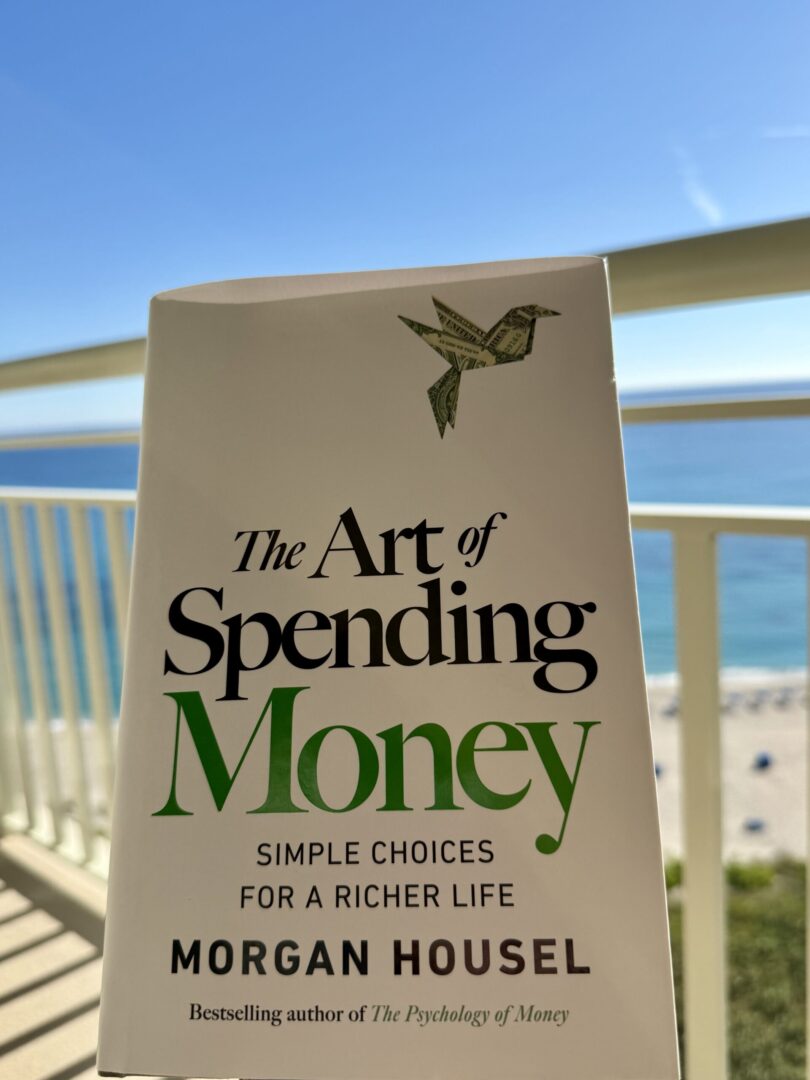
On my journey to financial independence, I’ve read close to 100 personal finance books. To kick off the new year, I just finished The Art of Spending Money by Morgan Housel.
If the name sounds familiar, you might recognize Housel as the bestselling author of The Psychology of Money, one of my favorite money mindset books.
Housel exemplifies what I look for in a personal finance book. My favorite books motivate me to think about the relationship between life and money.
I think of this type of book as a “money mindset book.”
For a list of my favorite money mindset books, click here.
What you’ll notice about these books is that they share a common theme. Each book will inspire you to use money as a tool to build a life that is personally meaningful.
My favorite money mindset books emphasize that money is emotional.
One of the ways these books do that is by exploring the emotional side of money. In other words, they don’t just talk about the numbers and math of personal finance. Money is so much more than a spreadsheet.
That not only makes the books more interesting to read, it also makes them so much more practical in the real world.
Nobody does this better than Housel.
See, I am striving to build the best life possible for my family. To do that, I need to learn more than just the numbers.
I need to be good at not only making money, but also using that money to build a life on my terms. That requires finding a balance, which can be tricky.
To help strike that balance, I’ve studied how others have done it, like Housel. Then, I can take what I learn and implement those lessons into my own life.
As a personal finance professor, I can also share these lessons with law students and young lawyers.
My favorite money mindset books view money as a tool and nothing more.
We talk about it all the time. Money is nothing more than a tool you can use to build a life on your terms.
My favorite money mindset books hammer this point home. Housel hammers this point home with a sledge hammer.
By the way, you can get a sense of what building a life on your own terms means by reviewing my personal Tiara Goals for Financial Freedom.
Each of the money mindset books I’ve read has helped me develop these core life philosophies. Importantly, these books have helped me acquire and use money in alignment with those core beliefs.
A good money mindset book might teach you how to acquire money. The best money mindset books will teach you how to use that money to live your best life.
Perhaps no book that I’ve read does that better than today’s money mindset book: The Art of Spending Money by Morgan Housel.
Housel is no stranger to the financial independence community.
As mentioned at the top, Housel’s bestselling book, The Psychology of Money, has long been featured on my list of The Best Money Mindset Books.
In The Psychology of Money, Housel writes about how people make decisions with their money in the real world. Housel agrees with one of our main themes at Think and Talk Money:
Money is emotional.
We can all be shown data and spreadsheets and understand what we should do. But, that’s usually not enough to change our behavior.
Housel is here to help with that. In The Psychology of Money, he takes core personal finance lessons and translates those lessons into regular life concepts.
Additionally, Housel teaches us the different ways people think about money. Then, he offers his perspective on how we can make better sense of money through our own life experiences.
Read The Psychology of Money. This money mindset book will help you understand the relationship between money and happiness.
The Art of Spending Money is the natural sequel.
The Art of Spending Money advances Housel’s message about the relationship between money and happiness, this time with an emphasis on spending.
Of course, Housel excels at illustrating the interconnection between money and our emotions.
In his newest book, Housel’s primary thesis is that there are no hard and fast rules on how you should spend your money. What you may value is different from what I may value.
For that reason, we should all make individual spending choices based on what matters the most to us. To go along with that, we should not spend money to impress other people. When we do that, we will never find happiness.
In Housel’s estimation, seeking external validation based on material possessions is a one-way ticket to a miserable life.
It’s hard to disagree with that.
Here’s a passage about spending habits that resonated with me:
The people I know who’ve used money best have inconsistent spending habits. They spend a lot of money on this, and very little on that. They value this, and couldn’t care less about that. They’re independent thinkers, forcing their money to work for them, not the other way around.
This was such a brilliant observation that I’ve been thinking about whether this is how I spend my money. I like to think that it is. Stay tuned for a follow-up post on this topic.
Money can’t buy happiness, but it can make a happy person… happier.
Housel also writes that while money can’t buy happiness, it can be leveraged in a way to enhance your life if you are already happy.
Think of it like gasoline on a fire. Gasoline won’t start a fire on its own. But if a fire already exits, gasoline can be used to make it bigger.
This relates back to using money as a tool. When you use your money like you would use a screwdriver, you can make the task at hand easier. You control the tool and use it to your advantage.
That’s how money can be used to enhance your pre-existing happiness.
Housel shares entertaining stories to highlight his points.
Housel is at his best as a writer when sharing stories about people in his life, historical icons, and modern day figures.
One of my favorites is the anecdote he shares about Kevin Costner and the origin story of the legendary movie, Dances with Wolves. Truly incredible.
Here’s another anecdote that I’ll never forget about money and raising children:
John D. Rockefeller–then the richest man in the world–once walked into the Waldorf Astoria hotel in New York City. He needed a room while his home was being remodeled.
He asked the hotel agent for the cheapest room available. The agent said, “Mr. Rockefeller, surely we can get you something better. When your son stays here he takes the Presidential Suite.”
Rockefeller responds, “Yes, but my son has something I’ve never had: a rich father.”
As lawyers, we have the opportunity to make a lot of money in our careers. That’s not something to boast about or be ashamed of. It’s just a fact. We can’t ignore that fact when it comes to teaching our children about money.
How you earn is as important as how much you earn.
OK, one more passage from Housel that jumped off the page at me that I need to share.
This is a personal finance blog for lawyers, right?
A lawyer who works one hundred hours a week and hates their job may have an urge to spend frivolously in an attempt to compensate for the misery of how their paycheck was earned. Never have I seen money burn a hole in someone’s pocket faster than an investment banker receiving their annual bonus. After twelve months of Excel modeling until 3 a.m., you have an urge to prove to yourself that it was worth it, offsetting what you sacrificed.
Does that one strike a nerve?
If it does, that might just be teaching you something about both your job and your relationship with money.
And, if I had to guess, that’s Housel’s main purpose in writing The Art of Spending Money.
You might not like everything that he has to say. I found myself wanting to push back on some of his opinions. You know what That’s how it should be.
I think Housel would agree that he would rather have us think critically about his viewpoint than blindly accept his opinions as gospel.
That holds especially true when it comes to life and money. This is your life. It’s your money. You need to explore that dynamic relationship for yourself.
When it comes to money, Housel encourages us to think for ourselves.
Housel wants us to explore our personal and emotional relationship with money so we can make intentional spending choices.
He’s not here to tell you what to do with your money. Neither am I.
He uses examples and relatable stories that will make you think about your money and spending decisions.
Yes, he shares his perspective to help get our wheels turning. But, he encourages us to think for ourselves.
In other words, don’t do something because he’s doing it. He wouldn’t want that. Do it because you’ve thought about what you value the most and what kind of life you want to live.
The corollary to that point: don’t spend money hoping that it will impress other people. It won’t.
Spend money on what matters the most to you. For Housel and many others in the financial independence community, that means buying your freedom.
There is no material possession in the world more valuable than that.
Read The Art of Spending Money. This money mindset book will help you spend money in line with what matters most to you.
Have you read The Art of Spending Money?
What did you think?
Let us know in the comments below.