
Tag: money goals

  • Money is Just a Tool: My 2026 Money and Life Goals

    Money is Just a Tool: My 2026 Money and Life Goals

    What I love most about studying and teaching personal finance is the interconnection between money and life.

    We talk about it all the time in the blog.

    Money is just a tool to be wielded to get what you really want in life. Money is not the destination, it’s the vehicle to help get you there.

    With that in mind, here are my money and life goals for 2026.

    By the way, this is the first year I’m sharing more than just my financial goals. My aim is to help you think about how money and life connect in your own situation.

    2026 Money and Life Goals

    1. Pay off remaining HELOC debt.
    2. Save 6 Months in my Parachute Money.
    3. Run the NYC Marathon in 4 hours.
    4. Expand the TATM Resource Library.
    5. Create the first TATM online course.
    6. Refocus my best energy on my family.

    1. Pay off remaining HELOC debt

    For years, my wife and I used HELOCs to help acquire rental properties. Now that we’re not actively looking to acquire more properties, our goal is to eliminate this HELOC debt.

    This is a carryover goal from 2025. Last year, we set out to eliminate the debt entirely. In the end, we managed to pay off 71% of the remaining balance. 

    While not the end result we targeted, I’m happy with this outcome. Any year that you eliminate 71% of a debt burden is a tremendous year.

    Because we made so much progress on this goal in 2025, I anticipate that at our current saving rate, we’ll have the HELOC debt fully paid off by the end of 2026. 

    It will be an incredible feeling to have this debt load off of our shoulders. We’ve been carrying it for too long now.

    Once this debt is eliminated for good, I can focus on more fun goals.

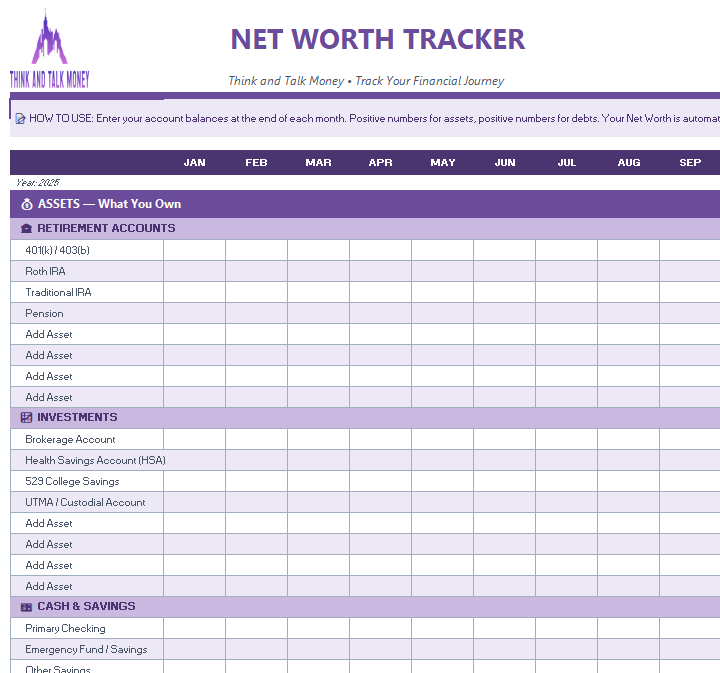
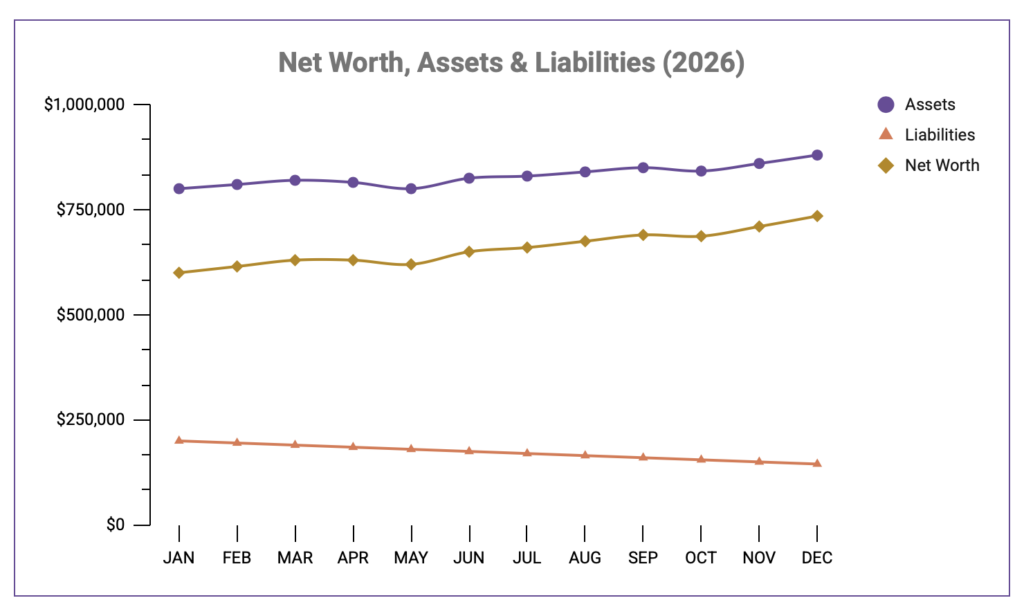
    I look forward to updating my net worth in the TATM Net Worth Tracker™️. It excites me to think about my assets growing, instead of just seeing debt shrink.
    Think and Talk Money Net Worth Tracker is a purple and white spreadsheet and the only thing you need to measure your progress towards financial independence.

    2. Save 6 Months of Parachute Money.

    Your emergency savings account is the most important savings account in personal finance.

    I like to refer to emergency savings as Parachute Money.

    Last year, my goal was to have four months of living expenses saved up in my Parachute Money account. This year, I’m upping the goal to six months.

    Why six months?

    Most personal finance experts recommend three to six months. Much of it depends on your current income situation and overall comfort level.

    I have income from my primary job, rental properties, and part-time teaching. I could probably get away with only a few months in emergency savings.

    However, I now have three young kids. That raises the stakes. I need to make sure they are protected should financial disaster strike.

    Taking all that into account, six months of emergency savings feels like the right target for me.

    In 2025, for the first time in a few years, we saved 1.5 months of Parachute Money. 

    This was another “failure” that I don’t view as a failure at all.

    When it comes to emergency savings, my challenge has been that I’ve been so focused on eliminating HELOC debt that this goal has typically been pushed aside.

    This year, with the HELOC debt dwindling, we’ve set out to make emergency savings more of a priority.

    By the end of 2026, this is another goal that we should be able to complete because of what we accomplished this year.

    3. Run the NYC Marathon in 4 hours.

    I’m 41-years-old. It occurred to me a few months back that the last time I really challenged myself physically was when I played club basketball in college. That was 20 years ago.

    Oof.

    While I’ve done a decent job of regularly exercising over the years, I’ve never really challenged myself. I’ve kind of just gone through the motions without a specific target in mind.

    This year, I’m changing that.

    So, why the NYC Marathon?

    I listened to a podcast recently where the host encouraged people to think back to what they enjoyed doing as kids and make that a part of their adult lives. Doing so can help improve our overall happiness in life.

    I love this advice.

    As a kid, I liked to play sports. I liked to compete. Running endurance was always one of my strengths. I was never a fast sprinter, but I could run for days without getting winded.

    As an adult, I like running. My normal exercise routine includes going for 2-3 jogs per week. Plus, I’ve always thought about running a marathon, but never made it an actual goal.

    Until now.

    For my first marathon, I had always planned on running in Chicago. It’s one of the seven world majors and a terrific event. Of course, I love Chicago.

    As it happens, my brother-in-law is getting married the weekend of the Chicago marathon, so I pivoted to New York.

    Choosing the NYC Marathon led to a great example of using money as a tool.

    What’s interesting is that my decision to run the NYC Marathon led to a great example of what I mean about using money as a tool to get what you want out of life.

    Here’s the story:

    Over the holidays, I mentioned to an experienced runner that I was going to run New York for my first marathon.

    He told me it was a bad idea. It would be too expensive. I’d have to buy flights and pay for a hotel. I’d also have to register through an expensive charity because so many people enter the race lottery.

    For a few minutes, he told me all the reasons I couldn’t do the NYC Marathon.

    I politely listened… and then booked my hotel in New York as soon as I got home.

    Money is a tool.

    This year, I’m using that tool to run a marathon, something I’ve wanted to do for a while now. Something that will be a personal challenge. Something that allows me to compete like I did as a kid.

    The sound of all of that makes me happy.

    If I’m not going to use money to improve my health and accomplish something I’ve always wanted to do, what would I ever use it for?

    This is exactly what I mean when I encourage you to use money to get what you really want in life.

    Any marathon runners out there, please reach out! I’d love to hear your stories.

    4. Expand the TATM Resource Library.

    In creating Think and Talk Money, my aim is to share the content of the personal finance course I’ve been teaching law students and lawyers for years.

    I dedicated 2025 to that aim by blogging 2-3 times per week.

    In 2026, the plan is to continue blogging, while also sharing the personal finance tools and resources that have helped me and so many others.

    To that end, we now have a TATM Resource Library designed to help you chart out and achieve all of your money goals.

    The TATM Resource Library includes five online calculators.

    TATM Resource Library includes 5 online financial calculators that are completely free to use.

    These five calculators are 100% free to use.

    I specifically chose to create these five calculators because I find them to be extremely motivating on my own journey to financial independence.

    I’ve heard the same from the students and lawyers I have shared them with in the past.

    I encourage you to use these calculators to help formulate your own plan to financial independence:

    1. Compound Interest Calculator to visualize the magic of compound interest over time.
    2. Student Loan Payoff Calculator where you can see big savings with even small extra loan payments.
    3. Credit Card Payoff Calculator where you can see how quickly you can pay off debt using debt snowball or debt avalanche.
    4. Coast Fire Calculator where you can find out if you already have enough saved for retirement.
    5. 529 College Savings Calculator where you can estimate how much you need to save for your child’s college education.

    The TATM Resource Library includes the only two spreadsheets you’ll ever need.

    In addition to the five calculators, you can also download the only two spreadsheets you’ll ever need to stay on top of your finances.

    First, you’ll find the TATM Net Worth Tracker™️.

    This is the template I’ve personally used for years. It’s easy to use and customizable for your individual situation.

    There’s no better way to measure your progress towards financial freedom.

    Coming soon, you’ll find the TATM Budgeting Template™️.

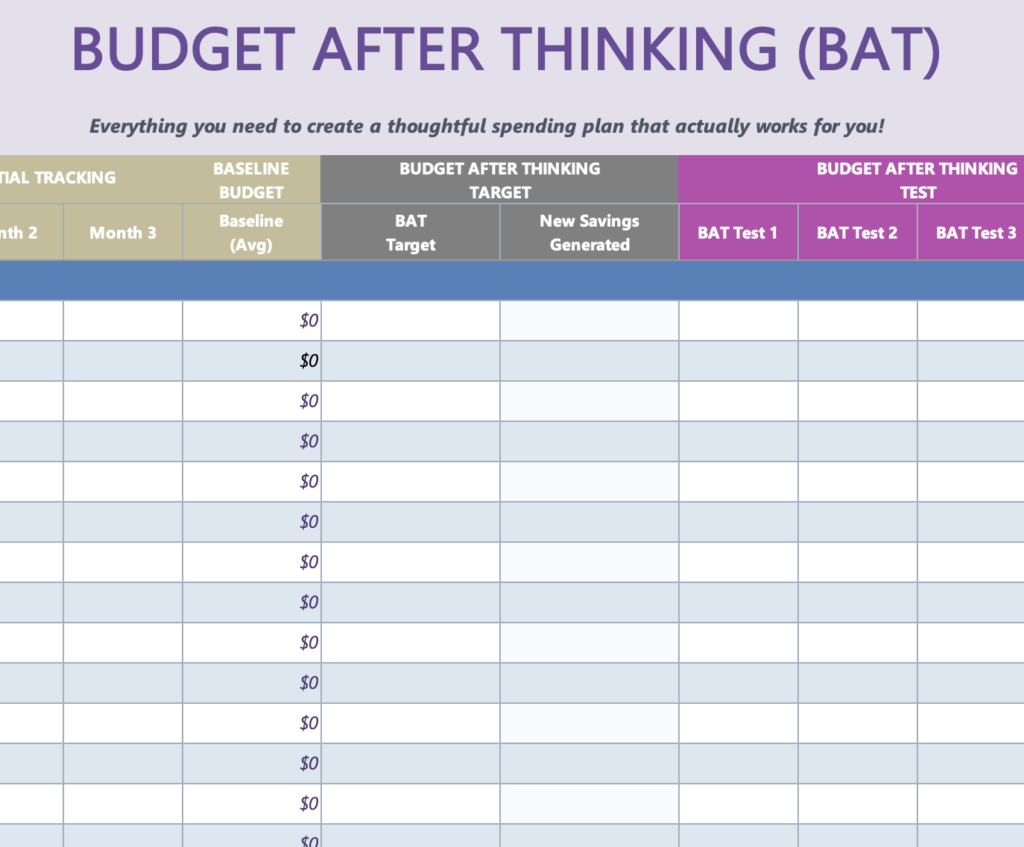
    This custom template utilizes my Budget After Thinking framework.

    I’ve learned through years of teaching personal finance that people quit on budgeting when it’s unnecessarily complicated.

    There’s no reason to make budgeting a process you hate.

    Using the TATM Budgeting Template™️, you’ll learn enough about your spending habits in six months that you can create a lasting budget that actually works for you.

    At that point, you’ll only need to track two simple numbers to stay on course and achieve your financial goals.

    5. Create the first TATM online course.

    I’ve taught personal finance to law students and lawyers for years, and I’m energized about sharing my course material online.

    So, in addition to building out the TATM Resource Library, I plan to release the first TATM online course in 2026.

    Admittedly, I wouldn’t be taking this step if it weren’t for the positive feedback I’ve received from students over the years.

    Here’s a sampling of what I mean:

    “Really worthwhile course! Prof Adair made a lot of sensitive money-related subjects very accessible and comfortable to talk about, and seems super passionate about the content and helping his students.”

    “Should be taught twice a semester probably, so everyone can have a chance to take it.”

    “Prof. Adair is very welcoming and relatable. He cares a lot about his students and what he is teaching. He is clearly very knowledgeable in this area and was able to answer everyone’s questions. I am so grateful for his passion to spend the weekend with us!”

    “Killed it! Honestly, this may be the most important class I have taken in law school.”

    I’m humbled by these sorts of comments and can’t wait to share my course with the TATM community.

    6. Refocus my best energy on my family.

    two kids looking at the ocean reminding me to refocus my best energy on my family.

    I saved my most important goal for last.

    This one is a hard goal to measure. I’m sure the “goal police” will take issue with such a vague idea.

    Well, it’s my blog. And, it’s my goal.

    The truth is my other goals don’t matter without this one.

    Similar to my Tiara Goals for Financial Freedom, I view this goal as more of an overarching, continuous force in my life, rather than striving for a particular finish line.

    This is the type of goal that I will remind myself of every day.

    For starters, it will help me be a better husband. I want to refocus my best energy for more quality time with my wife.

    As just one example, that means more date nights.

    As any parent with young kids knows, date nights can be hard to come by. In 2026, I want to change that. No more (or at least not as much) ships passing in the night.

    I also want to refocus my best energy on my kids.

    My kids turn 6, 4, and 1 this year. These years are flying by way too fast.

    My oldest daughter is the best chatter I know. She can happily chat for hours, just ask her aunts and grandmas.

    There isn’t a person alive who asks me harder questions. “Does space ever end? Is an elephant bigger than my room? Can you drive to South America?”

    My son is the sweetest boy in the world. My wife and I ask ourselves just about every day, “How did we get so lucky?”

    He’s also a total jokester. Nobody makes me laugh harder. In the car the other day, I quizzed him:

    “You and your sister are two of my four favorite things in the whole world. Can you name my two other favorite things?”

    Without missing a beat, he responded “Costco and Chick-fil-A.”

    Then, there’s my baby girl. She smiles ear-to-ear whenever I walk in the room.

    If I don’t smile back at her right away, she’ll say “Hey Dada, Hey Dada, Hey Dada” until I do. Then, she’ll erupt in the biggest smile you’ve ever seen. There is no better feeling.

    All in all, I know how lucky I am. I just want to be better at remembering it every single day.

    These are the good old days.

    Good luck to everyone on achieving your own 2026 money and life goals.

    Those are my goals for 2026. I’ll keep you all posted throughout the year on my progress.

    I love hearing from TATM readers.

    Your goals will surely be different than my goals. By talking about them, maybe we can help each other.

    Keep me posted on your progress along the way.

    If I can be of any help, don’t hesitate to reach out.

    The best way to reach me is to sign up for my weekly newsletter and then reply to any email.

    Or, you can leave a comment below.

  • Failing to Reach a Money Goal Does Not Make You a Failure

    Failing to Reach a Money Goal Does Not Make You a Failure

    Money goals are all about having a plan ahead of time so your dollars don’t disappear.

    If I could synthesize all of personal finance into one message, that would be it.

    Make a plan. No disappearing dollars.

    This is essentially all that budgeting is.

    Put a little effort into learning where your money is going. Then, evaluate whether you need to make any adjustments. I call this a Budget After Thinking (BAT) .  

    Having a BAT in place ahead of time means you know where every dollar is going before you earn it. At the end of each month, all you need to do is make your transfers to each account.

    That’s how you stay on budget with only two simple numbers.

    Focusing on just two numbers, you can rest easy knowing that you’re making progress towards your personal finance goals.

    This takes the anxiety out of trying to figure it out after the money has already hit your checking account.

    And, it eliminates the risk that the money sits in your checking account and slowly disappears because of mindless spending choices.

    The bottom line is that if you don’t have a plan in place, it’s going to be very difficult to accomplish your goals.

    As 2025 winds to a close, I wanted to share how I did with my money goals this year.

    Here are the three money goals my wife and I came up with in early 2025:

    1. Pay off the HELOC debt. Our first goal was to continuing paying down HELOC debt that we used to help acquire some of our rental properties. Now that we’re not actively looking for more rentals, we’re focused on paying back these loans.
    2. Build up our emergency savings. Our second goal was to build up our emergency savings. We mostly ignored our emergency savings between 2017 and 2024 as we focused on buying investment properties. It was risky and led to some touch-and-go moments that we’d like to avoid moving forward.
    3. Fully fund college for our second kid. Our third goal was to boost our contributions to our kids’ 529 college savings accounts. We have three kids. We previously hit our savings goal for our first kid. This year, we were focused on our second kid.

    In the end, I did not accomplish two of my three money goals.

    Does that make 2025 a failure?

    No way!

    This year was far from a failure. It might have been our best year ever. I’ll explain below.

    What’s interesting is the goal we did achieve was the lowest priority of the three at the beginning of the year. I’ll talk about that, too.

    Before we get to that, I want to first talk about failure.

    Failing to complete a goal does not make you a failure.

    I realized years ago that failing to complete a goal does not mean that I am a failure. Goals are about making progress, not just the end result.

    If you put in the effort and make progress toward a desired result, any progress should be viewed as a success.

    In theory, we all know this.

    Here’s an example:

    Think about a woman who sets a goal to finish a 10k in less than an hour. She’s never run that far or that fast before.

    She trains for months in pursuit of her goal. It’s not easy. There are training runs she wants to skip. Her legs ache and her body is sore. But, she sticks with it.

    On the big day, she gives it her all and finishes the race in one hour and 2 minutes.

    Two minutes too slow.

    Is she a failure because she didn’t finish in less than an hour?

    Of course not.

    This woman ran further than she’s ever run before. She’s stronger and more fit than she was before training.

    On top of that, she now has a new baseline to start from. She can evaluate her process and learn from what she accomplished.

    If she wants to, she can sign up for another 10k with all the knowledge and improved fitness she gained this time around.

    By just about every measure, she’s a success. Goals are about the process and not just the result.

    Keep this little example in mind when you review your own goals.

    We are harder on ourselves than we are with other people.

    Throughout life, we tend to be harder on ourselves than we are on other people. This is especially true when we fall short of accomplishing all of our goals.

    I want to encourage you to reframe how you evaluate your goals. Instead of focusing just on the result, think about how far you progressed from where you started.

    This part can be difficult.

    Years ago, I would get down on myself for not hitting all of my targets. It took some time to realize that even when I didn’t hit my target, I still had a successful year.

    Here’s a personal example, sticking with the running theme.

    A few years ago I made a goal to run 500 miles for the year. In the end, I ran something like 460 miles.

    At first, I was very hard on myself. I concluded that I failed because I did not reach 500 miles.

    Then, I evaluated why I fell short.

    I realized that I was making great progress before I was sidelined with an injury for a couple of months. I did my best to make up for the lost time but couldn’t quite recover.

    Looking back, the fact that I got close and didn’t give up entirely was a good thing, not a failure.

    I was proud that I continued to make progress, even after a setback.

    By the end of the year, running 460 miles was an accomplishment despite falling short of the ultimate goal.

    Nowadays, this is exactly how I evaluate all of my goals, whether they’re fitness goals, money goals or any other type of goal.

    person in red hoodie standing on snowy mountain showing that ambitious goals do not make you a failure even if you don't hit them.
    Photo by Joshua Earle on Unsplash

    I set ambitious targets knowing that I might not hit them.

    If I don’t complete all my goals, I don’t let myself think that I’m a failure.

    Instead, I evaluate my progress and the actions I took to reach my target. If I fall short, I try to understand what happened so I can learn for next time.

    Sometimes, I fall short because I made an unrealistic goal. Other times, it might just be that I got close but not all the way across the finish line.

    There have also been times when my goal was simply a bad goal, meaning something I didn’t actually care about.

    Regardless, I review my motivation and my effort so I can recalibrate for the following year.

    With this process in mind, let’s take a look at how I did with my 2025 money goals.

    How did I do with my 2025 money goals?

    I failed to achieve my three money goals for 2025.

    But, this year was not a failure.

    Not even close.

    As I look back on my 2025 money goals, I’m thrilled with my progress.

    1. Pay off the HELOC debt

    For years, my wife and I used HELOCs to help acquire rental properties. Now that we’re not actively looking to acquire more properties, our goal is to eliminate this HELOC debt.

    Admittedly, this was a very ambitious goal to accomplish in one year. Especially considering the other two goals on this list.

    In the end, we paid off 71% of our HELOC balance.

    While not the end result we targeted, I’m happy with this outcome. Any year that you eliminate 71% of a debt burden is a tremendous year.

    Because we made major progress on this goal in 2025, I anticipate that at our current saving rate, we’ll have the HELOC debt fully paid off by the end of 2026. 

    It will be an incredible feeling to have this debt load off of our shoulders. We’ve been carrying it for too long now.

    Once this debt is eliminated for good, I can focus on more fun goals. I can watch my accounts grow, instead of just seeing debt shrink.

    That excites me.

    How to pay off debt on a budget.

    By the way, I don’t regret using HELOC debt to help purchase investment properties and build our portfolio.

    That said, at this stage in my life, I’m ready for that debt to be gone.

    If you are similarly working towards paying off debt, check out my top 10 strategies for paying off debt on a budget:

    My top 10 strategies for how to pay off debt on a budget.

    1. Write down your Tiara Goals.
    2. Create a Budget After Thinking so the debt stops growing.
    3. Prioritize Later Money funds for debt.
    4. Apply our Top 10 strategies for staying on budget.
    5. Talk to your people about paying down debt.
    6. Track your net worth and saving rate for small wins.
    7. Pick a strategy and stick with it: Debt Snowball v. Debt Avalanche.
    8. Think about loan consolidation.
    9. Get a side hustle.
    10. Don’t let yourself fall backwards.

    Throughout the year, I was focused on prioritizing funds for debt, using the debt snowball approach, and not letting myself fall backwards.

    For a deep dive on each of the 10 strategies, check out my full post on paying off debt on a budget:

    2. Build up our emergency savings.

    Your emergency savings account is the most important savings account in personal finance. I like to refer to emergency savings as Parachute Money.

    My goal is to have four months of living expenses saved up in my Parachute Money account.

    Why four months?

    Most personal finance experts recommend three to six months. Much of it depends on your current income situation and overall comfort level.

    I have income from my primary job, rental properties, and part-time teaching. Taking all that into account, four months of emergency savings feels like the sweet spot to me.

    So, how did I do with this goal?

    Well, it was another “failure” that I don’t view as a failure at all.

    When it comes to emergency savings, my challenge has been that I’ve been so focused on eliminating HELOC debt that this goal has typically been pushed aside.

    This year, I set out to make emergency savings more of a priority.

    I’m happy to share that for the first time in a few years, we now have an emergency savings account with 1.5 months of living expenses.

    It’s not the four months we targeted, but once again, we made good progress.

    By the end of 2026, this is another goal that we should be able to check off because of what we accomplished this year.

    3. Fully fund college for our second kid.

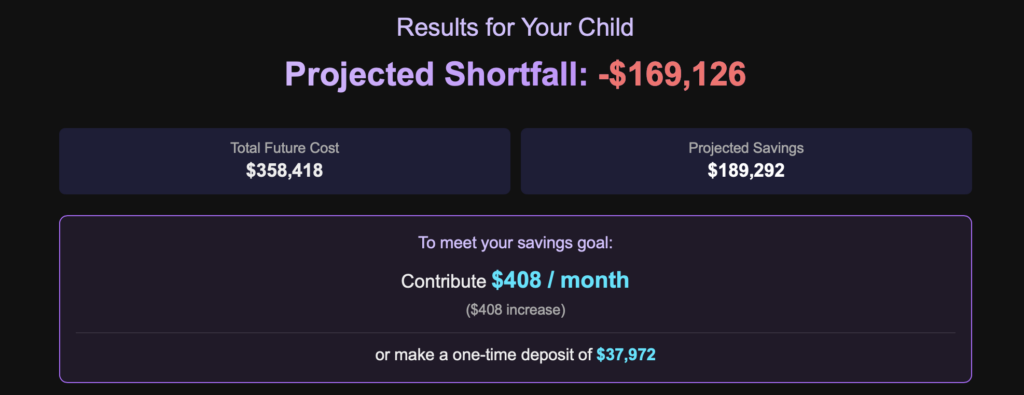
    Using the Think and Talk Money 529 College Savings Calculator, I figured out how much money we would need to invest this year in our son’s 529 savings account to fully fund his college.

    The 529 Savings Calculator showed us that with investments of $37,972 this year, we could fully fund his in-state tuition at the University of Illinois (our premier in-state university).

    Here’s what the results look like from the calculator:

    think and talk money 529 college savings calculator showing how much you need to save for your kid's college.

    When my wife and I saw these results, we realized that we could make it happen, if we made it a priority.

    So that’s what we did.

    We made it a priority to fully fund our son’s college account.

    And, I’m happy to report that we completed this goal.

    The tradeoff was that we did not make as much progress on our HELOC debt or our emergency savings.

    The funny thing is this was the lowest priority goal of ours when the year started.

    In the end, it’s the only one we accomplished. How did that happen?

    Well, our emotions took over.

    This is an example of why I always say that money is emotional.

    When my wife and I chose to fund our son’s college savings account, we knew that would mean we’d fall short on our other goals.

    We were more than OK with that tradeoff.

    My wife and I received a powerful emotional boost by prioritizing our son’s college. We can now cross this item off the “to-do” list once and for all.

    See, most “financial experts” would have advised us to eliminate our debt and build an emergency savings before targeting college savings for our kids.

    Well, most experts ignore that money is emotional.

    We don’t live in a spreadsheet.

    When my wife and I talked about doing this for our little boy, the decision was easy.

    There’s nothing we wouldn’t do for him. I smile every time I think about what the future may have in store for him.

    How did you do with your 2025 money goals?

    As you look back on your 2025 goals, don’t beat yourself up if you didn’t reach your ultimate target.

    We all need to give ourselves some grace. Any and all progress is an accomplishment and something to build upon.

    As you look ahead to 2026, evaluate what you learned about yourself in 2025.

    Soon, I’ll share my 2026 money goals. You can already guess my first two goals: eliminating the HELOC debt once and for all and hitting that 4-month emergency savings target.

    If you’ve never set money goals before, my process might help you get started.

    How did you do with your 2025 money goals?

    What did you learn about yourself?

    Let us know in the comments below.

  • Are You Making Progress on Your 2025 Money Goals?

    Are You Making Progress on Your 2025 Money Goals?

    As summer turns to fall, it’s the perfect time to revisit the money goals you made at the beginning of the year.

    Summer travel season is over. The kids are back in school. For most people, this is a quieter time of year before the holiday season kicks into high gear.

    Plus, many professionals earn raises and bonuses as we move towards the end of the year. It’s crucial to have a clear idea of what to do with those raises and bonuses ahead of time so that hard-earned money doesn’t disappear.

    But, Matt, I didn’t make any money goals at the beginning of the year.

    That’s OK- you still have three months left this year to accomplish something you’ve been putting off.

    There’s no reason you can’t make a goal today and see how far you can get by New Year’s Eve. Why let these three months go to waste?

    To help you refocus on your money goals, here’s a status update on how I’m doing with my 2025 money goals.

    Let’s start off with some context.

    My goals in 2025 look a lot different than previous years.

    Leading up to 2025, my wife and I were focused on acquiring real estate. We now own five properties and are very happy with our current portfolio.

    We are not looking to add more properties at the moment. To make that decision, I owe a lot of credit to Chad “Coach” Carson and his excellent book, Small and Mighty Real Estate Investor: How to Reach Financial Freedom with Fewer Rental Properties.

    In his book, Coach Carson makes a compelling argument to think about when enough is enough.

    His message was about acquiring more and more real estate, to no end, but also applies to any pursuit in life.

    Reading Small and Mighty Real Estate Investor  helped my wife and I conclude that at this point in our lives, we have enough.

    We self-manage our 10 units in Chicago and work closely with a property manager in Colorado. If we were to continue expanding, the headaches could end up outweighing the financial benefits. 

    We want to build a life full of experiences and memories. That means we need more time, not more money.

    Acquiring and managing more properties right now would take up a lot of time. That tradeoff is not currently worth it to us.

    That’s the main reason why our goals look different this year than they have in the past.

    scissors and two paper clips beside opened spiral notebook which is perfect for revisiting your 2025 money goals.
    Photo by Alexa Williams on Unsplash

    My wife and I came up with 3 money goals earlier this year.

    Here are the three money goals my wife and I came up with in early 2025:

    1. Pay off the HELOC debt. Our first goal is to continuing paying down HELOC debt that we used to help acquire some of our rental properties. Now that we’ve determined that “enough is enough,” we’re focused on paying back these loans.
    2. Build up our emergency savings. Our second goal is to build up our emergency savings. We mostly ignored our emergency savings between 2017 and 2024 as we focused on buying investment properties. It was risky and led to some touch-and-go moments that we’d like to avoid moving forward.
    3. Fully fund college for our second kid. Our third goal is to boost our contributions to our kids’ 529 college savings accounts. We have three kids. We previously hit our savings goal for our first kid. Now, we’re focused on the next kid.

    Why is it so important to have a plan for your money ahead of time?

    Money goals are all about having a plan ahead of time so your dollars don’t disappear.

    Having a plan in place ahead of time means we know where every dollar is going before we earn it. At the end of each month, all we need to do is make our transfers to each account.

    Also, we can rest easy knowing that we’re making progress towards our personal finance goals.

    This takes the anxiety out of trying to figure it out after the money has already hit our bank account.

    And, it eliminates the risk that the money sits in our checking account and slowly disappears because of mindless spending choices.

    If you don’t have a plan in place, it’s going to be very difficult to accomplish your goals.

    How am I doing with my 2025 money goals?

    As I revisit my 2025 money goals, it’s fair to say that I’m happy with our progress but still have a ways to go.

    Here’s a look at my progress so far:

    1. Pay off the HELOC debt.

    We’ve made major progress on this goal. I anticipate that at our current saving rate, we’ll have the HELOC debt fully paid off by the end of the year.

    It will be an incredible feeling to have this debt load off of our shoulders. We’ve been carrying it for too long now.

    By the way, I don’t regret using HELOC debt to help purchase investment properties and build our portfolio. That said, at this stage in my life, I’m ready for that debt to be gone.

    If you are similarly working towards paying off debt, check out my top 10 strategies for paying off debt on a budget:

    My top 10 strategies for how to pay off debt on a budget.

    1. Write down your Tiara Goals.
    2. Create a Budget After Thinking so the debt stops growing.
    3. Prioritize Later Money funds for debt.
    4. Apply our Top 10 strategies for staying on budget.
    5. Talk to your people about paying down debt.
    6. Track your net worth and savings rate for small wins.
    7. Pick a strategy and stick with it: Debt Snowball v. Debt Avalanche.
    8. Think about loan consolidation.
    9. Get a side hustle.
    10. Don’t let yourself fall backwards.

    Throughout the year, I have been especially focused on prioritizing funds for debt, using the debt snowball approach, and not letting myself fall backwards.

    For a deep dive on each of the 10 strategies, check out my full post on paying off debt on a budget:

    Once this debt is eliminated for good, I can focus on more fun goals. I can watch my accounts grow, instead of just seeing debt shrink.

    That excites me.

    2. Build up our emergency savings.

    Your emergency savings account is the most important savings account in personal finance.

    My challenge is that I’ve been so focused on eliminating my HELOC debt this year that I haven’t been able to address this goal yet.

    I’m still hopeful I’ll have a chance before the year is over.

    My goal is to have four months of living expenses saved up.

    Why four months?

    Most personal finance experts recommend three to six months. Much of it depends on your current income situation and overall comfort level.

    I have income from my primary job, rental properties, and part-time teaching. Taking all that into account, four months of emergency savings feels like the sweet spot to me.

    Admittedly, it will take some time to complete this goal. If I can’t achieve this goal by the end of the year, it will become my top priority for next year.

    man in front of waterfall representing what you can do to accomplish your 2025 money goals.
    Photo by Caleb on Unsplash

    3. Fully fund college for our second kid.

    I recently used an online calculator to figure out how much money I would need to invest right now in my son’s 529 savings account to fully fund his college. We already hit our mark for my first kid.

    I learned that with an investment today of $67,000, I could fully fund my son’s in-state tuition. 

    Of course, the key is to let that money grow for the next 15 years to take advantage of compound interest.

    What an accomplishment that would be to not have to worry about his future college. I could cross that item off the “to-do” list once and for all.

    Then, it would be onto the next kid.

    Because my son is only three years-old, this goal is not as pressing as paying off my debt and fully funding my emergency savings account. Looking back, it was probably overly ambitious to include it as a goal for this year.

    Aim for the stars, land on the moon, right?

    Like my emergency savings account, this will be a top priority for next year.

    Are you making progress on your 2025 money goals?

    Don’t wait until the end of the year to look back on your goals. Take a few minutes today to assess your progress.

    There’s still plenty of time ahead of you to make any necessary adjustments.

    Maybe you’re getting a raise or a bonus soon. Maybe you’re about to earn a big commission.

    Revisit your goals so you have a plan for that money before it hits your checking account.

    How are you doing with your 2025 money goals?

    Let us know in the comments below.