

Two young coworkers, Mike and Elissa, start the same job at the same time making the same amount of money.
While still many years away, Mike and Elissa both know that they should invest early and often for retirement.
They each decide to fund a retirement account with an initial contribution of $2,500. They are also dedicated to making contributions of $250 every month until they retire.
Both plan to retire in 40 years while they’re in their 60s.
There’s one major difference between Mike and Elissa.
They view risk differently.
Because they view risk differently, one of them will end up with six times more money in retirement.
Let’s see how that happens.
Mike doesn’t like risk.
Mike doesn’t like risk. He wants to be able to sleep at night knowing that his hard-earned money is safe and sound in the bank. He can’t stand the idea of potentially losing money from one month to the next.
Even though Mike doesn’t like risk, he knows that saving money is important. In fact, he’s a bit obsessive about tracking his accounts using the TATM Net Worth Tracker™️.
When Mike wakes up in the morning, he likes to check his bank accounts while he drinks his coffee. He gets a jolt out of opening up his mobile banking app and seeing exactly how much money he has.
Because Mike doesn’t want to take any chances, he decides to stash all of his retirement savings in a savings account that earns an average annual return of 3%.
Mike is lucky because this is a pretty generous return for a savings account based on historical savings account interest rates.
Elissa is more comfortable with reasonable risk.
Elissa is more comfortable with reasonable risk. Upon starting her career, Elissa was smart enough to know what she didn’t know about money. Because she had never learned basic personal finance skills, she was determined to put in a little bit of effort early on to set herself up for a prosperous future.
Elissa was a frequent reader of Think and Talk Money. She listened to financial independence podcasts. Elissa even read JL Collins’ book on investing, The Simple Path to Wealth.
Through the process of educating herself about personal finance, Elissa started thinking about what she really wanted out of life. Since she was young and had just started her career, it wasn’t easy to come up with a good answer.
Still, Elissa knew that whatever she wanted to do in life, investing was an important part of her financial journey. If she wanted to create more time for herself down the road, she would need passive income from investments to sustain her.
So, after doing her homework, Elissa decided to invest her money in a low cost S&P 500 index fund.
While she appreciated that there are no guarantees when it comes to investing, Elissa had learned that the S&P 500 has historically earned an average annual return of 10%.
Unlike Mike, Elissa only checked her accounts once per month when she updated her TATM Net Worth Tracker™️. Elissa slept fine at night because she knew time was on her side.
Let’s see how Mike and Terry turned out 40 years later.
Using the Think and Talk Money Compound Interest Calculator, let’s see how much money Mike and Elissa will have in their retirement accounts after 40 years.
The way I’ve framed our hypothetical, you can probably guess who ends up with more money. What may surprise you is just how much of a gap there is.
Remember, both Mike and Elissa started with the same initial contribution of $2,500, made the same $250 monthly contributions, and invested for the same 40 year period.
The only difference between their two journeys was that Elissa was more comfortable with risk.
After 40 years, Mike has $234,358.
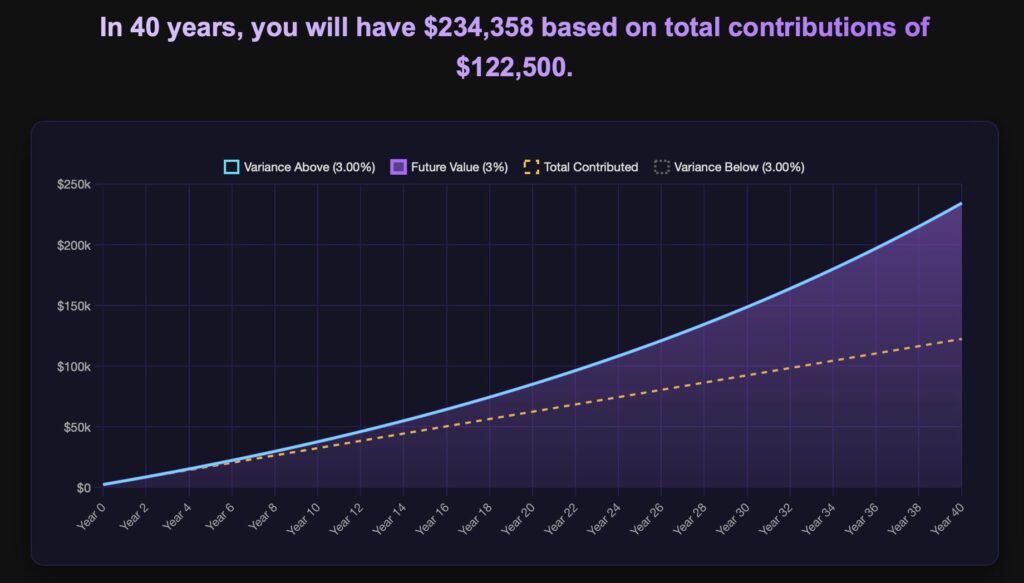
After 40 years, Mike will have contributed a total of $122,500 to his retirement savings account.
At a 3% interest rate, Mike will have $234,358 after 40 years.
In other words, Mike has just about doubled the value of his total contributions in his account.
Not bad, Mike.
Now, let’s check out Elissa’s account.
After40 years, Elissa has $1,440,925.
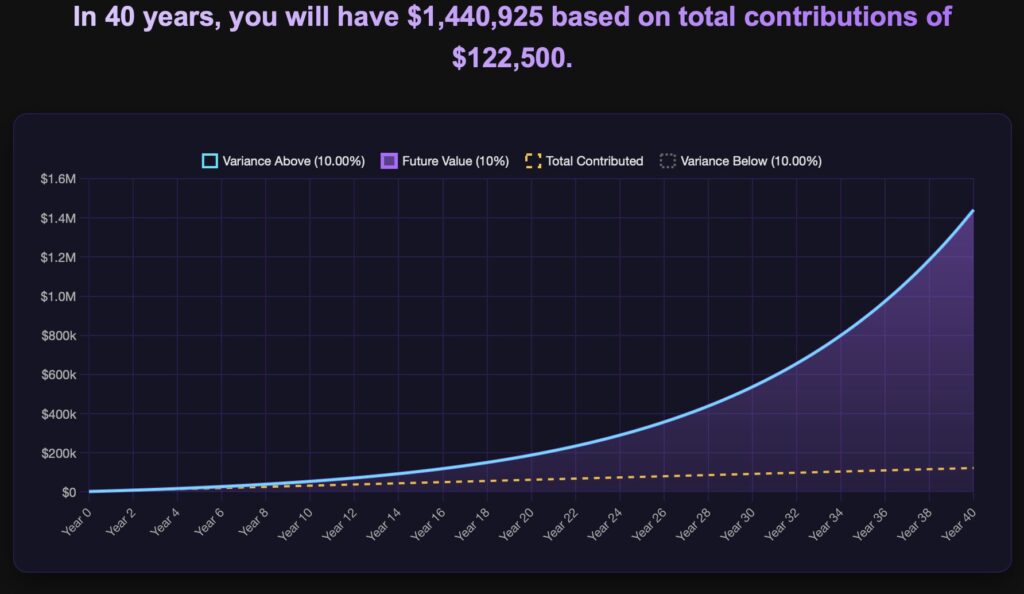
Elissa likewise contributed $122,500. After 40 years, at a 10% interest rate, Elissa’s retirement account will have a total of $1,440,925.
Wow, Elissa!
Elissa’s retirement account is worth 10 times more than what she personally contributed. Mike failed to even double his money.
Recall in this hypothetical, Elissa did the exact same things as Mike, with one key difference. Elissa educated herself in basic personal finance concepts and was more comfortable taking on reasonable risk.
Because Elissa was comfortable taking on some risk, her retirement savings were worth more than six times as much as Mike’s savings. Put another way, she has more than a million dollars more than what Mike has!

Look at compound interest in action.
One last thing: take a look at the pictures of Mike and Elissa’s investments over time. Notice the gaps between each of lines on the graphs. The blue lines represent the total account value, and the dotted lines represent only the contributions.
While they each benefited from compound interest, Elissa benefited exponentially more.
Look at how Mike’s blue line stayed much closer to the dotted line. Because he wasn’t earning as much overall interest, he didn’t have as much money to multiply from compound interest.
On the other hand, Elissa’s blue line mirrored her dotted line closely for the first 12-15 years. Then, the gap widened before the blue line skyrocketed over the final decade or so.
That’s the power of compound interest kicking in.
So, what can we learn from Mike and Elissa?
The point of this hypothetical is to reinforce the concept of risk when it comes to investing.
We’ve all heard the saying, “You don’t get something for nothing.”
That motto applies to investing as much as anything else. There is always risk involved in investing.
The question is how do you react to that risk.
Some people are so fearful of that risk that they don’t invest at all, like our friend, Mike.
Other people are so desperate to get rich quickly that they take wild risks.
The people that tend to reach and sustain financial independence are the ones who educate themselves and become comfortable with taking on reasonable risk. This is what Elissa did.
Think of risk as the cost to invest.
If you want to reach true financial independence or any other financial goal, it’s going to cost you something.
Think of risk as the cost to invest.
Sure, there are lawyers out there who may reach financial independence on a massive salary, even with poor financial habits.
For the vast majority of us, we’re going to have to get comfortable with investing and taking on reasonable risk.
If you’re on the fence about taking on reasonable risk, now’s a good time to think about your ultimate life goals. Embrace the reasons for why you’re investing. Think about what would motivate you to open yourself up to reasonable risk. For me, it’s having ultimate optionality in life.
It never hurts to remind yourself what you are hoping to achieve in the future. When you know what that thing is, it’s much easier to pay the cost of risk.
When you understand reasonable risk, you know that market fluctuations are a good thing.
Warren Buffett once said, “Look at market fluctuations as your friend rather than your enemy; profit from folly rather than participate in it.”
This wisdom is important to remember today as multiple wars are being fought around the world and nobody truly knows where the economy is headed.
Recently, I’ve talked to people still early in their careers who are selling stocks and moving into “safer” positions, like precious metals and cash. Setting aside whether these asset classes are in fact safer, I think it’s a mistake for young lawyers to get out of the stock market right now when they have decades of investment horizon ahead.
Right now the market is fluctuating. That is completely normal. As Buffett says, this might be a great time to lean into the stock market. When the market goes down, if you consistently invest in broad-based index funds, you can purchase stocks on sale. That’s what Buffett means by profiting from other people’s folly instead of participating in it.
This is why it’s important to think of reasonable risk in terms of decades, not weeks or months.
When you look at Elissa and Mike’s future outlook, who would you rather be?
It’s not really a hard question, right?
It’s not only that Elissa has a bigger bank account. What matters even more is that she has created options for herself.
Elissa should be in position to do whatever she wants at that point in her life, within reason.
Mike won’t be.
The takeaway is that when you have decades ahead of you, let risk work in your favor. Let other people panic and sell their assets when the market is dropping. Ignore the noise. You can’t time the market. Stay invested for the long-term by embracing the risk.
Readers: are you naturally more inclined to act like Mike or Elissa when it comes to investing?
If you’re more like Mike, have you thought about what outcome in life would make it worth taking on some reasonable risk?
Does it feel more difficult to stay invested when the market is dropping?
Have you tried flipping the script by telling yourself that stocks are on sale when the market drops?
Let us know in the comments below.