Tag: financial wellness for lawyers

  • Better to Buy 10 Businesses or Wait for Compound Interest?

    Better to Buy 10 Businesses or Wait for Compound Interest?

    I read an article the other day where the author says he’s not going to save another dime for retirement. He reasoned that waiting for compound interest to kick in takes way too long.

    He found a better way, he claimed.

    Instead of investing in the markets long term, he’s going to buy small businesses that generate cash flow. He gave an example of buying a website for $10,000 that kicks off $400 per month.

    That’s money in his pocket right now that he can spend in early retirement. He figures that owning ten small business like that is a faster and better path to retirement than traditional investments.

    When you buy businesses, your cash flow increases. When you invest in stocks, only your net worth increases. Since you can’t retire off your net worth, you’re better off owning businesses.

    The author suggested that everyone can do this and should be doing this. In his opinion, investing for cash flow is much more important than investing for long term net worth.

    Do you want to own and manage ten businesses?

    Interesting philosophy. I hope it works for him.

    Personally, I won’t be following his lead.

    For starters, how are you supposed to select, acquire, and operate ten small businesses? Is that even possible? If it is, it sounds like a major headache. As attorneys, we have enough headaches in our day jobs.

    On top of that, I don’t buy his main concept that owning ten businesses will allow you to retire early. To me, owning ten businesses sounds like ten jobs and a lot of work.

    As attorneys, we already have a demanding job and a lot of work. If you don’t want to work as an attorney anymore but want to keep working, maybe this is an idea you want to explore. If you want to retire and not work, this doesn’t sound like the ticket to me.

    Finally, this scheme sounds risky. How many small businesses would I have to buy to land on 10 that actually generate cash flow?

    According to the US Bureau of Labor, 18% of small businesses fail within their first year, 50% fail after five years, and approximately 65% fail by their tenth year. What are the odds that I’m going to own ten successful businesses that stick around long enough to fund my retirement? Way too risky for me.

    In the end, the internet is full of schemes like this one promising a better and faster way to retire. Some of them might even work!

    I’m not interested in going down this path. I’m sticking with the personal finance concepts that have worked for generations.

    For today’s conversation, that means investing early and often to benefit from the magic of compound interest.

    It’s not sexy. It’s not exciting. But, it works.

    Here’s why.

    Business Consulting meeting working and brainstorming new business project finance investment concept which seems like a lot more work than investing and relying on compound interest.
    Photo by Christin Hume on Unsplash

    Invest early and often to benefit from the magic of compound interest.

    Compound interest is the interest you earn on interest. 

    How’s that for a confusing definition?

    Fortunately, the idea of compound interest makes a lot more sense with a simple example.

    Let’s say you make an initial investment contribution of $1,000. Let’s assume that you earn 10% interest each year on that investment. We will also assume that you re-invest your investment gains. 

    After the first year, your initial contribution of $1,000 earns $100 in interest (10% of $1,000). That means after one year, you have $1,100 in your investment account.

    Because we are re-investing our gains, that means that at the start of year two, you have $1,100 to invest: $1,000 from your initial contribution plus the $100 earned in interest.

    If you earn the same 10% interest on that $1,100 investment, you will have $1,210 at the end of year two. 

    Notice that in year two, you earned $110 in interest, whereas in year one you earned $100 in interest. That’s because in year 2, you earned interest on the interest your previously earned. 

    This is the key point about compound interest: you earned more money in year two, even though the interest rate remained the same and you did not contribute any additional money.

    That’s how compound interest works. Compound interest is earning interest on interest you’ve previously earned.

    Importantly, you don’t have to work harder or make the right decisions like you would if you owned a small business. With compound interest, you make more money as time goes on by doing nothing.

    So, why is compound interest so powerful?

    Earning an additional $10 in interest year two may not seem like a lot. 

    Over the long run, those additional earnings add up.

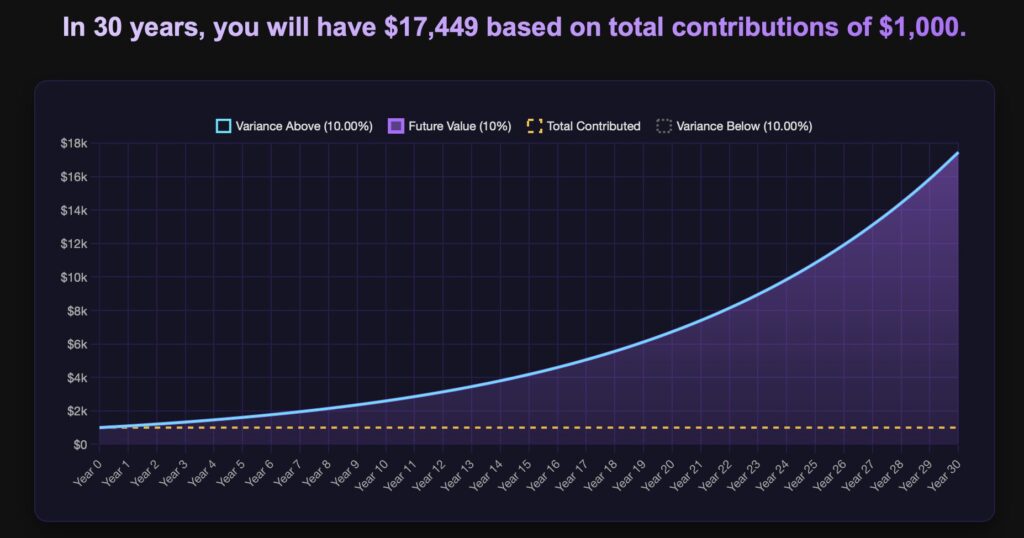
    Let’s look at an illustration from the Think and Talk Money Compound Interest Calculator of what happens to that initial $1,000 contribution over a 30-year period:

    In 30 years, you will have a total of $17,449.40. That’s a pretty good result from total contributions of only $1,000. 

    However, for this example, that total is not the important part. The important part is to visualize how compound interest worked its magic to get that result.

    Look closely as the two lines on the graph. The dotted line that doesn’t change represents your initial $1,000 contribution.

    The blue line represents the amount of money you have over time.

    Notice how in the first 10 years or so, the dotted line and the blue line mirror each other pretty closely. Around year 12, you start to see some separation between the two lines. 

    While the dotted line stays flat, the blue line begins to arc upwards. That’s because all that interest you earned during the previous decade has been earning interest. Your investment begins to accelerate upwards without any additional contributions from you.

    By the end of year 30, look at how steep the blue line is jetting upwards.

    Like I said, compound interest is not sexy. But given enough time, it works incredibly well.

    Look at the specific amount of money you’d earn each year in this hypothetical.

    When you use the Compound Interest Calculator, you can also see how much more interest you earn each year as time goes on. Just click the button that says “Show/Hide Data Table.”

    As we mentioned earlier, you earned $100 in interest during year 1. Then, you earned $110 in interest during year 2. That’s a good, but modest, increase.

    During year 12, you earned $285.31 in interest. That’s significantly more than you earned in the early years, all without any additional contributions on your part.

    During year 30, you earned $1,586.31 in interest! 

    The more time that you stay invested, the more money you’ll earn as compound interest works its magic.

    That’s the power of compound interest.

    Invest early and often to be a millionaire with very little effort on your part.

    Compound interest is so powerful that it can make you a millionaire with very little effort on your part. All it takes is time and consistency.

    Compared to owning ten small businesses, that sounds much easier.

    Let’s look at another example to see how you can easily become a millionaire if you invest early and often.

    Let’s say you begin your career after going to law school or grad school at age 25. During your first year working, you saved up $3,000 and decided to invest in a low cost index fund.

    You also make a plan to contribute an additional $300 per month to your investment account for the next 40 years, setting yourself up to retire at age 65.

    We’ll also assume you earn the same 10% interest from our prior example, and you don’t make any withdrawals from your account.

    To provide a fuller picture, we’ll also factor in a 2% variance rate, meaning you can see what would happen if you only earned 8% interest and also if you earned 12%.

    Now, let’s see the results.

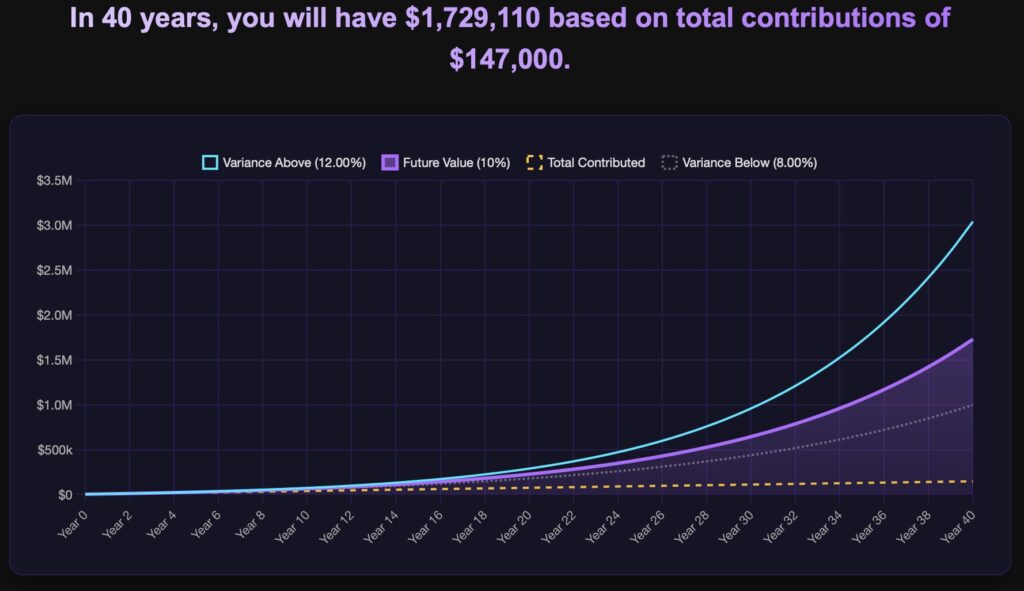
    By the time you reach retirement age, you’ll have $1,729,110.97 in your retirement account at 10% interest.

    That amount increases to $3,040,682 with 12% returns and drops to $997,777 with 8% returns. 

    That’s after contributing only $3,000 initially and $300 per month after that.

    Put another way, your total contributions of only $147,000 turns into $1,729.110.97 by the end of your career. Even if the market performs below historical averages, you would still have nearly $1 million.

    Take a look at the graph and notice the similarities to our prior example.

    You’ll notice this graph looks almost identical to our prior example, even with the additional contributions that you make over time. 

    You can once again see that the lines mirror each other closely for the first 10-15 years. 

    Then, the dotted line stays relatively flat while the investment lines gradually arc up before skyrocketing towards the end.

    Now, there’s no way to predict exactly when you’ll start to notice the magic of compound interest. There are too many variables at play.

    The point is that given enough time, your personal investment trajectory should look similar because of compound interest. 

    You can play with your own numbers in an investment calculator like this one to match your personal situation.

    If you’ve created a Budget After Thinking, you may be able to invest much more than $300 per month.

    No matter what initial contribution you make and what interest rate you assume, you should notice a similar investment picture over the long run.

    When I say investing is the easy part, this is what I mean. 

    I just showed you how an early contribution of $3,000 and regular contributions of $300 can turn into more than $1.7 million.

    You don’t have to understand the math behind compound interest. 

    You just have to trust that it works. 

    Then, invest early and often.

    Given enough time, assuming normal, historical market conditions, your investments will gradually increase before shooting up in the later years.

    Read that sentence again. “Given enough time” is the key phrase. 

    The magic behind compound interest is time. 

    The earlier you can start investing, the better off you will be.

    Since we can’t control investment returns, I prefer to focus on what we can control when it comes to investing. 

    We can control when we start investing and how long we invest for.

    By making regular contributions over a long period of time, compound interest ensures that your wealth will grow.

    Invest early and often.

    People smarter than you and me preach the power of compound interest.

    Warren Buffett, the world’s greatest investor, fully appreciates the power of compound interest. He’s famous for saying that his favorite holding period for an asset is “forever”. 

    Buffet’s not literally saying that there’s never a time or reason to sell an asset, like a a stock. He’s simply making the point that compound interest benefits people who stay invested over the long term.

    If the world’s greatest investor isn’t impressive enough for you, how about the world’s greatest thinker?

    Albert Einstein is often credited with this famous quote about compound interest:

    Compound interest is the eighth wonder of the world. He who understands it, earns it. He who doesn’t, pays it.

    You don’t have to be as smart as Buffet or Einstein to benefit from compound interest. 

    You just have to invest early and often.

    Lawyers: would you rather manage ten businesses, or let your money quietly grow in the background thanks to compound interest?

    Let us know in the comments below.

  • How the Jay Leno Rule Turbocharged My Net Worth

    How the Jay Leno Rule Turbocharged My Net Worth

    Jay Leno: former host of The Tonight Show and famous comedian.

    Rob Gronkowski: Super Bowl champion and celebrity spokesperson.

    Matt Adair: just like them.

    At least, in one way.

    The three of us follow the same money philosophy when it comes to how we earn and spend.

    This philosophy has become known as the “Jay Leno Rule.”

    Here’s how the Jay Leno Rule works, as explained by the man himself in an interview with CNBC:

    From the moment he entered the working world, “I always had two incomes,” [Leno] explains to CNBC. “I’d bank one and I’d spend one.”

    And he made sure to spend the smaller amount. 

    “When I was younger, I would always save the money I made working at the car dealership and I would spend the money I made as a comedian,” he says. ”When I started to get a bit famous, the money I was making as a comedian was way more than the money I was making at the car dealership, so I would bank that and spend the car dealership money.”

    “When I got ‘The Tonight Show,’ I always made sure I did 150 [comedy show] gigs a year so I never had to touch the principal,” Leno says. “I’ve never touched a dime of my ‘Tonight Show’ money. Ever.”

    ″So many people get to be the age I’m at now and they’ve got nothing because they just blew it all,” he says. “I put my money in a hammock and say, ‘You relax. I’m going to go work.’ And when I come back, I put some more money in the pile. 

    “It sounds ridiculous, but if everything ends tomorrow, I know I’ll be fine.”

    The Jay Leno Rule is such a simple and powerful money philosophy.

    The Jay Leno Rule boils down to three simple steps:

    • Earn income from multiple sources.
    • Spend only the money from one income source, preferably the smaller one.
    • Save and invest the rest.

    If you can employ this strategy, you can create significant wealth for you and your family.

    I’ve been following the Jay Leno Rule since 2011 when I started with my law firm and got my first job teaching at a law school. More on that below.

    First, let’s revisit Leno’s story.

    When we think of Leno today, we think of the famous and wealthy host of The Tonight Show. His net worth is estimated to be $450 million. He could buy anything he wants.

    But, read his story again. He developed good money habits before he got famous. He earned two incomes from working at a car dealership plus doing standup comedy shows and always saved one of those incomes.

    Don’t gloss over that part. Leno established a strong financial foundation early in his career, before he started making a ton of money.

    Because he had established the habit, he continued earning multiple salaries, even after his income soared with The Tonight Show. That’s impressive.

    Leno’s story shows why practicing good money habits is so important early in our careers.

    You’ll also notice that Leno took nothing for granted: “if everything ends tomorrow, I know I’ll be fine.”

    Leno wasn’t referring to the world ending. He was talking about losing his job. He meant that if is income went away, he had saved enough that he didn’t have to worry about it.

    That is freedom.

    brown football representing rob Gronkowski who never spent his NFL money and now is financially free.
    Photo by Sarah Elizabeth on Unsplash

    Rob Gronkowski follows the Jay Leno Rule.

    NFL legend Rob Gronkowski applied the Jay Leno Rule during his career as an NFL superstar and celebrity endorser. He explained his money philosophy recently on the “Bussin’ with the Boys” podcast:

    “I didn’t know how long the NFL was gonna last. I was a second-round pick, so it was like a four-year, $4 million deal, and I was like, if I can play this contract out, I’ll be set for life.

    I just always wanted to save it, and I just used my money that I was getting off the field to just spend it on whatever I needed to spend it on. Technically, I have not spent any of my NFL money.”

    Gronk is a very smart man. Just like Leno, he established the habit of saving one of his sources of income early in his career.

    Again like Leno, he didn’t take his career for granted. He didn’t fool himself into thinking that his high salary would always be coming in. Even if he got injured or failed to perform during his initial contract, he would be just fine.

    Imagine how much confidence that gave him on and off the field. Because he knew he was set financially, he did not have added pressure to perform. He could be himself and play the sport that he loved without worrying about his next contract.

    There’s no doubt in my mind that feeling of financial freedom helped him perform at his best on his way to winning four Super Bowls.

    How I’ve applied The Jay Leno Rule to build significant wealth.

    Just like Gronk, I have applied the Jay Leno Rule since I first earned multiple income streams in 2011.

    Back then, I had just left my first job after law school as a judicial law clerk and started at my law firm. It was also the first year I taught a law school course.

    My primary financial goal at the time was to pay off my student loan debt. The Jay Leno Rule helped me do just that in a fraction of the time it otherwise would have taken.

    Executing the strategy was easy. When I received my monthly paycheck from teaching, I immediately made an extra payment on my loans. It gave me an emotional boost to put that money to good use before I was tempted to blow it on something else.

    I wasn’t earning a lot teaching back then, but every bit helped to accelerate my debt payoff.

    You can play around with my Student Loan Payoff Calculator and see for yourself how even small extra payments can make a huge difference.

    I did the same thing with any bonus I received: as soon as it hit my account, I used it to pay off my loans.

    The Jay Leno Rule works because it forces you to save money.

    We know that our saving rate is the one thing we can truly control on our way to financial independence.

    Even though most of us would agree that we should be saving more money, sometimes it’s easier said than done. That’s where Jay Leno’s Rule is so helpful. If you commit to the philosophy, you’ll be forced to automatically save your supplemental income.

    Once you commit to the philosophy, the execution is easy.

    As soon as the money hits your checking account, you move it to one of your savings or investment accounts, or use it to pay off debt. Do this right away so you don’t get tempted to spend the money elsewhere.

    This is exactly what I continue to do today because I knew that if the money sat in my checking account, it would slowly disappear.

    One other tip: don’t include this money in your Budget After Thinking. Pretend you never even had the money. This is a money mindset trick that will help you solidify the habit.

    Because my teaching paychecks and bonuses were irregular, I did not factor them into my budget. It might sound silly, but I just pretended that extra money wasn’t really mine. As soon as it came in, I put it to good use.

    Help yourself out by pretending your supplemental income isn’t even yours. This applies to side hustles, bonuses, windfalls, etc.

    Use this extra money to advance your financial goals and continue living off of your salary.

    The key to establishing the habit is starting early in your career, like Leno and Gronk did. It’s important to do this before you become dependent on spending the supplemental income.

    I have used the Jay Leno Rule since 2011 to turbocharge my net worth.

    As the years went on, my wife and I have added income streams and continue to use the Jay Leno Rule. Here’s a snapshot of our income streams:

    • My salary as an attorney
    • Bonuses earned as an attorney
    • My wife’s salary as an attorney (until 2025)
    • Chicago Rental Property 1
    • Chicago Rental Property 2
    • Chicago Rental Property 3
    • Colorado Rental Property
    • Law School Course 1: Financial Wellness for Lawyers
    • Law School Course 2: Moot Court & Appellate Advocacy S.1
    • Law School Course 3: Moot Court & Appellate Advocacy S.2

    Adhering to the Jay Leno Rule, my wife and I have only ever spent our salaries as attorneys. The rest of the income we earn goes directly to our financial goals.

    Since 2011, we’ve built significant wealth by applying this simple strategy. Our financial goals evolved, but the strategy remained the same: earn multiple sources of income, live off of one source, invest the rest.

    Early in my career, my primary financial goal was to get out of debt. Whenever I earned a bonus or a paycheck from teaching, I immediately transferred the money out of my checking account to pay down the debt.

    Within a few years, my debt was gone.

    But, I didn’t stop applying the Jay Leno Rule just because I was out of debt.

    I had already done the hard part and established the habit of using any supplemental income for financial goals. That made it easy to then use any supplemental income to build up my assets.

    That meant I could more aggressively invest in the stock market and more quickly acquire rental properties.

    Today, my wife and I continue to apply the Jay Leno Rule. Any income from bonuses or side hustles goes immediately to paying off debt or to fueling our investments.

    At first, I didn’t fully appreciate the impact the Jay Leno Rule had on my finances. That’s how personal finance works. It takes time for compound interest to work its magic.

    Now, I’m seeing the results from the “forced savings.”

    And, I’m so grateful that I learned the Jay Leno Rule early in my career.

    person in yellow jacket running down a road showing what it means to hustle to financial freedom.
    Photo by Oskar Smethurst on Unsplash

    I’ve had side hustles for just about my entire career as a lawyer.

    My first side hustle was as an adjunct professor at a local law school, teaching just one class. I made hardly any money when I started teaching. It didn’t matter to me. I wasn’t dependent on the money to feed my lifestyle.

    I was playing the long game. Because I got my foot in the door and did a good job, the school took notice. At my peak, I was asked to teach four classes. That meant I earned a lot more and could put all that extra income to financial goals. 

    At the same time, I also launched a rental property business with my wife. We now manage 11 rental units in Chicago and Colorado.

    By the way, earning more money does not only apply to side hustles.

    There are always ways to make more money within your primary job. 

    For example, can you earn a larger bonus by performing better?

    Can you ask your employer for more responsibilities and a corresponding raise?

    Or, can you earn additional money by generating business for your company? 

    It’s no secret that lawyers have the ability to earn more money if they generate business. That means bringing in clients.

    How can you find these clients?

    You can make it a priority to go to more events where you might meet potential clients. 

    You could launch a blog or create other content to help people find you and know what you do.

    Either one of these pursuits could be your side hustle.

    There are endless opportunities for anyone that is motivated and is looking to earn more money.

    And when you earn and invest that additional money, you’re on your way to financial independence without having to sacrifice the things that make your daily life enjoyable.

    If you take on a side hustle, don’t forget the Jay Leno Rule.

    I recommend that every young lawyer take on a side hustle or look to earn supplemental income. And, when you start earning extra money, don’t spend it. Apply the Jay Leno Rule.   

    Never forget that when it comes to side hustles or supplemental income, it’s what you do with that extra money that makes it worth it.

    A side hustle is another time commitment, after all. If you’re going to take on the responsibility, make sure it counts.

    Before you consider a side hustle, have a plan in place for why you want additional money.

    Are you looking to pay down debt faster?

    Save for a wedding?

    Invest in your first rental property?

    To help you think through why you might want a side hustle, check out these three posts:

    BTW, you’re not too busy or important for a side hustle.

    Some lawyers reading this will automatically think, “I’m way too busy to even think about another job.”

    In my personal finance class for law students, we spend a lot of time challenging that notion. Very few people- and I mean very few- are too important or too busy to take on a side hustle.

    You may think you’re one of those “too important” people. I would challenge you to assess whether you’re confusing “too important” with “too stressed.”

    Setting that conundrum aside, the ideal side hustle is something you enjoy doing that can earn you extra money at the same time. Some examples my students have come up with in class include:

    • Bartending. Entice your friends to come to your bar by offering cheap drinks. You get to hang out with them and get paid at the same time.
    • Fitness instructor. Instead of paying $48 for the spin class you love, become the instructor and get paid to lead the class.
    • Dog Walker. If you love dogs and don’t currently have one of your own, what better way to fill that void in your life while making money. The same applies to babysitting.
    • Home Baker. Make homemade treats with your kids and sell them to parents who don’t have the time.

    The point is there are always ways to make more money by doing things you like to do anyways. Even if you’re busy. You just have to exert some mental energy to figure out how.

    a mug on a desk indicating that we an all have a side hustle to reach financial freedom.
    Photo by Garrhet Sampson on Unsplash

    This idea of being “too busy” reminds me of a conversation my dad and I had when I was in high school.

    Growing up, my siblings and I were busy kids. Sports, clubs, performances, classes, you name it. I made a remark to my dad about it at one point.

    He responded that being busy wasn’t a bad thing because you don’t have time to fool around. When you have no choice other than to stay focused, you actually perform better in all facets of life.

    You’re not thrown off by distractions because you’re locked in on accomplishing your goals. Back then, that meant going to class followed by soccer or basketball practice, a quick dinner, some homework and bed. I didn’t have any time for fooling around.

    The same is true today.

    I take care of business as best I can, while prioritizing my family and my health, and don’t have a lot of time to goof around.

    I can see your eye rolls through your screen.

    This guys is nuts. He’s a workaholic. He has no life.

    The people who know me best would beg to differ.

    They might even tell you that I’m pretty good at spending my working hours doing what is meaningful to me. And, that I spend my personal time with the people who are meaningful to me.

    If you want to get ahead financially, you really only have two options.

    At the end of the day, there are really only two ways to get ahead financially: spend less money and/or make more money.

    Of course, if you really want to get ahead financially, earning more money at the same time you’re spending less money is a dominate combination.

    This is what Jay Leno and Gronk did. It’s also what I did.

    I was talking to a friend recently. He wants to improve his financial situation. After all of life’s expenses, he doesn’t have much left to invest and get ahead.

    We talked about how there are no shortcuts. He either needed to start making more money or needed to spend less. It wasn’t what he wanted to hear at first. He wanted a quick fix.

    Money doesn’t work that way, even if you win the lottery, inherit a large sum of money, or earn a huge bonus. If you don’t have a strong foundation, that money will disappear as soon as you get it.

    If you take on a side hustle, you can use every dollar you earn to get ahead. Since this is new money you’re earning, you shouldn’t need it to fund your life’s expenses

    Avoid the temptation of using that money on things you don’t really want anyways.

    One more tip: use a financial calculator to see how much faster you’ll reach your goals if you’re able to throw additional money at them each month. Track and watch your net worth grow.

    If you’re not ready for a side hustle, the same logic applies anytime you earn a bonus or commission at your primary job. Put that money to good use by paying down your debt.

    Start using the Jay Leno Rule and never look back.

    This concept of living off of my salary and not spending any bonus or side hustle income is one of the biggest reasons for my net worth today.

    I recommend anyone striving for financial independence make the same commitment to not spend your supplemental income.

    The hard part is getting past the initial temptation to spend your bonus money. If you can convince yourself that you don’t need the money right now to live the good life, you will be significantly better off down the road.

    One of my favorite experiences teaching personal finance to law students involved a side hustle story. A couple of years ago, a student approached me during a break and told me about his credit card debt. It had been weighing heavily on him.

    After our discussion about side hustles, he committed himself to driving for DoorDash and using the income to pay off his credit card balance.

    Six months later he sought me out to share that the plan worked. His side hustle allowed him to pay off his credit card in less than six months. All while working a full-time job and attending law school par-time.

    I couldn’t have been happier.

    Jay Leno would certainly have approved.

    Do you adhere to the Jay Leno Rule?

    Has it helped accelerate your progress towards financial independence?

    Let us know in the comments below.

  • Why Wouldn’t You Want to be Good With Money?

    Why Wouldn’t You Want to be Good With Money?

    Do you want to be good with money?

    It’s not a trick question.

    I absolutely want to be good with money.

    Money is the tool that will allow me to spend more time with my family.

    It will allow me to spend more time pursuing meaningful work.

    When I’m not exerting mental energy stressing about money, I can exert that mental energy on my relationships and passions.

    So, do I want to be good with money?

    Absolutely, I do!

    People who want to be good with money sometimes get a bad rap.

    Unfortunately, there’s a common misconception that people who care about money are bad people. Or, it makes you greedy.

    In fact, I was called a “Greedy Dragon” earlier this year by an online troll because I own rental properties. I actually took that one as a compliment because I love dragons.

    To that point, have you ever noticed how clichés about money often feature a cocky guy driving a sports car and wearing a fancy suit?

    That kind of depiction is so wrong it makes me huff. Like, out loud, huff. 

    The reality is that guy doesn’t want to be good with money at all. As soon as he earns money, he spends it on liabilities like clothes and cars. His main focus is on what people think of him, not his financial security.

    Of course, that’s not what being good with money is about. Not even close.

    You probably know people who think about money like this. These same people think that money is evil and so is anyone who has it.

    People who think that money is somehow evil don’t understand what money is.

    They make excuses for why they don’t invest in their own financial wellness. They convince themselves that there are more important things to think about than money.

    The flawed logic goes something like: “That guy only thinks about money. I have better things to worry about. Besides, I don’t need money to be happy. I don’t even like material things.”

    Since you’re reading a personal finance blog, I’m guessing that you don’t share that attitude. You’ve most likely come to recognize that being good with money is an essential life skill.

    You also recognize that being “good with money” is not the same thing as “making a lot of money.”

    A lot of lawyers make good money but aren’t good with money.

    I know plenty of lawyers who make a lot of money. That doesn’t mean they’re good with money. Far from it.

    This is a problem because our profession can be very taxing. We tend to work long hours under stressful conditions.

    This means time away from our families. It means less time available to exercise, cook healthy meals, and sleep. You already know how important these things are to a healthy life.  

    Sadly, the nature of our profession means that lawyers have high rates of alcohol abuse and depression.

    In a prominent study, the American Bar Association and the Hazelden Betty Ford Foundation found rates of alcohol abuse and depression among lawyers are among the highest of any career field in the U.S.

    Studying nearly 13,000 attorneys, the authors concluded:

    Substantial rates of behavioral health problems were found, with 20.6% screening positive for hazardous, harmful, and potentially alcohol-dependent drinking. Men had a higher proportion of positive screens, and also younger participants and those working in the field for a shorter duration… 

    Levels of depression, anxiety, and stress among attorneys were significant, with 28%, 19%, and 23% experiencing symptoms of depression, anxiety, and stress, respectively.

    The authors further concluded:

    Attorneys experience problematic drinking that is hazardous, harmful, or otherwise consistent with alcohol use disorders at a higher rate than other professional populations. Mental health distress is also significant.

    As a lawyer, and someone who comes from a big family of lawyers, these conclusions terrify me.

    red fancy car representing whether you want to be good with money which means investing in your financial wellness.
    Photo by Serge Kutuzov on Unsplash

    Personal financial stress on top of professional stress is a recipe for disaster. 

    Now, I don’t know how to address all of the reasons why lawyers are struggling. I don’t think any one person has the answers.

    But, I want to do my part.

    What I do know is that layering our personal finance stress on top of our professional stress is a recipe for disaster.

    That’s why I’m so passionate about teaching financial wellness to law students and lawyers. 

    Here’s the way I see it: if I can help alleviate your money stress at home, you won’t be distracted by that money stress when you’re at work.

    That means you can more efficiently and productively serve your clients.

    Not only does that benefit your clients and your firm, it benefits you.

    How?

    When you can work free of personal distractions, you can work more efficiently and productively. The end game is that you have more energy and time for your relationships and passions outside of work.

    And, that’s what being good with money is all about.

    Does any of that sound evil to you?

    So, what can you do if you want to work your financial wellness?

    You’re in the right place.

    I have a three-step plan to get you on your way.

    Step 1: Foster a positive money mindset.

    The first step is to foster a positive money mindset. Without establishing why you want to be good with money, none of the specific skills and recommendations will matter.

    Too many people want to jump right to investing and buying rental properties. Financial wellness doesn’t work like that.

    You need to start at the beginning. That means money mindset.

    In my blog, I write regularly about money mindset. You can learn all about developing a strong money mindset by reading my posts here.

    Additionally, if you are interested in checking out one of my favorite money mindset books, you can find my top recommendations here.

    Step 2: Find out where all your money is going.

    The next step is to evaluate where your money is actually going each month. Once you know where your money is going, you can come up with a realistic plan that moves you closer to reaching your financial goals.

    I call this process your Budget After Thinking.

    For a step-by-step guide on how to create a Budget After Thinking, read my post here and follow-up posts here and here.

    You might be wondering what makes my budget process different from any other budget.

    My budgeting philosophy is premised upon your actual spending habits and realistic adjustments. 

    In other words, forget about aiming for predetermined, generic goals like saving 20% of your income.

    I’ve taught enough law students and lawyers to know that these rigid, predetermined targets don’t work.

    With massive student loan debt and soaring costs of living, generic savings targets just don’t work.

    If you aim for some predetermined amount, you’ll end up cutting out everything you like spending money on to the point where you will resent your budget. Then, you’ll give up on your budget and fall back to your old habits.

    The beauty of creating a Budget After Thinking is that it is based upon a baseline budget of your actual, current spending habits.

    In evaluating your current habits, you can then make thoughtful and realistic adjustments to that budget that will actually last. Through this process, you can accomplish the main goal of generating more fuel for your ultimate financial goals.

    And that leads us to the third and final step to begin establishing strong personal finance skills.

    Step 3: Use financial calculators for concrete motivation.

    Online Calculators are some of the most powerful motivational tools for developing financial wellness.

    Check out our Think and Talk Money calculators for concrete motivation to allocate more of your monthly income to your financial goals.

    When you play around with these calculators, you will quickly see how even seemingly small adjustments to your Budget After Thinking will pay massive dividends in the long run.

    Remember, the goal of your Budget After Thinking is to generate more fuel for your future goals. What exactly does that mean?

    This is where using a good financial calculator pays off. 

    For example, let’s say you cut $200 of spending per month and invested that money in an S&P 500 index fund with average historical returns of 10%.

    Look at the results using the Think and Talk Money Compound Interest Calculator:
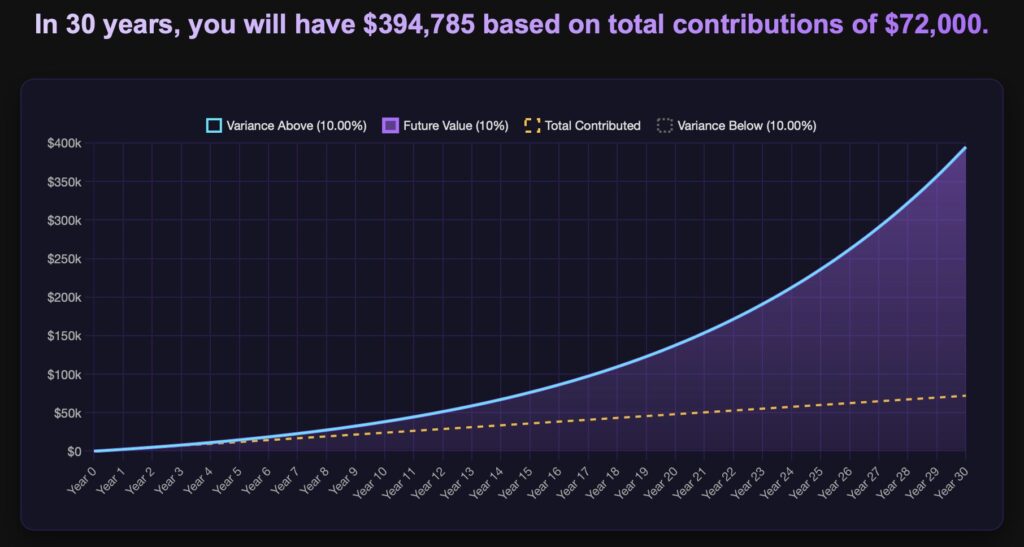
    If you invested just that $200 each month for the next 30 years, you would have $394,785!

    And, that’s based on contributing only $72,000 of your own money. The rest is interest you earned for doing nothing.

    Take a second to let that sink in: You’d have nearly $400,000 in your investment account all because you created a Budget After Thinking.

    If that doesn’t motivate you to make some thoughtful adjustments to your spending, I don’t know what will.

    Now is the perfect time to invest in your financial wellness.

    Now is the time to think back on the past year and remember all your wins. But, don’t forget about your mistakes. Those mistakes are how we learn.

    If you’re not confident with your personal finances, there’s no better time than now to start developing your skills.

    Whether we like it or not, money touches every facet of our lives. 

    When you take control of your money, you’ll see that your productivity at work improves.

    Your relationships outside of work will improve. 

    I’d even go so far as to say that you’ll start to believe in yourself more. You may even find the courage to follow a different path in life you hadn’t previously explored.

    It all starts with wanting to be good with money.

    Are you ready?